Sodium chloride 0,9% kabi
Poland
Table of Contents
- Patient Information Leaflet
- 1. What Natrium chloratum 0,9% Kabi is and what it is used for
- 2. Important information before using Natrium chloratum 0,9% Kabi
- 3. How to use Natrium chloratum 0,9% Kabi
- 4. Possible adverse reactions
- 5. How to store Natrium chloratum 0,9% Kabi
- 6. Contents of the packaging and other information
Patient Information Leaflet
Natrium chloratum 0,9% Kabi, 9 mg/ml, solvent for preparation of parenteral medicines
Sodium chloride
Please read this leaflet carefully before using this medicine, because it contains
important information for the patient.
- Keep this leaflet, as you may need to read it again.
- If you have any further questions, please ask your doctor or pharmacist.
- This medicine has been prescribed for a specific individual. Do not pass it on to others. It may harm other people, even if their symptoms are the same.
- If you experience any adverse reactions, including any not listed in this leaflet, inform your doctor or pharmacist. See section 4.
Leaflet Contents
- What Natrium chloratum 0,9% Kabi is and what it is used for
- Important information before using Natrium chloratum 0,9% Kabi
- How to use Natrium chloratum 0,9% Kabi
- Possible side effects
- How to store Natrium chloratum 0,9% Kabi
- Contents of the pack and other information
1. What Natrium chloratum 0,9% Kabi is and what it is used for
Natrium chloratum 0,9% Kabi is used as a solvent for intravenous,
intramuscular or subcutaneous medicinal products, serving as a vehicle for added drugs.
2. Important information before using Natrium chloratum 0,9% Kabi
When not to use Natrium chloratum 0,9% Kabi:
- if the patient is allergic or has shown an unusual reaction to sodium chloride;
- if the patient has high sodium levels in the blood (hypernatremia);
- if the patient has increased muscle tension (hypertonia);
- if the patient has heart failure (the heart is unable to pump the required amount of blood);
- if the patient has impaired heart, liver or kidney function and has fluid retention in the body;
- if the patient has high blood pressure (severe hypertension);
- if the patient has increased blood acidity (metabolic acidosis).
Warnings and precautions
Before starting treatment with Natrium chloratum 0,9% Kabi, discuss this with the doctor or
nurse.
- After opening, the solution should be used immediately.
- When administering subcutaneously, do not use any additives that could alter the isotonicity of the solution.
- Do not use the solution if it is not clear or contains a precipitate.
- When adding a drug to the vial, ensure physicochemical compatibility.
- Avoid adding alcohol to sodium chloride solutions.
Children
In newborns, excessively high sodium levels may occur due to immature kidney function.
Therefore, repeated injections of sodium chloride may be given only after determining serum sodium concentration.
Sodium chloride should be used with caution in patients with hypertension, heart failure,
pulmonary edema or peripheral edema, impaired kidney function, pre-eclampsia, hyperaldosteronism, liver cirrhosis and other liver diseases, hypervolemia, urinary tract obstruction, hypoproteinemia, and other conditions and treatments (e.g. corticosteroids) associated with sodium retention.
Natrium chloratum 0,9% Kabi and other medicines
Tell the doctor or pharmacist about all medicines the patient is currently taking or has recently taken, as well as any medicines the patient plans to use.
Interactions with other medicines depend on the drug that may be added.
Natrium chloratum 0,9% Kabi is incompatible with hydrocortisone, amphotericin B,
tetracyclines, cephalothin, erythromycin, lactobionate and lithium salts.
This medicine is incompatible with active substances insoluble in sodium chloride solution due to the risk of precipitation of the active ingredient, as well as with medicines whose stability or
solubility requires very acidic or very alkaline pH.
Pregnancy and breastfeeding
If the patient is pregnant or breastfeeding, suspects she may be pregnant, or is planning to have a
child, she should consult a doctor or pharmacist before using this medicine.
Due to the properties of the drug, no effects on women during pregnancy or breastfeeding are expected, provided the administration is correct and under medical supervision.
Driving and operating machinery
There is no evidence that this medicine may affect the ability to drive or operate machinery.
3. How to use Natrium chloratum 0,9% Kabi
You must follow these instructions unless your doctor has advised otherwise.
Natrium chloratum 0,9% Kabi should be administered intravenously, intramuscularly, or subcutaneously.
There is no need to disinfect the ampoule before opening.
There is no need to use any special device to open the ampoule.
After opening, the ampoule's outlet fits precisely onto the tip of a syringe (Luer tip), so there is no need to use a needle.
Instructions for use
Twist off one ampoule in the opposite direction from the others, taking care not to touch the neck or tip of the ampoule (1). Shake the ampoule once as shown below to dislodge any solution from the tip of the ampoule (2). To open the ampoule, twist the tip in the opposite direction from the rest of the ampoule until it breaks at the break line (3). Connect the ampoule directly to a Luer or Luer-Lock syringe as shown in the illustration (4).
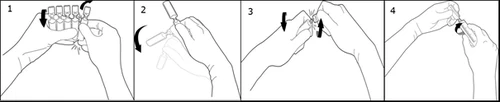
There is no need to use a needle—draw up the solution from the ampoule.
The solution contains no preservatives or antimicrobial agents; therefore, any unused ampoules must be discarded immediately after opening.
The volume used depends on the concentration of the medicinal product to be dissolved.
Your doctor will inform you about the duration of treatment with this medicine.
If you feel that the effect of Natrium chloratum 0,9% Kabi is too strong or too weak, tell your doctor.
Use of a higher than recommended dose of Natrium chloratum 0,9% Kabi
If you have taken too much Natrium chloratum 0,9% Kabi, inform your doctor immediately.
Due to the properties of this medicinal product, when used according to indications and administered properly and under control, there is no risk of poisoning.
However, an excess of sodium chloride in the most severe cases may cause dehydration of internal organs, nausea, vomiting, diarrhoea, abdominal cramps, thirst, reduced salivation, urine output, and sweating, fever, hypotension, tachycardia, renal failure, pulmonary oedema, acidosis, respiratory failure, headache, dizziness, irritability, muscle cramps, stiffness, coma, and death.
If symptoms of poisoning occur, administration of the medicinal product should be discontinued and symptomatic treatment initiated.
In children, coma and convulsions may persist due to cellular dehydration. Respiratory disturbances may also occur, including rapid breathing and nasal redness.
In case of overdose or accidental ingestion, seek immediate medical attention or contact a poison control centre.
4. Possible adverse reactions
Like all medicines, this medicine can cause adverse reactions, although not everybody experiences them.
If the medicine is administered correctly, no adverse reactions should occur.
Improper or excessive administration of sodium chloride solution may lead to overhydration,
hypernatremia, hyperchloremia, and associated symptoms such as metabolic acidosis
caused by decreased bicarbonate concentration and the occurrence of edema.
Excess sodium chloride may cause nausea, vomiting, and headache.
Adverse reactions may also be related to added medicinal products.
Reporting of adverse reactions
If any adverse symptoms occur, including any adverse symptoms not listed
in this leaflet, inform your doctor, pharmacist, or nurse. Adverse reactions
can be reported directly to the Department of Monitoring Adverse Drug Reactions of the Office for Registration of Medicinal Products, Medical Devices and Biocidal Products
Al. Jerozolimskie 181C
02-222 Warsaw
Phone: +48 22 49 21 301
Fax: +48 22 49 21 309
Website: https://smz.ezdrowie.gov.pl
Adverse reactions can also be reported to the marketing authorization holder.
Reporting adverse reactions allows the collection of further information on the safety of using the medicine.
5. How to store Natrium chloratum 0,9% Kabi
Keep this medicine out of the sight and reach of children.
No special storage instructions apply to this medicine.
Do not use this medicine after the expiry date stated on the container after "EXP".
The expiry date refers to the last day of the stated month.
Period of validity after first opening: use immediately.
6. Contents of the packaging and other information
What Natrium chloratum 0,9% Kabi contains
- The active substance is sodium chloride. 100 ml of solution contains 0.9 g of sodium chloride.
- Other components are: water for injections, hydrochloric acid 25%, and sodium hydroxide.
100 ml contains:
Electrolytes mmol/l mEq/l
Sodium chloride 0.9 g Na 154 154
Cl 154 154
Water for injections q.s. to 100 ml
The osmolarity of the solution is 308 mOsmol/l.
What Natrium chloratum 0,9% Kabi looks like and contents of the pack
Natrium chloratum 0,9% Kabi, solvent for the preparation of parenteral medicinal products, is a clear, colourless solution, free or almost free from solid particles.
Natrium chloratum 0,9% Kabi is available in the following pack sizes:
20 ampoules of 5 ml
50 ampoules of 5 ml
20 ampoules of 10 ml
50 ampoules of 10 ml
20 ampoules of 20 ml.
Not all pack sizes may be marketed.
Marketing Authorisation Holder and Manufacturer
Marketing Authorisation Holder
Fresenius Kabi Polska Sp. z o.o.
Al. Jerozolimskie 134
02-305 Warsaw
Poland
Manufacturer
FRESENIUS KABI ESPAÑA S.A.
Marina 16–18, planta 17 Torre Mapfre
08005 Barcelona
Spain
For further information, contact the Marketing Authorisation Holder:
Fresenius Kabi Polska Sp. z o.o.
Al. Jerozolimskie 134
02-305 Warsaw
Poland
Tel.: +48 22 345 67 89
This medicinal product is authorised for sale in the European Economic Area under the following names:
Belgium Natriumchloride 0,9% Fresenius Kabi oplosmiddel voor parenteraal gebruik
Czech Republic Sodium chloride Kabi 0,9%
Estonia Sodium chloride Kabi 0,9%, süstervaimi lahusti
Greece Sodium Chloride 0.9%/Fresenius
Spain Cloruro de sodio Meinsol 9 mg/ml disolvente para uso parenteral
Ireland Sodium Chloride 0.9% w/v solvent for parenteral use
Lithuania Sodium Chloride Kabi 0,9 % tirpiklis parenteriniam vartojimui
Latvia Sodium chloride Kabi 0,9% šķīdinātājs parenterālai lietošanai
Poland Natrium chloratum 0,9% Kabi
Romania Ser fiziologic 9 mg/ml Kabi solvent pentru uz parenteral
Slovakia Sodium chloride Kabi 0,9 % rozpúšťadlo na parenterálne použitie
Slovenia Natrijev klorid Fresenius Kabi 9 mg/ml
Hungary Nátrium-klorid Kabi 9 mg/ml oldószer parenterális készítményekhez