Sodium bicarbonicum 8.4% polpharma
Poland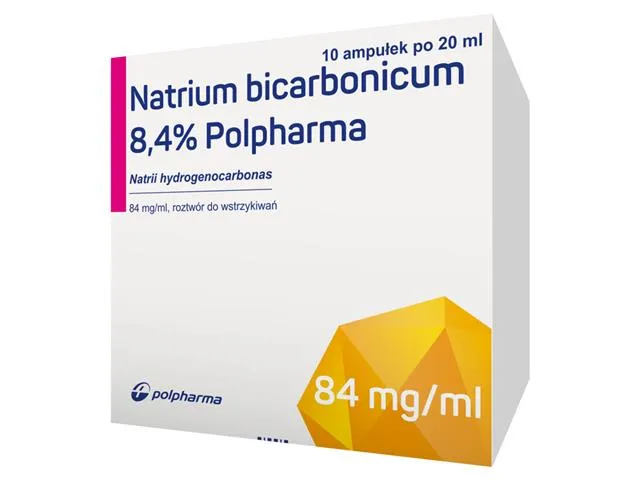
Table of Contents
- Package leaflet: information for the patient
- 1. What Natrium bicarbonicum 8.4% Polpharma is and what it is used for
- 2. Information before using Natrium bicarbonicum 8.4% Polpharma
- 3. How to use the medicinal product Natrium bicarbonicum 8,4% Polpharma
- 4. Possible adverse reactions
- 5. How to store Natrium bicarbonicum 8,4% Polpharma
- 6. Contents of the pack and other information
- Information intended exclusively for healthcare professionals
Package leaflet: information for the patient
Natrium bicarbonicum 8.4% Polpharma, 84 mg/ml, solution for injection
Natrii hydrogenocarbonas
Please read all of this leaflet carefully before using this medicine because it contains important information for you.
- Keep this leaflet. You may need to read it again.
- If you have any further questions, please ask your doctor, pharmacist, or nurse.
- This medicine has been prescribed for a specific individual. Do not pass it on to others. It may harm them, even if their symptoms are the same.
- If you experience any adverse reactions, including any not listed in this leaflet, tell your doctor, pharmacist, or nurse. See section 4.
Contents of the leaflet
- What Natrium bicarbonicum 8.4% Polpharma is and what it is used for
- Important information before using Natrium bicarbonicum 8.4% Polpharma
- How to use Natrium bicarbonicum 8.4% Polpharma
- Possible side effects
- How to store Natrium bicarbonicum 8.4% Polpharma
- Contents of the pack and other information
1. What Natrium bicarbonicum 8.4% Polpharma is and what it is used for
Natrium bicarbonicum 8.4% Polpharma is an alkalinizing agent which, through dissociation, releases sodium and bicarbonate ions. It increases serum bicarbonate concentration and serum pH.
Indications for use include:
- Metabolic acidosis (excess of acidic metabolic products in the blood), occurring in severe kidney diseases, congestive heart failure, shock and dehydration, alcohol-related disease, and during treatment with carbonic anhydrase inhibitors (diuretics) and ammonium chloride.
- Lactic acidosis (increased blood lactate levels).
- Need for rapid urinary alkalinization, e.g., in salicylate or barbiturate poisoning, or in sulfonamide nephropathy.
2. Information before using Natrium bicarbonicum 8.4% Polpharma
When not to use Natrium bicarbonicum 8.4% Polpharma
- if the patient is allergic to sodium hydrogen carbonate or any of the other ingredients of this medicine (listed in section 6);
- if the patient has metabolic alkalosis;
- if the patient has respiratory alkalosis;
- if the patient has hypoventilation (impaired lung respiratory function, leading to increased carbon dioxide concentration in blood);
- if the patient has hypernatraemia (increased sodium concentration in serum) or conditions where sodium administration is contraindicated, e.g. congestive heart failure, oedema, hypertensive disease, eclampsia, renal failure;
- if the patient has hypocalcaemia (decreased calcium concentration in serum), in which alkalosis may induce tetany;
- in patients with excessive chloride loss caused, among others, by vomiting;
- in patients at risk of developing diuretic-induced alkalosis.
Warnings and precautions
Before starting treatment with Natrium bicarbonicum 8.4% Polpharma, discuss this with your doctor.
Exercise particular caution:
- if the patient is at risk of hypokalaemia (decreased potassium concentration in blood);
- if sodium administration is not indicated and renal function is intact – in such cases, alkalization using tromethamine (THAM) solution is recommended;
- if the patient has uncompensated congestive heart failure, other oedematous states, or conditions associated with sodium retention;
- if the patient has severe renal failure with oliguria or anuria.
Natrium bicarbonicum 8.4% Polpharma may cause hypokalaemia and hypocalcaemia. Hypokalaemia may contribute to metabolic alkalosis, and hypocalcaemia may lead to tetany and carpopedal spasm.
To reduce the risk of hypocalcaemia and hypokalaemia, the doctor should correct electrolyte deficiencies before administering Natrium bicarbonicum 8.4% Polpharma.
Natrium bicarbonicum 8.4% Polpharma must be administered only by qualified medical personnel, for the following reasons:
- the medicine must be administered intravenously, as extravascular administration may cause tissue necrosis;
- too rapid injection (10 ml/min) of the hypertonic solution of Natrium bicarbonicum 8.4% Polpharma in neonates and children under 2 years of age may cause hypernatraemia, reduce cerebrospinal fluid pressure, and lead to intracranial haemorrhage.
Natrium bicarbonicum 8.4% Polpharma and other medicines
Inform the doctor about all medicines currently used or recently used by the patient, as well as any medicines the patient plans to use, particularly:
- lithium salts, because Natrium bicarbonicum 8.4% Polpharma increases their excretion;
- corticosteroids or corticotropin (1 g of Natrium bicarbonicum 8.4% Polpharma contains approximately 12 mEq Na);
- tetracycline antibiotics (especially doxycycline), as urine alkalization may accelerate their renal excretion;
- quinidine, amphetamine derivatives, ephedrine, and pseudoephedrine (the half-life of these drugs may be prolonged – longer presence in the body);
- bumetanide, ethacrynic acid, furosemide, and thiazide diuretics (concomitant administration may lead to hypochloraemic alkalosis);
- potassium-containing products (concomitant administration may result in decreased serum potassium concentration).
Due to incompatibility, Natrium bicarbonicum 8.4% Polpharma must not be mixed with solutions containing phosphates, calcium salts, or magnesium salts.
Other medicinal products should not be added to the Natrium bicarbonicum 8.4% Polpharma solution without prior verification of physicochemical compatibility. If cloudiness or precipitate is observed, the solution must not be used.
The medicine is compatible with the following solutions:
- 6% dextran in 5% glucose
- 6% dextran in 0.9% sodium chloride
- 5% glucose in 0.9% sodium chloride
- 0.45% and 0.9% sodium chloride.
Pregnancy and breastfeeding
If the patient is pregnant or breastfeeding, suspects she may be pregnant, or plans to become pregnant, she should consult a doctor before using this medicine.
Pregnancy
The safety of Natrium bicarbonicum 8.4% Polpharma in pregnant women has not been established. The medicine should be used during pregnancy only if, in the opinion of the doctor, the expected benefit outweighs the potential risk to the foetus.
Breastfeeding
The use of this medicine should be avoided during breastfeeding.
Driving and operating machinery
The medicine does not affect the ability to drive or operate machinery.
Natrium bicarbonicum contains sodium
The medicine contains 23 mg of sodium (the main component of table salt) in each 1 ml of solution. This corresponds to 1.15% of the maximum recommended daily dietary sodium intake for adults.
The medicine may be diluted, for example, with 0.9% NaCl solution or 5% glucose solution. The sodium content originating from the diluent should be taken into account when calculating the total sodium content in the prepared diluted solution. For accurate information on the sodium content in the solution used for dilution, refer to the patient leaflet of the diluent used.
3. How to use the medicinal product Natrium bicarbonicum 8,4% Polpharma
The medicinal product may be administered only by qualified medical personnel.
Detailed dosage instructions, method of administration, and preparation of the medicinal product for infusion are provided at the end of this leaflet under the section "Information for healthcare professionals".
Use of a higher than recommended dose of Natrium bicarbonicum 8,4% Polpharma
If a higher than recommended dose has been administered, medical advice must be sought immediately.
In case of overdose, metabolic alkalosis may occur with Natrium bicarbonicum 8,4% Polpharma.
Treatment of overdose
In case of overdose, the physician will discontinue the infusion and monitor symptoms of alkalosis.
The patient will be provided with rebreathing technique using exhaled air.
In more severe cases, 0.9% sodium chloride solution will be administered intravenously by infusion.
In hypokalemia, potassium chloride will be given.
If tetany occurs and cannot be controlled by rebreathing, intravenous calcium gluconate will be administered.
In case of injection site reactions, warm compresses should be applied, along with local lidocaine or hyaluronidase.
Missed dose of Natrium bicarbonicum 8,4% Polpharma
The medicinal product is administered under strict medical supervision, therefore it is unlikely that a dose will be missed. If the patient suspects that a dose has been missed, they should immediately inform the physician or nurse.
Do not administer a double dose to make up for a missed dose.
If there are any further questions concerning the use of this medicinal product, consult a physician.
4. Possible adverse reactions
Like all medicines, this medicine can cause adverse reactions, although not everybody will experience them.
The following adverse reactions may occur after administration of this medicine:
Metabolism and nutrition disorders
- Metabolic alkalosis, tetany (particularly in patients with hypocalcemia and following administration of high doses of the medicine)
- Hypokalemia
- Hypernatremia
- Hyperosmolarity (severe hyperosmolarity may occur during cardiopulmonary resuscitation and administration of high doses of the medicine).
General disorders and administration site conditions
- Local ulceration
- Tissue necrosis
- Edema (water and sodium retention and edema may occur during administration of high doses of the medicine, particularly in patients with renal insufficiency, circulatory insufficiency, and those prone to sodium retention and edema).
Reporting of adverse reactions
If any adverse reactions occur, including any adverse reactions not listed
in this leaflet, inform a doctor or nurse. Adverse reactions can be reported directly to the Department of Monitoring of Adverse Drug Reactions of the Office for Registration of Medicinal Products, Medical Devices and Biocidal Products
Al. Jerozolimskie 181C
02-222 Warsaw
Phone: +48 22 49 21 301
Fax: +48 22 49 21 309
Website: https://smz.ezdrowie.gov.pl
Adverse reactions can also be reported to the marketing authorization holder.
Reporting adverse reactions enables further collection of information on the safety of the medicine.
5. How to store Natrium bicarbonicum 8,4% Polpharma
Keep the medicine out of sight and reach of children.
Store below 25°C. Do not store in the refrigerator.
Do not use this medicine after the expiry date stated on the packaging after: EXP.
The expiry date refers to the last day of the stated month.
Medicines should not be disposed of via wastewater or household waste. Ask your pharmacist how to dispose of medicines no longer required. Such practices help protect the environment.
6. Contents of the pack and other information
What Natrium Bicarbonicum 8,4% Polpharma contains
- The active substance is sodium hydrogen carbonate. Each 20 ml ampoule contains 1.68 g of sodium hydrogen carbonate.
- Other ingredients: disodium edetate, water for injections.
What Natrium Bicarbonicum 8,4% Polpharma looks like and contents of the pack
Each pack contains 10 ampoules of colourless glass with a capacity of 20 ml, packed in a cardboard box.
Marketing Authorisation Holder and Manufacturer
Zakłady Farmaceutyczne POLPHARMA S.A.
ul. Pelplińska 19, 83-200 Starogard Gdański
tel. + 48 22 364 61 01
<-------------------------------------------------------------------------------------------------------------- >
Information intended exclusively for healthcare professionals
Natrium bicarbonicum 8.4% Polpharma may be administered:
- by direct undiluted intravenous injection (in life-threatening indications, e.g., during cardiac arrest);
- rarely subcutaneously, after dilution and adjustment of the solution to isotonicity (e.g., 1.5% solution); absorption rate is difficult to predict;
- by intravenous infusion, exclusively through a catheter inserted into a vein, in diluted form mixed with 5% glucose solution in a 1:1 ratio, at a rate of 60 drops/min.
The dose of Natrium bicarbonicum 8.4% Polpharma depends on the acid-base balance status and the patient's body weight. It can be calculated using the following formula:
NaHCO₃ (mmol) = base deficit (mmol) × body weight × 0.3.
1 ml of solution contains: 1 mmol Na⁺ and 1 mmol HCO₃⁻ (= 1 mEq sodium bicarbonate NaHCO₃).
Use in children
In children, intravenous infusion of Natrium bicarbonicum 8.4% Polpharma is recommended at a dose not exceeding 8 mEq/kg body weight per day.
In infants and children under 2 years of age, the solution should be administered as a slow intravenous infusion at a dose of up to 8 mEq/kg body weight/day (8 ml/kg body weight/day).
The initial dose should be 1 mEq/kg body weight. Due to the risk of intracranial hemorrhage, the solution should be administered in diluted form.
If rapid administration of the drug is required via direct intravenous injection, initially 33–50% of the calculated dose should be administered.
Complete correction of the base deficit within 24 hours of therapy should not be attempted, as metabolic alkalosis and associated adverse effects may occur.
Natrium bicarbonicum 8.4% Polpharma injection solution is not indicated for routine use to support cardiac function, e.g., during resuscitation. If used in patients with cardiac arrest, the initial dose should not exceed 1 mEq/kg body weight. If no therapeutic effect is observed, a subsequent dose of up to 0.5 mEq/kg body weight may be administered after 10 minutes.
In milder forms of metabolic acidosis, in older children and adults, the drug is administered as an intravenous infusion at a dose of 2 to 5 mEq/kg body weight (2 to 5 ml/kg body weight) every 4–8 hours.
The maintenance dose should be adjusted according to the therapeutic response and laboratory test results, particularly assessment of acid-base balance.