Nasen
Poland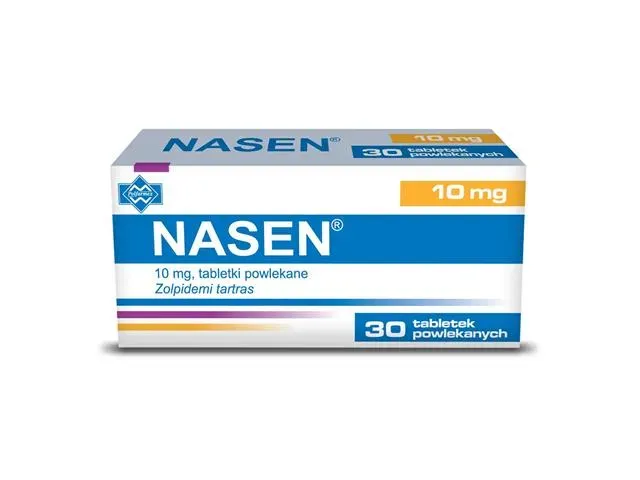
Table of Contents
Package leaflet: Information for the user
NASEN, 10 mg, film-coated tablets
Zolpidemi tartras
Please read the entire leaflet carefully before using this medicine, as it contains
important information for the patient.
- Keep this leaflet so that you can read it again if necessary.
- If you have any doubts, please consult your doctor or pharmacist.
- This medicine has been prescribed for a specific individual. Do not pass it on to others. This medicine may harm other people, even if their symptoms are the same.
- If the patient experiences any adverse reactions, including any adverse reactions not listed in this leaflet, inform a doctor or pharmacist. See section 4.
Table of contents of the leaflet:
- What Nasen is and what it is used for
- Important information before taking Nasen
- How to take Nasen
- Possible side effects
- How to store Nasen
- Contents of the pack and other information
1. What Nasen is and what it is used for
The active substance in Nasen – zolpidem – is a short-acting hypnotic agent from the imidazopyridine class.
Zolpidem shortens the time needed to fall asleep, reduces the number of awakenings, prolongs sleep duration, and improves sleep quality.
Nasen is indicated for:
- Short-term treatment of insomnia. Nasen should only be used to treat insomnia that impairs normal functioning or is extremely distressing to the patient.
2. Important information before using Nasen
When not to use Nasen:
- if the patient is allergic to the active substance or to any of the other ingredients of this medicine (listed in section 6);
- if the patient has sleep apnoea syndrome;
- if the patient has myasthenia gravis (abnormal muscle fatigue after exertion);
- if the patient has severe hepatic insufficiency;
- if the patient has severe respiratory insufficiency.
The medicine should not be used in children and adolescents under 18 years of age.
Warnings and precautions
Before starting treatment with Nasen, discuss this with your doctor or pharmacist.
Special caution is required when using Nasen in patients:
-
with hepatic insufficiency;
-
aged over 65 years or debilitated patients. In these patients, a reduced initial dose and individual dose adjustment according to the patient's condition are recommended. In elderly patients, the risk of adverse effects, especially disturbances in orientation and motor coordination, is increased. Due to its muscle-relaxing effect, there is an increased risk of falls and hip fractures;
-
with symptoms of depression, as suicidal tendencies may occur in this group of patients;
-
who abuse alcohol and/or drugs;
-
with psychiatric disorders and in patients after detoxification treatments following overdoses, e.g. of narcotics;
-
with breathing disorders, as the medicine may worsen respiratory insufficiency.
The medicine should be discontinued if paradoxical reactions occur (psychomotor agitation, insomnia, irritability, delusions, nightmares, hallucinations, psychoses, changes in behaviour).
Prolonged use of the medicine may lead to a gradual decrease in its effectiveness due to tolerance. Long-term use of high doses of hypnotic medicines may lead to physical and psychological dependence. The risk of dependence increases with higher doses, longer duration of treatment, and in patients who abuse alcohol and/or drugs.
The duration of treatment should be kept to a minimum. The maximum duration of treatment should not exceed 4 weeks, including the period of discontinuation.
Sudden discontinuation after long-term use of high doses may cause withdrawal symptoms such as: insomnia; headache; muscle pain; increased anxiety and tension; psychomotor agitation; confusion and irritability. In severe cases, the following may occur: depersonalization (feeling of altered personality); derealization (altered perception of reality); hyperacusis (increased sensitivity to acoustic stimuli); numbness and tingling of limbs; hypersensitivity to light, noise and touch; hallucinations or seizures.
The medicine may cause anterograde amnesia, especially if less than 7–8 hours of sleep follow administration of the medicine.
There are no data on the safety and efficacy of using the medicine in children and adolescents under 18 years of age.
Next-day psychomotor disturbances (see also Driving and operating machinery)
The risk of next-day psychomotor disturbances, including impaired ability to drive, may be increased the day after taking Nasen if:
- the medicine was taken less than 8 hours before activities requiring increased mental alertness;
- a higher than recommended dose was taken;
- the patient took zolpidem while being treated with other central nervous system depressants or other medicines that increase blood levels of zolpidem, during alcohol consumption, or while using illicit substances.
A single dose should be taken immediately before bedtime.
Do not take another dose during the same night.
Nasen and other medicines
Inform your doctor or pharmacist about all medicines currently or recently taken, as well as any medicines you plan to take.
Alcohol enhances the hypnotic effect of zolpidem and increases the risk of paradoxical reactions (psychomotor agitation, aggression, irritability).
Medicines that inhibit or induce the cytochrome P450 enzyme system (e.g. erythromycin) may enhance or reduce the effect of zolpidem; rifampicin reduces the effect of the medicine.
When zolpidem is used concomitantly with certain medicines, next-day drowsiness and psychomotor disturbances, including impaired ability to drive, may be intensified. These medicines include:
- medicines used to treat certain mental health disorders (antipsychotics);
- medicines used to treat sleep problems (hypnotics);
- sedatives or medicines that reduce anxiety;
- medicines used to treat depression;
- medicines used to treat moderate to severe pain (opioid analgesics);
- medicines used to treat epilepsy;
- anaesthetics;
- medicines used to treat hay fever, rashes or other allergies, which may cause drowsiness (sedating antihistamines).
When zolpidem is taken with antidepressants, including bupropion, desipramine, fluoxetine, sertraline and venlafaxine, the patient may see unreal things (visual hallucinations).
Concomitant use of zolpidem with fluvoxamine or ciprofloxacin is not recommended.
Pregnancy and breastfeeding
If the patient is pregnant or breastfeeding, suspects she may be pregnant, or plans to become pregnant, she should consult her doctor or pharmacist before using this medicine.
Zolpidem, like other hypnotic medicines, should not be used during pregnancy, especially during the first trimester. In newborns whose mothers have taken benzodiazepines or benzodiazepine-like medicines long-term during the late stages of pregnancy, withdrawal symptoms or physical dependence may occur.
If use of the medicine is justified during the late stages of pregnancy or during delivery, it may cause hypothermia, hypotonia, and respiratory insufficiency in the newborn.
Zolpidem has been shown to pass into breast milk in small amounts. Use of the medicine during breastfeeding is not recommended.
Driving and operating machinery
Do not drive or operate machinery for 7–8 hours after taking zolpidem due to the risk of drowsiness.
The ability to drive and operate machinery may be impaired due to amnesia, sedative (calming, hypnotic), myorelaxant (muscle-relaxing) effects, and coordination disturbances.
Nasen has a major influence on the ability to drive and operate machinery and may cause events such as "falling asleep at the wheel". The day after taking Nasen (as with other hypnotic medicines), it may happen that:
- the patient feels drowsy, sleepy, dizzy, or disoriented;
- the patient needs more time to make quick decisions (impaired reflexes);
- the patient may have blurred or double vision;
- the patient may be less alert.
To minimize the risk of such events, it is recommended to maintain a gap of at least 8 hours between taking zolpidem and driving, operating machinery, or working at heights.
Do not consume alcohol or psychoactive substances while taking Nasen, as this may intensify the effects mentioned above.
Nasen contains monohydrate lactose and sodium
If the patient has previously been diagnosed with intolerance to certain sugars, he or she should consult a doctor before taking the medicine.
The medicine contains less than 1 mmol (23 mg) of sodium per coated tablet, meaning the medicine is considered "sodium-free".
3. How to use Nasen
This medicine should always be taken as directed by the physician. If in doubt, consult your
doctor or pharmacist.
The recommended dose of Nasen is 10 mg once every 24 hours. Some patients may be prescribed
a lower dose by their doctor. Nasen should be taken:
- as a single dose;
- immediately before bedtime.
Patients must allow at least an 8-hour interval between taking the medicine and engaging in
activities requiring increased concentration.
Do not exceed the dose of 10 mg within 24 hours.
Elderly patients (over 65 years of age) and debilitated patients, who may be particularly
sensitive to the drug's effects: treatment should be initiated at a dose of 5 mg (half a tablet).
The dose should not exceed 10 mg (1 tablet) taken before bedtime.
Patients with hepatic impairment: 5 mg (half a tablet) immediately before bedtime.
In adults (under 65 years of age), dose increase may be considered if the patient is in good
health and tolerates the drug well.
The duration of treatment ranges from several days to 2 weeks, with a maximum of 4 weeks.
Use of a higher than recommended dose of Nasen
Overdose of zolpidem may cause disturbances in consciousness of varying severity (drowsiness,
coma). No long-term consequences have been observed following overdose up to 40 times the
recommended dose.
Life-threatening poisoning may occur when zolpidem is combined with alcohol or other central
nervous system depressant drugs. Management includes: induction of emesis (within one hour
after ingestion) or gastric lavage if the patient is unconscious, and administration of activated
charcoal. Any overdose requires immediate medical intervention. Cardiovascular and respiratory
functions should be monitored and supportive symptomatic treatment initiated. In cases of
overdose, intravenous flumazenil may be administered; however, administration of flumazen
il may provoke neurological symptoms such as seizures.
Zolpidem is not removed by hemodialysis.
Missed dose of Nasen
Do not take a double dose to make up for a missed dose.
4. Possible adverse reactions
Like all medicines, this medicine can cause adverse reactions, although not everyone will experience them.
Cardiac disorders: palpitations, occasionally cardiac arrhythmia (disturbance of heart rhythm)
Blood and lymphatic system disorders: blood count changes, e.g. leukopenia (reduced number of white blood cells in the blood), agranulocytosis (marked reduction or absence of neutrophil granulocytes)
Nervous system disorders: dizziness, feeling of faintness, headache, somnolence, retrograde amnesia (memory impairment), apathy (reduced sensitivity to emotional and physical stimuli), emotional lability (emotional instability), sleep disturbances, taste disturbances, ataxia (impaired coordination of movements), unsteady gait
Psychiatric disorders: nightmares, nocturnal restlessness
Eye disorders: visual disturbances
Respiratory, thoracic and mediastinal disorders: cough, asthma
Gastrointestinal disorders: diarrhoea, nausea, vomiting, flatulence
Musculoskeletal and connective tissue disorders: muscle cramps, arthritis
Endocrine disorders: menstrual disorders
Reproductive system and breast disorders: decreased libido (reduced sexual drive)
Metabolism and nutrition disorders: change in appetite, increased thirst, change in body weight
Immune system disorders: hypersensitivity reactions such as rash, urticaria
Reporting of adverse reactions
If any adverse reactions occur, including any adverse reactions not listed in this leaflet, inform a doctor or pharmacist. Adverse reactions can be reported directly to the Department of Monitoring Adverse Drug Reactions at the Office for Registration of Medicinal Products, Medical Devices and Biocidal Products
Al. Jerozolimskie 181C
02-222 Warszawa
Tel.: (22) 49 21 301
Faks: (22) 49 21 309
Website: https://smz.ezdrowie.gov.pl
Adverse reactions can also be reported to the marketing authorization holder.
Reporting adverse reactions enables better assessment of the medicine's safety profile.
5. How to store Nasen
Keep the medicine out of sight and reach of children.
Do not use this medicine after the expiry date stated on the carton, blister, or container following the "EXP" label. The expiry date refers to the last day of the stated month.
Store in the original packaging.
Medicines must not be disposed of via wastewater or household waste. Ask your pharmacist how to dispose of medicines no longer in use. Such measures help protect the environment.
6. Contents of the pack and other information
What Nasen contains
- The active substance is zolpidem tartrate. One tablet contains 10 mg of zolpidem tartrate.
- The other ingredients are: microcrystalline cellulose, lactose monohydrate, hypromellose, magnesium stearate, sodium carboxymethyl starch (type A). Coating: lactose monohydrate, hypromellose, polyethylene glycol (6000), titanium dioxide (E 171).
What Nasen looks like and contents of the pack
White to off-white, elongated, biconvex tablets, with a score line on one side. The tablet can be divided into equal doses.
The pack contains 10, 20 or 30 tablets.
Marketing Authorisation Holder and Manufacturer
Polfarmex S.A.
ul. Józefów 9
99-300 Kutno
Poland
Tel.: 24 357 44 44
Fax: 24 357 45 45
E-mail: [email protected]