Nakom mite
Poland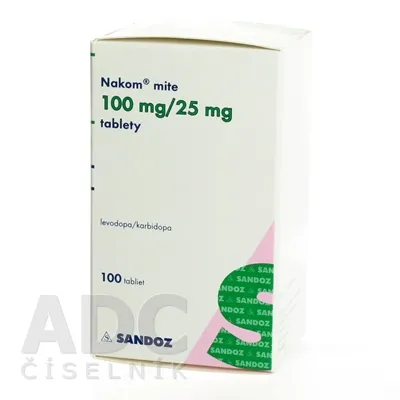
Table of Contents
Package leaflet: Information for the patient
Nakom mite, 100 mg + 25 mg, tablets
Levodopum + Carbidopum
Please read all of this leaflet carefully before taking this medicine, because it contains
important information for the patient.
- Keep this leaflet, as you may need to read it again.
- If you have any further questions, please ask your doctor or pharmacist.
- This medicine has been prescribed for a specific individual. Do not pass it on to others. It may harm someone else, even if their symptoms are the same.
- If you experience any side effects, including any not listed in this leaflet, tell your doctor or pharmacist. See section 4.
Contents of the leaflet:
- What Nakom mite is and what it is used for
- What you need to know before taking Nakom mite
- How to take Nakom mite
- Possible side effects
- How to store Nakom mite
- Contents of the pack and other information
1. What Nakom mite is and what it is used for
Nakom mite is used to treat symptoms of Parkinson's disease and Parkinsonism. Parkinson's disease is a chronic condition characterized by slow and uncoordinated movements, muscle stiffness, and tremors. Untreated Parkinson's disease may cause difficulties in performing daily activities.
The symptoms of Parkinson's disease are caused by a lack of dopamine (a naturally occurring chemical in the body), which is produced by certain brain cells. Dopamine acts as a neurotransmitter in brain areas responsible for controlling muscle movements. Movement difficulties result from insufficient dopamine production.
Nakom mite tablets contain a combination of two active substances: levodopa (a dopamine precursor) and carbidopa (an aromatic amino acid decarboxylase inhibitor).
Levodopa compensates for the dopamine deficiency, and carbidopa ensures that an adequate amount of levodopa reaches the brain. In many patients, this reduces the severity of Parkinson's disease symptoms.
2. What you need to know before taking Nakom mite
When not to take Nakom mite
Do not take Nakom mite if:
- you are allergic (hypersensitive) to levodopa, carbidopa, or to any of the other ingredients of this medicine (listed in section 6);
- you have increased intraocular pressure (narrow-angle glaucoma);
- you have severe heart failure;
- you have severe cardiac arrhythmias;
- you are in the acute phase of a stroke;
- you have ever been diagnosed with malignant melanoma;
- you have skin lesions that have not yet been diagnosed by a doctor;
- you have severe psychosis;
- you must not take medicines that act on the central nervous system (sympathomimetic drugs);
- you are taking antidepressant medicines (so-called monoamine oxidase inhibitors - MAOIs), see below.
Concomitant use of Nakom mite and non-selective monoamine oxidase inhibitors (MAO) or selective type A MAO inhibitors is contraindicated. These medicines must be discontinued at least 2 weeks before starting treatment with Nakom mite.
Nakom mite may be used concomitantly with selective MAO-B inhibitors (e.g. selegiline hydrochloride) at the recommended dose; see "Nakom mite with other medicines".
Warnings and precautions
Before starting to take Nakom mite, consult your doctor or pharmacist if:
- you have ever been treated with levodopa alone. You should wait at least 12 hours before starting Nakom mite;
- you have movement disorders such as facial muscle twitching, muscle stiffness, difficulty initiating movement, finger or hand tremors. A dose reduction may be necessary;
- you have ever experienced involuntary movements or psychiatric disturbances; if you develop depression or suicidal tendencies, contact your doctor immediately;
- you have ever had a psychotic episode or psychosis (a serious mental illness in which control over one's behavior and conduct is impaired);
- you are taking psychotropic medicines;
- you have severe cardiovascular diseases;
- you have severe lung disease or sudden attacks of breathlessness caused by muscle spasms and mucosal swelling in the airways, often associated with cough and sputum production (bronchial asthma);
- you have impaired kidney or liver function;
- you have endocrine system disorders (glands that secrete hormones into the blood);
- you have ever had gastric or intestinal ulcers (due to increased risk of gastrointestinal bleeding);
- you are vomiting blood;
- you have recently had a myocardial infarction and still have cardiac arrhythmias;
- you have chronic open-angle glaucoma (increased intraocular pressure). Patients with this condition may use Nakom mite provided that intraocular pressure is well controlled.
- you experience excessive drowsiness and/or sudden sleep attacks – in such cases, your doctor may consider reducing the dose or discontinuing the medicine;
- you need to undergo general anesthesia;
- you have ever had seizures;
- you have Huntington's chorea, a hereditary disease characterized by sudden but coordinated involuntary movements. Use of Nakom mite is not recommended.
Sudden dose reduction or discontinuation of Nakom mite (especially if the patient is also receiving antipsychotic medicines) may cause disturbances in consciousness.
Sudden dose reduction or discontinuation of Nakom mite may lead to symptoms resembling neuroleptic malignant syndrome. This syndrome is characterized by muscle rigidity, elevated body temperature, mental status changes, and increased serum creatine kinase activity.
Due to the risk of developing melanoma (a malignant skin or mucosal tumor), patients should have regular skin examinations to detect any changes suggestive of melanoma development. The best approach is periodic skin checks by a qualified professional (e.g. a dermatologist).
Contact your doctor if you or your family members/caregivers notice unusual behaviors resulting from irresistible impulses, compulsions, or obsessive performance of certain actions harmful to the patient or others. These behaviors are known as impulse control disorders and may include gambling addiction, compulsive eating or shopping, abnormally increased sexual drive, or intense sexual thoughts and feelings. In such cases, inform your doctor, as the treatment may need to be re-evaluated.
If you or your family (caregiver) notice symptoms resembling addiction, leading to a desire to take high doses of Nakom mite or other medicines used in Parkinson's disease treatment, inform your doctor.
During long-term therapy, your doctor may recommend periodic monitoring of liver, kidney, hematological, and cardiovascular function.
Nakom mite may cause falsely positive results in certain laboratory tests. Inform medical personnel that you are taking Nakom mite before any laboratory tests are performed.
Each of the above situations requires consultation with your doctor.
Use in children and adolescents under 18 years of age
The use of Nakom mite in children and adolescents under 18 years of age is not recommended, as safety and efficacy have not been established in this age group.
Nakom mite with other medicines
Tell your doctor about all medicines you are currently taking, have recently taken, or plan to take.
This is particularly important for the following medicines:
- antihypertensive medicines – due to the risk of reduced blood pressure upon changing position (orthostatic hypotension);
- antidepressants (monoamine oxidase inhibitors) – due to the risk of hypertension, uncoordinated and involuntary limb or whole-body movements (so-called dyskinesias);
- anticholinergic medicines (e.g. used in bronchial asthma treatment) – due to the risk of worsening involuntary movement disorders and reduced efficacy of the medicine caused by delayed absorption;
- certain psychoactive medicines (e.g. phenothiazine derivatives, butyrophenones, and risperidone) and isoniazid (used in tuberculosis treatment), as they may reduce the therapeutic effect of levodopa; phenytoin (used in epilepsy) and papaverine (a muscle relaxant and spasmolytic in the gastrointestinal tract) may inhibit its action in Parkinson's disease treatment;
- selegiline (an antidepressant medicine) – due to the risk of significant drop in blood pressure upon changing body position;
- certain other medicines used in Parkinson's disease (tolcapone, entacapone) – due to the risk of increasing the amount of Nakom mite entering systemic circulation, which may require dose adjustment;
- amantadine (used in Parkinson's disease or influenza treatment) – due to the risk of worsening side effects of Nakom mite, which may require dose adjustment;
- metoclopramide (used in gastrointestinal disorders) – due to the risk of increasing the amount of Nakom mite entering systemic circulation by accelerating gastric emptying;
- certain central nervous system-acting medicines, bronchodilators, and medicines used in asthma treatment (adrenergic agonists) – due to the risk of worsening cardiovascular side effects;
- iron sulfate or iron gluconate (e.g. used in iron deficiency treatment) – due to the risk of reduced levodopa absorption.
If you are unsure whether you are taking any of the medicines listed above, consult your doctor or pharmacist.
Nakom mite with food and drink
The effect of levodopa may be reduced in patients on a high-protein diet.
Pregnancy and breastfeeding
If you are pregnant, breastfeeding, think you may be pregnant, or are planning to have a baby, consult your doctor before taking this medicine.
Pregnancy
Your doctor will decide whether to continue or discontinue treatment, weighing the benefits for the mother's health against the risks to the unborn child.
All women of childbearing age taking Nakom mite should use effective contraception.
Nakom mite is not recommended for use in pregnant women.
Breastfeeding
If you are breastfeeding, your doctor will decide whether you should continue taking Nakom mite, considering the importance of treatment for your health.
Driving and operating machinery
Levodopa may cause severe drowsiness and sudden sleep attacks, as well as double vision, which poses a risk of serious injury or death during activities requiring full concentration. While taking Nakom mite, avoid driving and operating machinery until these side effects subside.
Nakom mite contains sodium
This medicine contains less than 1 mmol (23 mg) of sodium per tablet, meaning it is considered "sodium-free".
3. How to take Nakom Mite
This medicine should always be taken exactly as prescribed by your doctor. If in doubt, consult your doctor or pharmacist.
General instructions
Your doctor has prescribed the appropriate dose of Nakom Mite to be taken. The usual doses are as follows:
Initial dose:
Patients not previously treated with levodopa
1 tablet of Nakom Mite three times daily.
Your doctor may increase this dose by one tablet daily or every other day, depending on individual patient needs, up to a maximum of 8 tablets of Nakom Mite per day.
Switching from a previous levodopa preparation to Nakom Mite
If the patient is currently taking levodopa alone, the doctor will recommend discontinuing it at least 12 hours before starting Nakom Mite (24 hours if using extended-release levodopa).
The switch should be performed gradually and only under medical supervision.
If the patient previously took less than 1500 mg of levodopa per day
1 tablet of Nakom Mite three or four times daily, depending on individual patient needs.
If the patient previously took more than 1500 mg of levodopa per day
For these patients, the doctor will prescribe Nakom (250 mg levodopa + 25 mg carbidopa).
Maintenance treatment
The doctor will determine the dosage individually for each patient and adjust it according to the response to treatment.
Recommended maximum dose
8 tablets of Nakom per day (2 g levodopa and 200 mg carbidopa), which in a patient weighing 70 kg corresponds to approximately 30 mg/kg body weight of levodopa and 3 mg/kg body weight of carbidopa.
After several months or years of treatment, motor fluctuations (so-called "on-off" periods) may occur, likely related to disease progression.
The doctor may adjust the dose and intervals between doses accordingly.
Dosage adjustment is not required in patients with impaired kidney and/or liver function.
Taking more than the recommended dose of Nakom Mite
If too many tablets are taken, contact your doctor or the nearest hospital immediately.
In some patients, an early sign of excessive dosage may be eyelid twitching (blepharospasm).
In cases of significant overdose, management is essentially the same as for levodopa overdose, except that pyridoxine does not reverse the effects of Nakom Mite.
The patient's heart function should be monitored using an electrocardiograph and carefully observed for possible cardiac arrhythmias. If necessary, appropriate antiarrhythmic treatment should be initiated. It should be considered that the patient may be taking other medications along with Nakom Mite. The role of dialysis in treating overdose is unknown.
Missed dose of Nakom Mite
Nakom Mite should be taken exactly as directed by the doctor. If a dose is missed, it should be taken as soon as possible. If it is almost time for the next dose, the missed dose should not be taken; continue treatment according to the prescribed schedule. A double dose must not be taken to make up for a missed dose.
Stopping treatment with Nakom Mite
Do not stop taking the medicine or reduce the dose without consulting your doctor. Abruptly stopping treatment may cause symptoms such as muscle stiffness, fever, and personality changes.
4. Possible adverse reactions
Like all medicines, this medicine can cause adverse reactions, although not everyone will experience them.
The most commonly observed adverse reactions include abnormal movements, such as tremor or muscle contractions (which may resemble symptoms of Parkinson's disease).
Other adverse reactions are listed below by frequency:
If any of the listed symptoms occur, consult your doctor
to discuss ways of managing or reducing these symptoms.
During treatment with Nakom mite, the following hypersensitivity reactions (allergic reactions) may occur: urticaria, burning sensation, skin rash, and swelling of the face, lips, tongue, and (or) throat, which may cause difficulty in breathing or swallowing. If any of these symptoms occur, seek immediate medical attention.
Very common (may affect more than 1 in 10 people):
urinary tract infections
Common (may affect up to 1 in 10 people):
nausea, vomiting, dry mouth, bitter taste in the mouth, loss of appetite (anorexia), palpitations, irregular heartbeat, decreased blood pressure (e.g. due to standing up too quickly from sitting or lying position), sometimes with dizziness (orthostatic hypotension), fainting tendency, sudden loss of consciousness, seeing, hearing or feeling things that are not real (hallucinations), confusion, drowsiness, nightmares, feeling of fatigue, insomnia, depression (very rarely with suicidal attempts), elevated mood (euphoria), mental dullness, episodes of severe mental illness with impaired control of behavior and actions (psychosis), increased motivation, movement disorders (dyskinesias), a condition characterized by sudden involuntary movements (chorea), muscle tension disorders (dystonia), extrapyramidal movement disorders, sudden fluctuations in the severity of Parkinson's disease symptoms.
Uncommon (may affect up to 1 in 100 people):
decrease or increase in body weight, movement incoordination (ataxia), intensified hand tremor, increased blood pressure, phlebitis, hoarseness, chest pain, constipation, diarrhoea, hypersalivation, difficulty in swallowing, bloating, fluid accumulation (oedema), muscle cramps, dark discoloration of urine.
Rare (may affect up to 1 in 1000 people):
white blood cell deficiency with increased susceptibility to infections (leukopenia), hemolytic and non-hemolytic anemia, platelet deficiency with increased tendency to bruising and bleeding (thrombocytopenia), restlessness, anxiety, thought disturbances, disorientation, headache, numbness, seizures, severe condition caused by antipsychotic (neuroleptic) drugs, which may present as muscle stiffness, inability to sit still, high fever, sweating, hypersalivation, and disturbances in consciousness (neuroleptic malignant syndrome), sensation of pricking, tingling and burning (paresthesia), fainting, movement incoordination, jaw tightness, blurred vision, spasm of the circular eye muscle surrounding the eyeball, exacerbation of pre-existing Horner’s syndrome (eye disorder), double vision, dilated pupils, worsening of eye movement, shortness of breath, breathing difficulties, digestive disorders with symptoms such as feeling of fullness in the upper abdomen, upper abdominal pain, belching, nausea, vomiting and heartburn (dyspepsia), stomach and intestinal pain, dark discoloration of saliva, teeth grinding, hiccups, gastrointestinal bleeding, burning sensation of the tongue, duodenal ulcers, sudden accumulation of fluid in the skin and mucous membranes (e.g. throat and tongue), breathing difficulties and (or) itching and skin rash, often as an allergic reaction (angioedema), skin rash with intense itching and blister formation (urticaria), itching, facial flushing, hair loss, rash, excessive sweating, dark discoloration of sweat, activation of malignant melanoma, in children skin hemorrhages and gastrointestinal bleeding due to allergy (Henoch-Schönlein purpura), urinary retention, involuntary urination, persistent painful penile erection, weakness, malaise, recurrence of disease symptoms, drowsiness.
Very rare (may affect up to 1 in 10,000 people):
agranulocytosis (lack of white blood cells with sudden high fever, severe sore throat, and mouth ulcers), feeling of constant daytime fatigue and sudden episodes of falling asleep.
Frequency not known (cannot be estimated from available data):
malignant melanoma, dizziness, sensation of numbness, hot flushes, gait disturbances, falls.
The following adverse reactions may also occur:
-
Inability to resist an impulse, urge, or compulsion to perform actions that may be harmful to the patient or others; this includes:
- strong impulse towards uncontrollable gambling despite serious personal or family consequences,
- altered or increased sexual interests and behaviors of significance to the patient or others, e.g. activities related to increased sexual drive,
- compulsive, uncontrolled spending or shopping,
- binge eating (consuming large amounts of food in a short time) or compulsive eating (eating more food than normal and more than needed to satisfy hunger).
-
Desire to take high doses of Nakom mite (higher than necessary to control motor symptoms), known as dopamine dysregulation syndrome. In some patients, taking high doses of Nakom mite may lead to severe adverse effects such as involuntary movements (dyskinesias), mood fluctuations, or other adverse reactions.
Reporting of adverse reactions
If any adverse reactions occur, including those not listed in this leaflet, inform your doctor, pharmacist, or nurse. Adverse reactions can be reported directly to the Department of Monitoring Adverse Reactions of Medicinal Products at the Office for Registration of Medicinal Products, Medical Devices and Biocidal Products: Al. Jerozolimskie 181C, 02-222 Warsaw
Tel: +48 22 49 21 301 / Fax: +48 22 49 21 309 / Website: https://smz.ezdrowie.gov.pl
Adverse reactions may also be reported to the marketing authorization holder.
Reporting adverse reactions helps provide more information on the safety of this medicine.
5. How to store Nakom mite
- Keep the medicine out of sight and reach of children.
- Store below 25 °C. Protect from light and moisture.
- Do not use Nakom mite after the expiry date stated on the packaging after EXP. The expiry date refers to the last day of the stated month.
- Medicines must not be disposed of via the sewage system or household waste. Ask your pharmacist how to dispose of medicines no longer required. This will help protect the environment.
6. Contents of the pack and other information
What Nakom Mite contains
The active substances are levodopa and carbidopa. One tablet of Nakom Mite contains 100 mg of levodopa and 25 mg of carbidopa in the form of carbidopa monohydrate.
The other ingredients are: maize starch, gelatinized starch, magnesium stearate, quinoline yellow (E 104), microcrystalline cellulose.
What Nakom Mite looks like and contents of the pack
Yellow, oval, biconvex tablets with a score line on one side.
Aluminium/PVC foil blisters in a cardboard box contain 100 tablets.
Marketing Authorisation Holder
Sandoz GmbH
Biochemiestrasse 10
A-6250 Kundl, Austria
Manufacturer
Lek Pharmaceuticals d.d.
Verovškova 57
1526 Ljubljana, Slovenia
Lek Pharmaceuticals d.d.
Trimlini 2d, 9220 Lendava
Slovenia
For further information, please contact:
Sandoz Polska Sp. z o.o.
ul. Domaniewska 50 C
02-672 Warszawa
tel. 22 209 70 00