Mycosolon
Poland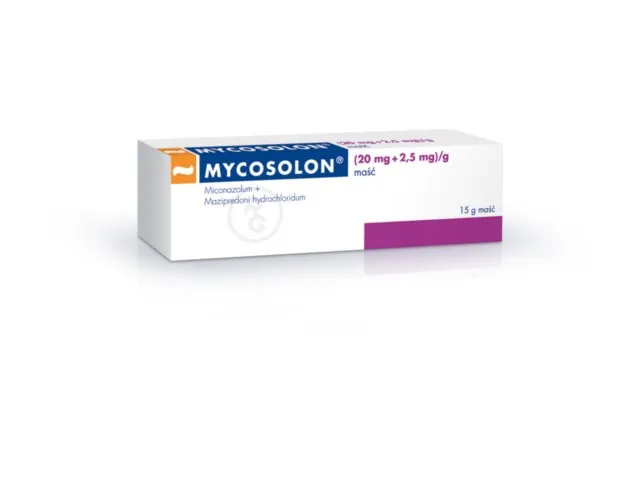
Table of Contents
Package leaflet: Information for the user
MYCOSOLON, (20 mg + 2.5 mg)/g, ointment
Miconazole + Mazipredone hydrochloride
Please read all of this leaflet carefully before using this medicine, because it contains
important information for the patient
- Keep this leaflet, as you may need to read it again.
- If you have any further questions, please ask your doctor or pharmacist.
- This medicine has been prescribed for a specific individual. Do not pass it on to others. It may harm someone else, even if their symptoms are the same.
- If you experience any adverse reactions, including any not listed in this leaflet, inform your doctor or pharmacist. See section 4.
Contents of the leaflet:
- What Mycosolon is and what it is used for
- Important information before using Mycosolon
- How to use Mycosolon
- Possible side effects
- How to store Mycosolon
- Contents of the package and other information
1. What Mycosolon is and what it is used for
Mycosolon is an ointment containing the active substances miconazole and mazipredone.
Topically applied miconazole exerts antifungal activity against dermatophytes, yeasts, and other fungi,
as well as antibacterial activity against Gram-positive bacteria and coccidia.
Mazipredone belongs to a group of medicines called corticosteroids; when applied topically, it exerts
anti-inflammatory and antipruritic effects.
Mycosolon is indicated for the treatment of: inflammatory rashes, eczema, interdigital fungal infection (athlete's foot), fungal nail infections caused by dermatophytes or other fungi (e.g. Candida albicans), fungal infections with bacterial superinfection, and fungal infection of the external auditory canal.
2. Important information before using Mycosolon
When not to use Mycosolon:
- if the patient is allergic to mazipredone, miconazole, other similar antifungal medicines, or any of the other ingredients of this medicine (listed in section 6);
- if the patient is allergic to isoconazole, thiocanazole, or oxiconazole;
- on skin affected by cutaneous tuberculosis, herpes simplex, varicella (chickenpox), or other viral and bacterial infectious skin diseases;
- in fungal infections of the hairy scalp, mucous membranes, or on broken or damaged skin.
Warnings and precautions
Before starting treatment with Mycosolon, consult your doctor or pharmacist.
If allergic reactions, skin irritation, skin atrophy, or systemic hypersensitivity reactions occur, discontinue use immediately and contact your doctor.
Cross-allergy may occur in patients allergic to isoconazole, thiocanazole, or oxiconazole.
Avoid contact of the medicine with eyes and mucous membranes.
Corticosteroids can be absorbed through the skin; therefore, there is a risk of systemic adverse effects of mazipredone typical of corticosteroids, including suppression of adrenal cortex function. For this reason, avoid using Mycosolon over large areas of skin, in high doses, or for prolonged periods.
Use on the facial skin and in the armpits and groin area only when absolutely necessary, due to increased absorption through thin skin and the associated increased risk of capillary dilation, perioral dermatitis, and skin atrophy, even after short-term use.
Avoid applying the ointment under an occlusive dressing (e.g., plaster, diaper), as such dressings enhance absorption of the medicine into the body.
Children
No available data.
Mycosolon and other medicines
Inform your doctor or pharmacist about all medicines the patient is currently taking or has recently taken, as well as any medicines the patient plans to use.
Interactions with other medicines are very rare. Exercise particular caution if taking other medicines, especially anticoagulants such as warfarin, oral antidiabetic drugs, or phenytoin.
Pregnancy and breastfeeding
If the patient is pregnant or breastfeeding, suspects she may be pregnant, or is planning to become pregnant, she should consult a doctor before using this medicine.
Mycosolon may be used during pregnancy only on a doctor's advice, when the benefits to the mother outweigh the potential risks to the fetus.
Mycosolon may be used during breastfeeding only on a doctor's advice.
Driving and operating machinery
Mycosolon has no effect on the ability to drive or operate machinery.
Mycosolon contains methyl parahydroxybenzoate (E 218), cetostearyl alcohol, and propylene glycol (E 1520).
Methyl parahydroxybenzoate may cause allergic reactions (including delayed-type reactions).
Cetostearyl alcohol may cause local skin reactions (e.g., contact dermatitis).
The medicine contains 80 mg of propylene glycol in each gram of ointment. Propylene glycol may cause skin irritation.
3. How to use Mycosolon
This medicine should always be used exactly as directed by a doctor or pharmacist. If in doubt,
consult a doctor or pharmacist.
This medicine is intended for external use on the skin only.
Fungal skin and nail infections
The ointment is usually applied once or twice daily, rubbed gently into the affected area of skin. In fungal
infections of the nails, after removal of the damaged part of the nail, Mycosolon ointment should be
applied under a dressing with a bandage. After removal of the damaged part of the nail, treatment should
be continued without interruption until the nail is completely regenerated.
Fungal infection of the external auditory canal
A piece of gauze soaked with the ointment should be inserted into the external auditory canal twice daily,
until complete healing occurs.
Use in children and adolescents
Myconolon should not be used in children and adolescents due to lack of data.
Use of a higher than recommended dose of Mycosolon
Prolonged or improper topical use of the medicine (e.g. under an occlusive dressing such as adhesive plaster or diaper) or application over large skin surface areas may lead to suppression of adrenal axis function and inhibition of growth and development in children.
Myconolon should be used topically only. In case of accidental ingestion, seek immediate medical advice from a doctor.
Missed dose of Mycosolon
Do not apply a double dose to make up for a missed dose. Apply the ointment as soon as you remember. However, if it is almost time for the next dose, skip the missed dose and continue with your regular dosing schedule.
If you have any further questions about the use of this medicine, consult your doctor or pharmacist.
4. Possible adverse reactions
Like all medicines, this medicine can cause adverse reactions, although not everyone will experience them.
The ointment is generally well tolerated.
The most commonly reported adverse reactions are local skin reactions.
Rare adverse reactions (may occur in fewer than 1 in 1,000 people):
hypersensitivity reactions, including anaphylactic reactions (severe allergic reaction) or
angioedema (swelling of the face, lips, tongue, throat or eyelids, which may cause difficulty in
swallowing and breathing), urticaria, local skin irritation, skin burning sensation, skin
redness, contact dermatitis, itching, rash.
Adverse reactions with unknown frequency (frequency cannot be estimated from the available
data):
secondary infections, skin atrophy, striae, steroid acne, perioral dermatitis (when the medicine is used on the same area, especially for prolonged periods), eruptions,
dry skin, folliculitis, skin depigmentation, superficial blood vessel dilation.
Due to the presence of mazipredone, typical symptoms associated with corticosteroid use may occur, especially with long-term use, application over large skin areas, use under occlusive dressings, and suppression of hypothalamic-pituitary-adrenal (HPA) axis function.
Additional adverse reactions in children
In children, due to increased systemic absorption of corticosteroids compared to adults, suppression of the hypothalamic-pituitary-adrenal axis may occur more easily, leading to systemic corticosteroid adverse effects, including growth and developmental disturbances.
Reporting of adverse reactions
If any adverse reactions occur, including any not listed in this leaflet, inform your doctor or pharmacist. Adverse reactions can be reported directly to the Department of Monitoring Adverse Drug Reactions at the Office for Registration of Medicinal Products, Medical Devices and Biocidal Products
Al. Jerozolimskie 181C
02-222 Warsaw
Tel.: +48 22 49 21 301
Fax: +48 22 49 21 309
Website: https://smz.ezdrowie.gov.pl
Adverse reactions can also be reported to the marketing authorization holder.
Reporting adverse reactions helps to provide more information on the safety of the medicine.
5. How to store Mycosolon
Store in a refrigerator (2°C – 8°C).
Keep the medicine out of the sight and reach of children.
Do not use this medicine after the expiry date stated on the packaging after "Expiry date (EXP)". The expiry date refers to the last day of the stated month.
Medicines must not be disposed of via wastewater or household waste. Ask your pharmacist how to dispose of medicines no longer required. This will help protect the environment.
6. Contents of the pack and other information
What Mycosolon contains
The active substances are: miconazole and maprisone hydrochloride.
Each 1 g of cream contains 20 mg of miconazole and 2.5 mg of maprisone hydrochloride.
The other ingredients are: methyl 4-hydroxybenzoate (E 218), polysorbate 60, liquid paraffin,
propylene glycol (E 1520), cetostearyl alcohol, purified water.
What Mycosolon looks like and contents of the pack
A white or almost white, homogeneous cream with a mild, characteristic odour.
The aluminium tube contains 15 g of cream and is packaged in a cardboard box.
Marketing Authorisation Holder:
Gedeon Richter Plc.
Gyömrői út 19-21
1103 Budapest
Hungary
For further information about this medicinal product, please contact the local representative of the Marketing Authorisation Holder.
GEDEON RICHTER POLSKA Sp. z o.o.
Medical Department
ks. J. Poniatowskiego Street 5
05-825 Grodzisk Mazowiecki
Poland
Tel. +48 (22) 755 96 48
[email protected]