Myconafine
Poland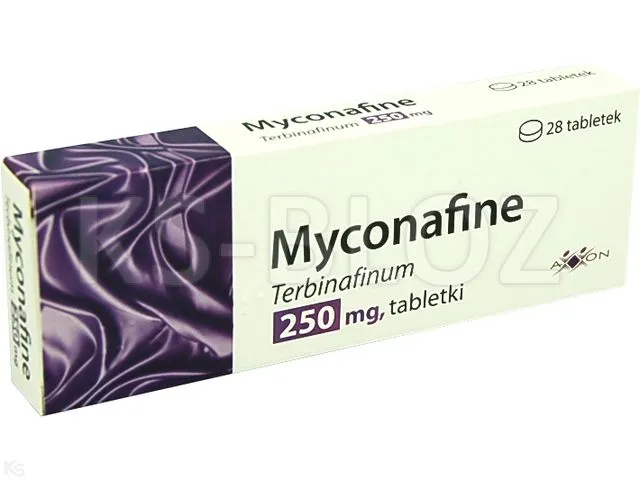
Table of Contents
Patient Information Leaflet
Myconafine 250 mg tablets
Terbinafinum
Please read all of this leaflet carefully before taking this medicine, because it contains
important information for you.
- Keep this leaflet, as you may need to read it again.
- If you have any further questions, please ask your doctor or pharmacist.
- This medicine has been prescribed for a specific individual. Do not pass it on to others. It may harm other people, even if their symptoms are the same.
- If you experience any side effects, including any not listed in this leaflet, tell your doctor or pharmacist. See section 4.
Leaflet Contents
- What Myconafine is and what it is used for
- What you need to know before taking Myconafine
- How to take Myconafine
- Possible side effects
- How to store Myconafine
- Contents of the pack and other information
1. What Myconafine is and what it is used for
Myconafine contains terbinafine, an antifungal agent. Terbinafine kills fungi by disrupting their cell membranes.
Myconafine is used to treat fungal infections of the fingernails and toenails, athlete's foot (tinea pedis), fungal infection of the groin area (tinea cruris), and widespread fungal skin infections (dermatophytosis).
2. Important information before using Myconafine
When not to use Myconafine
- If the patient is allergic to terbinafine or any of the other ingredients of this medicine (listed in section 6).
- If the patient has severe impairment of liver or kidney function.
Warnings and precautions
Before starting treatment with Myconafine, discuss with a doctor if:
- The patient has psoriasis (a scaly skin disease). Myconafine may worsen the condition.
- The patient has systemic lupus erythematosus (an autoimmune disease).
Seek immediate medical advice if:
- The patient suddenly develops high fever or sore throat.
Myconafine and other medicines
Tell your doctor or pharmacist about all medicines the patient is currently taking, has recently taken, or plans to take.
This is important because Myconafine may interact with other medicines, potentially increasing or decreasing their effects.
If the patient is taking any of the following medicines, the doctor may adjust the dose of Myconafine or the dose of the other medicine:
- Rifampicin (a medicine used in the treatment of tuberculosis).
- Cimetidine (a medicine used to treat stomach ulcers).
- Tricyclic antidepressants, selective serotonin reuptake inhibitors, and monoamine oxidase inhibitors (medicines used in the treatment of depression).
- Beta-adrenergic receptor blockers and antiarrhythmic medicines (medicines used to treat high blood pressure and certain heart conditions).
- Caffeine.
- Cyclosporine (a medicine used to prevent rejection of transplanted organs).
- Fluconazole and ketoconazole (medicines used in the treatment of fungal infections).
If a female patient is taking oral contraceptives while using Myconafine, intermenstrual bleeding and irregular menstrual bleeding may occur.
Myconafine with food and drink
Food does not affect the action of Myconafine, so the patient does not need to take the tablets with food.
Pregnancy, breastfeeding, and fertility
If the patient is pregnant or breastfeeding, suspects she may be pregnant, or is planning to become pregnant, she should consult a doctor or pharmacist before using this medicine.
Myconafine should not be used in pregnant women unless the doctor considers it particularly indicated.
Myconafine should not be used if the patient is breastfeeding, as terbinafine passes into breast milk.
Driving and operating machinery
Myconafine has no effect or negligible effect on the ability to drive and operate machinery. However, patients who experience dizziness should avoid driving and operating machinery.
3. How to use Myconafine
This medicine should always be used as directed by a physician. In case of doubt, consult
your doctor or pharmacist.
The recommended dose of the medicine in adult patients, including elderly patients, is 250 mg
once daily (1 tablet of Myconafine).
Duration of treatment
The duration of treatment depends on the location and severity of the infection and is as follows:
- Fungal infections of the groin area and in the folds of the skin (tinea cruris), as well as extensive fungal skin infections (dermatomycosis): in most cases, the treatment duration is 2–4 weeks.
- Fungal infections of the soles of the feet (athlete's foot), on the feet and between the toes: the treatment duration may last up to 6 weeks.
- Fungal nail infections of the hands: in most cases, the treatment duration is 6 weeks.
- Fungal nail infections of the feet: the treatment duration is usually 12 weeks, but
in some cases up to 6 months.
Use in children and adolescents (under 18 years of age)
There is no information available on the use of this medicine in children and adolescents under 18 years of age.
Do not administer Myconafine to children unless specifically recommended by a doctor.
Taking more Myconafine than recommended
If a patient takes more Myconafine than recommended, they should contact their doctor or hospital immediately.
Symptoms of overdose include headache, nausea, upper abdominal pain, and dizziness.
Missed dose of Myconafine
If a patient forgets to take a dose of the medicine, they should take it as soon as they remember. If it is almost time for the next dose, the missed dose should be skipped and the next dose taken at the usual time. Do not take a double dose to make up for a missed dose.
Stopping treatment with Myconafine
Your doctor will inform you how long your treatment with Myconafine should last. Do not stop treatment before completing the prescribed course, as the infection may not be fully cured. It may take several weeks after the end of treatment for all symptoms to resolve.
If you have any further questions about the use of this medicine, consult your doctor or pharmacist.
4. Possible adverse reactions
Like all medicines, this medicine can cause adverse reactions, although not everyone will experience them.
The following adverse reactions are serious and require immediate action if they occur in a patient.
Stop taking Myconafine and contact a doctor immediately if any of the following symptoms occur:
- Swelling of the face, tongue, or windpipe, which may cause difficulty breathing (angioedema).
- Sudden allergic reaction with shortness of breath, rash, wheezing, and drop in blood pressure (anaphylactic reaction).
- Severe skin reaction, such as a serious allergic reaction with fever, joint inflammation, and/or eye inflammation, blisters on the skin, or skin peeling (Stevens-Johnson syndrome, toxic epidermal necrolysis).
- Yellowing of the skin or eyes, dark urine, or pale stools, nausea, loss of appetite, fatigue, vomiting, abdominal pain (symptoms of liver problems such as: jaundice, hepatitis, cholestasis, or liver failure).
Additional adverse reactions may also occur:
Very common adverse reactions (may affect more than 1 in 10 patients):
Mild skin reactions such as: rash and urticaria. Skin reactions may be accompanied by joint and muscle pain. Other possible reactions include: feeling of fullness in the stomach, indigestion, nausea, abdominal pain, diarrhoea, decreased appetite.
Common adverse reactions (may affect up to 1 in 10 patients):
Headache.
Uncommon adverse reactions (may affect less than 1 in 100 patients):
Taste disturbances, including loss of taste. This condition usually resolves slowly after discontinuation of treatment. In isolated cases, permanent taste disturbances have been observed.
Rare adverse reactions (may affect less than 1 in 1,000 patients):
Increased liver enzyme activity, general malaise, fatigue, numbness and tingling of the skin, or prickling and tingling sensations (paresthesia), reduced sensitivity to touch, or dizziness.
Very rare adverse reactions (may affect less than 1 in 10,000 patients):
Irregular red spots on the skin of the hands and arms (erythema multiforme). Changes in blood cell counts, severe autoimmune disease with skin symptoms (SLE – systemic lupus erythematosus), exacerbation of psoriasis symptoms (a skin condition characterized by skin scaling), hair loss, sudden appearance of red swollen areas on the skin with numerous blisters (acute generalized exanthematous pustulosis). Symptoms of severe psychiatric disorders such as: depression and anxiety.
Frequency not known (frequency cannot be estimated from available data):
Anaemia, inability to perceive smells (anosmia), moderate to severe allergic reactions (serum sickness-like reaction and anaphylactic reaction), hearing loss (deafness), hearing disturbances, auditory disorders (tinnitus), vasculitis, pancreatitis.
Moderate to severe photosensitivity allergic reactions, muscle pain and damage to skeletal muscles (rhabdomyolysis), weight loss caused by reduced food intake, influenza-like illness, fever, increased blood creatine kinase concentration.
Reporting of adverse reactions
If any adverse reactions occur, including any not listed in this leaflet, inform your doctor, pharmacist, or nurse. Adverse reactions can be reported directly to the Department of Monitoring Adverse Drug Reactions of the Office for Registration of Medicinal Products, Medical Devices and Biocidal Products:
Al. Jerozolimskie 181C, 02-222 Warsaw, tel.: 22 49-21-301, fax: 22 49-21-309, e-mail: [email protected].
Adverse reactions can also be reported to the marketing authorization holder.
Reporting adverse reactions helps provide more information on the safety of this medicine.
5. How to store Myconafine
Keep this medicine out of sight and reach of children.
Do not use this medicine after the expiry date stated on the carton after EXP. The expiry date refers to the last day of the stated month.
No special storage instructions apply.
Medicines must not be disposed of via wastewater or household waste. Ask your pharmacist how to dispose of medicines no longer required. Such measures help protect the environment.
6. Contents of the packaging and other information
What Myconafine contains:
-
The active substance is terbinafine, in the form of terbinafine hydrochloride. One tablet contains 250 mg of terbinafine (as terbinafine hydrochloride).
-
The other components are: microcrystalline cellulose, sodium croscarmellose, colloidal anhydrous silica, hypromellose, and magnesium stearate.
What Myconafine looks like and contents of the pack
White, round, flat tablets, 11 mm in diameter, with a bisecting groove on both sides,
marked with the letter “T” above the groove and the number “1” below the groove on one side.
Myconafine is available in the following pack sizes:
Blister packs: 7, 14, 28, 56 and 112 tablets in blisters, in a cardboard box.
Bottles: 50 and 100 tablets in bottles.
Not all pack sizes may be marketed.
Marketing Authorisation Holder and Manufacturer
Marketing Authorisation Holder:
Aristo Pharma Sp. z o.o.
ul. Baletowa 30
02-867 Warsaw
Manufacturer:
Actavis Ltd.
BLB015-016 Bulebel Industrial Estate
Zejtun ZTN3000
Malta