Multihance
Poland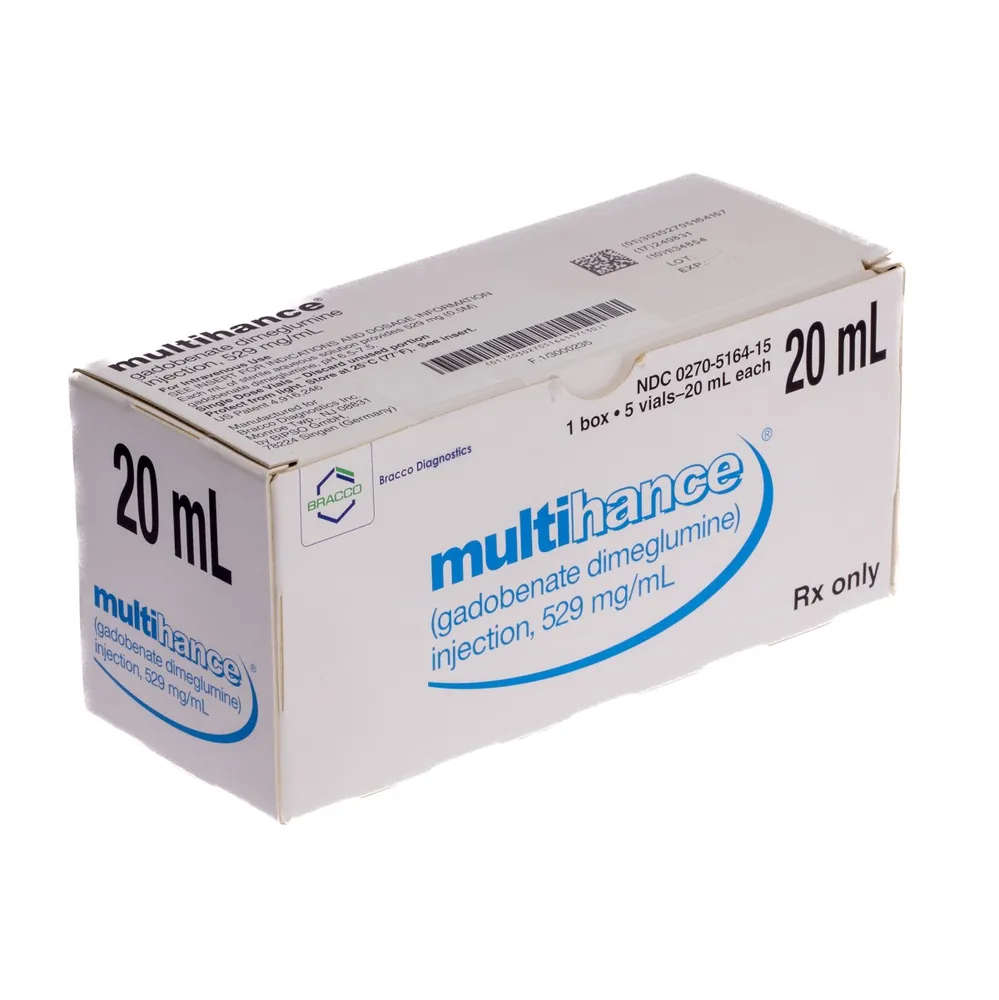
Table of Contents
MultiHance, 529 mg/ml (0.5 mmol/ml), solution for intravenous injection
Gadobenate dimeglumine
Please read the entire leaflet carefully before using the product, as it contains
important information for the patient.
- Keep this leaflet for future reference.
- Consult your doctor if you have any questions.
- This medicine has been prescribed for a specific individual. Do not share it with others. This medicine may harm other people, even if their symptoms are the same.
- If the patient experiences any adverse reactions, including any adverse reactions not listed in this leaflet, inform the doctor or nurse immediately. See section 4.
Table of contents
- What MultiHance is and what it is used for
- Important information before using MultiHance
- How to use MultiHance
- Possible side effects
- How to store MultiHance
- Contents of the pack and other information
1. What MultiHance is and what it is used for
MultiHance is a special contrast agent containing the rare earth element gadolinium, which improves liver imaging during magnetic resonance imaging (MRI). This helps physicians detect any abnormalities in the patient's liver.
This product is intended for diagnostic use only.
MultiHance is approved for use in children above 2 years of age.
2. Important information before using MultiHance
MultiHance should only be used in a hospital or clinic equipped with appropriate equipment and staff trained to manage allergic reactions.
Retention in the body
MultiHance works because it contains a metal called gadolinium. Studies have shown that small amounts of gadolinium may be retained in the body, including in the brain. No adverse effects related to gadolinium retention in the brain have been observed.
When not to use MultiHance
- If the patient is allergic to gadobenate dimeglumine or to any of the other ingredients of this medicine (listed in section 6).
- If the patient has previously experienced an allergic reaction (hypersensitivity reaction) such as rash, itching, hives, or breathing difficulties after injection of any MRI contrast agent or other contrast medium.
Patients should inform their doctor if any of the above apply.
Children
MultiHance is not recommended for use in children under 2 years of age.
Warnings and precautions
Inform the doctor before receiving MultiHance if:
- the patient has heart disorders or high blood pressure,
- the patient has had seizures or brain injury,
- the patient has a pacemaker implanted, or has any metal objects in the body such as clips, screws, or plates, which could interfere with the magnetic field during an MRI scan,
- the patient’s kidneys are not functioning properly,
- the patient has recently undergone or is scheduled to undergo liver transplantation.
The doctor may decide to perform a blood test to check kidney function before deciding to administer MultiHance, especially in patients over 65 years of age.
MultiHance and other medicines
Tell the doctor about all medicines the patient is currently taking or has recently taken, as well as any medicines the patient plans to take.
There have been no reports of interactions between MultiHance and other medicines.
Pregnancy and breastfeeding
If the patient is pregnant or breastfeeding, suspects she may be pregnant, or is planning to become pregnant, she should consult her doctor before using this medicine.
Pregnancy
Gadobenic acid may cross the placenta. It is not known whether this may affect the unborn child.
Women who are pregnant or suspect they may be pregnant should inform their doctor, as MultiHance should not be used during pregnancy unless absolutely necessary.
Breastfeeding
Women who are breastfeeding or planning to breastfeed should inform their doctor. The doctor will discuss with the patient whether she should continue breastfeeding or interrupt breastfeeding for 24 hours after receiving MultiHance.
Driving and operating machinery
There is no information available regarding the effects of MultiHance on driving or operating tools or machinery. Patients should consult their doctor to determine whether they can drive and safely operate machines or tools.
Important information about certain ingredients of MultiHance
During storage, small amounts of benzyl alcohol (an alcohol derivative) may be released into the MultiHance solution.
Patients should inform their doctor if they are allergic (hypersensitive) to benzyl alcohol.
3. How to use MultiHance
MultiHance is injected into a vein, usually into a vein in the arm, shortly before an MRI scan.
The number of millilitres of solution injected depends on the patient's body weight.
The recommended dose is:
Liver MRI: 0.1 ml per kilogram of body weight.
The MultiHance injection will be administered by medical personnel supervising the imaging procedure,
who will ensure that the needle is correctly positioned. If the patient experiences pain or a burning sensation,
this should be reported immediately to the medical staff.
The patient should remain in the hospital for one hour after receiving the MultiHance injection.
Dosing in special patient groups
Renal impairment
The use of MultiHance is not recommended in patients with severe kidney disease, as well as in patients who
have recently undergone or are about to undergo liver transplantation. However, if the use of MultiHance is necessary,
the patient should receive only a single dose of MultiHance during the examination and should not receive a second injection
within at least 7 days.
Elderly patients
Dose adjustment is not required for patients over 65 years of age; however, a blood test should be performed
to monitor kidney function.
If there are any further questions or uncertainties regarding the use of this medicine, consult a physician.
4. Possible side effects
Like all medicines, this product can cause side effects, although not everybody experiences them.
Most of the adverse reactions associated with MultiHance have been mild and transient, resolving spontaneously
without lasting consequences. However, serious and life-threatening reactions have been reported,
which occasionally led to death.
| Possible adverse reactions | |
| Common: (> 1 in 100 patients, but < 1 in 10 patients) |
|
| Uncommon: (> 1 in 1,000 patients, but < 1 in 100 patients) |
|
| Rare: (> 1 in 10,000 patients, but < 1 in |
|
| 1,000 patients) |
|
| Frequency unknown** (cannot be estimated from available data) |
|
Cases of nephrogenic systemic fibrosis (a disease associated with skin sclerosis that may also affect soft tissues and internal organs) have been reported in patients who received MultiHance in combination with other drugs containing gadolinium.
If any adverse reaction occurs after injection of MultiHance, the patient should immediately inform the medical personnel supervising the imaging procedure.
For any unanswered questions not covered in this leaflet, please consult the medical personnel supervising the imaging procedure.
If any of the adverse effects worsen or if any adverse effects not listed in this leaflet occur, inform your doctor.
Reporting of adverse reactions
If any adverse effects occur, including those not listed in this leaflet, inform your doctor or pharmacist. Adverse reactions can be reported directly to the Department of Monitoring Adverse Drug Reactions of the Office for Registration of Medicinal Products, Medical Devices and Biocidal Products,
Al. Jerozolimskie 181C,
02-222 Warsaw,
Phone: +48 22 49 21 301,
Fax: +48 22 49 21 309,
Website: https://smz.ezdrowie.gov.pl
Adverse reactions may also be reported to the marketing authorization holder.
Reporting adverse reactions enables better assessment of the safety profile of the medicinal product.
5. How to store MultiHance
- Keep this medicine out of sight and reach of children.
- Do not use this medicine after the expiry date stated on the label. The expiry date refers to the last day of the stated month.
- Store below 25°C. Do not freeze. Protect from light.
- MultiHance should be administered immediately after being drawn into a syringe.
- Do not use this product if the container or closure is damaged, or if discoloration of the solution or the presence of particles is observed.
- Medicines must not be disposed of via the sewage system or household waste. Hospital pharmacists will handle the disposal of unused medicine and waste. This will help protect the environment.
6. Contents of the pack and other information
What MultiHance contains
- The active substance is gadobenic acid. 1 ml of injection solution contains: gadobenic acid 334 mg (0.5 mmol) as gadobenate dimeglumine (529 mg).
- The excipient is water for injections.
What MultiHance looks like and contents of the pack
MultiHance is a sterile aqueous solution (clear and colourless or slightly yellow) for intravenous injection.
MultiHance is supplied to hospitals in single-use glass vials containing 5 ml, 10 ml, 15 ml, or 20 ml of solution.
Not all pack sizes may be marketed.
Marketing Authorisation Holder
Bracco Imaging Deutschland GmbH
Max-Stromeyer-Strasse 116
D-78467 Konstanz, Germany
For further information, contact the local representative of the Marketing Authorisation Holder:
Bracco Imaging Polska Sp. z o.o.
ul. Domaniewska 39 A
02-672 Warszawa, Poland
Manufacturer
Patheon Italia S.p.A.
2° Trav. SX Via Morolense 5
03013 Ferentino, Italy
Bracco Imaging S.p.A.
via Ribes, 5
10010 Colleretto Giacosa (TO), Italy
Information intended exclusively for healthcare professionals:
Administration method
The medicinal product MultiHance should be drawn into a syringe immediately before use and must not be diluted. Any unused medicinal product must be discarded. It must not be used for examinations of other patients.
To reduce the potential risk of extravasation of the medicinal product MultiHance, verify that the intravenous injection needle or cannula is properly placed within the vein.
The medicinal product should be administered intravenously as a bolus injection or slow injection (10 ml/min), without dilution.
MRA: The medicinal product should be administered intravenously as a bolus, either manually or using an automatic injector.
After injection of the medicinal product, flush the cannula or needle with a bolus of physiological saline solution administered intravenously.
Image acquisition after contrast administration:
| Liver | Dynamic imaging: | Immediately after administration of the medicinal product. |
| Delayed imaging: | Between 40 and 120 minutes after administration, depending on individual requirements. |
Before administering MultiHance, it is recommended that all patients undergo evaluation for renal function impairment, including laboratory tests.
Cases of nephrogenic systemic fibrosis (NSF) associated with the use of certain gadolinium-containing medicinal products have been reported in patients with acute or chronic severe renal impairment (GFR < 30 mL/min/1.73 m²). Patients undergoing liver transplantation are at particular risk, as the likelihood of developing acute renal failure in this patient group is high. Due to the risk of NSF occurring with the use of MultiHance, this medicinal product should be avoided in patients with severe renal impairment and in patients during the perioperative period of liver transplantation, unless the diagnostic information is essential and not available from non-contrast MRI. If administration of MultiHance cannot be avoided, the dose should not exceed 0.05 mmol/kg body weight. Due to lack of data on multiple administrations, injections of MultiHance should not be repeated unless intervals between doses are at least 7 days.
Since renal clearance of gadobenate dimeglumine may be reduced in elderly patients, it is particularly important to monitor renal function in patients aged 65 years and older.
Hemodialysis shortly after administration of MultiHance may facilitate elimination of the product from the body. However, there is no evidence to support initiating hemodialysis for the prevention or treatment of NSF in patients not already undergoing hemodialysis.
MultiHance should not be used during pregnancy unless the woman's clinical condition requires administration of gadobenate dimeglumine.
The physician and the breastfeeding mother should jointly decide whether to continue breastfeeding or to discontinue it for 24 hours following administration of MultiHance.
The label detached from the vial should be attached to the patient's medical record to ensure proper documentation of the administered gadolinium-containing medicinal product. The administered dose should also be recorded. If an electronic patient record is used, the name of the medicinal product, batch number, and dose should be entered into the patient's electronic documentation.