Mukolina
Poland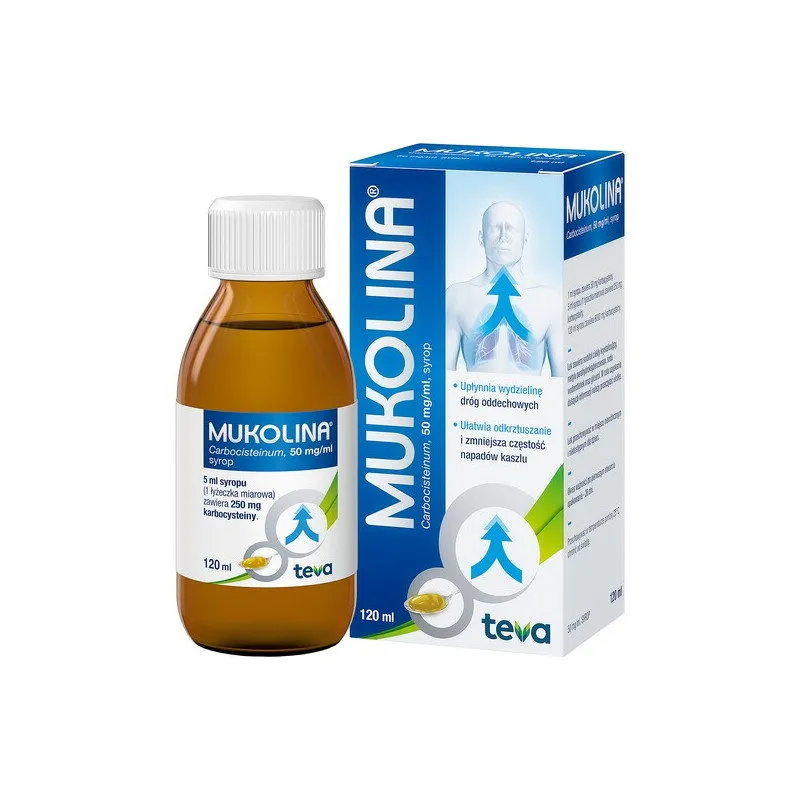
Table of Contents
Patient Information Leaflet: Information for the User
MUKOLINA, 50 mg/ml, syrup
Carbocisteinum
Please read the entire leaflet carefully before using the medicine, as it contains
important information for the patient.
This medicine should always be used exactly as described in the patient leaflet or as directed by
the physician or pharmacist.
- Keep this leaflet for future reference.
- If advice or additional information is needed, consult a pharmacist.
- If the patient experiences any adverse reactions, including any possible adverse reactions not listed in this leaflet, inform a doctor or pharmacist immediately. See section 4.
- If there is no improvement after 4 to 5 days of treatment, or if the patient feels worse, consult a doctor.
Table of contents:
- What Mukolina is and what it is used for
- Important information before taking Mukolina
- How to take Mukolina
- Possible side effects
- How to store Mukolina
- Contents of the pack and other information
1. What Mukolina is and what it is used for
Mukolina syrup contains carbocisteine, which affects respiratory tract secretions. The medicine reduces the viscosity of bronchial mucus, making it more fluid (mucolytic action), thus facilitating expectoration and reducing the frequency of coughing episodes.
This medicine is used for the symptomatic treatment of respiratory diseases associated with excessive production of thick and sticky mucus.
If there is no improvement after 4 to 5 days of treatment, or if the patient feels worse, consult a doctor.
2. Important information before using Mukolina
When not to use Mukolina
- if the patient is allergic to carbocysteine or to any of the other ingredients of this medicine (listed in section 6),
- if the patient has active gastric or duodenal ulcer,
- in asthmatic conditions,
- in children under 6 years of age.
Warnings and precautions
Before starting treatment with Mukolina, consult a doctor or pharmacist if:
- the patient has a history of peptic ulcer disease, as mucolytic agents may damage the gastric mucosa.
If there is abundant purulent sputum and fever, or in case of chronic bronchial or lung disease, as well as in patients with reduced ability to expectorate, a visit to a doctor is necessary, who may recommend additional treatment.
Treatment of patients with bronchial asthma should be conducted under strict medical supervision due to the risk of bronchospasm. If this symptom occurs, administration of the drug must be stopped immediately.
Do not take the medicine before going to sleep.
Children
Mukolina is not intended for use in children under 6 years of age.
Mukolina and other medicines
Inform your doctor or pharmacist about all medicines currently used, recently used, or planned to be used.
Do not take carbocysteine simultaneously with antitussive drugs or drugs that suppress mucus secretion.
Mukolina with food and drink
Mukolina syrup should be taken after meals.
Pregnancy, breastfeeding and fertility
If the patient is pregnant, breastfeeding, suspects she may be pregnant, or is planning to have a child, she should consult a doctor or pharmacist before using this medicine.
The use of this medicine during pregnancy is not recommended.
It is unknown whether carbocysteine passes into breast milk; therefore, the use of this medicine is not recommended during breastfeeding.
There is no data available on the effect of carbocysteine on fertility.
Driving and operating machinery
This medicine does not affect the ability to drive or operate machinery.
Mukolina contains methyl parahydroxybenzoate
This medicine may cause allergic reactions (including delayed-type reactions) and, very rarely, bronchospasm.
Mukolina contains sorbitol
The medicine contains 2.5 g of sorbitol in 5 ml of syrup, equivalent to 22.5 g of sorbitol in the maximum recommended daily dose (45 ml). Sorbitol may cause gastrointestinal discomfort and may have a mild laxative effect. The caloric value of sorbitol is 2.6 kcal/g.
Sorbitol is a source of fructose. If intolerance to certain sugars has been previously diagnosed in the patient (or his/her child), or if hereditary fructose intolerance—a rare genetic disorder in which the body cannot break down fructose—has been diagnosed, the patient should consult a doctor before taking the medicine or giving it to a child.
Mukolina contains sodium
The medicine contains 32.07 mg of sodium (main component of table salt) in 5 ml of syrup.
The maximum recommended daily dose of this medicine contains 288.7 mg of sodium. This corresponds to 14.4% of the maximum recommended daily intake of sodium in the diet for adults.
3. How to use Mukolina
This medicine should always be taken exactly as described in the patient information leaflet or as directed by a doctor or pharmacist. If in doubt, consult a doctor or pharmacist.
The medicine is taken orally. The appropriate volume of syrup should be measured using the dosing spoon provided with the medicine package.
The usual dosage is as follows:
Adults and adolescents over 12 years of age:
Initially, 750 mg (15 ml of syrup) should be taken three times daily. After achieving the desired effect (thinning of secretions, easier expectoration), the dose should be reduced to 500 mg (10 ml of syrup) three times daily.
Children from 6 to 12 years of age:
250 mg (5 ml of syrup) three times daily.
In children and adolescents, the daily dose of carbocysteine must not exceed 30 mg/kg body weight.
It is recommended that the child drinks water after taking the medicine.
Elderly patients:
The dosage recommended for adult patients should be used.
Do not use the medicine for longer than 4 to 5 days without medical advice.
It is not recommended to take the medicine before going to sleep.
Taking more Mukolina than recommended
There are no reports of carbocysteine overdose. The most likely symptoms of overdose may be gastrointestinal disturbances.
In case of overdose, a doctor may perform gastric lavage and monitor the patient.
If you have taken more than the recommended dose, seek immediate medical advice from a doctor or pharmacist.
Missing a dose of Mukolina
Take the missed dose as soon as possible. Do not take a double dose to make up for a missed dose.
Stopping Mukolina treatment
If you have any further questions about the use of this medicine, consult your doctor or pharmacist.
4. Possible adverse reactions
Like all medicines, this medicine can cause adverse reactions, although they do not occur in everyone.
Gastrointestinal disorders:
Rare (in less than 1 in 1,000 people, but in more than 1 in 10,000 people): nausea, diarrhoea.
Very rare (in less than 1 in 10,000 people): gastrointestinal bleeding, gastric disturbances, abdominal pain.
Central nervous system disorders:
Single cases: headaches.
Immune system disorders:
In hypersensitive patients, inflammation of the mucous membranes of the mouth and nose may occur.
Skin and subcutaneous tissue disorders:
Very rare (in less than 1 in 10,000 people): allergic reactions (skin rash, itching, urticaria).
Frequency not known (frequency cannot be estimated from the available data): isolated cases of blistering skin reactions such as Stevens-Johnson syndrome have been reported.
Reporting of adverse reactions
If any adverse reactions occur, including any adverse reactions not listed in this leaflet, inform your doctor or pharmacist. Adverse reactions can be reported directly to the Department for Monitoring Adverse Reactions of Medicinal Products at the Office for Registration of Medicinal Products, Medical Devices and Biocidal Products:
Al. Jerozolimskie 181C, 02-222 Warsaw, phone: +48 22 49 21 301, fax: +48 22 49 21 309,
website: https://smz.ezdrowie.gov.pl
Adverse reactions can also be reported to the marketing authorization holder.
Reporting adverse reactions helps provide more information on the safety of this medicine.
5. How to store Mukolina
Keep the medicine out of sight and reach of children.
Store below 25°C and protect from light.
Do not use this medicine after the expiry date stated on the cardboard box and label. The expiry date refers to the last day of the stated month.
Period of validity after first opening of the container - 28 days.
Medicines must not be disposed of via wastewater or household waste. Ask your pharmacist how to dispose of medicines no longer required. These measures will help protect the environment.
6. Contents of the packaging and other information
What Mukolina contains
- The active substance is carbocysteine. 5 ml of syrup contains 250 mg of carbocysteine.
- The other ingredients are: crystallizing liquid sorbitol 70% (E 420), glycerol (E 422), sodium hydroxide (E 524), methyl parahydroxybenzoate (E 218), powdered caramel, banana flavour, purified water.
What Mukolina looks like and contents of the pack
A bottle containing 120 ml or 200 ml of syrup. The bottle is made of brown glass, closed with an aluminium cap with a tamper-evident ring or a polypropylene cap with a polyethylene foam seal and a polyethylene tamper-evident ring, packed in a cardboard box. An oral dosing spoon with graduations at 2.5 ml and 5 ml is included in the package.
Marketing Authorisation Holder and Manufacturer
Marketing Authorisation Holder:
Teva Pharmaceuticals Polska Sp. z o.o.
Emilii Plater 53 Street
00-113 Warsaw
Tel.: (22) 345 93 00
Manufacturer:
Teva Operations Poland Sp. z o.o.
Mogilska 80 Street
31-546 Kraków