Muccosinal
Poland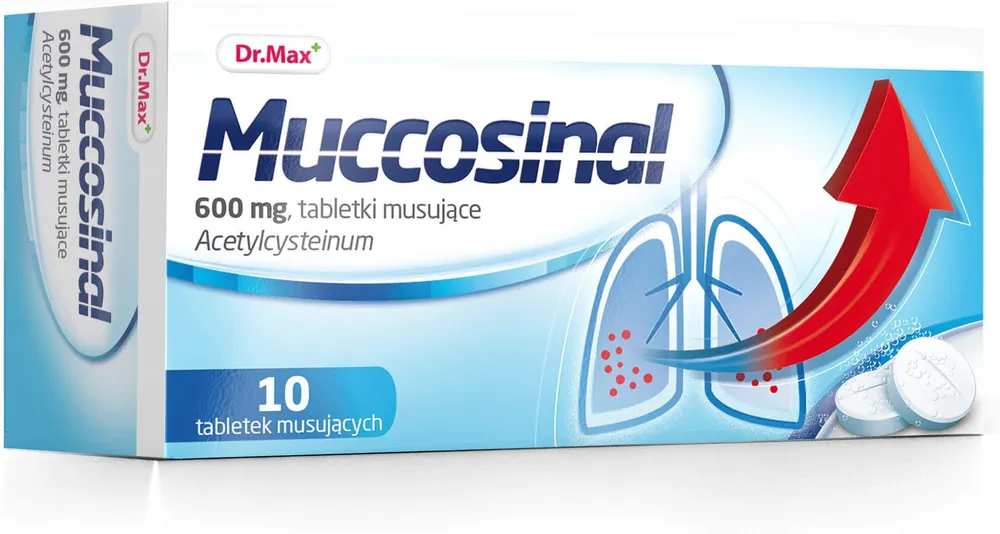
Table of Contents
Package leaflet: Information for the patient
Muccosinal, 600 mg, effervescent tablets
Acetylcysteine
For adults and adolescents above 14 years of age
Please read carefully the entire leaflet before using this medicine, as it contains
important information for the patient.
This medicine should always be used exactly as described in this patient leaflet or as directed by
your doctor or pharmacist.
- Keep this leaflet for possible future reference.
- If you need advice or further information, please consult your pharmacist.
- If you experience any adverse reactions, including any not listed in this leaflet, inform your doctor or pharmacist. See section 4.
- If there is no improvement after 4 to 5 days, or if you feel worse, consult your doctor.
Table of contents
- What Muccosinal is and what it is used for
- Important information before taking Muccosinal
- How to take Muccosinal
- Possible side effects
- How to store Muccosinal
- Contents of the pack and other information
1. What Muccosinal is and what it is used for
Muccosinal contains the active substance acetylcysteine, a mucolytic agent which reduces the viscosity of bronchial secretions and facilitates expectoration.
Muccosinal is used in the treatment of acute respiratory conditions—such as colds—and in chronic respiratory diseases associated with the production of thick mucus and difficulty in expectoration, in adults and adolescents above 14 years of age.
This medicine may be used without prior medical consultation only for the treatment of acute conditions. If the patient suffers from chronic respiratory diseases, this medicine should be used only upon medical advice.
If there is no improvement after 4 to 5 days, or if you feel worse, consult your doctor.
2. Important information before using Muccosinal
When not to use Muccosinal
if the patient is allergic to acetylcysteine or to any of the other ingredients of this
medicine (listed in section 6);
if the patient has acute bronchial asthma;
if the patient has active gastric or duodenal ulcer disease;
due to the high content of active substance, this medicine should not be used in children
and adolescents under 14 years of age.
Warnings and precautions
Before using Muccosinal, consult a doctor or pharmacist if:
the patient has diabetes;
the patient suffers from bronchial asthma;
the patient currently has or has had gastric or duodenal ulcer disease in the past.
In very rare cases, severe skin reactions (Stevens-Johnson syndrome, Lyell's syndrome) may occur after administration of acetylcysteine. If skin lesions or mucosal changes occur during treatment with acetylcysteine, immediate medical advice must be sought.
In patients with histamine intolerance, treatment with acetylcysteine should be as short as possible.
Administration of acetylcysteine, particularly at the beginning of treatment, may lead to liquefaction and thus an increase in bronchial secretions. If the patient is unable to cough up secretions adequately, the doctor will perform appropriate procedures (e.g. drainage and suction).
Muccosinal should not be used in patients with liver or kidney impairment to prevent the formation of nitrogen compounds.
Children and adolescents
Muccosinal should not be used in children under 14 years of age. Other, more suitable pharmaceutical forms are available for children under 14 years of age.
Muccosinal and other medicines
Inform your doctor or pharmacist about all medicines currently or recently taken, as well as any medicines the patient intends to use.
Muccosinal and other concomitantly administered medicines may interact with each other. Before using Muccosinal and any over-the-counter medicine, medical advice should be sought.
Concomitant use of Muccosinal and antitussive medicines (cough suppressants) may reduce the cough reflex and lead to dangerous accumulation of secretions in the respiratory tract. Simultaneous use of Muccosinal and antitussive medicines must be justified by important reasons and should be preceded by medical consultation.
Concomitant use of acetylcysteine and activated charcoal may reduce the effectiveness of acetylcysteine.
When using oral antibiotics (tetracyclines, semi-synthetic penicillins, aminoglycosides, and cephalosporins), Muccosinal should be taken at least 2 hours after the antibiotic. A 2-hour interval is recommended also for other antibiotics (except amoxicillin, doxycycline, erythromycin, thiamphenicol, cefuroxime, cefixime, and loracarbef).
Concomitant use of Muccosinal and medicines containing nitroglycerin may lead to increased vasodilation and inhibition of platelet aggregation.
Acetylcysteine may interfere with colorimetric assays for salicylates and with urinary ketone body tests. If the patient intends to undergo such tests, the medical staff should be informed about the use of acetylcysteine-containing medicine.
Muccosinal with food and drink
The effect of acetylcysteine on mucus is enhanced by increased fluid intake. It is not recommended to dissolve Muccosinal with other medicines.
Pregnancy and breastfeeding
If the patient is pregnant or breastfeeding, suspects she may be pregnant, or is planning to become pregnant, she should consult a doctor or pharmacist before using this medicine.
Pregnancy
Due to the lack of sufficient experience with the use of acetylcysteine in pregnant women, Muccosinal should be used during pregnancy only if the physician considers it absolutely necessary.
Breastfeeding
There are no data on the passage of acetylcysteine into human milk. Therefore, Muccosinal should be used during breastfeeding only if the physician considers it absolutely necessary.
Driving and operating machinery
Muccosinal has no effect or only a negligible effect on the ability to drive vehicles and operate machinery.
Muccosinal contains lactose, sorbitol, and sodium
If the patient has previously been diagnosed with intolerance to certain sugars, the patient should consult a doctor before taking this medicine.
This medicine contains less than 40 mg of sorbitol in one 600 mg effervescent tablet.
This medicine contains approximately 138 mg (6 mmol) of sodium (main component of table salt) in each effervescent tablet. This corresponds to 6.9% of the maximum recommended daily dietary sodium intake for adults.
3. How to use Muccosinal
This medicine should always be taken exactly as described in this patient leaflet or as directed by a doctor or pharmacist. If in doubt, consult a doctor or pharmacist.
The recommended dose for adults and adolescents over 14 years of age is 1 effervescent tablet (600 mg acetylcysteine) once daily. In adolescents, half a tablet should be taken twice daily.
The medicine should be taken after a meal. The tablet must be dissolved in half a glass of water. The solution should be consumed immediately after dissolving the tablet. Since the medicine is stabilised with ascorbic acid, the solution should be drunk within 2 hours after preparation.
Without a doctor's recommendation, Muccosinal should not be used for longer than 4 to 5 days.
If symptoms do not improve, worsen, or if adverse effects occur, consult a doctor regarding the possibility of re-administering acetylcysteine.
Taking more Muccosinal than recommended
In case of overdose or accidental ingestion of an effervescent tablet by a child, consult a doctor. Gastrointestinal irritation (e.g. abdominal pain, nausea, vomiting, diarrhoea) may occur in overdose. However, serious adverse effects or signs of poisoning have not been observed even in extreme cases of overdose. If an overdose of Muccosinal is suspected, inform a doctor immediately.
Missing a dose of Muccosinal
Do not take a double dose to make up for a missed dose. Continue using Muccosinal as described in the dosing schedule.
If you have any further doubts regarding the use of this medicine, consult your doctor or pharmacist.
4. Possible adverse reactions
Like all medicines, this medicine can cause adverse reactions, although not everyone will experience them.
The following adverse reactions may occur during treatment with acetylcysteine.
Uncommon (may occur in less than 1 out of 100 patients)
- allergic reactions (itching, urticaria, skin rash, rapid heartbeat, and drop in blood pressure)
- headache
- inflammation of the mouth, abdominal pain, nausea, vomiting, and diarrhoea
- fever.
Rare (may occur in less than 1 out of 1,000 patients)
- dyspnoea, bronchospasm – primarily in patients with hyperreactive respiratory system, especially in bronchial asthma
- dyspepsia.
Very rare (may occur in less than 1 out of 10,000 patients)
- anaphylactic reactions up to shock
- occurrence of bleeding, partly associated with hypersensitivity reactions.
If the first symptoms of hypersensitivity reactions (see above) occur, the medicine Muccosinal should not be taken again. In such a case, consult a doctor.
Reporting of adverse reactions
If any adverse symptoms occur, including any adverse symptoms not listed in this leaflet, inform a doctor, pharmacist, or nurse. Adverse reactions can be reported directly to the Department of Monitoring Adverse Drug Reactions at the Office for Registration of Medicinal Products, Medical Devices and Biocidal Products: Al. Jerozolimskie 181C, 02-222 Warsaw, phone: +48 22 49-21-301, fax: +48 22 49-21-309, website: https://smz.ezdrowie.gov.pl
Adverse reactions can also be reported to the marketing authorization holder.
Reporting adverse reactions helps to provide more information on the safety of the medicine.
5. How to store Muccosinal
Keep the medicine out of the sight and reach of children.
Do not use the medicine after the expiry date stated on the packaging after EXP.
The expiry date refers to the last day of the stated month.
Polypropylene container:
Keep the container tightly closed to protect from moisture. Do not store above 30°C.
Shelf-life after first opening: 1 year
Soft blister:
No special requirements for storage conditions.
Medicines must not be disposed of via wastewater or household waste. Ask your pharmacist how to dispose of medicines no longer required. Such measures will help protect the environment.
6. Contents of the pack and other information
What Muccosinal contains
- The active substance is acetylcysteine. Each effervescent tablet contains 600 mg of acetylcysteine.
- The other ingredients are: anhydrous citric acid, ascorbic acid, sodium citrate, sodium cyclamate, sodium saccharin, mannitol, sodium hydrogen carbonate, anhydrous sodium carbonate, anhydrous lactose, lemon flavour “AU” code 132 (consisting of natural lemon oils (code 5051), natural/identical to natural lemon oils (code 5023), mannitol, maltodextrin, glucono delta-lactone, sorbitol (E 420) and colloidal anhydrous silica).
What Muccosinal looks like and contents of the pack
White, round tablets with a smooth surface and a division line on one side. The tablet can be divided into equal doses.
The container for tablets made of PP, closed with a PE stopper and containing a desiccant, holds 10, 20, 25, 50 or 100 effervescent tablets, in a cardboard box.
Soft blister pack made of Aluminium/Paper foil containing 10, 20 or 100 effervescent tablets, in a cardboard box.
Not all pack sizes may be marketed.
Marketing Authorisation Holder and Manufacturer
Marketing Authorisation Holder:
Dr. Max Pharma s.r.o.
Na Florenci 2116/15
Nové Město
110 00 Prague 1
Czech Republic
Manufacturer:
HERMES PHARMA GmbH
Hans-Urmiller-Ring 52
82515 Wolfratshausen
Germany
This medicinal product is authorised in the following names in the Member States of the European Economic Area:
Czech Republic Acetylcystein Dr.Max
Poland Muccosinal
Slovakia Acetylcystein Dr.Max 600 mg