Motesin
PolandTable of Contents
Package leaflet: Information for the user
Motesin
(137 micrograms + 50 micrograms)/metered nasal dose
nasal spray, suspension
Azelastini hydrochloridum + Fluticasoni propionas
Please read all of this leaflet carefully before using this medicine, because it contains
important information for you.
- Keep this leaflet. You may need to read it again.
- If you have any further questions, ask your doctor or pharmacist.
- This medicine has been prescribed for a specific individual. Do not pass it on to others. It may harm someone else even if their symptoms are the same.
- If you experience any adverse effects, including any not listed in this leaflet, tell your doctor or pharmacist. See section 4.
Contents of the leaflet
- What Motesin is and what it is used for
- Important information before using Motesin
- How to use Motesin
- Possible side effects
- How to store Motesin
- Contents of the pack and other information
1. What Motesin is and what it is used for
Motesin contains two active substances: azelastine hydrochloride and fluticasone propionate.
- Azelastine hydrochloride belongs to a group of medicines called antihistamines. Antihistamines work by preventing the action of substances such as histamine, which the body produces as part of an allergic reaction, thereby reducing the symptoms of allergic rhinitis.
- Fluticasone propionate belongs to a group of medicines called corticosteroids, which reduce inflammation.
Motesin is used to relieve symptoms of moderate to severe seasonal and perennial allergic rhinitis when treatment with other intranasal medicinal products containing either an antihistamine or a corticosteroid alone is considered insufficient.
Seasonal and perennial allergic rhinitis is a type of allergic reaction to substances such as: pollen (hay fever), house dust mites, mould spores, dust, or pet dander.
Motesin relieves allergy symptoms such as nasal discharge, postnasal drip, sneezing, itching, and nasal congestion.
2. Important information before using Motesin
When not to use Motesin
- if the patient is allergic to azelastine hydrochloride or fluticasone propionate, or to any of the other ingredients of this medicine (listed in section 6).
Warnings and precautions
Before starting to use Motesin, discuss with your doctor or pharmacist:
- If the patient has recently undergone nasal surgery.
- If the patient has a nasal infection. Infections of the nasal passages should be treated with antibacterial or antifungal medicines. Patients who have been treated for nasal infection may still use Motesin for allergy treatment.
- If the patient has tuberculosis or untreated infection.
- If the patient experiences changes in vision or has previously been diagnosed with increased intraocular pressure, glaucoma and/or cataracts. Such patients will be closely monitored during treatment with Motesin.
- If the patient has adrenal gland function disorders. Caution is advised when switching from systemic steroid therapy to treatment with Motesin.
- If the patient has severe liver disease. In such cases, the risk of systemic adverse effects increases.
In these situations, the decision on whether Motesin can be used will be made by the treating physician.
It is important that the patient uses the medicine at the dose specified below in section 3 or as directed by the treating physician. Use of intranasal corticosteroids in doses higher than recommended may lead to adrenal suppression, a condition in which symptoms such as weight loss, fatigue, muscle weakness, low blood sugar, increased salt craving, joint pain, depression, and darkening of the skin may occur. In such cases, the doctor may recommend taking another medicine during periods of stress or before planned surgical procedures.
To avoid adrenal suppression, the doctor may recommend using the medicine at the lowest effective dose that still controls symptoms of nasal mucosal inflammation.
If the patient experiences blurred vision or other visual disturbances, medical advice should be sought.
If in doubt whether any of the above conditions apply, consult a doctor or pharmacist before starting treatment with Motesin.
Children and adolescents
This medicine is not recommended for children under 12 years of age.
In children and adolescents, long-term use of intranasal corticosteroids (such as Motesin) may cause growth suppression. The doctor will regularly monitor the child's growth and ensure that the lowest effective dose is used.
Motesin and other medicines
Inform your doctor or pharmacist about all medicines currently used or recently taken, as well as any medicines planned for use, including those available without a prescription.
Some medicines may increase the effect of Motesin, and the doctor may recommend careful monitoring if the patient is taking such medicines (including certain HIV medicines: ritonavir, cobicistat, and antifungal medicines: ketoconazole). Do not use Motesin if the patient is taking sedatives or medicines acting on the central nervous system.
Pregnancy and breastfeeding
If the patient is pregnant or breastfeeding, suspects she may be pregnant, or is planning to have a baby, she should consult a doctor or pharmacist before using this medicine.
Driving and operating machinery
Motesin has minor influence on the ability to drive and operate machinery.
Very rarely, fatigue and dizziness may occur, which may be caused by the disease itself or by using Motesin. In such cases, driving and operating machinery should be avoided. Be aware that alcohol consumption may worsen these effects.
Motesin contains benzalkonium chloride
This medicine contains 14 micrograms of benzalkonium chloride per spray. Benzalkonium chloride may cause irritation or swelling inside the nose, especially if used for prolonged periods.
3. How to use Motesin
This medicine should always be used exactly as prescribed by your doctor. If in doubt, consult your doctor or pharmacist.
For optimal treatment results, Motesin must be used regularly.
Avoid contact with the eyes.
Use in adults and adolescents (aged 12 years and older)
It is recommended to administer one dose into each nostril in the morning and evening.
Use in children under 12 years of age
This medicine is not recommended for use in children under 12 years of age.
Use in patients with renal or hepatic impairment
There is insufficient data available regarding use in patients with impaired kidney or liver function.
Method of administration
Nasal administration.
Please read the following instructions carefully and use the medicine exactly as directed.
INSTRUCTIONS FOR USE
Preparing the spray
- Gently shake the bottle up and down for 5 seconds, then remove the protective cap.
- If the nasal spray is being used for the first time, prime the pump by releasing a dose into the air.
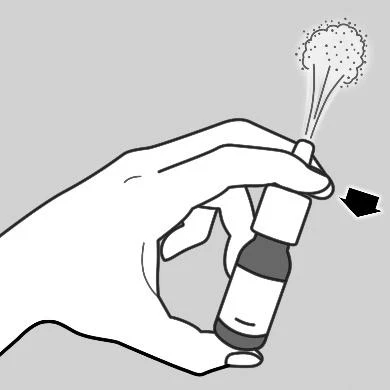
- Prime the pump by placing two fingers on either side of the pump and your thumb at the bottom of the bottle.
- Press and release the pump 6 times until a fine mist is produced (see figure a).
a
- The pump is now primed and ready for use.
- If the nasal spray has not been used for more than 7 days, re-prime the pump by pressing and releasing it once.
Using the spray
- Gently shake the bottle up and down for 5 seconds, then remove the protective cap.
- Blow your nose to clear the nasal passages.
- Keep your head tilted forward, looking toward your toes. Do not tilt your head backward.
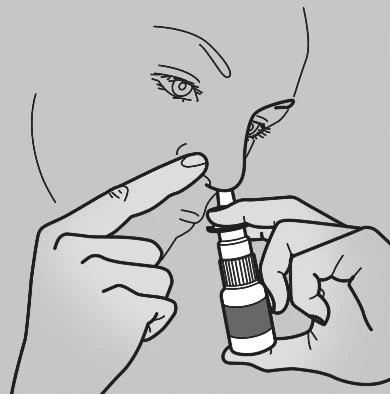
- Hold the bottle upright and gently insert the nozzle into one nostril.
- Close the other nostril with your finger, press the pump quickly once, and at the same time inhale gently (see figure b).
b
- Breathe out through your mouth.
- Repeat the same procedure for the other nostril.
- After administering the medicine, take gentle breaths and do not tilt your head backward. This helps prevent the medicine from draining into the throat and causing an unpleasant taste.
- After each use, wipe the nozzle with a clean tissue or cloth and replace the protective cap.
- If the nozzle becomes blocked, do not pierce it or use a sharp object to unblock it. Clean the nozzle with water.
It is important to use the dose prescribed by your doctor. Use only the dosage recommended by your doctor.
Duration of treatment
Motesin may be used long-term. The duration of treatment should correspond to the period during which allergy symptoms occur.
Use of more than the recommended dose of Motesin
The risk of complications following an overdose of the nasal spray is low. However, consult your doctor if you experience any concerns or if a higher-than-recommended dose has been used for an extended period. If anyone, especially a child, accidentally swallows Motesin, contact a doctor immediately or go to the nearest hospital emergency department.
Missed dose of Motesin
Use the nasal spray as soon as you remember, then continue with your next dose at the usual time. Do not use a double dose to make up for a missed dose.
Stopping Motesin
Do not stop using Motesin without consulting your doctor, due to the risk of ineffective treatment.
If you have any further questions about the use of this medicine, consult your doctor or pharmacist.
4. Possible side effects
Like all medicines, this medicine can cause side effects, although not everybody will experience them.
Very common side effects (may affect more than 1 in 10 people):
- Nosebleeds
Common side effects (may affect up to 1 in 10 people):
- Headache
- Bitter taste in the mouth, especially if the patient tilts their head backwards when using the nasal spray. This taste should disappear if the patient drinks a non-alcoholic beverage a few minutes after using the medicine
- Unpleasant smell
Uncommon side effects (may affect up to 1 in 100 people):
- Mild irritation inside the nose. This may cause a mild stinging sensation, itching or sneezing
- Dryness in the nose, cough, dry throat or sore throat
Rare side effects (may affect up to 1 in 1,000 people):
- Dryness in the mouth
Very rare side effects (may affect up to 1 in 10,000 people):
- Dizziness or drowsiness
- Cataract, glaucoma or increased eye pressure, which may lead to loss of vision and (or) redness and eye pain. These side effects have been reported after long-term use of nasal spray containing fluticasone propionate.
- Skin and nasal mucosa damage
- Malaise, feeling of fatigue, exhaustion or weakness
- Rash, itching or redness of the skin, itchy blisters on the skin
- Bronchospasm (narrowing of the lower airways)
Seek immediate medical help if any of the following symptoms occur:
- Swelling of the face, lips, tongue or throat, which may cause difficulty in swallowing and (or) breathing, and sudden appearance of a skin rash. These may be symptoms of a severe allergic reaction. Note: these symptoms are very rare.
Side effects with unknown frequency (frequency cannot be estimated from available data):
- Blurred vision
- Nasal mucosal ulceration
When the medicine is used in high doses over a long period, systemic side effects (side effects affecting the whole body) may occur. The likelihood of such effects is significantly lower with corticosteroids administered as a nasal spray than with oral corticosteroid treatment. These effects may vary between individual patients and depending on the corticosteroid used (see section 2). Nasal corticosteroids may affect normal hormone production processes in the body, especially when used long-term at high doses. In children and adolescents, these side effects may cause slowed growth rate. In rare cases, reduced bone density (osteoporosis) has been observed with long-term use of intranasally administered corticosteroids.
Reporting of side effects
If any side effects occur, including any not listed in this leaflet, tell your doctor or pharmacist. Side effects can be reported directly to the Department of Monitoring Adverse Drug Reactions, Office for Registration of Medicinal Products, Medical Devices and Biocidal Products, Al. Jerozolimskie 181C, 02-222 Warsaw, tel.: +48 22 49 21 301, fax: +48 22 49 21 309, website: https://smz.ezdrowie.gov.pl
Side effects can also be reported to the marketing authorization holder.
Reporting side effects helps provide more information on the safety of this medicine.
5. How to store Motesin
Keep this medicine out of sight and reach of children.
Do not use this medicine after the expiry date stated on the bottle and outer packaging following: Expiry (EXP). The expiry date refers to the last day of the stated month.
Do not store in the refrigerator or freeze.
Shelf life after first opening: Unused medicine should be discarded 6 months after the first opening of the nasal aerosol.
Medicines must not be disposed of via the sewage system or in household waste. Ask your pharmacist how to dispose of medicines no longer required. Such measures help protect the environment.
6. Contents of the pack and other information
What Motesin contains
- The active substances are: azelastine hydrochloride and fluticasone propionate. Each gram of suspension contains 1000 micrograms of azelastine hydrochloride and 365 micrograms of fluticasone propionate.
Each actuation of the pump (0.14 g) delivers 137 micrograms of azelastine hydrochloride (= 125 micrograms of azelastine) and 50 micrograms of fluticasone propionate.
- Other ingredients include: disodium edetate, glycerol, microcrystalline cellulose, sodium croscarmellose, polysorbate 80, benzalkonium chloride, phenylethyl alcohol, and purified water.
What Motesin looks like and contents of the pack
Motesin is a white or almost white, homogeneous suspension.
Motesin is available in a 25 mL amber glass bottle with a spray pump, applicator, and protective cap, packed in a cardboard box.
The 25 mL bottle contains 23 g of nasal aerosol in the form of a suspension (providing at least 120 doses).
Motesin is available in:
packs containing 1 bottle with 23 g of nasal aerosol, suspension.
Marketing Authorisation Holder
SUBSTIPHARM
24 rue Erlanger
75016 Paris
France
Manufacturer
FARMEA
10, rue Bouché Thomas
ZAC d’Orgemont
49007 Angers
France
FARMACLAIR
440 Avenue Du Général De Gaulle
14200 Hérouville-Saint-Clair
France
This medicinal product is authorised in the European Economic Area member states under the following names:
Poland: Motesin
Sweden: Motesin