Montelukast sandoz
Poland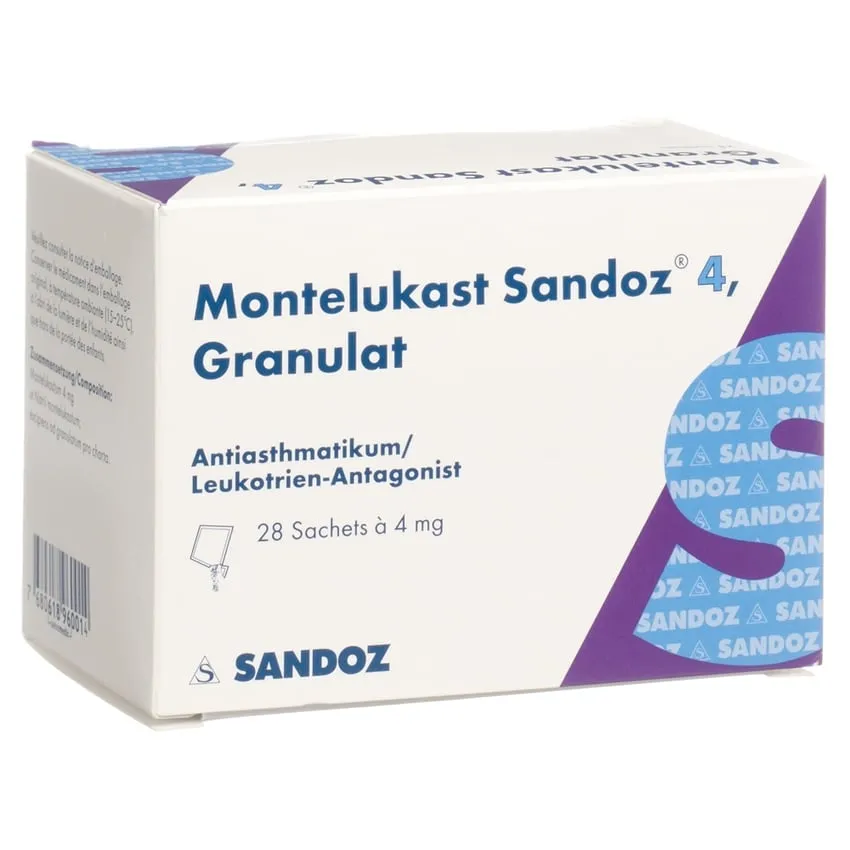
Table of Contents
- Package leaflet: Information for the patient
- 1. What Montelukast Sandoz is and what it is used for
- 2. Important information before using Montelukast Sandoz
- 3. How to use Montelukast Sandoz
- 4. Possible adverse reactions
- 5. How to store Montelukast Sandoz
- 6. Contents of the package and other information
Package leaflet: Information for the patient
Montelukast Sandoz, 4 mg, granules
Montelukastum
Please read this leaflet carefully before taking the medicine, as it contains important information for the patient.
- Keep this leaflet for future reference.
- If you have any further questions, please consult your doctor or pharmacist.
- This medicine has been prescribed for a specific child only. Do not give it to others. The medicine may harm other people, even if their symptoms are the same as the child's.
- If the child experiences any adverse reactions, including any not listed in this leaflet, inform your doctor or pharmacist (see section 4).
Leaflet contents:
- What Montelukast Sandoz is and what it is used for
- Important information before taking Montelukast Sandoz
- How to take Montelukast Sandoz
- Possible side effects
- How to store Montelukast Sandoz
- Contents of the pack and other information
1. What Montelukast Sandoz is and what it is used for
What Montelukast Sandoz is
Montelukast Sandoz is a leukotriene receptor antagonist that inhibits the activity of substances called leukotrienes.
How Montelukast Sandoz works
Leukotrienes cause narrowing and swelling of the airways. By blocking the action of leukotrienes, Montelukast Sandoz relieves asthma symptoms and helps control the disease.
When Montelukast Sandoz should be used
Your doctor has prescribed Montelukast Sandoz for the treatment of asthma in the child and to prevent its symptoms during the day and night.
Montelukast Sandoz is used for the treatment of patients aged 6 months to 5 years who have not achieved adequate asthma control with previously used medications and require additional therapy.
Montelukast Sandoz may also be used as an alternative to inhaled corticosteroids in children aged 2 to 5 years who have not recently received oral corticosteroids and who are unable to use inhaled corticosteroids.
Montelukast Sandoz also helps prevent exercise-induced narrowing of the airways in patients aged 2 years and older.
Your doctor will determine how to use Montelukast Sandoz based on the child's symptoms and the severity of asthma.
What is asthma?
Bronchial asthma is a chronic disease.
Asthma causes:
- Difficulty breathing due to narrowing of the airways. This narrowing may worsen or improve in response to various triggers.
- Increased sensitivity of the airways, causing them to react to various factors such as cigarette smoke, pollen, cold air, or physical exertion.
- Swelling (inflammation) of the mucosal lining of the airways.
Symptoms of asthma include coughing, wheezing, and chest tightness.
2. Important information before using Montelukast Sandoz
You should inform the doctor about any current or past health problems or allergies in the child.
When not to use Montelukast Sandoz
if the child is allergic to montelukast or to any of the other ingredients of this medicine (listed in section 6).
Warnings and precautions
Before starting to use Montelukast Sandoz, you should discuss this with the doctor or pharmacist.
If the child's asthma symptoms worsen or if breathing difficulties occur, you should inform the doctor immediately.
Montelukast Sandoz taken orally is not intended for the treatment of acute asthma attacks. In case of an asthma attack, follow the doctor's instructions precisely. Always keep an inhaler medicine for use during asthma attacks at hand.
It is important that the child takes all anti-asthma medicines recommended by the doctor. Montelukast Sandoz should not be used instead of other anti-asthma medicines prescribed for the child by the doctor.
You should remember to consult the doctor if the child taking anti-asthma medicines experiences the following symptoms: flu-like symptoms, tingling or numbness in the hands or feet, worsening of respiratory symptoms and (or) rash.
The child should not be given acetylsalicylic acid or anti-inflammatory medicines (so-called non-steroidal anti-inflammatory drugs – NSAIDs) if they worsen the child's symptoms of bronchial asthma.
Various neuropsychiatric events (for example, changes in behaviour and mood, depression and suicidal tendencies) have been reported in patients of all ages treated with montelukast (see section 4). If such symptoms occur in the patient during treatment with montelukast, consult a doctor.
Children and adolescents
This medicine must not be given to children under 6 months of age.
For children and adolescents under 18 years of age, this medicine is available in other pharmaceutical forms appropriate for specific age groups.
Montelukast Sandoz and other medicines
Some medicines may affect the way Montelukast Sandoz works, or Montelukast Sandoz may change the effect of other medicines taken by the child.
You should tell the doctor or pharmacist about all medicines currently or recently given to the child, as well as about any medicines planned for administration, including those available without a prescription.
Before starting Montelukast Sandoz, inform the doctor if the child is taking any of the following medicines:
phenobarbital (a medicine used in the treatment of epilepsy),
phenytoin (a medicine used in the treatment of epilepsy),
rifampicin (a medicine used in the treatment of tuberculosis and certain other infections),
gemfibrozil (a medicine used to lower high blood lipid levels).
Montelukast Sandoz with food and drink
This medicine can be taken regardless of meals.
Pregnancy and breastfeeding
This section does not apply to Montelukast Sandoz, as the medicine is intended for children aged 6 months to 5 years. However, the following information refers to the active substance of the medicine, montelukast.
Use during pregnancy
Women who are pregnant or planning to become pregnant should consult a doctor before using Montelukast Sandoz. The doctor will assess whether they can take it during this period.
Use during breastfeeding
It is not known whether Montelukast Sandoz passes into breast milk. Therefore, women who are breastfeeding or planning to breastfeed should consult a doctor before using it.
Driving and using machines
This section does not apply to Montelukast Sandoz, as the medicine is intended for children aged 6 months to 5 years. However, the following information refers to the active substance of the medicine, montelukast.
Montelukast should not affect the ability to drive a car or operate machinery. However, the effect of the medicine may vary between individual patients. Some adverse reactions (such as dizziness and drowsiness), which have been very rarely reported during treatment with Montelukast Sandoz, may affect the ability to drive or operate machinery in some patients.
Montelukast Sandoz contains sodium
This medicine contains less than 1 mmol (23 mg) of sodium per sachet, meaning the medicine is considered "sodium-free".
3. How to use Montelukast Sandoz
This medicine should be given to a child under the supervision of an adult.
The child should take Montelukast Sandoz every evening.
The medicine should be given even when the child has no symptoms and on days when an asthma attack has occurred.
This medicine should always be used for the child exactly as directed by the doctor or pharmacist. If in doubt, contact the doctor or pharmacist.
The usual dose is:
Children from 6 months to 5 years of age
One sachet of Montelukast Sandoz 4 mg granules once daily, taken orally in the evening.
If the child is taking Montelukast Sandoz, ensure that they are not also receiving other medicines containing the same active substance, montelukast.
For children aged 2 to 5 years, Montelukast Sandoz is available as 4 mg chewable tablets and as granules. The use of 4 mg Montelukast Sandoz granules is not recommended in children under 6 months of age.
How to give Montelukast Sandoz to the child?
This medicine is for oral use.
Open the sachet immediately before administration.
Montelukast Sandoz can be given:
- directly into the child's mouth OR
- mixed with a spoonful of cold or room temperature soft food (e.g. apple puree, ice cream, carrot and rice). If Montelukast Sandoz granules are mixed with a spoonful of soft food (cold or room temperature), ensure that the entire dose of the medicine is mixed with the food. Also ensure that the child receives the full spoonful of granules (or the mixture of granules and food) immediately (within 15 minutes). WARNING: The mixture of granules and food must never be stored for later use. Montelukast Sandoz is not intended to be dissolved in liquid. However, a drink may be given to the child after administration of Montelukast Sandoz to help swallowing. Montelukast Sandoz may be taken with or without food.
If the child takes more Montelukast Sandoz than prescribed
Contact the child's doctor immediately.
In most cases of overdose, no adverse effects have been observed. The most commonly reported symptoms of overdose in adults and children include: abdominal pain, drowsiness, excessive thirst, headache, vomiting, and increased motor activity.
If a dose of Montelukast Sandoz is missed
Try to give the child Montelukast Sandoz as directed by the doctor. However, if a dose is missed, return to the regular dosing schedule – one sachet once daily.
Do not give a double dose to make up for a missed dose.
Stopping Montelukast Sandoz
Montelukast Sandoz is effective in treating asthma in children only when taken regularly. It is important that the child continues taking Montelukast Sandoz for as long as the doctor has instructed. This will help control the child's asthma symptoms.
If you have any further questions about the use of this medicine, consult your doctor or pharmacist.
4. Possible adverse reactions
Like all medicines, this medicine can cause adverse reactions, although not everybody will experience them.
If any of the following serious adverse reactions occur, consult a doctor immediately,
as urgent medical attention may be required.
Uncommon adverse reactions (may occur in less than 1 in 100 people):
allergic reactions, including swelling of the face, lips, tongue and (or) throat, which may cause
difficulty in breathing or swallowing.
changes in behaviour and mood: agitation, including aggressive behaviour or hostility, depression
seizures
Rare adverse reactions (may occur in less than 1 in 1,000 people):
increased tendency to bleed
tremor
palpitations
Very rare adverse reactions (may occur in less than 1 in 10,000 people):
reduced platelet count (thrombocytopenia)
changes in behaviour and mood: hallucinations, disorientation, suicidal thoughts and behaviour. Warning
signs include, for example, talking about suicide, withdrawal and desire to be left alone, or feelings of being trapped or helpless
yellowing of the skin and eyes, unusual tiredness or fever, darkening of the urine
due to inflammation of the liver
swelling (inflammation) of the lungs
a group of symptoms such as flu-like symptoms, tingling or numbness in the hands and feet, worsening of respiratory symptoms and (or) rash (Churg-Strauss syndrome). If a child develops one or more of these symptoms, inform the doctor immediately.
severe skin reactions (erythema multiforme), which may occur without warning.
The most commonly reported adverse reactions (may occur in less than 1 in 10 people)
associated with the use of montelukast and reported in clinical trials using the 4 mg oral granules, 4 mg or 5 mg chewable tablets, or 10 mg film-coated tablets were:
headache
abdominal pain
increased thirst
diarrhoea
excessive activity
asthma
skin peeling and itching
rash
These reactions were generally mild and occurred more frequently in patients treated with montelukast
than in those receiving placebo (a medicine containing no active ingredient).
In addition, the following adverse reactions have been reported since the medicine was placed on the market:
Very common adverse reactions (may occur in more than 1 in 10 people):
upper respiratory tract infection
Common adverse reactions (may occur in less than 1 in 10 people):
diarrhoea, nausea, vomiting
increased liver enzyme activity
rash
fever
Uncommon adverse reactions (may occur in less than 1 in 100 people):
changes in behaviour and mood (abnormal dreams, including nightmares, sleep disorders, sleepwalking, irritability, restlessness, psychomotor hyperactivity)
dizziness, drowsiness, tingling and (or) numbness
nosebleeds
dryness in the mouth, dyspepsia
bruising, itching, urticaria
joint or muscle pain, muscle cramps
nocturnal enuresis in children
weakness, feeling of fatigue, malaise, swelling
Rare adverse reactions (may occur in less than 1 in 1,000 people):
changes in behaviour and mood: attention disorders, memory impairment, uncontrolled muscle movements
Very rare adverse reactions (may occur in less than 1 in 10,000 people):
tender, red nodules under the skin, most commonly appearing on the shins (erythema nodosum)
obsessive-compulsive symptoms
stuttering
Reporting of adverse reactions
If any adverse reactions occur, including any adverse reactions not listed in this leaflet, inform a doctor, pharmacist or nurse. Adverse reactions can be reported directly to the Department of Monitoring Adverse Drug Reactions of the Office for Registration of Medicinal Products, Medical Devices and Biocidal Products: Al. Jerozolimskie 181C, 02-222 Warsaw
tel.: + 48 22 49 21 301/fax: + 48 22 49 21 309/website: https://smz.ezdrowie.gov.pl.
Adverse reactions can also be reported to the marketing authorisation holder.
Reporting adverse reactions helps provide more information on the safety of the medicine.
5. How to store Montelukast Sandoz
Keep this medicine out of sight and reach of children.
Do not use this medicine after the expiry date stated on the carton and sachet following "EXP". The expiry date refers to the last day of the stated month.
Do not store above 25 °C.
Store in the original packaging to protect from light and moisture.
Medicines must not be disposed of via wastewater or household waste. Ask your pharmacist how to dispose of medicines no longer required. These measures will help protect the environment.
6. Contents of the package and other information
What Montelukast Sandoz contains
The active substance is montelukast. Each sachet of granules contains montelukast sodium equivalent to 4 mg of montelukast.
Other ingredients are: mannitol, hydroxypropylcellulose and magnesium stearate.
What Montelukast Sandoz looks like and contents of the pack
White or off-white granules.
The granules are packed in PET/Aluminium/PE sachets placed in a cardboard box.
Pack sizes:
28 or 30 sachets.
Marketing Authorisation Holder and Manufacturer
Marketing Authorisation Holder
Sandoz GmbH
Biochemiestrasse 10
6250 Kundl, Austria
Manufacturers/Importers
Salutas Pharma GmbH
Otto-von-Guericke-Allee 1
39179 Barleben, Germany
Lek Pharmaceuticals d.d.
Verovškova 57
1526 Ljubljana, Slovenia
Lek Pharmaceuticals d.d.
Trimlini 2D
9220 Lendava, Slovenia
Lek S.A.
ul. Domaniewska 50 C
02-672 Warszawa, Poland
S.C. Sandoz, S.R.L.
Livezeni Street no 7A
540472 Targu-Mures, Romania
Lek S.A.
ul. Podlipie 16
95-010 Stryków, Poland
For further information about the medicinal product and its trade names in the countries of the European Economic Area, please contact:
Sandoz Polska Sp. z o.o.
ul. Domaniewska 50 C
02-672 Warszawa, Poland
tel. 22 209 70 00