Mobillek
Poland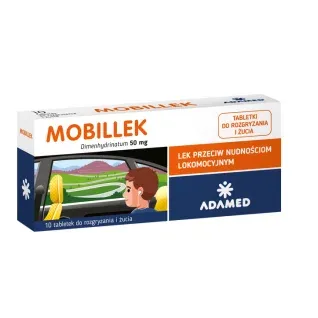
Table of Contents
Patient Information Leaflet
Mobillek, 50 mg, chewable tablets
Dimenhydrinate
Please read all of this leaflet carefully before taking this medicine, because it contains
important information for you.
This medicine should always be taken exactly as described in this patient leaflet or as directed by
your doctor or pharmacist.
- Keep this leaflet so that you can read it again if necessary.
- If you need advice or further information, please consult your pharmacist.
- If you experience any adverse reactions, including any possible side effects not listed in this leaflet, inform your doctor or pharmacist. See section 4.
- If your symptoms do not improve or if you feel worse, you should contact your doctor.
Leaflet Contents
- What Mobillek is and what it is used for
- Important information before taking Mobillek
- How to take Mobillek
- Possible side effects
- How to store Mobillek
- Contents of the pack and other information
1. What Mobillek is and what it is used for
Mobillek contains the active substance dimenhydrinate, which has antiemetic, antiallergic, and mild sedative properties.
The medicine is used to prevent motion sickness and to prevent and treat nausea and vomiting of other causes (except those caused by anticancer chemotherapy drugs and by gastritis). The onset of action occurs within 15–30 minutes.
2. Important information before taking Mobillek
When not to take Mobillek:
- if the patient is allergic to the active substance, antihistamines, or any of the other ingredients of this medicine (listed in section 6);
- if the patient has: acute asthma attack, narrow-angle glaucoma, pheochromocytoma, porphyria, benign prostatic hyperplasia with urinary retention, or epilepsy. Due to its strength (dose), Mobillek is not intended for children under 6 years of age.
Warnings and precautions
Exercise caution when using Mobillek in patients:
- with impaired liver or kidney function;
- with hyperthyroidism;
- with bradycardia (slowed heart rate), hypertension;
- with hypokalemia, magnesium deficiency in blood;
- with chronic breathing difficulties or asthma;
- with pyloric stenosis;
- with congenital long QT syndrome or other cardiac disorders, e.g. coronary artery disease, circulatory disorders, arrhythmia;
- who are concurrently taking drugs that prolong the QT interval on ECG or drugs that may cause hypokalemia;
- in elderly patients who are more susceptible to orthostatic hypotension, dizziness, and sedation.
Mobillek with other medicines
Inform your doctor or pharmacist about all medicines currently taken or recently used,
as well as any medicines the patient intends to take.
Mobillek should not be used concomitantly with antiarrhythmic drugs or agents that depress
the central nervous system, or with alcohol.
This medicine should not be used simultaneously with atropine, tricyclic antidepressants,
catecholamines, or central nervous system depressants such as sedatives or hypnotics, as Mobillek may enhance their effects.
Dimenhydrinate enhances the effects of other anticholinergic drugs such as atropine and tricyclic antidepressants.
Monoamine oxidase inhibitors (MAO inhibitors, antidepressants) may enhance the antihistaminic and sedative effects of dimenhydrinate.
Mobillek, when used with bismuth salts, analgesics, psychotropic drugs, and scopolamine, may cause transient visual disturbances (impaired vision in darkness and color vision).
Mobillek reduces the effectiveness of corticosteroids and oral anticoagulants.
Dimenhydrinate, when used in combination with antihypertensive drugs, may enhance their hypotensive effect.
Particular caution is advised when using dimenhydrinate with drugs that prolong the QT interval on ECG (e.g. certain antiarrhythmics, certain antibiotics such as erythromycin, antimalarials, antihistamines, neuroleptics) and with drugs that reduce serum potassium levels (e.g. certain diuretics).
Concomitant use of Mobillek with ototoxic drugs (drugs that damage hearing), such as aminoglycoside antibiotics, should be avoided.
Treatment with Mobillek should be discontinued at least three days before planned allergy testing, due to the risk of false-negative results.
Mobillek with food and drink
This medicine may be taken regardless of meals.
Pregnancy and breastfeeding
If the patient is pregnant or breastfeeding, suspects she may be pregnant, or is planning to become pregnant, she should consult a doctor or pharmacist before using this medicine.
Mobillek should not be used during the third trimester of pregnancy. In the first and second trimesters of pregnancy, and during breastfeeding, the medicine may be used only if, in the opinion of the physician, the benefits of treatment outweigh the potential risks to the fetus or infant.
Driving and operating machinery
Mobillek impairs psycho-motor performance, including causing drowsiness and reduced alertness. Mobillek should not be used by persons who drive vehicles or operate machinery.
Mobillek contains sodium
This medicine contains less than 1 mmol (23 mg) of sodium per chewable tablet, meaning the medicine is considered "sodium-free".
Mobillek contains maltodextrin, a source of glucose
If the patient has previously been diagnosed with intolerance to certain sugars, the patient should consult a doctor before taking this medicine.
3. How to take Mobillek
This medicine should always be taken exactly as described in the patient information leaflet or as
advised by your doctor or pharmacist. If in doubt, consult your doctor or pharmacist.
The recommended dose should be taken at least 30 minutes before the planned journey or before
taking a poorly tolerated medicine.
Adults and adolescents over 14 years of age: The recommended dose is 50 mg to 100 mg. If
necessary, it may be repeated every 4 to 6 hours. The maximum daily dose should not exceed 400 mg.
Children aged 6 to 14 years: The recommended dose is 50 mg. If necessary, it may be repeated every
6 to 8 hours. The maximum daily dose in children should not exceed 5 mg/kg body weight, with a
maximum of 150 mg per day. Mobillek is intended for children who are able to chew and suck the
tablet independently.
Due to the dose strength, Mobillek 50 mg chewable tablets are not intended for children under 6 years
of age.
Use of a higher than recommended dose of Mobillek
The first symptoms of overdose appear approximately 30 minutes to 2 hours after ingestion of a toxic
dose (25 mg/kg body weight) and consist mainly of headache and dizziness, increasing fatigue and
drowsiness. After some time, additional symptoms may occur: skin itching, dilation of skin blood
vessels, pupil dilation with slowed reaction to light and accommodation paralysis, nystagmus,
muscle weakness, diminished tendon reflexes, and urinary retention.
Heart function is markedly accelerated, and blood pressure may be elevated or reduced. Subsequently,
symptoms of central nervous system (CNS) depression progressively develop (speech disturbances,
disorientation in time and space, ataxia, and coma) or CNS stimulation (seizures, hallucinations).
In case of dimenhydrinate overdose, intensive symptomatic treatment should be administered.
Missed dose of Mobillek
If a dose is missed, it should be taken as soon as possible. Do not take a double dose to make up for
the missed dose.
4. Possible adverse reactions
Like any medicine, this medicine can cause adverse reactions, although not everyone will experience them.
Very common (occurring in 1 or more out of 10 patients) adverse reactions include:
drowsiness, concentration disturbances, dizziness.
Common (occurring in 1 or more out of 100 patients) adverse reactions include:
excitation, sleep disturbances, anxiety, tremor, visual disturbances, increased intraocular pressure,
nausea, vomiting, diarrhoea (in case of hypersensitivity to dimenhydrinate),
constipation, abdominal pain, dryness of the oral mucosa, feeling of weakness and fatigue, difficulty
in urinating, muscle weakness.
Rare (occurring in 1 or more out of 10,000 patients) adverse reactions include:
increased heart rate, drop in blood pressure, haemolytic anaemia, headaches, insomnia,
skin allergic reactions, skin photosensitivity, liver function disorders, cholestatic jaundice.
Very rare (occurring in less than 1 out of 10,000 patients) adverse reactions include:
exfoliative dermatitis and decreased appetite.
Long-term use of dimenhydrinate may lead to drug dependence.
Paradoxical reactions (e.g. anxiety, irritability, tremor) may occur in children during treatment with dimenhydrinate.
Reporting of adverse reactions
If any adverse reactions occur, including any adverse reactions not listed in this leaflet, inform your doctor, pharmacist, or nurse. Adverse reactions can be reported directly to the Department of Monitoring Adverse Drug Reactions of the Office for Registration of Medicinal Products, Medical Devices and Biocidal Products: Al. Jerozolimskie 181C, 02-222 Warsaw, tel.: 22 49-21-301, fax: 22 49-21-309, website: https://smz.ezdrowie.gov.pl
Adverse reactions can also be reported to the responsible entity.
Reporting adverse reactions enables better assessment of the medicine's safety profile.
5. How to store Mobillek
Store below 25°C. Keep in the original packaging to protect from moisture.
Keep the medicine out of sight and reach of children.
Do not use this medicine after the expiry date stated on the carton and blister pack following: EXP.
The expiry date refers to the last day of the stated month.
Medicines should not be disposed of via wastewater or household waste. Ask your pharmacist how to dispose of medicines no longer required. Such measures will help protect the environment.
6. Contents of the pack and other information
What Mobillek contains
- The active substance is dimenhydrinate.
- The other ingredients (excipients) are: microcrystalline cellulose, type 101, heavy magnesium oxide, iron oxide red (E 172), purified water, colloidal anhydrous silica, basic butyl methacrylate copolymer, microcrystalline cellulose, type 102, crospovidone, type A, strawberry flavour [maltodextrin, propylene glycol, strawberry essence, ascorbic acid], bitter taste masking flavour [sucralose, maltodextrin, propylene glycol, gum arabic, maltol (E 636), 4-hydroxy-2,5-dimethyl-3(2H)-furanone, 4-(4-hydroxyphenyl)-2-butanone], sodium stearyl fumarate.
What Mobillek looks like and contents of the pack
Pink, speckled, round, biconvex chewable tablets.
The pack contains 5 or 10 chewable tablets.
Not all pack sizes may be marketed.
Marketing Authorisation Holder and Manufacturer
Adamed Pharma S.A.
Pieńków, ul. M. Adamkiewicza 6A
05-152 Czosnów