Mivacron
Poland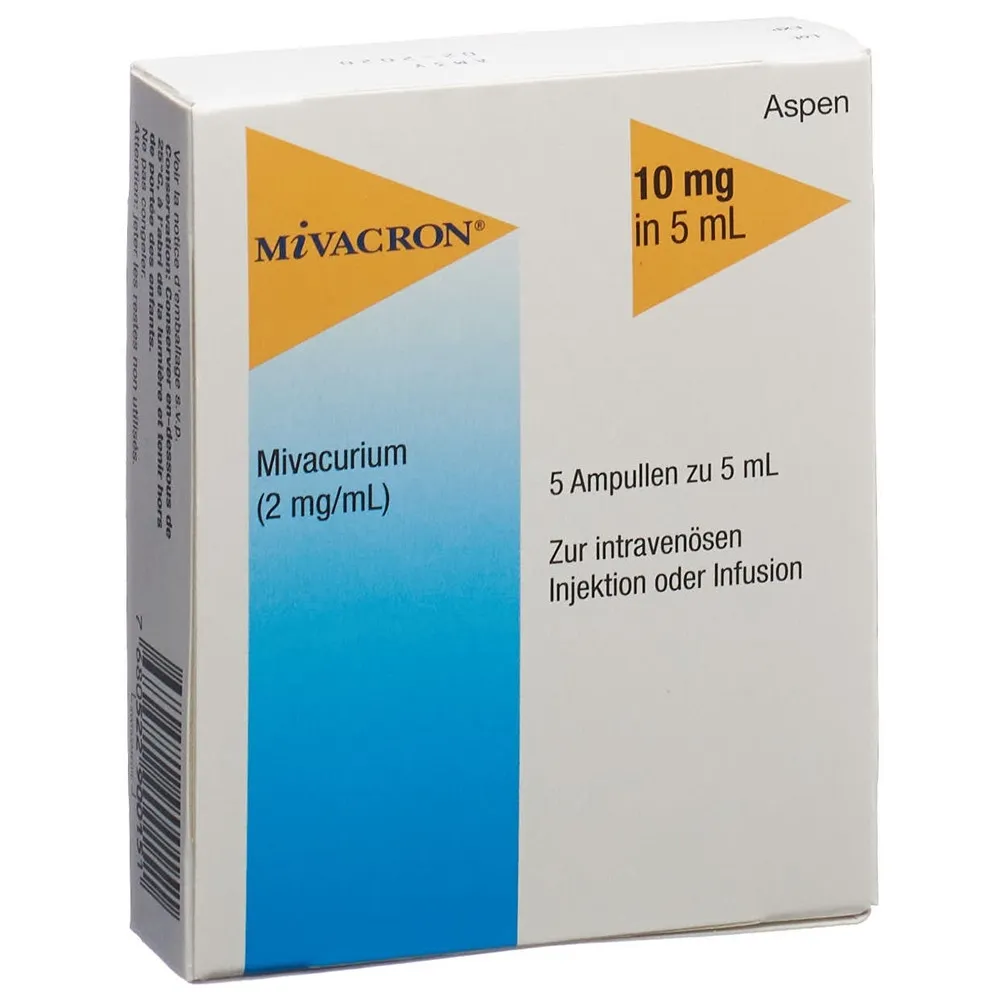
Table of Contents
Mivacron, 2 mg/ml, solution for injection
Mivacurii chloridum
Please read this leaflet carefully before using the medicine, as it contains
important information for the patient.
- Keep this leaflet, so that you can read it again if necessary.
- If you have any further questions, please consult your doctor.
- This medicine has been prescribed for a specific individual. Do not pass it on to others. The medicine may harm someone else, even if their symptoms are the same.
- If any adverse reactions occur in the patient, including any adverse reactions not listed in this leaflet, inform your doctor or nurse. See section 4.
Leaflet contents
- What Mivacron is and what it is used for
- Important information before using Mivacron
- How to use Mivacron
- Possible side effects
- How to store Mivacron
- Contents of the pack and other information
1. What Mivacron is and what it is used for
Mivacron belongs to a group of muscle relaxants. It is a highly specific, short-acting compound that blocks neuromuscular transmission, producing a non-depolarizing (polarizing, competitive) block with rapid offset.
Mivacurium binds to cholinergic receptors at the motor endplate, antagonizing the action of acetylcholine, resulting in competitive blockade of neuromuscular transmission. This effect can be readily reversed by cholinesterase antagonists such as neostigmine or edrophonium.
Mivacron is used as an adjunct to general anesthesia to provide skeletal muscle relaxation, facilitating tracheal intubation and allowing mechanical ventilation in adults, children, and infants aged 2 months and above.
Mivacron 2 mg/ml, solution for injection, does not contain antibacterial preservatives and is intended for single use in an individual patient.
2. Important information before using Mivacron
When not to use Mivacron
- If the patient is allergic (hypersensitive) to mivacurium or any of the other ingredients of Mivacron (listed in section 6);
- If the patient or any family member has been diagnosed with abnormal plasma cholinesterase activity (patients who are homozygous for the atypical gene coding for plasma cholinesterase).
Warnings and precautions
Like all other neuromuscular blocking agents, Mivacron causes paralysis of respiratory muscles and other skeletal muscles without affecting consciousness. Mivacron must be administered only by an experienced anaesthetist or under his strict supervision in conditions allowing tracheal intubation and artificial ventilation.
Before starting treatment with Mivacron, discuss with the doctor:
- If the patient has previously experienced hypersensitivity to histamine (e.g. patients with bronchial asthma);
- If the patient is hypersensitive to other neuromuscular blocking agents. Reports indicate a high incidence of cross-hypersensitivity (greater than 50%) between neuromuscular blocking agents;
- If the patient is at risk of hypotension (e.g. in patients with hypovolemia, i.e. abnormally low blood volume);
- If the patient has muscle weakness, fatigue or movement coordination difficulties (myasthenia);
- If the patient suffers from a debilitating disease;
- If the patient has severe acid-base or electrolyte imbalance;
- If the patient has suffered severe burns requiring medical intervention within the last two to three months.
Some conditions or diseases may reduce plasma cholinesterase activity. The patient should inform the doctor if any of the following conditions or diseases are present:
- Pregnancy and puerperium;
- Genetically determined abnormalities in plasma cholinesterase activity;
- Severe generalized tetanus, tuberculosis or other severe or chronic infections;
- Chronic debilitating disease, malignant tumour, chronic anaemia and malnutrition;
- Myxoedema (associated with hypothyroidism) and collagenoses (connective tissue disorders);
- Uncompensated heart disease;
- Peptic ulcer;
- Burns;
- End-stage liver failure;
- Acute, chronic or end-stage renal failure;
- Reduced plasma cholinesterase activity due to therapeutic procedures: after plasma exchange transfusion, plasmapheresis (a method of blood purification removing large particles, e.g. antigen-antibody complexes), use of extracorporeal circulation, and occurring as a result of concomitant therapy with other drugs (see section 'Mivacron with other medicines').
Reversal of neuromuscular blockade induced by Mivacron
As with other neuromuscular blocking agents, before administering acetylcholinesterase inhibitors (e.g. neostigmine), the doctor should confirm signs of spontaneous recovery of neuromuscular transmission. The use of a peripheral nerve stimulator to assess recovery of neuromuscular transmission before and during administration of acetylcholinesterase inhibitors is highly recommended. Standard doses of neostigmine given at the onset of spontaneous recovery usually result in complete reversal of the block.
Mivacron with other medicines
Inform the doctor about all medicines currently taken or recently taken, as well as any medicines the patient intends to take.
Concomitant use of inhaled anaesthetic agents, e.g. enflurane, isoflurane, sevoflurane or halothane, may enhance the neuromuscular blockade induced by mivacurium.
Mivacron can be safely used in patients previously given suxamethonium to facilitate tracheal intubation. Administration of Mivacron should begin only after signs of spontaneous recovery from suxamethonium-induced blockade appear.
As with other competitive neuromuscular blocking agents, the intensity and/or duration of depolarizing (non-depolarizing, competitive) neuromuscular blockade may be increased, and the required infusion rate decreased, due to interactions with certain drugs. These include:
- Antibiotics: aminoglycosides, polymyxins, spectinomycin, tetracyclines, lincomycin and clindamycin;
- Medicines used in the treatment of arrhythmias (heart rhythm disorders): propranolol, calcium channel blockers, lidocaine, procainamide and quinidine;
- Diuretics: furosemide and possibly thiazide diuretics, mannitol and acetazolamide;
- Magnesium salts (medicines used, among others, for indigestion and heartburn);
- Ketamine (anaesthetic agent);
- Lithium salts (medicines used in the treatment of psychiatric disorders);
- Ganglion-blocking agents such as trimethaphan and hexamethonium.
Drugs and substances that may reduce plasma cholinesterase activity may also prolong the neuromuscular blocking effect of Mivacron. These include:
- Antimitotic drugs (used in cancer treatment);
- Monoamine oxidase inhibitors (used, among others, in the treatment of depression);
- Etoiodate (a drug used in the treatment of glaucoma);
- Pancuronium (a muscle relaxant);
- Cholinesterase inhibitors (used in the treatment of myasthenia, Alzheimer's disease, glaucoma, and as antidotes in anticholinergic poisoning, e.g. atropine);
- Some hormones;
- Bambuterol (used in the treatment of asthma);
- Selective serotonin reuptake inhibitors (used, among others, in the treatment of severe depressive episodes, obsessive-compulsive disorders, panic anxiety disorders, social phobia and generalized anxiety disorders);
- Organophosphorus compounds (insecticides).
Rarely, some drugs may exacerbate or unmask latent myasthenia or even induce a myasthenic syndrome, resulting in increased sensitivity to the effects of Mivacron. Such drugs include:
- Various types of antibiotics;
- Beta-blockers, e.g. propranolol, oxprenolol (used in the treatment of hypertension);
- Antiarrhythmic drugs (procainamide, quinidine);
- Antirheumatic drugs (chloroquine, D-penicillamine);
- Trimethaphan (a ganglion-blocking agent);
- Chlorpromazine, lithium salts (used in psychiatric disorders);
- Steroids;
- Phenytoin (anticonvulsant).
Administration of drugs causing non-depolarizing neuromuscular blockade in combination with Mivacron may result in a greater degree of neuromuscular blockade than expected from administering an equivalent total dose of Mivacron alone. The synergistic (mutually enhancing) effect may vary depending on the combination of drugs used.
Depolarizing neuromuscular blocking agents such as suxamethonium should not be used to prolong relaxation induced by non-depolarizing agents, as this may lead to an excessively prolonged and complex blockade, which may be difficult to reverse with cholinomimetics.
Mivacron solution is acidic (pH about 4.5) and should not be mixed in the same syringe or administered through the same needle as strongly alkaline solutions, e.g. barbiturate solutions (see: Instructions for use).
Pregnancy and breastfeeding
If the patient is pregnant or breastfeeding, suspects she may be pregnant, or is planning to have a child, she should consult the doctor before using this medicine.
Animal studies have shown that mivacurium has no adverse effect on fetal development.
Mivacron may be used during pregnancy only if, in the opinion of the doctor, the benefit to the mother outweighs the potential risk to the fetus.
It is not known whether mivacurium passes into human milk.
Driving and operating machinery
Not applicable to the use of Mivacron. Mivacron is always administered together with drugs inducing general anaesthesia. The usual precautions regarding the effects of general anaesthesia on the patient's psycho-physical performance apply.
3. How to use Mivacron
Mivacron must be administered only by an experienced anaesthesiologist or under his/her strict supervision in settings allowing tracheal intubation and artificial ventilation to be performed.
Mivacron can be given as an intravenous injection or intravenous infusion. The method of administration and dosage will be determined by the physician.
4. Possible adverse reactions
Like all medicines, this medicine can cause adverse reactions, although not everyone will experience them.
Adverse reactions have been grouped according to their frequency of occurrence.
Very common adverse reactions ( may occur in more than 1 in 10 patients
receiving Mivacron ):
- skin flushing*
Uncommon adverse reactions ( may occur in 1 to 10 in 100 patients
receiving Mivacron ):
- transient tachycardia (abnormal rapid heartbeat)*
- hypotension*
- bronchospasm*
- erythema*, urticaria*
Very rare adverse reactions ( may occur in less than 1 in
10,000 patients receiving Mivacron ):
- severe anaphylactic reactions (immediate allergic reaction) or anaphylactoid reactions (reactions resembling allergic reactions). Severe anaphylactic or anaphylactoid reactions have been reported in patients receiving mivacurium in combination with at least one anesthetic medicine.
*The use of mivacurium has been associated with skin flushing, erythema, urticaria,
hypotension, transient tachycardia, and bronchospasm, which are attributed to histamine release.
These symptoms are dose-dependent, and their frequency increases after rapid bolus injection of an initial dose equal to or greater than 0.2 mg/kg body weight. Symptoms are less pronounced if mivacurium is administered by injection over 30 to 60 seconds or in divided doses administered 30 seconds apart.
The safety profile in children is similar to that in adults.
Reporting of adverse reactions
If any adverse reactions occur, including any adverse reactions not listed in this leaflet, inform your doctor, pharmacist, or nurse.
Adverse reactions can be reported directly to the Department of Monitoring Adverse Drug Reactions of the Office for Registration of Medicinal Products, Medical Devices and Biocidal Products, Al. Jerozolimskie 181C, 02-222 Warsaw,
tel.: + 48 22 49-21-301, fax: + 48 22 49-21-309, e-mail: [email protected]
Adverse reactions can also be reported to the marketing authorization holder or its representative.
Reporting adverse reactions enables further collection of information on the safety of the medicine.
5. How to store Mivacron
Do not store above 25°C. Protect from light. Do not freeze.
Keep Mivacron out of the sight and reach of children.
Do not use Mivacron after the expiry date stated on the container.
The expiry date 'EXP' refers to the last day of the stated month.
The abbreviation 'Lot' means batch number.
6. Contents of the packaging and other information
What Mivacron contains
The active substance is mivacurium (1 ml of solution contains 2 mg of mivacurium in the form of mivacurium chloride).
Other components: hydrochloric acid 0.1 M and water for injections.
What Mivacron looks like and contents of the pack
A clear, sterile aqueous solution, pale yellow in colour.
The pack contains:
5 ampoules each containing 5 ml of solution or
5 ampoules each containing 10 ml of solution.
Ampoules made of colourless glass in a cardboard box.
One 5 ml ampoule contains 10 mg of mivacurium (as mivacurium chloride).
One 10 ml ampoule contains 20 mg of mivacurium (as mivacurium chloride).
Mivacron does not contain antibacterial preservatives.
Marketing Authorisation Holder:
Aspen Pharma Trading Limited
3016 Lake Drive
Citywest Business Campus
Dublin 24, Ireland
Tel: 0048 221253376
Manufacturer:
Aspen Pharma Ireland Limited
One George’s Quay Plaza
Dublin 2, Ireland
GlaxoSmithKline Manufacturing S.p.A.
Strada Provinciale Asolana, 90
43056 San Polo di Torrile
Parma, Italy
Importer:
Aspen Bad Oldesloe GmbH
32-36 Industriestrasse
23843 Bad Oldesloe
Germany
Information intended exclusively for healthcare professionals
Dosage
Dosage in adults – intravenous injection
Mivacron is administered by intravenous injection. The average dose required to achieve 95% inhibition of the twitch response of the adductor pollicis muscle to ulnar nerve stimulation (ED95) is 0.07 mg/kg body weight (range 0.06–0.09 mg/kg) in adults anesthetized with narcotic analgesics.
To achieve conditions suitable for tracheal intubation, the following dosage regimens are recommended:
- A dose of 0.2 mg/kg body weight, administered over 30 seconds, provides good to excellent conditions for tracheal intubation within 2.0–2.5 minutes.
- A dose of 0.25 mg/kg body weight, administered in two divided doses (0.15 mg/kg followed by 0.1 mg/kg after 30 seconds), provides good to excellent conditions for tracheal intubation within 1.5–2.0 minutes after completion of the first injection.
With Mivacron, during the initial phase of action, no significant decrease in muscle twitch response measured by train-of-four stimulation is observed. Tracheal intubation may often be performed before complete suppression of the adductor pollicis twitch response to train-of-four stimulation.
In healthy adults, the recommended dose for rapid intravenous injection ranges from 0.07 to 0.25 mg/kg body weight. The duration of neuromuscular blockade depends on the dose administered. Doses of 0.07, 0.15, 0.20, and 0.25 mg/kg produce clinically effective blockade lasting approximately 13, 16, 20, and 23 minutes, respectively. Doses up to 0.15 mg/kg may be administered over 5 to 15 seconds. Higher doses should be given over 30 seconds to minimize the risk of cardiovascular adverse effects.
Sustained blockade may be maintained by administering supplemental doses of Mivacron. Each supplemental dose of 0.1 mg/kg, administered during narcotic analgesic anesthesia, prolongs clinically effective blockade by approximately 15 minutes. Repeated supplemental doses do not result in cumulative neuromuscular blocking effects.
The neuromuscular blocking effect of Mivacron is potentiated when isoflurane or enflurane are used for anesthesia. During stabilized anesthesia with isoflurane or enflurane, the initial dose of Mivacron should be reduced by up to 25%. Halothane appears to potentiate mivacurium only slightly, and dose reduction of Mivacron is probably not necessary.
From the onset of spontaneous recovery of neuromuscular transmission to its complete resolution, approximately 15 minutes elapse, regardless of the dose administered.
Neuromuscular blockade induced by Mivacron can be reversed by administering standard doses of cholinesterase inhibitors. However, since spontaneous recovery after mivacurium is rapid, routine reversal may not be necessary, as it shortens the time to recovery by only 5–6 minutes.
Dosage in adults – continuous infusion
To maintain neuromuscular blockade, Mivacron can be administered by continuous infusion. When early signs of spontaneous recovery appear after an initial dose of Mivacron, an infusion rate of 8 to 10 µg/kg body weight/minute (0.5 to 0.6 mg/kg body weight/hour) is recommended.
The initial infusion rate should be based on the patient's response to peripheral nerve stimulation and clinical criteria. The infusion rate should be adjusted gradually by increments or decrements of approximately 1 µg/kg body weight/minute (0.06 mg/kg body weight/hour). Generally, a given infusion rate should be maintained for at least 3 minutes before adjustment.
In adults anesthetized with narcotic analgesics, an average infusion rate of 6 to 7 µg/kg body weight/minute maintains 89 to 99% neuromuscular blockade for prolonged periods. During stabilized anesthesia with isoflurane or enflurane, the infusion rate of Mivacron should be reduced by up to 40%. Clinical studies have shown that when sevoflurane is used concomitantly, the infusion rate of mivacurium may be reduced by 50%. With halothane, a smaller reduction in infusion rate may be required.
Spontaneous recovery from neuromuscular blockade after continuous infusion of Mivacron is independent of the duration of infusion and is comparable to recovery after single doses.
Continuous infusion of Mivacron has not been associated with tachyphylaxis or cumulative neuromuscular blocking effects.
Mivacron (2 mg/ml) for infusion does not require dilution. Mivacron may be diluted with the following infusion fluids:
- 0.9% sodium chloride infusion solution;
- 5% glucose infusion solution;
- 0.18% sodium chloride with 4% glucose infusion solution;
- Lactated Ringer's solution (USP).
Mivacron has been shown to maintain physical and chemical stability for at least 48 hours at 30°C when diluted 1:3 (i.e., to a concentration of 0.5 mg/ml) with any of the above fluids. However, since the product does not contain antibacterial preservatives, dilutions should be prepared immediately before use, infusion should be started promptly, and any unused portion should be discarded.
Dosage in children aged 7 months to 12 years
In children aged 7 months to 12 years, compared to adults, the ED95 dose of Mivacron is higher (approximately 0.1 mg/kg body weight), the onset of action is faster, the duration of clinically effective blockade is shorter, and spontaneous recovery is more rapid.
The recommended dose range for intravenous injection administered over 5 to 15 seconds is 0.1 to 0.2 mg/kg body weight. A dose of 0.2 mg/kg administered during stabilized anesthesia with narcotic analgesics or halothane produces a clinically effective neuromuscular blockade lasting on average 9 minutes.
For tracheal intubation in children aged 7 months to 12 years, a dose of 0.2 mg/kg of Mivacron is recommended. Maximum neuromuscular blockade typically occurs within 2 minutes after administration, allowing intubation at that time.
Maintenance doses are generally required more frequently in infants and children than in adults. Available data indicate that a maintenance dose of 0.1 mg/kg prolongs clinically effective blockade by approximately 6 to 9 minutes during anesthesia with narcotic analgesics or halothane.
Infants and children generally require higher infusion rates than adults. The average infusion rate required to maintain 89 to 99% neuromuscular blockade in children aged 7 to 23 months anesthetized with halothane is approximately 11 µg/kg body weight/minute (about 0.7 mg/kg body weight/hour), with a range of 3 to 26 µg/kg body weight/minute (about 0.2 to 1.6 mg/kg body weight/hour). In children aged 2 to 12 years, the average infusion rate during halothane or narcotic analgesic anesthesia is approximately 13 to 14 µg/kg body weight/minute (about 0.8 mg/kg body weight/hour), with a range of 5 to 31 µg/kg body weight/minute (about 0.3 to 1.9 mg/kg body weight/hour).
Neuromuscular blockade induced by mivacurium is potentiated by concomitant administration of inhaled anesthetics. Clinical studies have shown that in children aged 2–12 years, when sevoflurane is used, the infusion rate of mivacurium may be reduced by 70%.
From the onset of spontaneous recovery to complete resolution, approximately 10 minutes elapse.
Dosage in infants aged 2 to 6 months
In infants aged 2 to 6 months, compared to adults, the ED95 dose of Mivacron is similar (0.07 mg/kg body weight), but the onset of action is faster, the duration of clinically effective blockade is shorter, and spontaneous recovery is more rapid.
The recommended dose range for intravenous injection administered over 5 to 15 seconds is 0.1 to 0.15 mg/kg body weight. A dose of 0.15 mg/kg administered during stabilized halothane anesthesia produces a clinically effective neuromuscular blockade lasting on average 9 minutes.
For tracheal intubation in infants aged 2 to 6 months, a dose of 0.15 mg/kg of Mivacron is recommended. Maximum neuromuscular blockade occurs approximately 1.4 minutes after administration, allowing intubation at that time.
Maintenance doses are generally required more frequently in infants aged 2 to 6 months than in adults. Available data indicate that a maintenance dose of 0.1 mg/kg prolongs clinically effective blockade by approximately 7 minutes during halothane anesthesia.
Infants aged 2 to 6 months generally require higher infusion rates than adults. The average infusion rate required to maintain 89–99% neuromuscular blockade during halothane anesthesia is approximately 11 µg/kg body weight/minute (about 0.7 mg/kg body weight/hour), with a range of 4 to 24 µg/kg body weight/minute (about 0.2 to 1.5 mg/kg body weight/hour).
From the onset of spontaneous recovery to complete resolution, approximately 10 minutes elapse.
Dosage in neonates and infants under 2 months of age
The safety and efficacy of mivacurium chloride in neonates and infants under 2 months of age have not been established. Dosage recommendations cannot be provided.
Dosage in elderly patients
In elderly patients receiving a single dose of Mivacron as a rapid intravenous injection, the time from administration to onset of effect, as well as the duration and rate of recovery from blockade, may be prolonged by 20 to 30% compared to younger patients. Elderly patients may require slower infusion rates, less frequent administration, or reduced maintenance doses when given as rapid intravenous injections.
Dosage in patients with cardiovascular disorders
In patients with clinically significant cardiovascular disease, the initial dose of Mivacron should be administered over at least 60 seconds. When administered this way, Mivacron has caused minimal hemodynamic changes in patients undergoing cardiac surgery.
Dosage in patients with renal impairment
In patients with severe renal impairment, clinically effective blockade induced by a 0.15 mg/kg dose of Mivacron lasts approximately 1.5 times longer than in patients with normal renal function. Therefore, dosage should be adjusted according to individual clinical response.
Prolonged and intensified neuromuscular blockade may also occur in patients with acute or chronic renal failure due to reduced plasma cholinesterase activity.
Dosage in patients with hepatic impairment
In patients with severe hepatic impairment, clinically effective blockade induced by a 0.15 mg/kg dose of Mivacron lasts approximately three times longer than in patients with normal liver function. This prolonged duration is associated with markedly reduced plasma cholinesterase activity observed in these patients. Therefore, dosage should be adjusted according to individual clinical response.
Dosage in patients with reduced plasma cholinesterase activity
Mivacurium is metabolized by plasma cholinesterase. Plasma cholinesterase activity may be reduced in the presence of genetic anomalies (e.g., patients who are heterozygous or homozygous for atypical plasma cholinesterase gene), in various pathological conditions (see: Dosage in patients with hepatic impairment), or after administration of certain drugs. In patients with reduced plasma cholinesterase activity, prolonged duration of neuromuscular blockade after Mivacron administration should be anticipated. A slight reduction in enzyme activity (up to 20% below the lower limit of normal values) does not have a clinically significant effect on blockade duration.
In patients heterozygous for the atypical plasma cholinesterase gene, the duration of clinically effective neuromuscular blockade after a 0.15 mg/kg dose of Mivacron is prolonged by approximately 10 minutes compared to control subjects.
Dosage in overweight patients
In obese patients (body weight exceeding ideal body weight by 30% or more), the initial dose of Mivacron should be calculated based on ideal body weight, not actual body weight.
Patient monitoring
Individualized dosage adjustment during administration of Mivacron is recommended by monitoring neuromuscular transmission, as with all other neuromuscular blocking agents.
Overdose
Symptoms
Excessively prolonged muscle paralysis and its consequences are the main symptoms of overdose with neuromuscular blocking agents. There is also an increased risk of hemodynamic adverse effects, especially hypotension.
Management
Until spontaneous recovery of adequate respiratory function occurs, airway patency must be maintained and positive-pressure ventilation should be applied. Agents providing complete unconsciousness should be administered, as Mivacron does not provide anesthesia. Administration of acetylcholinesterase inhibitors together with atropine or glycopyrrolate, when signs of spontaneous recovery of neuromuscular transmission appear, may accelerate recovery. Appropriate patient positioning and administration of fluids or vasoconstrictor agents as needed may support cardiovascular function.
Method of administration
Mivacron (2 mg/ml) for infusion does not require dilution.
Mivacron may be diluted with the following infusion fluids:
- 0.9% sodium chloride infusion solution;
- 5% glucose infusion solution;
- 0.18% sodium chloride with 4% glucose infusion solution;
- Lactated Ringer's solution (USP).
Mivacron has been shown to maintain physical and chemical stability for at least 48 hours at 30°C when diluted 1:3 (i.e., to a concentration of 0.5 mg/ml) with any of the above fluids. However, since the product does not contain antibacterial preservatives, dilutions should be prepared immediately before use, infusion should be started promptly, and any unused portion should be discarded.
Mivacron solution is acidic (pH approximately 4.5) and should not be mixed in the same syringe or administered through the same needle as strongly alkaline solutions (e.g., barbiturate solutions).
Mivacron has been shown to be compatible with certain acidic solutions commonly used during the perioperative period, such as fentanyl, alfentanil, sufentanil, droperidol, and midazolam.
When Mivacron and other anesthetic drugs are administered through the same indwelling needle or cannula and compatibility has not been established, the line should be flushed with isotonic sodium chloride solution after each drug injection.