Miofree
Poland
Table of Contents
Package leaflet: Information for the patient
Miofree, 100 micrograms/ml, eye drops, solution
Atropini sulfas
Please read all of this leaflet carefully before using this medicine, because it contains
important information for the patient.
- Keep this leaflet so that you can read it again if necessary.
- If you have any questions, please consult your doctor or pharmacist.
- This medicine has been prescribed for a specific individual. Do not give it to others. This medicine may harm others, even if their symptoms are the same as yours.
- If you experience any adverse effects, including any not listed in this leaflet, inform your doctor or pharmacist. See section 4.
Table of contents
- What Miofree is and what it is used for
- Important information before using Miofree
- How to use Miofree
- Possible side effects
- How to store Miofree
- Contents of the pack and other information
1. What Miofree is and what it is used for
Miofree contains atropine sulfate (atropine) as the active substance.
Miofree eye drops are used to inhibit the progression of myopia in children and adolescents aged 6 to 18 years.
In justified cases, the doctor may decide to start treatment at an earlier age.
Miofree does not contain preservatives.
2. Important information before using Miofree
When not to use Miofree:
- if the patient is allergic to atropine sulfate or to other substances with similar action (called anticholinergics), or to any of the other ingredients of this medicine (listed in section 6);
- if the patient has primary glaucoma with a tendency to angle closure;
- if the patient has narrow-angle glaucoma.
Warnings and precautions
Before starting treatment with Miofree, discuss this with your doctor or pharmacist.
- Treatment should be supervised by an ophthalmologist specializing in the care of children and adolescents. During treatment, especially long-term, the ophthalmologist will perform regular eye examinations, including monitoring of the development of the anterior segment of the eye, intraocular pressure, retinal status, and progression of myopia.
- Atropine should be used with caution in children with Down's syndrome, spastic paralysis, or brain damage, as increased sensitivity to atropine has been reported.
- After administration of atropine, eyes should be protected from light; therefore, the drops should be administered in the evening, immediately before sleep.
- Due to the type of active substance, the drops may temporarily impair vision, and the child may experience difficulty with sharp near vision or reading, or may develop photophobia. In such cases, contact your doctor to discuss possible solutions to this problem.
- Exercise caution in patients who have an increased heart rate (tachycardia).
- Miofree is intended for use in children and adolescents aged 6 to 18 years – see section 1 of the leaflet.
- If the patient wears soft contact lenses, they should not administer Miofree while wearing them. After instilling the drops, wait 15 minutes before inserting contact lenses.
- Patients who have previously experienced contact allergy to silver should not use this medicine, as the drops may contain trace amounts of silver originating from the bottle.
Extreme care should be taken during instillation to prevent the medicine from entering the mouth. Hands should be washed after use
(see also section 3, subsection "Method of administration").
Always discuss any problems or difficulties experienced during or after the use of Miofree eye drops with your doctor.
Miofree and other medicines
Inform your doctor or pharmacist about all medicines the patient is currently taking or has recently taken, as well as any medicines the patient plans to use.
- The effect of atropine is enhanced by drugs with anticholinergic action, e.g. amitriptyline (an antidepressant), haloperidol and chlorpromazine (medicines used in psychiatric disorders), hydroxyzine, and clemastine (antiallergic drugs belonging to first-generation antihistamines), as well as certain drugs used in Parkinson's disease.
- When used concomitantly with certain anti-glaucoma drugs (cholinergic anti-glaucoma agents with prolonged action), such as echothiophate, atropine may inhibit the anti-glaucoma and pupil-constricting effects. Concurrent use of atropine may also inhibit the action of these drugs when used in the treatment of strabismus. Although there are currently no studies evaluating the use of low-dose atropine eye drops in children with elevated intraocular pressure, some data suggest that low-dose atropine eye drops may reduce the risk of glaucoma in children with myopia.
- When atropine is used concomitantly with physostigmine, carbachol, or pilocarpine (medicines used, for example, in glaucoma treatment), mutual cancellation of drug effects may occur.
- If significant systemic absorption of atropine administered to the eye occurs (which is unlikely):
- concomitant use of potassium citrate, potassium-containing products, or drugs used in myasthenia may lead to adverse effects and symptoms of toxicity.
- concomitant use of drugs affecting the central nervous system, such as antiemetics, phenothiazine derivatives, or barbiturates, may result in neck and back muscle spasms (opisthotonus), convulsions, coma, and extrapyramidal symptoms.
Pregnancy, breastfeeding, and fertility
If the patient is pregnant or breastfeeding, suspects she may be pregnant, or is planning to have a child, she should consult her doctor or pharmacist before using this medicine.
Miofree is intended for children and adolescents (see section 1 of the leaflet). The information below refers to the active substance – atropine sulfate (atropine).
Atropine may be used during pregnancy only if, in the opinion of the doctor, the benefit to the mother outweighs the potential risk to the fetus.
It is not known whether atropine sulfate passes into human milk.
Use of atropine sulfate in breastfeeding women requires caution.
There is no data available on the effect on fertility in humans.
Driving and operating machinery
Miofree is intended for children and adolescents (see section 1 of the leaflet). The data refer to the active substance – atropine sulfate (atropine).
Clinical studies have shown that the effect of eye drops containing 0.01% atropine on visual acuity was minimal (in 2.3% of patients). Possible adverse effects such as blurred vision may affect the ability to drive and/or operate machinery in some patients. The potential effect of Miofree on the ability to drive and operate machinery should be assessed, especially at the beginning of treatment.
3. How to use Miofree
This medicine should always be used according to the instructions given by the doctor or pharmacist. If in doubt,
consult your doctor or pharmacist.
Treatment should be supervised by an ophthalmologist specialising in the treatment of children and adolescents,
who will determine the duration of treatment based on regular clinical assessment. It is important to use
Miofree exactly as prescribed by the doctor.
Children and adolescents aged 6 to 18 years
Instill 1 drop of the medicine into the conjunctival sac of each eye in the evening, immediately before sleep.
Do not use more drops than prescribed by the doctor or more frequently than recommended.
Using the medicine more often than recommended or in higher doses will not lead to faster improvement
in the patient's condition and may cause or worsen adverse effects.
When instilling, take great care to avoid the medicine entering the mouth.
If other eye drops are used in addition to Miofree, at least a 10-minute interval should be maintained between
instillation of Miofree and application of other eye drops. Eye ointments should be applied last.
Method of administration
Miofree is intended for external use – apply locally to the eye(s).
Follow the instructions below to properly use Miofree.
- Wash your hands thoroughly.
- Remove the protective cap (Figure 1.).
- Hold the bottle with the nozzle pointing downwards (vertically), placing your thumbs on the pump cap and the remaining fingers on the bottom of the bottle (Figure 2.). Before first use, press the pump cap 17 times to ensure consistent drop size.
- Tilt the head backwards and gently pull down the lower eyelid to form a small pouch between the eye and the eyelid.
- Position the tip of the bottle close to the eye without touching it.
- Do not touch the dropper tip to the eye, eyelid, surrounding areas, or any other surface, as this may lead to contamination of the drops.
- Hold the bottle as described above (Figure 2.), vertically above the eye, and gently press the pump cap to instill one drop into the eye, then release the lower eyelid (Figure 3.).
- Press a finger against the inner corner of the affected eye near the nose (Figure 4.). Hold for approximately 2 minutes with the eye closed.
- Instill the medicine into the other eye, if so directed by the doctor.
- Immediately after use, replace the protective cap on the bottle tip.
- If the drop misses the eye, repeat the instillation attempt.
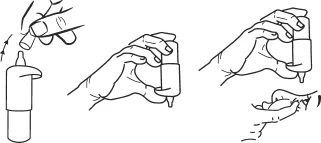
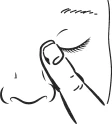
Figure 1. Figure 2. Figure 3. Figure 4.
Wash your hands after using the medicine.
Only one bottle should be used at a time.
The decision to discontinue treatment with the medicine is made by the ophthalmologist, who will provide
instructions on how to gradually withdraw the medicine.
Overdose of Miofree
If an excessive amount of atropine sulfate is absorbed into the systemic circulation, symptoms may include:
balance disorders, behavioural disturbances, dizziness, increased heart rate, arrhythmia (change in the normal
rhythm of heartbeats), fever, hallucinations (visual, auditory), rash, bloating (in infants), intense thirst, dry mouth,
drowsiness, fatigue, weakness, dry skin, urinary retention.
Other possible symptoms include: skin inflammation (eczema), severe generalized reactions manifesting as
low blood pressure and worsening respiratory disturbances.
If any of these symptoms occur or if the medicine has been used inappropriately (e.g. swallowed), contact
a doctor immediately for appropriate treatment.
Missed dose of Miofree
If a dose is missed, administer it as soon as possible. If it is almost time for the next dose, skip the missed
dose and continue with the regular dosing schedule. Do not use a double dose to make up for a missed dose.
4. Possible adverse effects
Like all medicines, this medicine can cause adverse effects, although not everyone will experience them.
If any of the following serious adverse effects occur,
you should immediately contact your doctor or go directly to the emergency department
of the nearest hospital:
- redness and dryness of the skin, rapid and irregular heartbeat, fever, mental disturbances, psychosis, and loss of neuromuscular coordination;
- allergic reactions, including rash, swelling of the face, lips, tongue, and (or) throat, which may cause difficulty breathing or swallowing.
The frequency of these adverse effects is described below.
You should contact your doctor if any of the following adverse effects occur.
Adverse effects associated with the use of 0.01% atropine eye drops
Common (may occur in less than 1 in 10 people):
- allergy, photophobia (light sensitivity), worsening of visual acuity (blurred vision), reduced near vision acuity.
Frequency unknown (frequency cannot be determined from available data):
- contact dermatitis, eczematous dermatitis;
- local irritation, granular conjunctivitis, hyperaemia, eye swelling, exudate.
Adverse effects associated with the use of 1% atropine eye drops (concentration
100 times higher than in Miofree) or higher
Very rare (may occur in less than 1 in 10,000 people):
- confusion, dizziness (particularly in elderly patients), vomiting.
Frequency unknown (frequency cannot be determined from available data):
- hypersensitivity (manifesting as skin rash or conjunctivitis);
- psychiatric disorders, restlessness, excitement, hallucinations, neuromuscular coordination disturbances, severe ataxia (impaired motor coordination);
- transient stinging, swelling and conjunctivitis (may occur after prolonged use of atropine); visual and accommodation disturbances (the eye's ability to adjust for viewing objects at varying distances), increased intraocular pressure (especially in patients with narrow-angle (closed-angle) glaucoma), conjunctivitis, eye itching, eyelid swelling, lacrimation;
- rapid and irregular heartbeat (palpitations), cardiac arrhythmias (e.g. atrial fibrillation), transient slowing of the heart rate (bradycardia) progressing to increased heart rate (tachycardia), hypotension with progressively worsening breathing difficulties, reduced bronchial secretion;
- bloating (in infants), dry mouth (causing difficulty swallowing and speaking), nausea, constipation;
- redness and dryness of the skin, urinary urgency, urinary retention, elevated body temperature.
Adverse events associated with the use of atropine eye drops in concentrations from 0.01% to 1%
Frequency unknown (frequency cannot be determined from available data):
- psychosis, decreased consciousness, headache, exacerbation of seizures, bilateral pigment dispersion syndrome (characterized by pigment granules dispersing into the aqueous humour of the eye), increased heart rate, fatigue.
During treatment, other systemic adverse effects may occur and symptoms listed above under the section "Use of a higher than recommended dose of Miofree" may appear.
Reporting of adverse effects
If any adverse effects occur, including any not listed in this leaflet, you should inform your doctor, pharmacist, or nurse. Adverse effects can be reported directly to the Department of Monitoring Adverse Drug Reactions, Office for Registration of Medicinal Products, Medical Devices and Biocidal Products
Al. Jerozolimskie 181C
02-222 Warsaw
Phone: +48 22 49 21 301
Fax: +48 22 49 21 309
Website: https://smz.ezdrowie.gov.pl
Adverse effects can also be reported to the marketing authorization holder.
Reporting adverse effects helps to provide more information on the safety of the medicine.
5. How to store Miofree
Keep this medicine out of sight and reach of children.
Do not store in the refrigerator or freeze.
After first opening the bottle:
Do not store at temperatures above 30°C.
Do not store in the refrigerator or freeze.
2.5 ml:
Shelf life after first opening of the bottle: 30 days.
7.5 ml:
Shelf life after first opening of the bottle: 90 days.
Do not use this medicine after the expiry date stated on the carton and bottle.
The expiry date refers to the last day of the stated month.
The label on the packaging shows EXP for the expiry date and Lot for the batch number.
Medicines should not be disposed of via wastewater or household waste. Ask your pharmacist how to dispose of medicines no longer required. Such measures help protect the environment.
6. Contents of the package and other information
What Miofree contains
- The active substance is atropine sulfate. Each ml of solution contains 100 micrograms of atropine sulfate. Each 2.5 ml bottle contains no fewer than 60 drops. Each 7.5 ml bottle contains no fewer than 180 drops.
- The other ingredients are: sodium chloride, disodium edetate, sodium hydroxide (for pH adjustment), diluted hydrochloric acid (for pH adjustment), purified water.
What Miofree looks like and contents of the pack
Miofree is a sterile eye drop solution, a clear, colourless liquid.
The container is a semi-transparent HDPE bottle with a multi-dose dropper pump (PP, HDPE, LDPE), a closure cap made of HDPE, and a dosing aid (PP).
The carton contains one bottle with either 2.5 ml or 7.5 ml of solution.
Not all pack sizes may be marketed.
Marketing Authorisation Holder
Zakłady Farmaceutyczne POLPHARMA S.A.
ul. Pelplińska 19, 83-200 Starogard Gdański
tel. +48 22 364 61 01
Manufacturer
Jadran - Galenski Laboratorij d.d.
Svilno 20
51000 Rijeka
Croatia