Minorga
Poland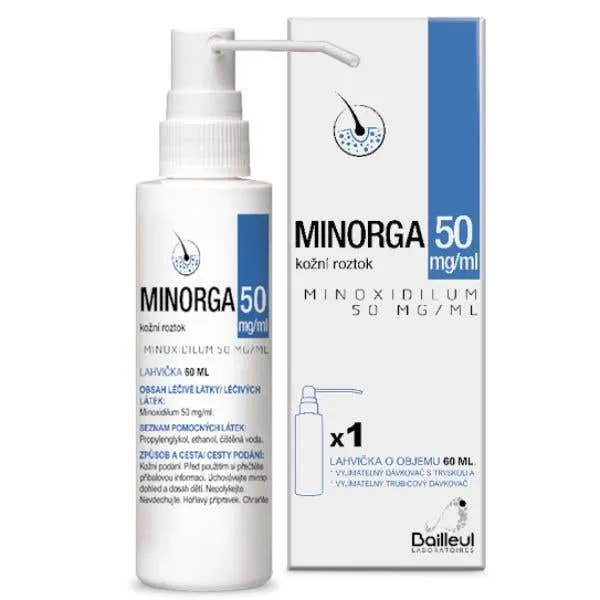
Table of Contents
Package leaflet: Information for the user
Minorga 20 mg/ml, solution for topical use
Minoxidilum
Please read all of this leaflet carefully before using this medicine, because it contains
important information for the patient.
This medicine should always be used exactly as described in this patient leaflet or as directed by
a doctor or pharmacist.
- Keep this leaflet, so that you can read it again if necessary.
- If you need advice or further information, consult your pharmacist.
- If you experience any adverse reactions, including any possible adverse reactions not listed in this leaflet, inform your doctor or pharmacist. See section 4.
- If there is no improvement after 4 months of treatment, or if your condition worsens, consult your doctor.
Table of contents
- What Minorga is and what it is used for
- Important information before using Minorga
- How to use Minorga
- Possible side effects
- How to store Minorga
- Contents of the pack and other information
1. What Minorga is and what it is used for
Minorga contains minoxidil at a concentration of 20 mg in 1 ml.
Minorga is a liquid medicine intended for direct application to the scalp.
It is used in the treatment of hair loss, but not as a medicine that provides a cure. Minoxidil is a peripheral vasodilator, and its exact mechanism of action leading to hair regrowth is unknown.
Minorga is indicated for use in adults aged 18 to 65 years with gradual thinning or hair loss on the crown of the head. Hair thinning or loss is a slow process, which may become noticeable after several years of progressive hair loss.
Minorga is particularly indicated in men with hair loss or thinning on the crown of the head, and in women with general hair thinning.
If there is no improvement after 4 months, or if symptoms worsen, consult your doctor.
2. Important information before using Minorga
When not to use Minorga:
- if the patient is allergic to minoxidil or any of the other ingredients of this medicine (listed in section 6).
Minorga is not indicated for use in cases of alopecia areata (sudden or unexplained hair loss) or scarring alopecia (characterized by healing with ulcers or scar tissue). Furthermore, Minorga should not be used if hair loss is associated with pregnancy, childbirth, or serious illnesses such as thyroid disorders, systemic lupus erythematosus, hair loss from a specific area of the scalp due to inflammatory conditions, or other diseases.
Warnings and precautions
Since hair loss may also be a symptom of a serious disease of the ovaries, pituitary gland, or adrenal glands, women should consult a doctor before starting treatment with Minorga if they have any of the following symptoms: rapid weight gain, particularly in the trunk and face while sparing the limbs (central obesity); facial hair growth resembling that seen in men (hirsutism); menstrual irregularities; hypertension; muscle weakness; back pain; osteoporosis; skin striae; acne.
Before starting treatment with Minorga, discuss this with your doctor or pharmacist.
Do not start using Minorga if hair loss is sudden or unexplained, or if it occurred following an illness or medical treatment. If you have any further doubts regarding hair loss, consult your doctor before starting treatment with Minorga.
If the patient has or has ever had heart or vascular disease, including irregular heartbeat, consult a doctor before starting treatment with Minorga.
Do not use Minorga if the area affected by hair loss is red and inflamed, irritated, or painful, such as in the case of severe sunburn or seborrheic dermatitis. Also, do not apply Minorga to other parts of the body or simultaneously with other topical skin medications.
If unusual symptoms occur after using Minorga, stop using the medicine and consult your doctor. It is particularly important to discontinue use of Minorga if you experience rapid heartbeat (palpitations), swelling of hands and feet, sudden unexplained weight gain, chest pain, weakness, and/or dizziness. Discontinue use also if scalp skin becomes red or irritated.
Systemic side effects (e.g., rapid heartbeat or fluid retention) are more common in patients with diagnosed or suspected ischemic heart disease and in patients with risk factors for myocardial infarction. If the decision is made to use Minorga, both patients with such conditions and their doctors should be aware of this risk.
Minorga is intended for use on the scalp only, as minoxidil may be absorbed to a greater extent from other body areas, increasing the frequency of adverse effects.
Do not use Minorga if the scalp skin is irritated or sunburned.
Furthermore, do not use Minorga on the scalp when concurrently using another topical medication on the skin.
Cases of excessive body hair growth in infants have been reported following skin contact with application sites of minoxidil in patients (caregivers) using topical minoxidil. Hair growth returned to normal within several months after the infant was no longer exposed to minoxidil. Care should be taken to prevent children from coming into contact with areas of the body where minoxidil has been applied topically. If excessive hair growth is observed on a child during use of topical minoxidil products, consult a doctor.
Do not swallow.
Do not inhale.
Minorga contains alcohol, which may cause a burning sensation and eye irritation. In case of accidental contact with sensitive areas (eye, abraded skin, mucous membranes), rinse the affected area thoroughly with plenty of cold tap water.
Children and adolescents
Minorga should not be used in patients under 18 years of age.
Minorga and other medicines
Tell your doctor or pharmacist if you are taking, have recently taken, or might take any other medicines.
Although not clinically confirmed, it is theoretically possible that minoxidil absorbed through the skin may exacerbate orthostatic hypotension in patients concurrently taking peripheral vasodilating agents.
Pregnancy and breastfeeding
If you are pregnant or breastfeeding, think you may be pregnant, or are planning to have a baby, consult your doctor or pharmacist before using this medicine.
Driving and using machines
Minorga is unlikely to affect the ability to drive or operate machinery.
Minorga contains propylene glycol.
It may cause skin irritation.
3. How to use Minorga
Minorga is intended for treatment but does not provide a cure. It is important not to interrupt the regular use of Minorga at the recommended dose of twice daily in order to maintain or improve the effects achieved.
Apply one dose of Minorga (1 ml) directly to the area of the scalp affected by hair loss TWICE DAILY, for example in the morning and evening. Spread the dose evenly over the entire area by gently massaging it in with the fingertips.
Each bottle of Minorga contains enough solution for 30 days of treatment.
Clinical studies have shown that the response to treatment varies considerably and effects are not immediate. New hair growth is usually gradual, and continuous treatment twice daily for at least 4 months is necessary before any improvement becomes noticeable.
Since Minorga acts on the hair follicles, a temporary increase in hair loss may occur approximately 2 to 6 weeks after starting treatment.
If a patient has very little hair at the start of treatment and responds to therapy, the newly growing hair will initially be soft and fine, and difficult to see. As treatment continues, the new hair will gradually gain color and texture similar to the patient's existing hair. If hair loss is not extensive at the beginning of treatment, the new hair will have color and texture similar to the rest of the patient's hair.
If the patient washes their hair before applying Minorga, a mild shampoo should be used.
There is no need to change your usual hair care routine during treatment with Minorga. However, Minorga should be applied first, allowed to dry completely, and only then should other hair products such as foams, conditioners, gels, or other products (e.g. coloring shampoos, permanent hair dyes) be applied. If the patient swims or wets their hair for other reasons, it is best to apply Minorga to dry scalp after swimming, or wait two hours after application of the product. Allow Minorga to remain on the scalp for at least two hours.
How to apply Minorga
Minorga is for external use only.
Apply one dose (1 ml) to the affected area twice daily. Do not apply more than the recommended dose. Do not apply the product to areas other than the scalp. If the patient washes their hair before applying Minorga, a mild shampoo should be used.
Seven sprays are required to deliver one dose (1 ml) of Minorga.
Massage the applied volume of solution thoroughly into the entire affected area. After each application, wash your hands.
Instructions for use
The method of application depends on the type of dispenser used.
A. Dispenser with spray nozzle for application to large areas of the scalp.
B. Dispenser with applicator for application to small areas of the scalp or areas covered with hair.
A. Dispenser with spray nozzle
Recommended for use on large areas of the scalp.
- Remove the cap from the bottle.
- Direct the nozzle toward the hairless area, press once, and spread the solution over the entire area with the fingertips. Repeat this procedure six times until the required dose of 1 ml is delivered (i.e. a total of 7 sprays). Avoid inhaling the solution during application.
- After use, rinse the nozzle and replace the cap on the bottle to prevent evaporation of alcohol.
B. Dispenser with applicator
Recommended for use on small or hairy areas of the scalp.
- Remove the cap from the bottle.
- Pull up the top part of the dispenser and remove it. Attach the applicator to the dispenser and press firmly until fully secured.
- Direct the applicator toward the hairless area, press once, and spread the solution over the entire area with the fingertips. Repeat this procedure six times until the required dose of 1 ml is delivered (i.e. a total of 7 sprays). Avoid inhaling the solution during application.
- After use, rinse the applicator and replace the cap on the bottle to prevent evaporation of alcohol.
This medicine should always be used exactly as described in this patient leaflet, or as directed by your doctor or pharmacist. If you have any doubts, consult your doctor or pharmacist.
Use of a higher than recommended dose of Minorga
No cases of minoxidil overdose due to topical application of Minorga have been reported.
Do not take Minorga orally. In case of accidental ingestion, consult a doctor or a toxicology information center immediately.
Possible symptoms and signs of minoxidil overdose are primarily cardiovascular effects related to fluid retention and tachycardia. In case of fluid retention, appropriate diuretic treatment may be administered. Tachycardia can be controlled with an appropriate beta-blocker. Symptomatic hypotension should be treated with intravenous electrolyte solutions. Avoid sympathomimetic agents such as adrenaline (epinephrine) and noradrenaline (norepinephrine), as these may cause excessive cardiac stimulation.
If any other side effects not described in this leaflet occur, inform your doctor or pharmacist immediately.
Clinical studies have established the exact dose of Minorga required to achieve satisfactory results. It is not recommended to use a higher dose than recommended (1 ml) or to apply the product more than twice daily. Increasing the frequency of application will not increase the rate or amount of new hair growth, but may increase the frequency of adverse reactions.
Missed dose of Minorga
If you miss one or two doses of Minorga, resume your normal twice-daily dosing schedule. Do not apply a higher dose to make up for the missed dose.
Stopping Minorga treatment
Maintaining hair growth requires continuous use of Minorga at the recommended dose. Three to four months after discontinuing treatment with Minorga, new hair growth will stop and the condition will return to the pre-treatment state.
If you have any further questions about the use of this medicine, consult your doctor or pharmacist.
4. Possible adverse reactions
Contact your doctor immediately if any of the following symptoms occur,
as urgent medical attention may be required:
- Swelling of the face, lips, or throat, causing difficulty in swallowing or breathing. These may be symptoms of a severe allergic reaction (frequency unknown, cannot be estimated from available data).
Like all medicines, this medicine can cause adverse reactions, although not everybody experiences them.
The adverse reactions are listed below in decreasing order of frequency.
Very common (may affect more than 1 in 10 patients):
- Headache
Common (may affect up to 1 in 10 patients):
- Depression
- Dyspnea (shortness of breath)
- Itching, excessive hair growth, rash, acneiform rash, skin inflammation, inflammatory skin conditions
- Musculoskeletal pain
- Peripheral edema
- Pain
Uncommon (may affect up to 1 in 100 patients):
- Dry skin, skin peeling, transient hair loss, change in hair structure, change in hair color
- Application site irritation
Rare (may affect up to 1 in 1000 patients):
- Palpitations, increased heart rate, chest pain
- Erythema at the site of administration
Very rare (may affect up to 1 in 10,000 patients):
- Hypotension
Reporting of adverse reactions
If any adverse reactions occur, including any not listed in this leaflet, inform your doctor or pharmacist.
Adverse reactions can be reported directly to the Department of Monitoring Adverse Drug Reactions
of the Office for Registration of Medicinal Products, Medical Devices and Biocidal Products
Al. Jerozolimskie 181 C, 02-222 Warsaw, Tel.: +48 22 49 21 301, Fax: +48 22 49 21 309,
Website: https://smz.ezdrowie.gov.pl
Adverse reactions can also be reported directly to the marketing authorization holder.
Reporting adverse reactions helps provide more information on the safety of this medicine.
5. How to store the medicine Minorga
Keep the medicine out of sight and reach of children.
The product is flammable. Protect from heat. Store the bottle tightly closed.
Do not use this medicine after the expiry date stated on the bottle after "EXP". The expiry date refers to the last day of the stated month.
6. Contents of the pack and other information
What Minorga contains
* The active substance is minoxidil.
* The other ingredients are propylene glycol, ethanol, and purified water.
What Minorga looks like and contents of the pack
Minorga is a clear, colourless or slightly yellowish alcoholic-smelling solution available in the following pack:
HDPE bottle with a spray pump/applicator containing 60 ml of solution.
Pack sizes:
1 bottle of 60 ml with 1 detachable dispenser with nozzle and cap, and 1 detachable dispenser with tubular applicator.
3 bottles of 60 ml with 3 detachable dispensers with nozzle and cap, and 3 detachable dispensers with tubular applicator.
Marketing Authorisation Holder and Manufacturer
Marketing Authorisation Holder
Laboratoires Bailleul S.A.
14-16 Avenue Pasteur
L-2310 Luxembourg
Manufacturer
DELPHARM HUNINGUE SAS
26 rue de la Chapelle
68330 Huningue
France
Lichtenheldt GmbH Pharmazeutische Fabrik
Industriestrasse 7-11
23812 Wahlstedt
Germany
This medicinal product is authorised in the Member States of the European Economic Area under the following names:
Cyprus Androxil 2%, δερματικό διάλυμα
Greece Androxil 2%, δερματικό διάλυμα
Spain Minoxidil Biorga 20 mg/mL solución cutánea
Malta Minorga 2%, taħlita likwida għall-ġilda
Poland Minorga 20 mg/mL, roztwór na skórę
Portugal Minoxidil Biorga 2%, solução cutânea
Czech Republic Minorga 20 mg/ml, kožní roztok
Slovakia Minorga 2%, dermálny roztok
Romania Minorga 20 mg/mL, soluție cutanată
Italy Minoxidil Biorga 2%, soluzione cutanea