Minirin
Poland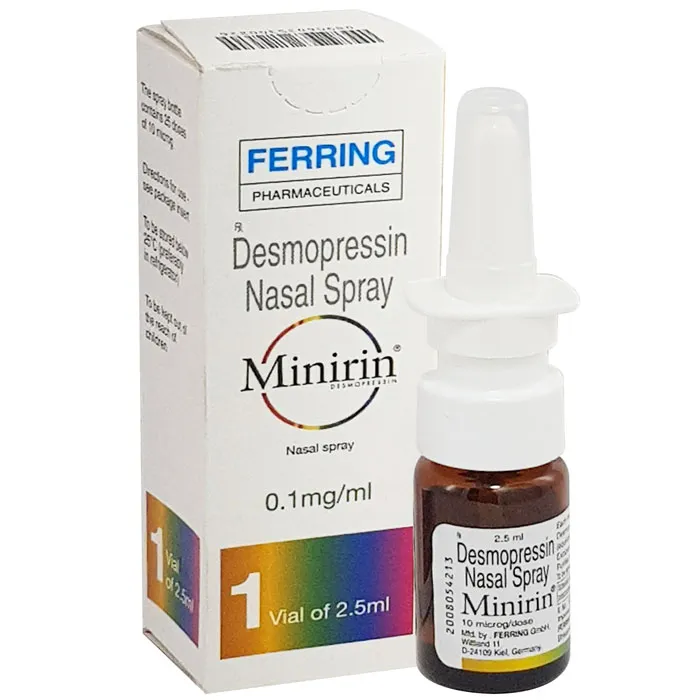
Table of Contents
- 1 -
Package leaflet: Information for the user
MINIRIN, 10 micrograms/dose nasal spray, solution
Desmopressini acetas
Please read all of this leaflet carefully before using this medicine, because it contains
important information for the patient.
- Keep this leaflet so that you can read it again if necessary.
- If you have any doubts, please consult your doctor.
- This medicine has been prescribed for a specific individual. Do not pass it on to others. This medicine may harm someone else, even if their symptoms are the same.
- If the patient experiences any adverse reactions, including any adverse reactions not listed in this leaflet, inform the doctor. See section 4.
Contents of the leaflet:
- What Minirin is and what it is used for
- Important information before using Minirin
- How to use Minirin
- Possible side effects
- How to store Minirin
- Contents of the package and other information
1. What Minirin is and what it is used for
Minirin is an antidiuretic medicine, i.e. it reduces urine excretion. It contains desmopressin, which acts similarly to the natural pituitary hormone – arginine vasopressin.
Minirin nasal spray is used:
for the treatment of central diabetes insipidus,
for testing the kidney's ability to concentrate urine.
2. Important information before using Minirin
When not to use Minirin
- If the patient has psychogenic or habitual polydipsia (excessive thirst), as a result of which urine output exceeds 40 ml/kg body weight/day.
- If the patient has cardiac failure or other conditions requiring treatment with diuretics.
- If the patient has moderate or severe renal impairment with creatinine clearance below 50 ml/min.
- If the patient has hyponatremia, i.e. low sodium concentration in blood. If the patient has syndrome of inappropriate antidiuretic hormone secretion (SIADH).
- If the patient is allergic to desmopressin or to any of the other ingredients of this medicine (listed in section 6).
Warnings and precautions
Warnings
Minirin nasal spray should only be used when oral formulations cannot be administered.
Before using Minirin nasal spray:
- Ensure that instructions regarding fluid intake restriction are strictly followed,
- 2 -
- Ensure that administration in children is supervised by an adult who controls the administered dose.
Additional information regarding the water deprivation test
The water deprivation test in children under 1 year of age should be performed only in hospital under strict medical supervision.
During the water deprivation test, fluid intake should be limited to a maximum of 0.5 litres from 1 hour before administration of the medicine up to 8 hours after administration.
Precautions
Children, elderly patients, and patients with serum sodium concentration at the lower limit of normal are at increased risk of developing hyponatremia.
To avoid hyponatremia, special precautions, including careful attention to fluid restriction and more frequent monitoring of serum sodium concentration, should be taken when Minirin is used concomitantly with drugs that may cause syndrome of inappropriate antidiuretic hormone secretion (SIADH), such as tricyclic antidepressants, selective serotonin reuptake inhibitors, chlorpromazine, carbamazepine, antidiabetic sulfonylureas, especially chlorpropamide, and nonsteroidal anti-inflammatory drugs (NSAIDs).
If acute illnesses with fluid and electrolyte disturbances occur, such as systemic infection, fever-related conditions, or gastroenteritis, consult a physician.
Post-marketing evidence has shown cases of severe hyponatremia associated with the use of desmopressin nasal spray in the treatment of central diabetes insipidus.
Children and adolescents
Minirin nasal spray is indicated in children for the treatment of central diabetes insipidus and for the water deprivation test.
Other medicines and Minirin
Some medicines may affect the action of Minirin nasal spray. Inform your doctor about all medicines the patient is currently taking or has recently taken, as well as any medicines the patient plans to take. In particular, inform the doctor if the patient is taking:
- tricyclic antidepressants,
- selective serotonin reuptake inhibitors,
- chlorpromazine,
- carbamazepine,
- antidiabetic sulfonylureas, especially chlorpropamide,
- nonsteroidal anti-inflammatory drugs (NSAIDs).
The above-mentioned medicines may exert additional antidiuretic effects, increasing the risk of excessive water retention or hyponatremia.
Pregnancy and breastfeeding
If the patient is pregnant or breastfeeding, suspects she may be pregnant, or is planning to become pregnant, she should consult her doctor before using this medicine.
Driving and using machines
Minirin nasal spray has no effect or negligible effect on the ability to drive and operate machinery.
Minirin contains benzalkonium chloride
Due to the presence of benzalkonium chloride, this medicine may cause bronchospasm.
- 3 -
3. How to use Minirin
This medicine should always be used as directed by the physician. If in doubt, consult your doctor.
Minirin nasal spray should only be used when oral formulations are not feasible
(see "Warnings and precautions" in section 2 above).
The medicine is administered intranasally (see "Instructions for use" below).
Minirin nasal spray is dosed using a manual applicator. The applicator is designed so that one press delivers 0.1 ml of solution, corresponding to 10 micrograms of desmopressin acetate per dose.
Use of Minirin in the treatment of central diabetes insipidus:
The physician determines the dose individually for each patient. The usual adult dose is 10 to 20 micrograms (1–2 sprays) once or twice daily.
Testing renal urine concentrating ability:
The dose for adults is 40 micrograms (4 sprays), for children over 1 year of age – 20 micrograms (2 sprays), for children under 1 year of age – 10 micrograms (1 spray).
Urine voided during the first hour after administration of Minirin should be excluded from the test. During the following 8 hours, two urine samples should be collected and their osmolality measured.
Instructions for use
Before first use of Minirin nasal spray, prime the applicator by pressing it several times until a spray appears. If the medicine has not been used for one week, the applicator must be re-primed by pressing several times until a spray appears.
Instructions for use:
Before administering the medicine, clear the nose.
- Remove the protective cap from the applicator.
- Ensure that the tip of the tube inside the bottle is submerged in the solution.
- Press the applicator several times if the medicine has not been used within the past week.
- Once the spray appears, each subsequent press of the applicator delivers one dose of the medicine.
- When inserting the applicator into the nostril, tilt the head slightly backward.
- If a higher dose is required, administer the spray consecutively into each nostril.
- After use, replace the protective cap and store the bottle in an upright position. The medicine bottle must be stored in an upright position.
If there is any doubt whether the medicine has been properly administered and in the correct dose, do not repeat the dose; wait until the next scheduled dose.
Administration of the medicine to young children should be performed under strict supervision of an adult who controls the amount of the dose administered.
Use in children and adolescents
Minirin nasal spray is indicated in children for the treatment of central diabetes insipidus and for testing renal urine concentrating ability.
Use of a higher than recommended dose of Minirin
Using a higher than recommended dose increases the risk of excessive water retention in the body or decreased sodium concentration in the blood, which may (but does not necessarily) manifest as headache, nausea, vomiting, weight gain, or, in severe cases, seizures.
If a higher than recommended dose has been used, seek medical advice immediately.
- 4 -
Missed dose of Minirin
Do not use a double dose to make up for a missed dose.
4. Possible side effects
Like all medicines, this medicine can cause side effects, although not everybody will experience them.
The following very common side effects (occur in more than 1 in 10 people treated):
- nasal congestion,
- rhinitis,
- increased body temperature.
The following common side effects (occur in 1 to 10 in 100 people treated):
- insomnia,
- emotional instability,
- nightmares,
- nervousness,
- aggression,
- headache,
- nosebleeds,
- upper respiratory tract infection,
- gastritis and enteritis,
- nausea,
- abdominal pain.
The following uncommon side effects (occur in 1 to 10 in 1,000 people treated):
- hyponatremia,
- vomiting.
Frequency not known (cannot be estimated from the available data):
- allergic reactions,
- dehydration,
- confusion,
- seizures,
- coma,
- dizziness,
- somnolence,
- hypertension,
- dyspnea,
- diarrhea,
- itching,
- rash,
- urticaria,
- muscle cramps,
- feeling of fatigue,
- peripheral edema,
- chest pain,
- chills,
- increased body weight.
Reporting of side effects
If any side effects occur, including any not listed in this leaflet, tell your doctor. Side effects can be reported directly to the Department of Monitoring of Adverse Drug Reactions at the Office for Registration of Medicinal Products, Medical Devices and Biocidal Products:
- 5 -
Aleje Jerozolimskie 181C, 02-222 Warsaw,
Tel: +48 22 49 21 301,
Fax: +48 22 49 21 309,
website: https://smz.ezdrowie.gov.pl .
Side effects can also be reported to the marketing authorization holder.
Reporting side effects can help provide more information on the safety of this medicine.
5. How to store Minirin
Keep this medicine out of sight and reach of children.
Store below 25°C.
Store in an upright position.
Do not use this medicine after the expiry date stated on the packaging after EXP.
The expiry date refers to the last day of the stated month.
Medicines should not be disposed of via wastewater or household waste. Ask your pharmacist how to dispose of medicines no longer required. This will help protect the environment.
6. Contents of the package and other information
What Minirin contains
The active substance is desmopressin acetate. 1 ml of solution contains 0.1 mg of desmopressin acetate.
Other ingredients are: sodium chloride, citric acid monohydrate, disodium hydrogen phosphate dihydrate,
benzalkonium chloride (50% solution), purified water.
What Minirin looks like and contents of the pack
Bottle with applicator containing 2.5 ml of solution (25 doses)
Bottle with applicator containing 5 ml of solution (50 doses)
Not all pack sizes may be marketed.
Marketing Authorisation Holder and Manufacturer
Marketing Authorisation Holder:
Ferring GmbH
Wittland 11
D-24109 Kiel
Germany
Manufacturer:
Ferring GmbH, Wittland 11, P.O. Box 2145, 24109 Kiel, Germany
For further information, please contact the representative of the Marketing Authorisation Holder:
Ferring Pharmaceuticals Poland Sp. z o.o.
ul. Szamocka 8
01-748 Warsaw
Tel.: +48 22 246 06 80
- 6 -
Fax: +48 22 246 06 81
- 7 -