Milgamma 100
Poland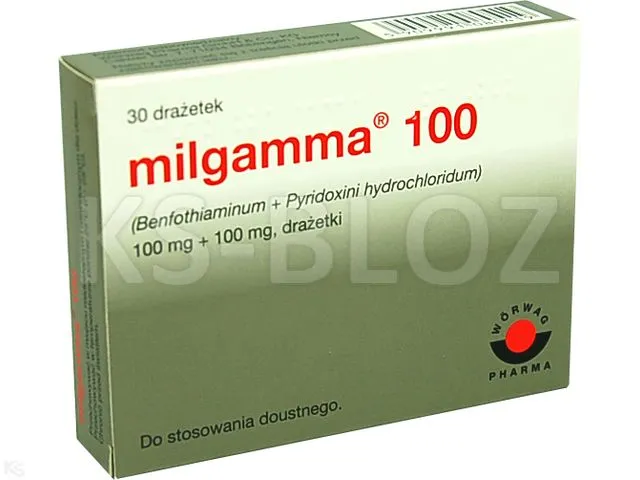
Table of Contents
Package leaflet: Information for the patient
Milgamma 100
(Benfothiaminum + Pyridoxini hydrochloridum)
100 mg + 100 mg, tablets
Please read this leaflet carefully before using the medicine, as it contains important information for you.
- Keep this leaflet so that you can read it again if necessary.
- If you have any further questions, please consult your doctor or pharmacist.
- This medicine has been prescribed for a specific individual. Do not pass it on to others. This medicine may harm other people, even if their symptoms are the same.
- If you experience any adverse effects, including any not listed in this leaflet, inform your doctor or pharmacist. See section 4.
Table of contents of the leaflet:
- What Milgamma 100 is and what it is used for
- Important information before taking Milgamma 100
- How to take Milgamma 100
- Possible side effects
- How to store Milgamma 100
- Contents of the pack and other information
1. What Milgamma 100 is and what it is used for
Milgamma 100 is a medicine containing two vitamins from the B group: benfotiamine (a fat-soluble form of vitamin B₁) and pyridoxine hydrochloride (vitamin B₆).
Milgamma 100 is used in the treatment of neurological disorders (systemic neurological diseases) caused by documented deficiency of vitamin B₁ and B₆.
Because benfotiamine is fat-soluble, it is well absorbed by the human body. After absorption in the intestine, benfotiamine is converted into active vitamin B₁ (thiamine).
Thiamine and pyridoxine are essential nutrients (vitamins). Long-term insufficient dietary intake of these vitamins or certain diseases may lead to severe deficiency symptoms, including neurological disorders. This may result in pain and sensory disturbances, particularly in the feet.
2. Important information before using Milgamma 100
When not to use Milgamma 100
- if the patient has a known hypersensitivity (allergy) to thiamine, pyridoxine hydrochloride, or any of the other ingredients of the medicine.
When to exercise special caution when using Milgamma 100
- in cases of hypersensitivity reactions such as skin rashes, urticaria, photosensitivity, or anaphylactic reactions (acute allergic reactions), treatment with the medicine should be discontinued. If necessary, the treating physician will initiate appropriate therapy.
Milgamma 100 and other medicines
Inform your doctor or pharmacist about all medicines you are currently taking,
have recently taken, or plan to take.
Interactions with other medicines:
- interactions occur with isoniazid, D-penicillamine, and cycloserine. The decision to use Milgamma 100 together with these medicines should be made by the treating physician;
- therapeutic doses of vitamin B6 may reduce the effectiveness of L-dopa (a medicine used in Parkinson's disease);
- alcohol consumption and long-term use of oral contraceptives containing estrogen may lead to vitamin B6 deficiency;
- anticancer drugs containing 5-fluorouracil may inactivate Milgamma 100.
Use of Milgamma 100 in children and elderly patients:
There is no data available on the use of Milgamma 100 in these age groups.
Pregnancy, breastfeeding, and fertility
Consult a doctor before taking any medicine.
Pregnancy
Inform your treating physician if you become pregnant. Milgamma 100 may be used during pregnancy only if the physician considers it absolutely necessary.
The recommended daily intake of vitamin B1 during pregnancy is approximately 1.4–1.6 mg and vitamin B6 2.4–2.6 mg. These doses may be increased only if a deficiency of vitamin B1 or B6 is confirmed, as the safety of higher than recommended doses has not been established.
Breastfeeding:
During breastfeeding, the recommended daily intake of vitamin B1 is approximately 1.4–1.6 mg and vitamin B6 2.4–2.6 mg. These doses may be increased only if a deficiency of vitamin B1 or B6 is confirmed, as the safety of higher than recommended doses has not been established.
Vitamins B1 and B6 pass into breast milk.
High doses of vitamin B6 may suppress milk production.
Inform your treating physician if you are breastfeeding. The physician will decide whether to use Milgamma 100 after evaluating the benefits for the mother and potential risks.
Driving and operating machinery:
Milgamma 100 has no effect on the ability to drive or operate machinery.
Milgamma 100 contains sucrose (sugar)
If the patient has previously been diagnosed with intolerance to certain sugars, the patient should consult a doctor before taking this medicine.
The medicine contains less than 1 mmol (23 mg) of sodium per tablet, meaning it is considered "sodium-free".
3. How to use Milgamma 100
This medicine should always be taken as directed by the physician. In case of doubt, consult
your doctor or pharmacist.
The usual dose of Milgamma 100 is 1 tablet 1 to 3 times daily. The medicine should be taken
with a glass of water.
After four weeks of treatment, your doctor should decide whether continued use of the medicine
is necessary.
Taking more Milgamma 100 than prescribed
Vitamin B has a wide therapeutic range, and symptoms of overdose are not known.
However, prolonged use of vitamin B for more than 2 months at doses exceeding 500 mg/day
may lead to neurotoxic effects (affecting the nerves).
Symptoms resolve after discontinuation of pyridoxine.
There is no specific antidote.
Contact your doctor if unexpected symptoms occur.
If you have taken more than the prescribed dose of the medicine, seek immediate advice from your doctor or
pharmacist.
Missing a dose of Milgamma 100
Do not take a double dose to make up for a missed dose. Continue taking the medicine at the
regular time and try to take it regularly in the future.
Stopping Milgamma 100 treatment
Discontinuing the use of the medicine may result in ineffective treatment. If unpleasant
side effects occur, contact your doctor to determine further management.
If you have any doubts regarding the use of this medicine, consult your doctor.
4. Possible adverse reactions
Like all medicines, this medicine can cause adverse reactions, although not everybody will experience them.
Adverse reactions during treatment with Milgamma 100 are rare.
The following adverse reactions have been observed:
Immune system disorders:
Very rare (less than 1/10,000): hypersensitivity reactions such as skin rashes, urticaria, photosensitivity, anaphylactic reactions (acute allergic reactions).
Nervous system disorders:
Rare (less than 1/1,000; more frequent or equal to 1/10,000): peripheral neuropathies (nervous system symptoms such as numbness of hands or feet).
Gastrointestinal disorders:
Very rare (<1/10,000): In clinical studies, isolated cases of gastrointestinal disturbances such as nausea and other gastrointestinal symptoms have been documented. However, their frequency did not differ significantly from the placebo group. A causal relationship with vitamin B and B intake has not yet been sufficiently clarified and may be dose-dependent.
Remedial measures
In the event of systemic hypersensitivity reactions, immediate medical assistance may be required. If adverse reactions occur, the use of the medicine should be discontinued and a doctor should be informed as soon as possible.
Other adverse reactions may occur in some individuals during treatment with Milgamma 100.
Reporting of adverse reactions
If any adverse reactions occur, including those not listed in this leaflet, inform your doctor or pharmacist. Adverse reactions can be reported directly to the Department of Monitoring Adverse Drug Reactions at the Office for Registration of Medicinal Products, Medical Devices and Biocidal Products:
Al. Jerozolimskie 181 C
02-222 Warszawa
Tel.: +48 22 49 21 301
Fax: +48 22 49 21 309
Website: https://smz.ezdrowie.gov.pl
Reporting adverse reactions enables better assessment of the medicine's safety profile.
5. How to store Milgamma 100
Store below 25°C (2 - 25°C), protect from light. The medicine should
be stored in a place inaccessible and out of sight of children.
Do not use Milgamma 100 after the expiry date stated on the packaging.
The expiry date refers to the last day of the stated month.
Medicines must not be disposed of via wastewater or household waste. Ask your
pharmacist how to dispose of medicines no longer required. This will help
protect the environment.
6. Contents of the package and other information
What Milgamma 100 contains
- The active substances are benfotiamine (100 mg) and pyridoxine hydrochloride (100 mg).
- The other ingredients are: silicon dioxide, microcrystalline cellulose, sodium carboxymethylcellulose, povidone K 30, talc, gum arabic, cross-linked glycerides, maize starch, titanium dioxide, macrogol 6000, glycerol 85%, polysorbate 80, montan wax, shellac, triethyl citrate, sucrose, calcium carbonate. The product contains excipients with known effects: sucrose (see section 2 of the leaflet).
What Milgamma 100 looks like and contents of the pack
Milgamma 100 is available as tablets.
Milgamma 100 is available in packages containing: 15, 30, 60, 90, 100, 500*, 1000*, 5000*, 10000* tablets
(* packages used in closed medical facilities)
Marketing Authorisation Holder:
Wörwag Pharma GmbH & Co. KG
Flugfeld-Allee 24
71034 Böblingen, Germany
Manufacturer:
Wörwag Pharma Production GmbH & Co. KG
Gewerbeallee 1, 82343 Pöcking, Germany
For further information, please contact the local representative of the Marketing Authorisation Holder:
Woerwag Pharma Polska sp. z o.o.
Józefa Piusa Dziekońskiego 1
00-728 Warsaw, Poland
Tel. (+48) 22 863 72 81
Fax (+48) 22 877 13 70