Migrenofen
PolandTable of Contents
Package leaflet: Information for the patient
Migrenofen, 10 mg, orodispersible tablets
Rizatriptanum
Please read carefully the entire leaflet before using the medicine, as it contains
important information for the patient.
- Keep this leaflet for future reference.
- If you have any questions, please consult your doctor or pharmacist.
- This medicine has been prescribed for a specific individual. Do not share it with others. This medicine may harm other people, even if their symptoms are the same.
- If the patient experiences any adverse reactions, including any not listed in this leaflet, inform a doctor or pharmacist immediately. See section 4.
Table of contents of the leaflet
- What Migrenofen is and what it is used for
- Important information before taking Migrenofen
- How to take Migrenofen
- Possible side effects
- How to store Migrenofen
- Contents of the package and other information
1. What Migrenofen is and what it is used for
Migrenofen belongs to a class of anti-migraine medicines known as triptans (also called selective serotonin 5-HT_{1B/1D} receptor agonists).
Migrenofen is used to relieve headache pain during a migraine attack in adults.
Rizatriptan works by reducing swelling of blood vessels around the brain (intracranial blood vessels). This swelling of blood vessels is what causes headache pain during a migraine attack.
2. Important information before using Migrenofen
When not to use Migrenofen:
- if the patient is allergic to rizatriptan or any of the other ingredients of this medicine (listed in section 6),
- if the patient is taking monoamine oxidase inhibitors (MAOIs), such as moclobemide, phenelzine, tranylcypromine or pargyline (antidepressants), or linezolid (an antibiotic), or if less than two weeks have passed since stopping MAO inhibitors,
- if the patient has severe liver or kidney function disorders,
- if the patient has previously experienced a stroke (cerebrovascular incident) or transient ischaemic attack (TIA),
- if the patient has moderate or severe hypertension, or mild hypertension inadequately controlled by medication,
- if the patient currently has or has previously had heart problems, including myocardial infarction or chest pain (angina pectoris), or symptoms of heart disease,
- if the patient has arterial blockage (peripheral vascular disease),
- if the patient is currently taking ergot derivatives, such as ergotamine or dihydroergotamine for migraine headaches, or methysergide for migraine prophylaxis,
- if the patient is taking any other medicine from the same therapeutic group, such as sumatriptan, naratriptan or zolmitriptan for migraine headaches (see "Rizatriptan and other medicines" below).
If in doubt whether any of the above situations apply to the patient, consult a doctor or pharmacist before using Migrenofen.
Warnings and precautions
Talk to a doctor or pharmacist before starting Migrenofen if:
- the patient has any of the following risk factors for heart disease: hypertension or diabetes, smoking or use of nicotine replacement products, family history of heart disease, age over 40 years in men or postmenopausal status in women,
- the patient has impaired kidney or liver function,
- the patient has certain heart disorders (bundle branch block),
- the patient has any allergies,
- headaches are accompanied by dizziness, difficulty walking, lack of coordination, or weakness in limbs (arms and legs),
- the patient is using herbal preparations containing St. John's wort (Hypericum perforatum),
- the patient has previously experienced an allergic reaction with swelling of the face, lips, tongue and/or throat, which may cause breathing and/or swallowing difficulties (angioedema),
- the patient is taking antidepressant medicines called selective serotonin reuptake inhibitors (SSRIs), such as sertraline, escitalopram oxalate and fluoxetine, or serotonin-noradrenaline reuptake inhibitors (SNRIs), such as venlafaxine and duloxetine, for depression,
- the patient has previously experienced brief episodes of chest pain or tightness.
Excessive use (overuse) of Migrenofen may lead to chronic daily headaches. In such cases, consult a doctor, as discontinuation of Migrenofen may be necessary.
Inform the doctor or pharmacist about any symptoms experienced. A diagnosis of migraine must be confirmed by a doctor. Migrenofen should only be used for migraine attacks. Migrenofen must not be used to treat headaches that may be caused by other, more serious conditions.
Tell the doctor or pharmacist about all medicines the patient is currently taking or has recently taken, as well as any medicines the patient plans to take. This also includes over-the-counter medicines, including herbal preparations and medicines commonly used for migraine. Migrenofen may affect how some other medicines work, and other medicines may affect the action of Migrenofen.
Children and adolescents
Migrenofen is not recommended for use in children and adolescents under 18 years of age; safety and efficacy have not yet been established in this age group.
Use in patients over 65 years of age
Full studies assessing the safety and efficacy of Migrenofen in patients over 65 years of age have not been conducted.
Migrenofen and other medicines
Do not take Migrenofen:
- if the patient is currently using a migraine medicine belonging to the class of 5-HT receptor agonists (called "triptans"), such as sumatriptan, naratriptan or zolmitriptan (see: "When not to use Migrenofen" above),
- if the patient is taking a monoamine oxidase inhibitor (MAOI) such as moclobemide, phenelzine, tranylcypromine, linezolid or pargyline, or if less than two weeks have passed since stopping an MAOI (see: "When not to use Migrenofen" above),
- if the patient is being treated for migraine with ergot alkaloid derivatives such as ergotamine or dihydroergotamine (see: "When not to use Migrenofen" above),
- if the patient is taking methysergide for prophylaxis of migraine attacks (see: "When not to use Migrenofen" above).
The above-mentioned medicines must not be used at the same time as Migrenofen, as this may increase the risk of adverse effects.
After taking Migrenofen, wait at least 6 hours before taking ergot alkaloid derivatives such as ergotamine, dihydroergotamine or methysergide.
After taking ergot alkaloid derivatives, wait at least 24 hours before taking Migrenofen.
Consult a doctor for information about the risks associated with taking Migrenofen:
- if the patient is taking propranolol (see "Warnings and precautions:"),
- if the patient is taking SSRIs such as sertraline, escitalopram and fluoxetine, or SNRIs such as venlafaxine and duloxetine used in the treatment of depression.
Inform the doctor or pharmacist about all medicines currently or recently taken by the patient, as well as any medicines the patient intends to take concurrently with Migrenofen.
This also includes over-the-counter medicines.
Taking Migrenofen with food and drink
Migrenofen may take longer to work if taken after a meal. It is better to take the medicine on an empty stomach, but it may also be taken after food.
Pregnancy and breastfeeding
If the patient is pregnant, breastfeeding, suspects she may be pregnant, or is planning to have a baby, she should consult a doctor or pharmacist before using this medicine.
Available data on the safety of rizatriptan use during the first three months of pregnancy do not indicate an increased risk of congenital malformations. It is not known whether Migrenofen is harmful to the unborn child if taken by a pregnant woman after the first three months of pregnancy.
If the patient is breastfeeding, she should suspend breastfeeding for 12 hours after taking the medicine to avoid exposing the infant.
Driving and operating machinery
While using Migrenofen, drowsiness or dizziness may occur. If these symptoms occur, the patient should not drive, use tools or operate any machinery.
3. How to use Migrenofen
Migrenofen is used to treat migraine attacks. Migrenofen should be taken as early as possible after the onset of migraine headache. Migrenofen must not be used to prevent migraine attacks.
This medicine should always be taken exactly as prescribed by your doctor. If in doubt, consult your doctor or pharmacist.
The recommended dose for adult patients (aged over 18 years) is one tablet (10 mg).
Patients taking propranolol or those with liver or kidney disorders should take rizatriptan at a dose of 5 mg. At least two hours should be maintained between the intake of propranolol and the administration of Migrenofen, and no more than 2 doses should be taken within 24 hours.
If migraine returns within 24 hours
In some patients, migraine symptoms may recur within 24 hours. If migraine returns, another dose of Migrenofen may be taken. Always wait at least 2 hours between doses. No more than two doses of this medicine should be taken within 24 hours.
If migraine does not improve after 2 hours
If there is no response to Migrenofen after 2 hours, do not take another dose of this medicine during the same migraine attack. However, a response to Migrenofen may occur during a subsequent migraine headache attack.
Do not take more than 2 doses of Migrenofen within 24 hours (do not take more than two 10 mg tablets within 24 hours). Always wait at least 2 hours between consecutive doses.
If migraines worsen, contact your doctor.
How to take Migrenofen orally disintegrating tablets.
- Migrenofen is available as orally disintegrating tablets. Each tablet contains 10 mg of rizatriptan.
- The sachet containing the tablet should be opened with dry hands.
- Place the tablet on the tongue; it will dissolve and be swallowed with saliva.
- The tablet does not need to be taken with liquid. The tablet can be used when drinking fluid is not available, or to avoid nausea and vomiting that may occur after taking tablets. If needed, you may drink fluid afterwards.
Taking more Migrenofen than recommended
If you take more Migrenofen than recommended, contact your doctor or pharmacist immediately. Take the medicine packaging with you.
Symptoms of overdose may include dizziness, drowsiness, vomiting, fainting, and slowed heart rate.
If you have any further doubts about using this medicine, consult your doctor or pharmacist.
Instructions for use
Important: Do not touch the tablet with wet hands!
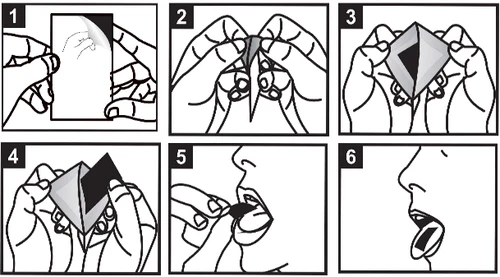
Instructions for use:
Step 1. Hold the sachet with the back side facing you. Locate the arrow in the upper corner of the sachet and hold the sachet so that the side with the arrow points upwards. This side of the sachet is only partially sealed. Two corners of the sachet are unsealed to allow opening.
Step 2. Grasp both unsealed corners of the sachet at the location indicated by the arrow. Gently pull the corners in opposite directions to open the sachet.
Step 3. Continue this motion until both sides of the sachet are almost completely separated. The tablet will become visible inside. There is no need to completely tear open the sachet to access the medicine tablet.
Steps 4, 5 and 6. Gently remove the tablet from the sachet and place it on the tongue. The tablet will disintegrate within a few seconds.
4. Possible adverse effects
Like all medicines, this medicine can cause adverse effects, although not everyone will experience them.
The medicine may cause the adverse effects listed below.
The most commonly reported adverse effects in clinical trials of this medicine involving adults are dizziness, drowsiness, and weakness and/or fatigue.
Common adverse effects (occurring in 1 to 10 out of 100 patients)
- drowsiness, tingling (paraesthesia), dizziness, headache, reduced skin sensitivity to touch (hypoesthesia), impaired mental performance, insomnia, weakness, fatigue,
- fast or irregular heartbeat (palpitations),
- transient facial flushing,
- unpleasant sensation (discomfort) in the throat,
- nausea, dry mouth, vomiting, diarrhoea, indigestion (dyspepsia),
- sensation of heaviness in certain body parts, neck pain, stiffness,
- abdominal pain or chest pain.
Uncommon adverse effects (occurring in 1 to 10 out of 1,000 patients)
- taste disturbances or unpleasant taste in the mouth,
- unsteadiness of gait (ataxia), blurred vision, tremor, fainting,
- confusion (disorientation), nervousness,
- increased blood pressure (hypertension), thirst, hot flushes, facial flushing, sweating,
- rash, itching and raised rash (urticaria), swelling of the face, lips, tongue and/or throat, which may cause breathing and/or swallowing difficulties (angioedema), breathing problems (dyspnoea),
- sensation of pressure in certain body parts, reduced muscle strength,
- changes in heart rhythm or heart rate (arrhythmia), abnormalities in electrocardiogram (ECG – a test used to assess the electrical activity of the heart), very rapid heart rate (tachycardia),
- facial pain, muscle pain.
Rare adverse effects (occurring in 1 to 10 out of 10,000 patients)
- wheezing,
- allergic reaction (hypersensitivity), severe life-threatening allergic reaction (anaphylaxis),
- stroke (usually occurs in patients with risk factors for cardiovascular disease – hypertension, diabetes, smoking, use of nicotine substitutes, family history of heart disease or stroke, age over 40 years in men, postmenopausal period in women, specific heart rhythm disorders (bundle branch block)),
- slow heartbeat (bradycardia).
Frequency not known (frequency cannot be estimated from available data):
- myocardial infarction (heart attack), constriction of blood vessels in the heart (coronary vasospasm) (particularly in patients with risk factors for cardiovascular disease such as hypertension, diabetes, smoking, use of nicotine substitutes, family history of heart disease or stroke, age over 40 years in men, postmenopausal period in women, specific heart rhythm disorders (bundle branch block)),
- serotonin syndrome, which may include adverse symptoms such as: stupor, unstable blood pressure, high body temperature, lack of muscle coordination, agitation and hallucinations,
- severe peeling of the skin with or without fever (toxic epidermal necrolysis),
- seizures (convulsions),
- constriction of blood vessels in hands and feet, including coldness and numbness,
- constriction of blood vessels in the colon (large intestine), which may cause abdominal pain.
If symptoms of allergic reaction, serotonin syndrome, heart attack, or stroke occur, seek medical advice immediately.
You should also contact a doctor immediately if any symptoms indicating allergy (such as rash or itching) appear after taking Migrenofen.
If any adverse effects occur or worsen, or if any adverse effects not listed in this leaflet occur, consult a doctor.
Reporting of adverse effects
If any adverse effects occur, including any adverse effects not listed in this leaflet, inform your doctor or pharmacist. Adverse effects can be reported directly to the Department of Monitoring Adverse Drug Reactions of the Office for Registration of Medicinal Products, Medical Devices and Biocidal Products
Al. Jerozolimskie 181C
02-222 Warsaw
Tel.: 22 49-21-301
Fax: 22 49-21-309
Website: https://smz.ezdrowie.gov.pl
Adverse effects can also be reported to the marketing authorisation holder.
Reporting adverse effects helps to provide more information on the safety of this medicine.
5. How to store Migrenofen
Keep this medicine out of the sight and reach of children.
No special storage conditions apply for this medicine.
Do not use this medicine after the expiry date stated on the carton/foil pouch after:
"EXP". The expiry date refers to the last day of the stated month.
Do not remove the orally disintegrating tablet from the external aluminum foil pouch
until the patient is ready to take the medicine. Do not use the medicine if the
aluminum foil pouch is damaged.
Medicines must not be disposed of via the sewage system or household waste.
Ask your pharmacist how to dispose of medicines no longer required.
Such measures help protect the environment.
6. Contents of the pack and other information
What Migrenofen contains
The active substance in Migrenofen is rizatriptan. Each orodispersible tablet contains 14.530 mg of rizatriptan benzoate (equivalent to 10 mg of rizatriptan).
The other ingredients of Migrenofen orodispersible tablets are:
Hypromellose
Glycerol
Propylene glycol (E 1520)
Titanium dioxide (E 171)
Sucralose
Peppermint essential oil with reduced menthol content
What Migrenofen looks like and contents of the pack
Migrenofen 10 mg is a white, rectangular, opaque, non-adhesive orodispersible tablet.
Each tablet is packed in a sachet made of LDPE/Aluminium/PET. The sachets are placed in a cardboard box.
Pack size: 2 x 1 tablet
Marketing Authorisation Holder and Importer
Marketing Authorisation Holder
Adamed Pharma S.A.
Pieńków, ul. M. Adamkiewicza 6A
05-152 Czosnów
tel. 22 732 77 00
Importer:
Adamed Pharma S.A.
ul. Marszałka Józefa Piłsudskiego 5
95-200 Pabianice