Metronidazole 0.5% polpharma
Poland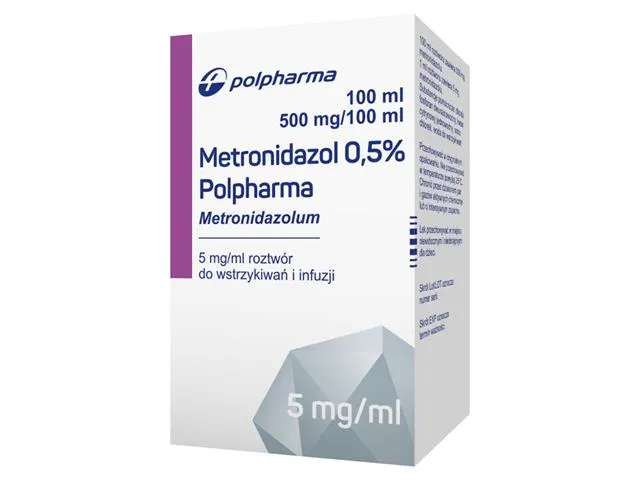
Table of Contents
- Package leaflet: Information for the user
- 1. What Metronidazol 0,5% Polpharma is and what it is used for
- 2. Important information before using Metronidazol 0,5% Polpharma
- 3. How to use Metronidazol 0,5% Polpharma
- 4. Possible adverse reactions
- 5. How to store Metronidazol 0,5% Polpharma
- 6. Contents of the packaging and other information
Package leaflet: Information for the user
Metronidazol 0,5% Polpharma
5 mg/ml, solution for injection and infusion
Metronidazolum
Please read all of this leaflet carefully before using this medicine, because it contains
important information for the patient.
- Keep this leaflet, as you may need to read it again.
- If you have any further questions, please ask your doctor or nurse.
- This medicine has been prescribed for a specific individual. Do not pass it on to others. This medicine may harm other people, even if their symptoms are the same.
- If the patient experiences any adverse reactions, including any not listed in this leaflet, inform the doctor or nurse immediately. See section 4.
Contents of the leaflet
- What Metronidazol 0,5% Polpharma is and what it is used for
- What you need to know before using Metronidazol 0,5% Polpharma
- How to use Metronidazol 0,5% Polpharma
- Possible side effects
- How to store Metronidazol 0,5% Polpharma
- Contents of the pack and other information
1. What Metronidazol 0,5% Polpharma is and what it is used for
Metronidazole is a 5-nitroimidazole derivative with antiprotozoal
and antibacterial activity.
Metronidazol 0,5% Polpharma is indicated in adults and children:
- For the treatment of infections caused by anaerobic bacteria of the genera Bacteroides, Fusobacterium, Clostridium, Eubacterium, Veilonella, Peptococcus, Peptostreptococcus: sepsis, bacteremia, peritonitis, brain abscess, pneumonia, osteomyelitis, puerperal fever, pelvic abscess, salpingitis, and post-surgical wound infections;
- For perioperative prophylaxis of infections caused by anaerobic bacteria, particularly species of the genera Bacteroides and Streptococcus. The medicine reduces the frequency of postoperative infections caused by anaerobic bacteria. Official guidelines on the appropriate use of antibacterial agents should be taken into account.
2. Important information before using Metronidazol 0,5% Polpharma
When not to use Metronidazol 0,5% Polpharma:
- if the patient is allergic to metronidazole or any of the other ingredients of this medicine (listed in section 6);
- if the patient is allergic to other 5-nitroimidazole derivatives;
- if the patient is in the first trimester of pregnancy.
Warnings and precautions
Before starting treatment with Metronidazol 0,5% Polpharma, discuss this with your doctor,
pharmacist, or nurse. Exercise particular caution when using Metronidazol 0,5%
Polpharma:
- if the patient has an active disease of the central nervous system (brain, spinal cord, or nerves);
- if the patient has developed neurological disorders during treatment (numbness, tingling in limbs, or convulsions);
- if the patient has severe liver failure or hepatic encephalopathy (see section 3);
- if the patient had significant abnormalities in blood count and differential count before and after previous metronidazole treatment. If re-treatment with metronidazole is necessary, such a patient should remain under medical supervision.
- During treatment, the doctor should monitor blood parameters. If the drug is used for longer than 10 days, such monitoring is absolutely necessary.
- if the patient is concurrently taking corticosteroids or if the patient is prone to developing oedema, because the medicine contains a considerable amount of sodium. Oral, vaginal, or gastrointestinal candidiasis may occur after administration of metronidazole, which requires appropriate treatment.
Metronidazole does not exhibit direct bactericidal activity against aerobic bacteria
and facultative anaerobes.
Despite eliminating bacteria causing trichomoniasis, gonococcal infection may still persist.
Metronidazole may affect the results of certain laboratory tests (AspAT, AlAT, LDH,
triglycerides, glucose).
During treatment with metronidazole, blistering skin reactions, sometimes fatal, such as Stevens-Johnson syndrome or toxic epidermal necrolysis (Lyell's syndrome), may occasionally occur (see
section 4). If influenza-like symptoms or progressive rash (often with blisters or mucosal lesions) develop, treatment must be discontinued and the patient should contact their doctor immediately.
In patients with Cockayne syndrome, cases of severe hepatotoxicity (acute liver failure), including fatal cases, have been reported during treatment with metronidazole-containing medicines.
In patients with Cockayne syndrome, the doctor should monitor liver function during and after treatment with metronidazole.
If any of the following symptoms occur, the patient should immediately inform the doctor
and discontinue taking metronidazole:
- abdominal pain, anorexia, nausea, vomiting, fever, malaise, fatigue, jaundice, dark urine, sticky or loose stools, or skin itching.
The medicine may cause darkening of urine.
Metronidazol 0,5% Polpharma and other medicines
Tell your doctor about all medicines currently or recently taken, as well as any medicines the patient plans to take, especially:
- anticoagulants (e.g. acenocoumarol, warfarin); the medicine does not show interaction with heparin;
- lithium salts (medicines used in psychiatric disorders);
- terfenadine and astemizole (antihistamines);
- disulfiram (a medicine used in the treatment of alcoholism); treatment with metronidazole may only be started at least 2 weeks after discontinuation of disulfiram therapy;
- 5-fluorouracil or busulfan (medicines used in cancer treatment);
- cyclosporine (a medicine used in transplant patients);
- medicines increasing liver enzyme activity (e.g. phenytoin, phenobarbital);
- medicines decreasing liver enzyme activity (e.g. cimetidine);
- medicines metabolized by the liver enzyme P-450 CYP 3A4 (e.g. certain antibiotics). See also section 4.
Metronidazol 0,5% Polpharma shows pharmaceutical incompatibility with:
- cefamandole sodium
- sodium cefoxitin
- 10% glucose solution
- sodium lactate
- potassium benzylpenicillin
Metronidazol 0,5% Polpharma and alcohol
Metronidazole intensifies the toxic effects of alcohol. During treatment with metronidazole and for at least
48 hours after completion of treatment, alcoholic beverages should not be consumed due to the
risk of adverse reactions. Consumption of alcohol during treatment may cause
unwanted reactions such as flushing, sweating, headache, nausea, vomiting, and epigastric pain.
Pregnancy, breastfeeding, and fertility
If the patient is pregnant or breastfeeding, suspects she may be pregnant, or is planning to become pregnant, she should consult a doctor before using this medicine.
Pregnancy
The medicine is contraindicated during the first trimester of pregnancy. In the second and third trimesters of pregnancy, the medicine may be used only if, in the opinion of the doctor, the expected benefit to the mother outweighs the potential risk to the fetus.
Breastfeeding
Metronidazole is excreted in human milk; therefore, the medicine should not be taken during breastfeeding. If treatment is necessary, a decision should be made to discontinue breastfeeding.
Fertility
Only in animal studies has a potentially negative effect of metronidazole on the male reproductive system been demonstrated, following administration of high doses significantly exceeding the maximum recommended human dose.
Driving and operating machinery
Metronidazol 0,5% Polpharma may cause drowsiness, dizziness, disorientation, hallucinations,
convulsions, or transient visual disturbances. It is recommended not to drive or
operate machinery if such symptoms occur.
Metronidazol 0,5% Polpharma contains sodium
The medicine contains 3.1 mg of sodium (main component of table salt) in each millilitre.
This corresponds to 0.15% of the maximum recommended daily dietary sodium intake for adults.
The medicine contains 62.04 mg of sodium (main component of table salt) in each 20 ml ampoule.
This corresponds to 3.1% of the maximum recommended daily dietary sodium intake for adults.
The medicine contains 310.21 mg of sodium (main component of table salt) in each 100 ml container.
This corresponds to 15.51% of the maximum recommended daily dietary sodium intake for adults.
This should be taken into account in patients with impaired renal function and in patients controlling dietary sodium intake.
The medicine may be diluted. When calculating the total sodium content in the prepared, diluted solution, the sodium content originating from the diluent must be considered.
For accurate information on the sodium content in the solution used to dilute the medicine, refer to the leaflet of the diluent used.
3. How to use Metronidazol 0,5% Polpharma
This medicine should always be used as directed by the physician. If in doubt, consult your
physician.
Due to insufficient evidence regarding mutagenicity risk in humans, prolonged use of metronidazole beyond the normally recommended duration should be carefully considered.
The usual dosage of the medicine is as follows:
Anaerobic bacterial infections
Metronidazole is administered intravenously at the beginning of treatment in patients whose symptoms prevent oral administration.
Adults and adolescents over 12 years: 100 ml of 0.5% metronidazole solution (500 mg metronidazole) intravenously every 8 hours. The infusion rate should not exceed 5 ml/min.
The maximum daily intravenous dose of metronidazole for adults is 4 g.
Metronidazole is usually administered for 7 days, although in severe anaerobic bacterial infections it may be used for 2–3 weeks.
Children above 8 weeks of age up to 12 years: the usual daily dose is 20–30 mg/kg body weight as a single dose or divided into doses of 7.5 mg/kg body weight every 8 hours. The daily dose may be increased up to 40 mg/kg body weight depending on the severity of infection. Treatment duration is usually 7 days.
Children below 8 weeks of age: 15 mg/kg body weight per day as a single dose or divided into doses of 7.5 mg/kg body weight administered every 12 hours.
In preterm infants born before the 40th week of gestation, metronidazole accumulation may occur during the first week of life; therefore, serum metronidazole concentration should be monitored after several days of treatment.
Prevention of anaerobic bacterial infections
particularly during surgical procedures involving the colon, rectum, or gynecological surgeries.
Drug administration should begin 5–10 minutes before the surgical procedure.
Adults and adolescents over 12 years: 100 ml of 0.5% metronidazole solution (500 mg metronidazole) administered intravenously by slow infusion.
Subsequent identical doses of 0.5% metronidazole solution should be given every 8 hours until oral therapy can be initiated as soon as possible.
Children below 12 years: 20–30 mg/kg body weight as a single dose administered 1–2 hours before surgery.
Preterm infants born before the 40th week of gestation: 10 mg/kg body weight as a single dose before surgery.
Prophylactic use of the drug should not exceed 12 hours after surgery.
Bacterial vaginosis
Adolescents: 400 mg twice daily for 5–7 days or 2000 mg as a single dose.
Trichomoniasis
Adults and children over 10 years: 2000 mg as a single dose or 200 mg three times daily for 7 days, or 400 mg twice daily for 5–7 days.
Note: treatment should be administered simultaneously to both sexual partners.
Children below 10 years: 40 mg/kg body weight orally as a single dose or 15–30 mg/kg body weight per day divided into 2–3 doses for 7 days, not exceeding 2000 mg per dose.
Giardiasis (lambliasis)
Adults and children over 10 years: 2000 mg once daily for 3 days or 400 mg three times daily for 5 days, or 500 mg twice daily for 7 to 10 days.
Children aged 7 to 10 years: 1000 mg once daily for 3 days.
Children aged 3 to 7 years: 600–800 mg once daily for 3 days.
Children aged 1 to 3 years: 500 mg once daily for 3 days.
Alternative dosing regimen for this indication (dose expressed in mg per kg body weight):
15–40 mg/kg body weight/day divided into 2–3 doses.
Amebiasis (amoebiasis)
Adults and children over 10 years: 400–800 mg three times daily for 5–10 days.
Children aged 7 to 10 years: 200–400 mg three times daily for 5–10 days.
Children aged 3 to 7 years: 100–200 mg four times daily for 5–10 days.
Children aged 1 to 3 years: 100–200 mg three times daily for 5–10 days.
Alternative dosing regimen for this indication (dose expressed in mg per kg body weight):
Children: 35–50 mg/kg body weight/day in three divided doses for 5 to 10 days, not exceeding 2400 mg/day.
Treatment of Helicobacter pylori infection (eradication therapy)
Children: as part of combination therapy, 20 mg/kg per day, not exceeding 500 mg twice daily for 7–14 days. Official guidelines should be consulted before initiating treatment.
Method of administration:
Metronidazol 0,5% Polpharma may be administered intravenously either undiluted or (in patients receiving intravenous fluids) diluted in an appropriate volume of 0.9% sodium chloride solution, 5% glucose solution, 5% glucose in 0.9% sodium chloride solution, or 20 and 40 mmol/l potassium chloride solution (the infusion solution should be prepared immediately before use).
After checking the integrity of the polyethylene container and removing the protective seal from the connector, connect it to a set with a double-lumen needle.
Any remaining solution after infusion must not be reused. The medicine must not be used if visible changes in the solution occur.
Use in patients with hepatic impairment
In patients with severe liver impairment or hepatic encephalopathy, drug accumulation may occur; therefore, the physician may recommend reducing the daily dose to one-third of the usual dose, administered once daily.
Use in patients with renal impairment
Dose reduction in these patients is not necessary.
In patients undergoing hemodialysis, metronidazole and its metabolites are removed during the 8-hour dialysis period; therefore, metronidazole should be administered again immediately after dialysis.
In patients undergoing intermittent peritoneal dialysis or continuous ambulatory peritoneal dialysis, no dosage adjustments are required.
Use in elderly patients
Caution should be exercised when administering the medicine to elderly patients, particularly when high doses are used.
Overdose of Metronidazol 0,5% Polpharma
In case of overdose, consult a physician immediately.
Overdose may cause neurotoxic symptoms such as peripheral neuropathies (tingling and burning sensations in hands and feet, sometimes loss of sensation in limbs), muscle tremors and seizures, as well as nausea, vomiting, and motor incoordination (difficulty maintaining balance, unsteady gait).
Missed dose of Metronidazol 0,5% Polpharma
If a dose is missed, it should be administered as soon as possible. If it is already time for the next dose, the missed dose should not be administered. A double dose must not be used to make up for the missed dose.
If you have any further questions about the use of this medicine, consult your physician, pharmacist, or nurse.
4. Possible adverse reactions
Like all medicines, this medicine can cause adverse reactions, although not everyone will experience them.
The frequency, type and severity of adverse reactions in children are the same as in adults.
If any of the following serious adverse reactions occur,
discontinue use of Metronidazole 0,5% Polpharma immediately and contact your doctor
without delay:
- Adverse reactions occurring rarely (occur in less than 1 in 1,000 people):
- anaphylaxis manifested by confusion, pale skin, low blood pressure, sweating, reduced urine output, rapid breathing, weakness and fainting;
- Adverse reactions occurring very rarely (occur in less than 1 in 10,000 people):
- agranulocytosis (absence of granulocytes in the blood; symptoms include fever, sore throat, superficial ulcers of the oral mucosa, flu-like symptoms, fatigue), neutropenia (deficiency of neutrophil granulocytes), thrombocytopenia (reduced number of blood platelets; symptoms include bruising, petechiae, purpura, nosebleeds), pancytopenia (deficiency of red and white blood cells and platelets);
- psychotic disorders, including confusion and hallucinations;
- encephalopathy (brain disorders, e.g. disorientation, fever, headache, hallucinations, paralysis, photophobia, visual and motor disturbances, neck stiffness) and subacute cerebellar syndrome (e.g. impaired coordination, speech difficulties, gait disturbances, nystagmus and tremor), which may influence the decision to discontinue treatment;
- hepatitis, liver cell damage, jaundice and pancreatitis, which resolve after discontinuation of the drug;
- Adverse reactions occurring with unknown frequency (frequency cannot be estimated from available data):
- angioedema (swelling of the face, tongue and larynx, causing breathing difficulties), urticaria, fever;
- during intensive and/or prolonged treatment with metronidazole, cases of
peripheral sensory neuropathy (numbness, tingling, abnormal sensations such as pricking, burning)
or transient seizure-like episodes have been reported; in most cases, neuropathy
resolved after discontinuation of the drug or dose reduction;
- aseptic meningitis;
- optic neuropathy/optic neuritis;
- erythema multiforme, Stevens-Johnson syndrome (blisters progressing to erosions in the oral mucosa, conjunctivae, genital organs), toxic epidermal necrolysis (Lyell's syndrome) (erythematous-bullous lesions of the skin and mucous membranes leading to sloughing of large skin areas and exposure of extensive skin surfaces), drug erythema;
- vaginal pain and yeast infection;
- following intravenous administration, thrombophlebitis may occur (pain, swelling, cyanosis or redness of the skin, subfebrile condition, painful hardening of the vein) (this can be avoided or its frequency reduced by short-term use of an intravenous catheter);
- acute liver failure in patients with Cockayne syndrome (see section 2 "Warnings and precautions"). Other adverse reactions may include:
Adverse reactions occurring very rarely (less than 1 in 10,000 people):
- drowsiness, dizziness, convulsions, headaches;
- visual disturbances such as double vision and myopia, mostly transient;
- increased liver enzyme activity (AspAT, AlAT, alkaline phosphatase);
- rash, acneiform rash, itching, redness;
- muscle pain, joint pain;
- darker urine discoloration due to the presence of water-soluble pigments formed as metabolites of metronidazole.
Adverse reactions occurring with unknown frequency (frequency cannot be estimated from available data):
- leukopenia (reduced number of white blood cells);
- loss of appetite;
- depressed mood;
- hearing disturbances and/or hearing loss, tinnitus;
- taste disturbances, oral mucosal inflammation, coated tongue, nausea, vomiting, gastrointestinal disturbances such as epigastric pain and diarrhoea. Cases of liver failure requiring transplantation have been reported in patients treated with metronidazole in combination with other antibiotics.
Reporting of adverse reactions
If any adverse symptoms occur, including any adverse reactions not listed
in this leaflet, inform your doctor or nurse. Adverse reactions can be reported
directly to the Department of Monitoring Adverse Drug Reactions of the Office for Registration of Medicinal Products, Medical Devices and Biocidal Products
Al. Jerozolimskie 181C
02-222 Warsaw
Tel.: + 48 22 49 21 301
Fax: + 48 22 49 21 309
Website: https://smz.ezdrowie.gov.pl
Adverse reactions can also be reported to the marketing authorization holder.
Reporting adverse reactions helps to provide more information on the safety of the medicine.
5. How to store Metronidazol 0,5% Polpharma
Keep this medicine out of sight and reach of children.
Glass ampoules: Store in the original packaging. Do not store above 25°C.
Polyethylene containers: Store in the original packaging. Do not store above 25°C. Protect from exposure to vapours and chemically reactive gases or gases with strong odours.
Do not use this medicine after the expiry date stated on the packaging. The expiry date refers to the last day of the stated month.
The label on the packaging shows the expiry date after the abbreviation EXP, and the batch number after the abbreviation Lot/LOT.
Medicines must not be disposed of via wastewater or household waste. Ask your pharmacist how to dispose of medicines no longer required. These measures will help protect the environment.
6. Contents of the packaging and other information
What Metronidazol 0,5% Polpharma contains
- The active substance is metronidazole. Each ml of solution contains 5 mg of metronidazole. Each 20 ml ampoule contains 100 mg of metronidazole. Each 100 ml container contains 500 mg of metronidazole.
- The other ingredients are: disodium phosphate dodecahydrate, citric acid monohydrate, sodium chloride, water for injections.
What Metronidazol 0,5% Polpharma looks like and contents of the pack
Metronidazol 0,5% Polpharma is a clear solution with a slightly yellowish-green tint.
Available pack sizes:
- glass ampoules containing 20 ml of solution, 10 ampoules in a cardboard box.
- polyethylene container with Insocap-type adapter containing 100 ml of solution. 1 or 40 containers in a cardboard box.
Marketing Authorisation Holder and Manufacturer
Zakłady Farmaceutyczne POLPHARMA S.A.
Pelplińska 19, 83-200 Starogard Gdański, Poland
tel. + 48 22 364 61 01