Metoclopramide hameln
Poland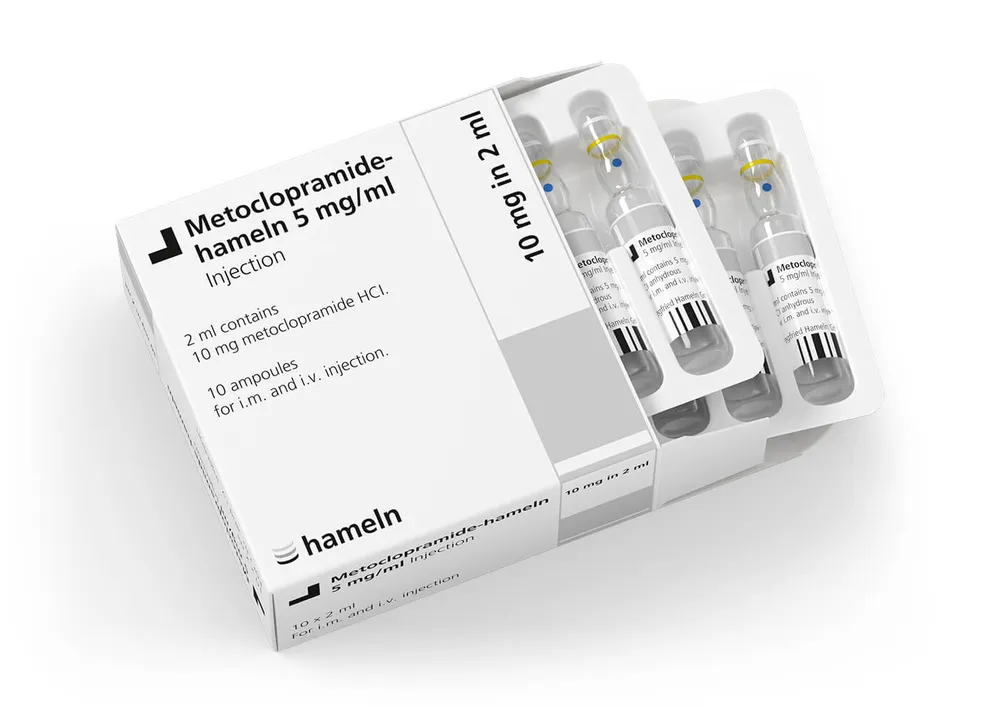
Table of Contents
- Patient Information Leaflet
- 1. What Metoclopramide hameln is and what it is used for
- 2. Important information before using Metoclopramide hameln
- 3. How to use Metoclopramide hameln
- 4. Possible adverse reactions
- 5. How to store Metoclopramide hameln
- 6. Contents of the package and other information
- Information intended exclusively for healthcare professionals:
Patient Information Leaflet
Metoclopramide hameln, 5 mg/ml, solution for injection
Metoclopramidi hydrochloridum
Please read all of this leaflet carefully before using this medicine, because it contains
important information for you.
- Keep this leaflet, as you may need to read it again.
- If you have any further questions, please ask your doctor, pharmacist or nurse.
- If you experience any side effects, including any not listed in this leaflet, tell your doctor, pharmacist or nurse. See section 4.
Leaflet Contents
- What Metoclopramide hameln is and what it is used for
- What you need to know before you use Metoclopramide hameln
- How to use Metoclopramide hameln
- Possible side effects
- How to store Metoclopramide hameln
- Contents of the pack and other information
1. What Metoclopramide hameln is and what it is used for
Metoclopramide hameln is an antiemetic medicine. It contains an active substance called
"metoclopramide". The medicine acts on a part of the brain that controls nausea and vomiting.
Adults
Metoclopramide hameln is used in adults for:
- preventing nausea and vomiting that may occur after surgical procedures;
- treating nausea and vomiting, including nausea and vomiting associated with migraine;
- preventing nausea and vomiting associated with radiotherapy.
Children and adolescents
Metoclopramide hameln is indicated for use in children (aged 1–18 years) only when other
treatment methods have proven ineffective or cannot be used, for:
- prevention of delayed nausea and vomiting that may occur after chemotherapy;
- treatment of nausea and vomiting occurring after surgical procedures.
2. Important information before using Metoclopramide hameln
When not to use Metoclopramide hameln
- if the patient is allergic to metoclopramide or to any of the other ingredients of this medicine (listed in section 6).
- in cases of bleeding, obstruction, or perforation of the stomach or intestines.
- if the patient has a rare tumour of the adrenal gland located near the kidney (pheochromocytoma).
- if the patient has or has previously had involuntary muscle contractions (tardive dyskinesia) while taking medicines.
- if the patient has epilepsy.
- if the patient has Parkinson's disease.
- if the patient is taking levodopa (a medicine for Parkinson's disease) or dopamine agonists (see "Metoclopramide hameln with other medicines" below).
- if the patient has ever had abnormal blood pigment (methemoglobinemia) or deficiency of NADH-cytochrome b5 reductase.
Metoclopramide hameln must not be used in children under 1 year of age (see "Children and adolescents" below).
Warnings and precautions
Before starting treatment with Metoclopramide hameln, discuss with your doctor, pharmacist, or nurse:
- if the patient has previously had irregular heart rhythm (QT prolongation) or other heart problems.
- if the patient has disturbances in blood electrolyte levels, such as potassium, sodium, or magnesium.
- if the patient is taking other medicines that affect heart function.
- if the patient has neurological (brain) disorders.
- if the patient has kidney or liver problems. A dose reduction may be necessary (see section 3).
Your doctor may order blood tests to check the level of blood pigment. If abnormal levels are detected (methemoglobinemia), treatment with this medicine must be stopped immediately.
Treatment should not continue for longer than 3 months due to the risk of developing involuntary muscle contractions.
Children and adolescents
Uncontrolled movements (extrapyramidal symptoms) may occur in children and adolescents.
This medicine must not be used in children under 1 year of age due to the increased risk of uncontrolled movements (see above: "When not to use Metoclopramide hameln").
Metoclopramide hameln with other medicines
Tell your doctor, pharmacist, or nurse about all medicines the patient is currently taking, has recently taken, or might take in the future. This is important because some medicines may affect the action of Metoclopramide hameln, or Metoclopramide hameln may affect the action of other medicines.
In particular, inform your doctor if the patient is taking any of the following medicines:
- levodopa or other medicines used to treat Parkinson's disease (see: "When not to use Metoclopramide hameln")
- anticholinergic medicines (medicines used to relieve stomach or intestinal spasms)
- morphine derivatives (medicines used to treat severe pain)
- sedatives
- medicines used to treat psychiatric disorders
- digoxin (a medicine used to treat heart failure)
- cyclosporine (a medicine used to treat certain immune system disorders)
- mivacurium and suxamethonium (medicines used to relax muscles)
- fluoxetine and paroxetine (medicines used to treat depression)
- rifampicin, a medicine used to treat tuberculosis or other infections, which may reduce the blood levels of metoclopramide when given at the same time.
Metoclopramide hameln and alcohol
Do not drink alcohol while taking metoclopramide, as alcohol may increase the sedative effect of Metoclopramide hameln.
Pregnancy and breastfeeding
Pregnancy
If the patient is pregnant or breastfeeding, suspects she may be pregnant, or is planning to become pregnant, she should consult her doctor or pharmacist before using this medicine.
If necessary, Metoclopramide hameln may be used during pregnancy. The doctor will decide whether treatment is required.
Breastfeeding
Metoclopramide hameln is not recommended during breastfeeding, because metoclopramide passes into breast milk and may affect the infant.
Driving and operating machinery
The patient may experience drowsiness, dizziness, uncontrolled tremors, sudden or twisting movements, or unusual muscle tension causing distorted body posture after taking Metoclopramide hameln. This may impair vision and the ability to drive or operate machinery.
Metoclopramide hameln contains sodium
This medicine contains less than 1 mmol (23 mg) of sodium per ampoule (2 ml), meaning the medicine is considered "sodium-free".
3. How to use Metoclopramide hameln
The medicine is usually administered by a doctor or nurse. It should be given as a slow
intravenous injection (over at least 3 minutes) or as an intramuscular injection.
Use in adults
Treatment of nausea and vomiting, including nausea and vomiting associated with
migraine, and prevention of nausea and vomiting related to radiotherapy:
The recommended single dose is 10 mg. This dose may be repeated up to 3 times daily.
The maximum recommended daily dose is 30 mg or 0.5 mg/kg body weight.
Prevention of nausea and vomiting after surgical procedures: The recommended single dose
is 10 mg.
Use in children and adolescents (aged 1 to 18 years) (in all indications)
The recommended dose is 0.1 to 0.15 mg/kg body weight, repeated up to 3 times daily, administered as a slow intravenous injection.
The maximum daily dose is 0.5 mg/kg body weight.
Dosing table
| Age | Body weight | Dosage | Frequency |
| 1-3 years | 10-14 kg | 1 mg | Up to 3 times daily |
| 3-5 years | 15-19 kg | 2 mg | Up to 3 times daily |
| 5-9 years | 20-29 kg | 2.5 mg | Up to 3 times daily |
| 9-18 years | 30-60 kg | 5 mg | Up to 3 times daily |
| 15-18 years | Over 60 kg | 10 mg | Up to 3 times daily |
Treatment should not last longer than 48 hours in the case of nausea and vomiting occurring after surgical procedures.
Treatment should not last longer than 5 days for the prevention of delayed nausea and vomiting that may occur after chemotherapy.
Children and adolescents
Metoclopramide must not be used in children under 1 year of age (see section 2).
Elderly patients
Dose reduction may be necessary depending on renal and hepatic function, as well as overall health status.
Adults with renal impairment
Inform your doctor about any kidney problems. The dose should be reduced in patients with moderate or severe renal impairment.
Adults with hepatic impairment
Inform your doctor about any liver problems. The dose should be reduced in patients with severe hepatic impairment.
Use of a higher than recommended dose of Metoclopramide hameln
Seek immediate medical advice from a doctor or pharmacist. The patient may experience uncontrolled movements (extrapyramidal symptoms), drowsiness, reduced level of consciousness, disorientation, hallucinations, and cardiorespiratory disturbances (cardiac arrest and respiratory arrest). If necessary, the doctor will initiate appropriate symptomatic treatment.
Missed dose of Metoclopramide hameln
Do not take a double dose to make up for a missed dose.
If you have any doubts concerning the use of this medicinal product, consult your doctor, pharmacist, or nurse.
4. Possible adverse reactions
Like all medicines, this medicine can cause adverse reactions, although not everyone will experience them.
If any of the following adverse symptoms occur, stop using this medicine immediately and inform your doctor, pharmacist or nurse without delay:
- Uncontrolled movements (often around the head and neck). These may occur in children, adolescents and young adults, especially when high doses are used. These symptoms usually occur at the beginning of treatment and may appear even after a single dose. Appropriate treatment will stop these movements.
- High fever, high blood pressure, seizures, excessive sweating, excessive salivation. These may be symptoms of a disorder called neuroleptic malignant syndrome.
- Itching or skin rash, swelling of the face, lips or throat, difficulty breathing. These may be potentially severe symptoms of an allergic reaction.
Very common adverse reactions (occur in more than 1 in 10 patients):
- Drowsiness
Common adverse reactions (occur in no more than 1 in 10 patients):
- Depression
- Uncontrolled movements such as tics, tremors, twisting movements of the body or muscle spasms (stiffness, rigidity)
- Symptoms resembling Parkinson's disease (stiffness, tremor)
- Motor restlessness
- Low blood pressure (especially after intravenous administration)
- Diarrhoea
- Weakness
Uncommon adverse reactions (occur in no more than 1 in 100 patients):
- Increased levels of a hormone called prolactin in the blood, which may lead to milk production in men and in women who are not breastfeeding
- Irregular menstruation
- Visual disturbances and involuntary upward deviation of the eyeball
- Hallucinations
- Reduced level of consciousness
- Slow heart rate (especially after intravenous administration)
- Hypersensitivity
Rare adverse reactions (occur in no more than 1 in 1,000 patients):
- Confusion
- Seizures (especially in patients with epilepsy)
Adverse reactions with unknown frequency (frequency cannot be estimated from available data):
- Presence of an abnormal pigment in the blood, which may cause skin discoloration
- Abnormal breast enlargement (gynaecomastia)
- Involuntary muscle contractions after long-term treatment, particularly in elderly patients
- High fever, high blood pressure, seizures, excessive sweating, excessive salivation
- Changes in heart function that may be seen on ECG
- Cardiac arrest (especially after intravenous administration)
- Shock (severe drop in blood pressure) (especially after intravenous administration)
- Loss of consciousness (especially after intravenous administration)
- Allergic reaction, which may be severe (especially after intravenous administration)
- Sudden increase in blood pressure in patients with a tumour of the adrenal gland located near the kidney (pheochromocytoma)
- Very high blood pressure
- Suicidal thoughts
Reporting of adverse reactions
If any adverse reactions occur, including any not listed in this leaflet, inform your doctor, pharmacist or nurse. Adverse reactions can be reported directly to the Department of Monitoring Adverse Reactions of Medicinal Products of the Office for Registration of Medicinal Products, Medical Devices and Biocidal Products,
Al. Jerozolimskie 181C, 02-222 Warsaw,
Tel.: 22 49 21 301,
Fax: 22 49 21 309,
Website: https://smz.ezdrowie.gov.pl
Adverse reactions can also be reported to the marketing authorization holder.
Reporting adverse reactions helps to provide more information on the safety of the medicine.
5. How to store Metoclopramide hameln
Keep this medicine out of sight and reach of children.
Do not use this medicine after the expiry date stated on the label or carton after EXP. The expiry date refers to the last day of the stated month.
There are no special requirements regarding storage temperature for this medicinal product.
Store ampoules in the outer packaging to protect from light.
Medicines should not be disposed of via wastewater or household waste. Ask your pharmacist how to dispose of medicines no longer required. These measures will help protect the environment.
6. Contents of the package and other information
What Metoclopramide hameln contains
- The active substance is metoclopramide hydrochloride. Each 1 ml of solution contains monohydrate metoclopramide hydrochloride equivalent to 5 mg of metoclopramide hydrochloride.
- The other ingredients are: sodium chloride, citric acid monohydrate, sodium citrate, concentrated hydrochloric acid or sodium hydroxide (for pH adjustment), and water for injections.
What Metoclopramide hameln looks like and contents of the pack
Metoclopramide hameln is a colourless, clear solution free from visible solid particles, supplied in 2 ml ampoules made of colourless, neutral glass of type I.
Each pack contains 10 ampoules.
Marketing Authorisation Holder and Manufacturer/Importer
Marketing Authorisation Holder:
hameln pharma gmbh, Inselstraße 1, 31787 Hameln, Germany
Manufacturer/Importer:
Siegfried Hameln GmbH, Langes Feld 13, 31789 Hameln, Germany
hameln rds s.r.o., Horná 36, 900 01 Modra, Slovakia
Zakłady Farmaceutyczne POLPHARMA S.A., ul. Pelplińska 19, 83-200 Starogard Gdański, Poland
This medicinal product is authorised in the European Economic Area countries under the following names:
| Bulgaria | Metoclopramide hameln 5 mg/ml, solution for injection Метоклопрамид хамелн 5 mg/ml инжекционен разтвор |
| Czech Republic | Metoclopramide hameln |
| Croatia | Metoklopramidklorid hameln 5 mg/ml, otopina za injekciju |
| Hungary | Metoklopramid hameln 5 mg/ml oldatos injekció |
| Poland | Metoclopramide hameln |
| Romania | Metoclopramid hameln 5 mg/ml soluţie injectabilă |
| Slovakia | Metoclopramide hameln 5 mg/ml injekčný roztok |
| Slovenia | Metoklopramid hameln 5 mg/ml raztopina za iniciranje |
Information intended exclusively for healthcare professionals:
PREPARATION INSTRUCTIONS
Metoclopramide hameln, 5 mg/ml, solution for injection
For complete information on the medicinal product, please refer to the Product Characteristics.
Administration
The solution should be administered intravenously or intramuscularly.
Intravenous administration should be given as a slow bolus (lasting at least 3 minutes).
Storage
No special storage temperature requirements for the medicinal product.
Store ampoules in the outer packaging to protect from light.