Metizol
Poland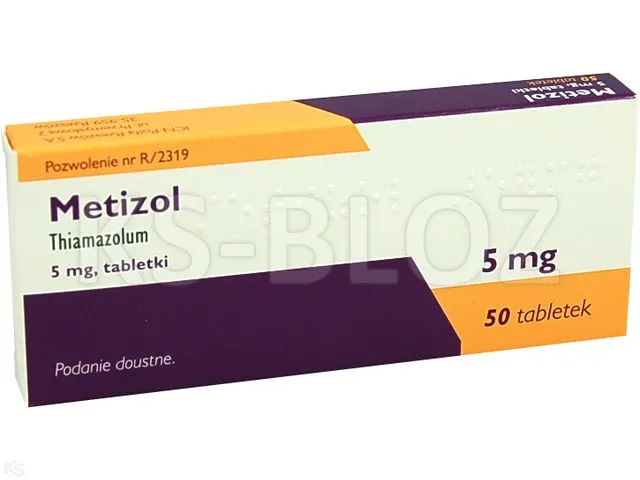
Table of Contents
Package leaflet: Information for the patient
Warning! Keep this leaflet! Information on the immediate packaging in a foreign language.
Metizol, 5 mg, tablets
Thiamazolum
Please read carefully the entire leaflet before taking this medicine, as it contains
important information for the patient.
- Keep this leaflet for future reference.
- If you have any questions, consult your doctor or pharmacist.
- This medicine has been prescribed for a specific individual. Do not pass it on to others. The medicine may harm another person, even if their symptoms are similar.
- If the patient experiences any adverse reactions, including any not listed in this leaflet, inform the doctor or pharmacist immediately. See section 4.
Table of contents:
- What Metizol is and what it is used for
- Important information before taking Metizol
- How to take Metizol
- Possible side effects
- How to store Metizol
- Contents of the pack and other information
1. What Metizol is and what it is used for
Metizol is a medicine that inhibits the production of thyroid hormones. However, it does not affect the amount of already produced hormones or their release; therefore, its effects become apparent only after several days of treatment.
Due to its properties, Metizol is used in hyperthyroidism (regardless of its type), in thyroid crisis, in preparation for thyroidectomy, and as an adjunctive agent in radioactive iodine therapy.
2. Important information before using Metizol
When not to use Metizol
- if the patient is allergic to thiamazole, substances of similar structure to thiamazole (thiourea derivatives), or any of the other components of this medicine (listed in section 6);
- if the patient has been diagnosed with a reduced number of certain blood cells (granulocytopenia);
- if the patient has cholestatic jaundice diagnosed before starting treatment with Metizol;
- if the patient previously experienced bone marrow damage following treatment with thiamazole or carbimazole;
- if the patient previously developed pancreatitis (acute pancreatitis) after administration of thiamazole or carbimazole.
Concomitant use of thiamazole and thyroid hormones is not recommended in pregnant women.
Warnings and precautions
Before starting to take Metizol, discuss this with your doctor.
If the patient previously experienced mild allergic reactions to thiamazole, such as skin rashes or
itching, inform the doctor – the doctor will decide whether the patient can take Metizol.
In cases of a large goitre causing breathing difficulties, discuss this with the doctor, as the goitre may
enlarge during treatment with Metizol. The doctor may decide to prescribe the medicine for a shorter
duration and will regularly monitor the patient during treatment.
Before starting treatment, the doctor will order blood morphology tests.
Immediately consult a doctor if symptoms such as oral mucosal inflammation, sore throat, or fever
occur. These symptoms may indicate a serious adverse effect of the medicine – agranulocytosis (a
severe deficiency of certain types of white blood cells responsible for immune responses in the
body). These symptoms usually occur within the first weeks of treatment but may appear even after
several months of therapy or when restarting treatment. If such symptoms occur, the doctor will order
a blood morphology test and may decide to discontinue treatment with Metizol.
Immediately consult a doctor if the patient develops fever or abdominal pain, as these may be
symptoms of pancreatitis (acute pancreatitis). Discontinuation of Metizol may be necessary.
If very high doses of Metizol (approximately 120 mg per day) are required, the doctor will order
regular blood tests, as bone marrow damage may occur. If toxic effects on the bone marrow occur,
the doctor may decide to discontinue treatment and, if necessary, prescribe another medicine.
If the goitre enlarges during treatment with Metizol or if thyroid function becomes excessively
suppressed, the doctor may adjust the dose of Metizol and, if necessary, additionally prescribe
thyroid hormones.
Metizol may harm the unborn child. If the patient may become pregnant, she should use a reliable
contraceptive method from the start of treatment and throughout therapy.
During treatment, the development or worsening of a condition called endocrine ophthalmopathy may
occur; this is unrelated to treatment with Metizol.
During treatment with Metizol, weight gain may occur. This is a normal bodily response. Metizol
affects thyroid hormones, which regulate energy expenditure in the body.
Children and adolescents
The safety and efficacy of Metizol have not been studied in children under 2 years of age.
Metizol can be used in children and adolescents aged 3 to 17 years (see section 3). For additional
information, consult a doctor.
Metizol and other medicines
Inform your doctor or pharmacist about all medicines currently taken or recently used, as well as any
medicines planned for use, including those available without a prescription.
The effect of thiamazole is reduced by:
- iodine;
- iodine-containing medicines (e.g. amiodarone – a medicine used to treat cardiac arrhythmias);
- radiographic contrast agents. Thiamazole reduces the uptake of radioactive iodine by the thyroid gland. If anticoagulant medicines (preventing blood clotting) are used, inform the doctor, as normalization of thyroid function due to Metizol may affect the action of these medicines. This may also apply to other medicines. As thyroid hormone levels return to normal due to treatment with Metizol, blood concentrations of certain concomitantly administered medicines may change. Therefore, dosage adjustment of concomitantly used medicines may be necessary.
Metizol with food and drink
Metizol can be taken regardless of meals.
Pregnancy, breastfeeding and fertility
Metizol may harm the unborn child.
If the patient may become pregnant, she should use a reliable contraceptive method from the start of
treatment and throughout therapy.
If the patient is pregnant, suspects she may be pregnant, or is planning to have a child, she should
immediately consult a doctor.
Continuation of treatment with Metizol during pregnancy may be necessary if potential benefits
outweigh the risks to the mother and fetus.
Concomitant use of Metizol and thyroid hormones is not permitted during pregnancy.
During breastfeeding, Metizol may be used only in low doses, up to 10 mg per day. However, thyroid
hormones must not be taken simultaneously. The infant of a patient treated with Metizol who is
breastfeeding should be regularly examined by a doctor monitoring thyroid function in the infant.
Patients receiving high doses of Metizol must not breastfeed.
Driving and operating machinery
Metizol has a minor influence on the ability to drive and operate machinery.
This medicine may cause dizziness (see section 4). Patients experiencing this adverse effect should
not drive or operate machinery until the symptoms have completely resolved.
Metizol contains monohydrate lactose
If the patient has previously been diagnosed with intolerance to certain sugars, the patient should
consult a doctor before taking this medicine.
3. How to use Metizol
This medicine should always be taken exactly as directed by the physician. In case of doubt, consult
your doctor or pharmacist.
Recommended dose
The physician determines the dose individually for each patient depending on the severity
of hyperthyroidism and the size of the goitre.
The initial daily dose is usually 40 mg to 60 mg (8 to 12 tablets), administered in 3
or 4 divided doses. This dosage should be maintained until thyroid function is suppressed
(usually 2–3 weeks, although in some cases this dosage may need to be continued for 8 weeks
or even longer). Subsequently, the dose should be gradually reduced to a maintenance dose
of usually 5 mg to 20 mg (1 to 4 tablets) per day. This dose may be taken as a single
daily dose or in 2 divided doses.
In the treatment of thyroid storm, the medicine is initially administered at a dose of 100 mg (20 tablets),
followed by 30 mg (6 tablets) every 8 hours.
Treatment of hyperthyroidism with Metizol usually lasts from 6 months to 2 years.
In preparation for surgical removal of the thyroid gland, the medicine is usually administered for 3–4 weeks
prior to the procedure.
Elderly patients:
There is no need to adjust the dosage.
Use in children and adolescents (aged 3 to 17 years):
In children and adolescents aged 3 years and older, the dose is adjusted according to body weight.
Typically, at the beginning of treatment, 0.5 mg/kg body weight is administered, divided into 2 or 3 equal doses.
Later, the physician may recommend reducing the dose. The total daily dose should not exceed
40 mg.
Use in children under 2 years of age is not recommended.
Patients with renal function impairment:
There is no need to adjust the dosage.
Patients with hepatic function impairment:
If there are impairments in liver function or liver disease, inform the physician.
In such cases, a reduction in the dose of Metizol may be necessary.
Metizol should be taken regularly.
Taking more Metizol than recommended
If more Metizol than recommended is taken, consult a doctor immediately. The doctor will initiate
appropriate management, including, among others, inducing vomiting, gastric lavage, administration of activated charcoal,
and symptomatic treatment.
In case of overdose, symptoms may include, among others: nausea, vomiting, muscle pain,
constipation, headache, in women menstrual disturbances, decreased body temperature,
enlargement or appearance of goitre (swelling in the front of the neck), excessive drowsiness or
lethargy, fatigue, weight gain, excessive dryness of the skin, and insomnia.
Missing a dose of Metizol
If a dose of the medicine is missed at the scheduled time, take it as soon as possible. However, if the time for the next dose is approaching,
skip the missed dose.
Do not take a double dose to make up for a missed dose.
Stopping treatment with Metizol
Premature discontinuation of treatment with Metizol may lead to worsening of hyperthyroidism.
In case of any doubts regarding the use of the medicine, consult your doctor or pharmacist.
4. Possible adverse reactions
Like all medicines, this medicine can cause adverse reactions, although not everyone will experience them.
Adverse reactions may occur:
Very common (may affect more than 1 in 10 people)
Common (may affect up to 1 in 10 people)
Uncommon (may affect less than 1 in 100 people)
Rare (may affect up to 1 in 1,000 people)
Very rare (may affect up to 1 in 10,000 people)
Frequency not known (frequency cannot be estimated from the available data)
If any of the following adverse reactions occur, stop taking the
medicine and contact a doctor immediately:
- Symptoms such as: inflammation of the mucous membranes of the mouth, sore throat, fever, which may indicate an uncommon adverse reaction – agranulocytosis (a marked decrease in the number of certain types of white blood cells). These symptoms may appear within the first weeks of treatment or even after several weeks or months of taking the medicine.
In addition, the following adverse reactions may occur:
Very common adverse reactions:
- Allergic skin reactions of varying severity (itching, rash, urticaria) – usually mild and resolve during continued treatment.
Common adverse reactions:
- Joint pain, which may occur even after several months of therapy.
Uncommon adverse reactions:
- Taste disturbances (altered sense of taste, loss of taste) – these symptoms may resolve after discontinuation of treatment, although this may take several weeks;
- Fever.
Very rare adverse reactions:
- Thrombocytopenia (reduced number of platelets; may manifest as excessive bleeding, e.g. after procedures, nosebleeds; frequent bruising; presence of blood in stool or urine; petechial hemorrhages on the skin);
- Pancytopenia (reduced number of all blood cells);
- Generalized lymphadenopathy (enlarged lymph nodes), decreased blood glucose concentration (caused by disturbances in glucose regulation processes);
- Neuritis, polyneuropathy (nerve damage, may manifest as numbness and tingling in the hands, feet, and face);
- Salivary gland swelling;
- Cholestatic jaundice (manifested by yellowing of the skin, mucous membranes, and whites of the eyes) and toxic hepatitis – these symptoms usually resolve after discontinuation of the medicine;
- Severe forms of skin allergic reactions, including generalized skin inflammation;
- Hair loss;
- Drug-induced lupus erythematosus (an immune-mediated disease; may manifest, among others, as fatigue, loss of appetite, and development of a characteristic butterfly-shaped rash on the face).
Frequency not known:
- Dizziness;
- Pancreatitis (acute inflammation of the pancreas).
Children and adolescents
The type, frequency, and severity of adverse reactions in children are similar to those observed in adults.
Reporting of adverse reactions
If any adverse reactions occur, including any not listed in this leaflet, inform a doctor or pharmacist. Adverse reactions can be reported directly to the Department of Monitoring Adverse Reactions of Medicinal Products at the Office for Registration of Medicinal Products, Medical Devices and Biocidal Products, Al. Jerozolimskie 181C, 02-222 Warsaw, tel.: + 48 22 49 21 301, fax: + 48 22 49 21 309; website: https://smz.ezdrowie.gov.pl.
Reporting adverse reactions helps to provide more information on the safety of the medicine.
5. How to store Metizol
Do not store above 25°C.
Keep the blisters in the outer packaging to protect from light.
Keep the medicine out of sight and reach of children.
Do not use this medicine after the expiry date stated on the packaging.
The expiry date refers to the last day of the stated month.
Medicines should not be disposed of via wastewater or household waste. Ask your pharmacist how to dispose of medicines no longer required. This will help protect the environment.
6. Contents of the package and other information
What Metizol contains
- The active substance is thiamazole.
- The other ingredients are: monohydrate lactose, potato starch, povidone, talc, magnesium stearate.
What Metizol looks like and contents of the pack
Metizol is a white, round, biconvex tablet, marked with an embossed "M" on one side and smooth on the other.
The pack contains 50 tablets in PVC/Al blisters within a cardboard box.
For further detailed information, please contact the responsible party or the parallel importer.
Marketing Authorisation Holder in Lithuania, the exporting country:
Viatris Healthcare Limited
Damastown Industrial Park
Mulhuddart, Dublin 15, Dublin, Ireland
Manufacturer:
ICN Polfa Rzeszów S.A.
Przemysłowa 2 Street
35-959 Rzeszów
Poland
Parallel importer:
InPharm Sp. z o.o.
Strumykowa 28/11 Street
03-138 Warsaw
Poland
Repackaged in:
InPharm Sp. z o.o. Services sp. k.
Chełmżyńska 249 Street
04-458 Warsaw
Poland
Marketing Authorisation Number in Lithuania, the exporting country: LT/1/95/2571/001
Parallel Import Licence Number: 354/14