Mestinon
Poland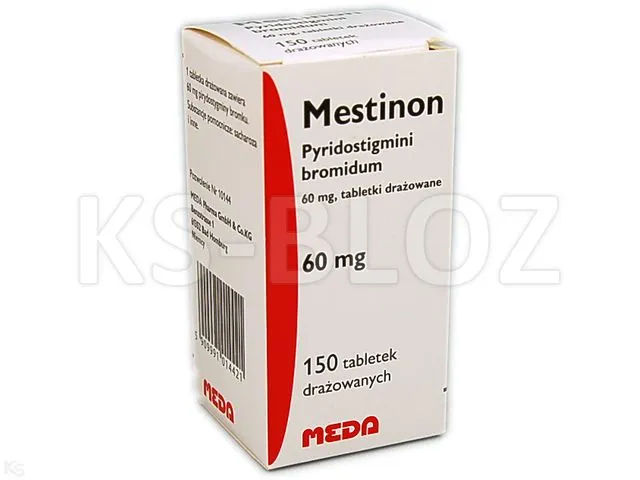
Table of Contents
Package leaflet: Information for the user
Warning! Keep this leaflet! Information on the immediate packaging in a foreign language.
Mestinon
60 mg, coated tablets
Pyridostigmini bromidum
Please read the entire leaflet carefully before using this medicine, as it contains
important information for the patient.
- Keep this leaflet to be able to read it again if necessary.
- If you have any questions, please consult your doctor or pharmacist.
- This medicine has been prescribed for a specific individual. Do not pass it on to others. The medicine may harm someone else, even if their symptoms are the same.
- If the patient experiences any adverse reactions, including any adverse reactions not listed in this leaflet, inform your doctor or pharmacist. See section 4.
Table of contents of the leaflet
- What Mestinon is and what it is used for
- Important information before taking Mestinon
- How to take Mestinon
- Possible side effects
- How to store Mestinon
- Contents of the pack and other information
1. What Mestinon is and what it is used for
Mestinon is a cholinesterase inhibitor – an enzyme that breaks down acetylcholine, which is responsible for transmitting signals from the brain to the muscles. It increases the amount of acetylcholine and improves muscle stimulation.
Mestinon is used in the treatment of myasthenia gravis, paralytic intestinal obstruction, and postoperative urinary retention.
2. Important information before using Mestinon
When not to use Mestinon
- if the patient is allergic to pyridostigmine, bromides, or any of the other ingredients of this medicine (listed in section 6);
- if the patient has mechanical obstruction of the gastrointestinal or urinary tract.
Warnings and precautions
Before starting treatment with Mestinon, discuss this with your doctor.
Exercise particular caution:
- if the patient has:
- obstructive respiratory disease, such as bronchial asthma or chronic obstructive pulmonary disease (COPD),
- cardiac arrhythmias, such as bradycardia (slowing of the heartbeat below 60 beats per minute) or atrioventricular block,
- hypotension,
- vagotonia (a neurovegetative regulatory disorder characterized by predominant symptoms related to vagus nerve stimulation, such as marked slowing of heart function, lowering of blood pressure),
- peptic ulcer of the stomach and/or duodenum,
- epilepsy,
- Parkinson's disease,
- hyperthyroidism,
- impaired kidney function,
- if the patient has recently been diagnosed with coronary artery disease,
- if the patient is taking atropine to prevent adverse effects of the medicine, as it may mask symptoms of pyridostigmine overdose,
- if the doctor has previously diagnosed the patient with intolerance to certain sugars, the patient should contact the doctor before taking this medicine.
There is currently no evidence that the medicine affects elderly individuals in any specific way.
However, elderly patients are more prone than younger adults to cardiac arrhythmias.
When high doses of Mestinon are used in patients with myasthenia, the doctor may consider
the need for atropine or another anticholinergic drug (medicines that counteract the effects
of Mestinon) to alleviate certain adverse effects.
However, it should be remembered that these drugs, by slowing intestinal motility, may affect
the absorption of pyridostigmine.
In patients suspected of having a cholinergic crisis (sudden worsening of the patient's condition,
manifested by difficulty breathing, muscle twitching, slowing of the heartbeat below
60 beats per minute, and pupillary constriction) caused by pyridostigmine overdose,
the doctor should consider a myasthenic crisis resulting from worsening myasthenia (sudden
worsening of the patient's condition, manifested by difficulty breathing, increased heart rate above
60 beats per minute, and pupillary dilation). Both conditions are characterized by increased
muscle weakness, but require completely different therapeutic approaches (a myasthenic crisis
may require intensification of Mestinon treatment, whereas a cholinergic crisis requires
- immediate discontinuation of Mestinon and symptomatic treatment, including assisted ventilation).
Mestinon and other medicines
Inform your doctor about all medicines the patient is currently taking or has recently taken,
as well as any medicines the patient plans to take.
Inform your doctor if the patient is taking:
- glucocorticosteroids or immunosuppressive medicines (medicines that suppress the immune system, used, among others, to prevent transplant rejection), as it may be necessary to reduce the dose of Mestinon, although the addition of new glucocorticosteroids may initially worsen myasthenia symptoms;
- methylcellulose or medicines containing methylcellulose as an excipient, as this may inhibit the absorption of Mestinon;
- antimuscarinic medicines, such as atropine or hyoscine (medicines that counteract the effects of Mestinon, causing pupil dilation, muscle relaxation, and increased heart rate), as they may counteract or impair the absorption of Mestinon;
- non-depolarizing muscle relaxants (e.g. pancuronium and vecuronium), as their effect may be antagonized;
- depolarizing muscle relaxants (e.g. suxamethonium), as their effect may be prolonged;
- aminoglycoside antibiotics;
- local anesthetics;
- general anesthetics;
- antiarrhythmic medicines;
- other medicines interfering with neuromuscular transmission.
Also inform your doctor if the patient has undergone thymectomy,
as it may be necessary to reduce the dose of Mestinon.
Taking Mestinon with food and drink
Mestinon should not be taken with meals, as this delays the onset of its effect.
Pregnancy and breastfeeding
If the patient is pregnant or breastfeeding, suspects she may be pregnant, or is planning to have a child,
she should consult her doctor or pharmacist before using this medicine.
Driving and operating machinery
Pupil constriction and accommodation disturbances caused by pyridostigmine or related to
inadequate treatment of myasthenia may impair visual acuity and, consequently, reaction ability,
as well as the ability to drive vehicles and operate machinery.
Mestinon contains sucrose
This medicine contains sucrose. If the patient has previously been diagnosed with intolerance to certain sugars,
the patient should contact the doctor before taking this medicine.
3. How to take Mestinon
This medicine should always be taken exactly as prescribed by your doctor. If in doubt, consult your doctor.
Myasthenia
Adults and children above 12 years of age:
Orally, 30 mg to 180 mg (½ to 3 tablets) several times daily, during periods when maximum physical strength is needed (e.g. before getting out of bed, before meals). The medicine usually acts for 3 to 4 hours after administration (if taken before going to bed at night, it acts for about 6 hours).
The total daily dose is usually between 120 mg (2 tablets) and 1200 mg (20 tablets), although higher doses may sometimes be necessary.
Children under 12 years of age:
Initial dose is 30 mg (½ tablet) daily in children under 6 years of age or 60 mg (1 tablet) daily in children aged 6–12 years. This should be gradually increased by 15 mg to 30 mg daily until maximum improvement is achieved.
The usual total daily dose ranges from 30 mg to 360 mg (½ to 6 tablets) daily.
Paralytic ileus and postoperative urinary retention
Adults and children above 12 years of age:
Orally, usually 60 mg to 240 mg (1 to 4 tablets) daily.
Children under 12 years of age:
Orally, usually 15 mg to 60 mg (¼ to 1 tablet) daily.
The frequency of dosing may vary depending on the patient's needs.
Dosage in elderly patients
No special recommendations.
Renal function disorders
Pyridostigmine, the active substance in Mestinon, is excreted mainly unchanged in the urine; therefore, in patients with impaired renal function, lower doses may be required, and treatment should be based on dose titration to achieve the desired effect.
Hepatic function disorders
No special recommendations.
Method of administration
Mestinon should be taken with water (half or a full glass of water).
Taking a higher than recommended dose of Mestinon
Mestinon may cause a cholinergic crisis. Symptoms of overdose include: abdominal cramps, increased intestinal peristalsis, diarrhoea, excessive sweating, nausea and vomiting, increased mucus secretion in the bronchial tree, increased salivation, bronchospasm, profuse sweating, miosis (pupillary constriction), muscle twitching, fasciculations (short-lived, small contractions of muscle fiber groups), generalised weakness progressing to muscle paralysis, which may lead to respiratory arrest, and in exceptionally severe cases, cerebral hypoxia, hypotension progressing to circulatory collapse, and bradycardia (slowing of heart rate below 60 beats/minute) up to cardiac arrest.
Effects on the central nervous system may include agitation, confusion, slurred speech, nervousness, irritability, visual hallucinations, convulsions, and coma.
In case of overdose, Mestinon should be discontinued immediately and medical advice sought, so that appropriate treatment can be initiated.
Missing a dose of Mestinon
If a dose is missed at the scheduled time, it should be taken as soon as possible. However, if the time for the next dose is approaching, the missed dose should be skipped. Do not take a double dose to make up for a missed dose.
Stopping treatment with Mestinon
Discontinuation of Mestinon may lead to worsening of symptoms of the disease for which the medicine is prescribed (e.g. myasthenia).
4. Possible adverse effects
Like all medicines, this medicine can cause adverse effects, although not everyone will experience them.
As with all cholinergic medicines, Mestinon may affect the function of the autonomic nervous system (a part of the nervous system whose nerves innervate internal organs).
Muscarinic-like adverse symptoms may occur, such as nausea, vomiting, diarrhoea, abdominal cramps, increased peristalsis, increased bronchial mucus and salivary secretion, bradycardia (slowing of heart rate below 60 beats per minute), and miosis (pupil constriction).
The primary nicotinic effect consists of muscle contractions, fasciculations (brief, minor contractions of groups of muscle fibres), and muscle weakness.
The frequency of the adverse effects listed below is unknown (cannot be estimated from available data).
Immune system disorders: hypersensitivity to the medicine.
Nervous system disorders: fainting.
Eye disorders: miosis (pupil constriction), excessive lacrimation, accommodation disorders (e.g. blurred vision).
Cardiac disorders: cardiac arrhythmias (including bradycardia – slowed heart rate, tachycardia – accelerated heart rate, atrioventricular block), Prinzmetal's angina (a form of coronary artery disease).
Vascular disorders: sudden flushing, especially of the face, hypotension.
Respiratory, thoracic and mediastinal disorders: increased bronchial mucus secretion accompanied by bronchospasm.
Gastrointestinal disorders: nausea, vomiting, diarrhoea, excessive gastrointestinal motility, excessive salivation, abdominal symptoms (discomfort, pain, cramps, etc.).
Skin and subcutaneous tissue disorders: rare (occurs in ≥1/10,000 to <1/1,000 patients): rash (usually resolves shortly after discontinuation of the medicine. Medicines containing bromides should not be used further); frequency unknown: excessive sweating, urticaria.
Musculoskeletal and connective tissue disorders: worsening of muscle weakness, fasciculations (brief, minor contractions of groups of muscle fibres), tremor and muscle spasms or decreased muscle tone.
Renal and urinary disorders: sudden urge to urinate.
Since these symptoms may indicate cholinergic crisis, they should be reported to a doctor immediately for proper diagnosis.
Reporting of adverse effects
If any adverse effects occur, including any not listed in this leaflet, inform your doctor or pharmacist. Adverse effects can be reported directly to the Department of Monitoring Adverse Drug Reactions of the Office for Registration of Medicinal Products, Medical Devices and Biocidal Products, Al. Jerozolimskie 181C, 02-222 Warsaw, tel.: +48 22 49 21 301, fax: +48 22 49 21 309, website: https://smz.ezdrowie.gov.pl.
Reporting adverse effects helps to provide more information on the safety of the medicine.
5. How to store Mestinon
Store below 25°C.
Keep the medicine in a place out of sight and reach of children.
Do not use this medicine after the expiry date stated on the container. The expiry date refers to the last day of the stated month.
The shelf-life after first opening the bottle is 90 days.
Medicines must not be disposed of via wastewater or household waste. Ask your pharmacist how to dispose of medicines no longer in use. This will help protect the environment.
6. Contents of the packaging and other information
What Mestinon contains
- The active substance is pyridostigmine in the form of pyridostigmine bromide (Pyridostigmini bromidum). One coated tablet contains 60 mg of pyridostigmine bromide.
- The other ingredients are: anhydrous colloidal silica, maize starch, povidone K 30, pregelatinized potato starch, talc, magnesium stearate,
- coating: sucrose, rice starch, gum arabic, solid paraffin, liquid paraffin, talc, iron oxide yellow (E 172), iron oxide red (E 172).
What Mestinon looks like and contents of the pack
An amber glass bottle closed with an HDPE screw cap, packed in a cardboard box.
Pack contains 20 or 100 coated tablets in a bottle.
For further information, please contact the responsible party or the parallel importer.
Responsible party in Portugal, country of export:
BGP Products, Unipessoal Lda.
Av. D. João II, Edifício Atlantis, nº 44C - 7.3 and 7.4
1990-095 Lisbon, Portugal
Manufacturer:
ICN Polfa Rzeszów S.A.
Przemysłowa 2 Street
35-959 Rzeszów, Poland
Labiana Pharmaceuticals S.L.
C/ Casanova, 27-31 - Corbera de Llobregat
08757 Barcelona, Spain
Parallel importer:
InPharm Sp. z o.o.
Strumykowa 28/11 Street
03-138 Warsaw, Poland
Repackaged in:
InPharm Sp. z o.o. Services sp. k.
Chełmżyńska 249 Street
04-458 Warsaw, Poland
Marketing authorization number in Portugal, country of export: 4328282
Parallel import authorization number: 54/23