Melkart
Poland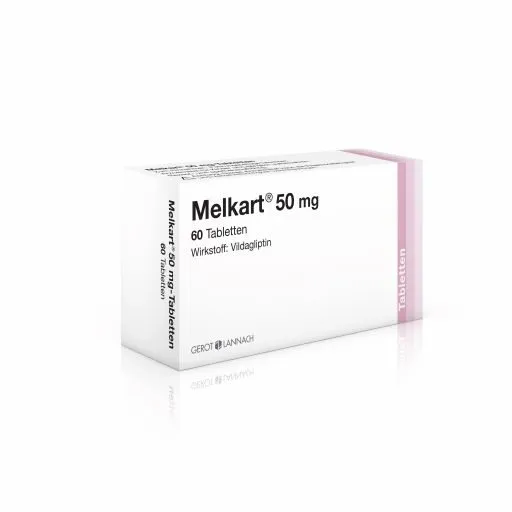
Table of Contents
Patient Information Leaflet
Melkart, 50 mg, tablets
Vildagliptinum
Please read this leaflet carefully before taking this medicine, because it contains important information for you.
- Keep this leaflet as you may need to read it again.
- If you have any questions, ask your doctor, pharmacist, or nurse.
- This medicine has been prescribed for you personally. Do not pass it on to others. It may harm someone else, even if their symptoms are the same as yours.
- If you experience any side effects, including any not listed in this leaflet, tell your doctor, pharmacist, or nurse. See section 4.
Contents of this leaflet
- What Melkart is and what it is used for
- What you need to know before taking Melkart
- How to take Melkart
- Possible side effects
- How to store Melkart
- Contents of the pack and other information
1. What Melkart is and what it is used for
The active substance in Melkart, vildagliptin, belongs to a group of medicines called oral antidiabetic drugs.
Vildagliptin is used to treat adult patients with type 2 diabetes when diabetes cannot be controlled by diet and physical exercise alone. The medicine helps control blood glucose levels. Your doctor may prescribe Melkart either as a single treatment or in combination with other antidiabetic medicines you are already taking, if they do not adequately control your diabetes.
Type 2 diabetes develops when the body does not produce enough insulin or when the insulin produced by the body does not work properly. Type 2 diabetes may also develop when too much glucagon is produced in the body.
Insulin helps lower blood glucose levels, especially after meals. Glucagon stimulates the liver to produce glucose, which increases blood glucose levels. Both substances are produced in the pancreas.
How Melkart works
Melkart works by stimulating the pancreas to produce more insulin and less glucagon. This helps control blood glucose levels. This medicine has been shown to reduce blood glucose levels, which may help prevent complications of diabetes.
Even if you start taking an antidiabetic medicine, it remains important to continue following a proper diet and (or) performing recommended physical exercise.
2. Important information before using Melkart
When not to take Melkart:
- if the patient is allergic to vildagliptin or any of the other ingredients of this medicine (listed in section 6). If the patient thinks they may be allergic to vildagliptin or any of the other ingredients of Melkart, they should not take the medicine and should contact their doctor.
Warnings and precautions
Before starting treatment with Melkart, discuss the following with your doctor, pharmacist or
nurse:
- if the patient has type 1 diabetes (i.e. the patient's body does not produce insulin) or has experienced diabetic ketoacidosis;
- if the patient is taking an antidiabetic medicine called a sulfonylurea (the doctor may recommend reducing the dose of the sulfonylurea taken together with Melkart to avoid excessively low blood glucose levels [hypoglycaemia]);
- if the patient has moderate or severe kidney disease (the patient may require a lower dose of Melkart);
- if the patient is on dialysis;
- if the patient has liver disease;
- if the patient has heart failure;
- if the patient has previously had or currently has a disease of the pancreas.
If the patient previously took vildagliptin but had to discontinue treatment due to liver disease, they should not use this medicine.
Diabetic skin changes are a common complication of diabetes. The patient should follow the doctor's or nurse's advice regarding skin and foot care. Particular attention should also be paid to the development of new blisters or ulcers during treatment with Melkart. If these occur, the patient should contact their doctor immediately.
Before starting treatment with Melkart, liver function tests should be performed, followed by repeat testing every three months during the first year of treatment and periodically thereafter. This is to detect any increase in liver enzyme activity as early as possible.
Children and adolescents
The use of Melkart in children and adolescents under 18 years of age is not recommended.
Melkart with other medicines
Tell your doctor or pharmacist about all medicines the patient is currently taking or has recently taken, as well as any medicines they plan to take.
The doctor may adjust the dose of Melkart if the patient is taking any of the following medicines at the same time:
- thiazides or other diuretics
- corticosteroids (usually used in the treatment of inflammatory conditions)
- medicines used in thyroid treatment
- certain medicines affecting the nervous system
Pregnancy, breastfeeding and fertility
If the patient is pregnant or breastfeeding, suspects she may be pregnant, or is planning to have a child, she should consult her doctor or pharmacist before using this medicine.
Melkart should not be used during pregnancy. It is not known whether Melkart passes into breast milk. Melkart should not be used if the patient is breastfeeding or planning to breastfeed.
Driving and operating machinery
If the patient experiences dizziness while taking Melkart, they should not drive or operate machinery.
Melkart contains lactose
Melkart contains lactose (milk sugar). If the patient has been diagnosed with an intolerance to certain sugars, they should consult their doctor before starting treatment with this medicine.
This medicine contains less than 1 mmol sodium (23 mg) per tablet; that is, the medicine is considered "sodium-free".
3. How to take Melkart
This medicine should always be taken according to the instructions given by the doctor or pharmacist. If in doubt, consult your doctor or pharmacist.
When and how to take Melkart
The dose of Melkart depends on the patient's condition. The doctor will inform the patient exactly how many tablets of Melkart should be taken. The maximum daily dose is 100 mg.
The usual recommended dose of Melkart is:
- 50 mg once daily in the morning, if the patient is taking Melkart together with another medicine called a sulfonylurea;
- 100 mg daily, divided into two doses: 50 mg in the morning and 50 mg in the evening, if the patient is taking Melkart alone, in combination with metformin or glitazone, with metformin and a sulfonylurea, or with insulin;
- 50 mg once daily in the morning, if the patient has moderate or severe kidney disease or is undergoing dialysis.
How to take Melkart
The tablets should be swallowed whole with water.
How long to take Melkart
- Melkart should be taken every day for as long as your doctor recommends. The doctor may decide on long-term treatment.
- The doctor will regularly monitor the patient’s condition to check whether the treatment is achieving the desired effect.
Taking more Melkart than recommended
If the patient has taken too many Melkart tablets, or if someone else has taken this medicine, seek medical advice immediately. Medical attention may be necessary. If it is necessary to visit a doctor or hospital, take the medicine packaging with you.
Missed dose of Melkart
If the patient forgets to take a dose, take it as soon as possible. Then take the next dose at the usual time. However, if it is almost time for the next scheduled dose, the missed dose should not be taken.
Do not take a double dose to make up for a missed tablet.
Stopping Melkart
Do not stop taking Melkart without consulting your doctor. If you have any further doubts regarding the use of this medicine, consult your doctor.
4. Possible adverse reactions
Like all medicines, this medicine can cause adverse reactions, although not everyone experiences them.
Some adverse reactions require immediate medical attention:
Treatment with Melkart should be discontinued and medical advice sought immediately if the patient experiences any of the following adverse reactions:
- Angioedema (rare: may occur in less than 1 in 1,000 people): symptoms include swelling of the face, tongue or throat, difficulty swallowing, difficulty breathing, sudden appearance of rash or hives, which may indicate a reaction known as "angioedema";
- Liver disease (hepatitis) (frequency not known): symptoms include yellowing of the skin and eyes, nausea, loss of appetite, or dark urine, which may indicate liver disease (hepatitis);
- Pancreatitis (rare: may occur in up to 1 in 1,000 patients): symptoms include severe and persistent abdominal pain (around the stomach) radiating to the back, as well as nausea and vomiting.
Other adverse reactions
The following adverse reactions have been reported during treatment with Melkart:
- Very common (may affect more than 1 in 10 people): sore throat, cold, fever.
- Common (may affect up to 1 in 10 people): itchy rash, tremor, headache, dizziness, muscle pain, joint pain, constipation, swollen hands, ankles or feet (oedema), excessive sweating, vomiting, stomach and abdominal pain, diarrhoea, heartburn, nausea, blurred vision.
- Uncommon (may affect up to 1 in 100 people): weight gain, chills, fatigue, sexual dysfunction, hypoglycaemia, flatulence.
- Rare (may affect up to 1 in 1,000 people): pancreatitis.
Following the marketing of this medicine, the following adverse reactions have also been reported:
- Frequency not known (frequency cannot be estimated from available data): localised peeling of the skin or formation of blisters, vasculitis which may cause skin rash or spotty, flat, red, round spots under the skin surface or bruising.
Reporting of adverse reactions
If any adverse effects occur, including any adverse effects not listed in this leaflet, please inform your doctor, pharmacist or nurse. Adverse reactions can be reported directly to the Department of Monitoring Adverse Reactions of Medicinal Products at the Office for Registration of Medicinal Products, Medical Devices and Biocidal Products:
Al. Jerozolimskie 181C,
02-222 Warsaw
Tel.: +48 22 49 21 301
Fax: +48 22 49 21 309
Website: https://smz.ezdrowie.gov.pl
Adverse reactions can also be reported to the marketing authorisation holder.
Reporting adverse reactions helps to provide more information on the safety of this medicine.
5. How to store Melkart
Keep this medicine out of sight and reach of children.
Do not use this medicine after the expiry date stated on the packaging after: EXP.
The expiry date refers to the last day of the stated month.
No special storage conditions are required for this medicine.
Do not use Melkart if you notice that the packaging is damaged or shows signs of tampering.
Medicines must not be disposed of via wastewater or household waste. Ask your pharmacist how to dispose of medicines no longer in use. This will help protect the environment.
6. Contents of the packaging and other information
What Melkart contains
- The active substance is vildagliptin. Each tablet contains 50 mg of vildagliptin.
- Excipients: lactose, sodium stearyl fumarate, microcrystalline cellulose PH 102, sodium croscarmellose.
What Melkart looks like and contents of the pack
White to almost white, round, biconvex tablets with a diameter of 8.0 mm ± 0.5 mm.
Aluminum/OPA/Aluminum/PVC blister packs containing 28 or 56 tablets, in a cardboard box.
Not all pack sizes may be marketed.
Marketing Authorisation Holder
G.L. Pharma GmbH
Schlossplatz 1
8502 Lannach
Austria
Manufacturer
G.L. Pharma GmbH
Schlossplatz 1
8502 Lannach
Austria
Galenicum Health, S.L.U.
Sant Gabriel, 50
Esplugues de Llobregat
08950 Barcelona
Spain
SAG Manufacturing, S.L.U
Ctra. N-I, km 36
28750 San Agustín de Guadalix
Madrid – Spain
For further information and information on the medicinal product names in other EEA countries, please contact the representative of the Marketing Authorisation Holder:
G.L. PHARMA POLAND Sp. z o.o.
Al. Jana Pawła II 61/313
01-031 Warsaw, Poland
Tel: 022/ 636 52 23; 636 53 02
email: [email protected]