Maxiseptic
Poland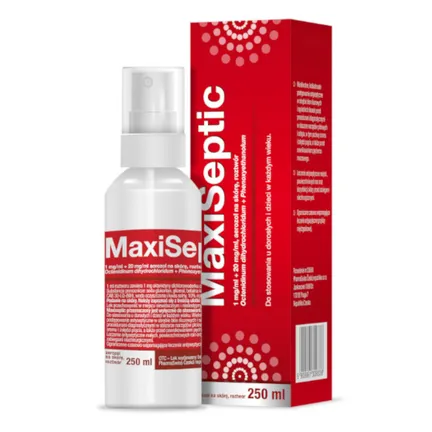
Table of Contents
Package leaflet: Information for the user
Maxiseptic, 1 mg/ml + 20 mg/ml, solution for skin application
Octenidinum dihydrochloridum + Phenoxyethanolum
Please read all of this leaflet carefully before using this medicine, because it contains
important information for the patient.
This medicine should always be used exactly as described in this patient leaflet, or as directed by a
doctor, pharmacist, or nurse.
- Keep this leaflet, as you may need to read it again.
- If you need advice or further information, please consult your pharmacist.
- If you experience any adverse reactions, including any not listed in this leaflet, inform your doctor, pharmacist, or nurse. See section 4.
- If there is no improvement after 14 days, or if you feel worse, consult your doctor.
Leaflet contents
- What Maxiseptic is and what it is used for
- Important information before using Maxiseptic
- How to use Maxiseptic
- Possible side effects
- How to store Maxiseptic
- Contents of the pack and other information
1. What Maxiseptic is and what it is used for
Maxiseptic is an antiseptic medicine applied to the skin or wounds to destroy microorganisms and infectious agents, and to prevent infections. Maxiseptic contains two active substances: octenidine dihydrochloride and phenoxyethanol, which have antibacterial and antifungal properties. Maxiseptic is intended for use in adults and children of all ages for:
- repeated, short-term antiseptic treatment of mucous membranes and adjacent tissues prior to diagnostic procedures involving the genital organs and anus, including the vagina, vulva, and glans penis, as well as prior to urinary bladder catheterization
- antiseptic treatment of minor, superficial wounds and skin disinfection before non-surgical procedures
- limited-duration supportive antiseptic treatment of interdigital tinea (athlete's foot).
If there is no improvement after 14 days, or if you feel worse, consult your doctor.
2. Information before using Maxiseptic
When not to use Maxiseptic:
- if the patient is allergic to octenidine dihydrochloride, phenoxyethanol, or any of the other ingredients of this medicine (listed in section 6)
- for irrigation of the abdominal cavity (e.g. during surgery), urinary bladder, or inside the ear (the eardrum in the middle ear, which vibrates in response to sound waves).
Warnings and precautions
Before using Maxiseptic, discuss it with your doctor, pharmacist, or nurse.
Maxiseptic is intended for external use only.
Do not swallow Maxiseptic or allow it to enter the bloodstream, for example through accidental injection.
After irrigating deep wounds using a syringe, cases of persistent swelling, erythema, and tissue necrosis have been reported. In some cases, surgical intervention was necessary (see section 4).
To avoid tissue damage, the product must not be administered via syringe into deep tissues. Maxiseptic is intended exclusively for external use (using gauze).
Use with caution in newborns, especially premature infants. Maxiseptic may cause severe skin reactions. Excess product should be removed and care must be taken to ensure that the solution does not remain on the skin longer than necessary (this also applies to materials impregnated with the solution that are in direct contact with the patient).
Do not use Maxiseptic in the eye. If contact occurs, rinse immediately with plenty of water.
In interdigital fungal infections (fungal infection of the skin between fingers and toes), Maxiseptic is used only for limited, short-term antiseptic supportive treatment. In case of interdigital fungal infection, consult a doctor or pharmacist. To achieve optimal treatment results, strictly follow the instructions provided by your doctor or pharmacist.
Avoid contact of the product with anionic surfactants, e.g. detergents and cleaning agents. Due to the risk of interaction with anionic compounds, it is recommended to use distilled water (or water for injections) as the solvent.
Children and adolescents
Maxiseptic may be used in children of all ages.
Other medicines and Maxiseptic
Tell your doctor or pharmacist about all medicines the patient is currently taking or has recently taken, as well as any medicines the patient plans to use.
Maxiseptic must not be mixed with other substances. In particular, do not use it concomitantly with antiseptic agents based on PVP-iodine (povidone-iodine) on adjacent skin areas, as intense discolouration ranging from brown to violet may occur at the interface.
Maxiseptic, food, drink and alcohol
Maxiseptic is intended for external use only.
Pregnancy, breastfeeding and fertility
If the patient is pregnant or breastfeeding, suspects she may be pregnant, or is planning to become pregnant, she should consult her doctor or pharmacist before using this medicine.
Pregnancy
As a precautionary measure, it is best to avoid using Maxiseptic during pregnancy. Do not use Maxiseptic unless otherwise directed by a doctor.
Breastfeeding
As a precautionary measure, it is best to avoid using Maxiseptic during breastfeeding. Do not use Maxiseptic unless otherwise directed by a doctor. Maxiseptic should not be applied to the breast area in breastfeeding women.
Fertility
The effect of Maxiseptic on fertility in humans has not been studied.
Driving and using machines
Maxiseptic has no influence on the ability to drive or operate machinery.
3. How to use Maxiseptic
This medicine should always be used exactly as described in this patient information leaflet, or as directed by a doctor, pharmacist, or nurse. If in doubt, consult a doctor, pharmacist, or nurse.
Administration method
For topical application.
Maxiseptic is intended for use on the skin surface and must not be administered, for example by injection, into deep tissue layers.
Maxiseptic is intended for use on skin surfaces or small, superficial wounds.
Maxiseptic should be used undiluted.
Adults
Apply Maxiseptic once daily to the affected area, ensuring complete wetting of the surface.
Unless otherwise advised, gently wipe the affected area with at least two gauze pads soaked in Maxiseptic, one after the other, to ensure complete wetting. Application using gauze pads is the preferred method.
Before covering the wound with a dressing, plaster, or clothing, wait at least one or two minutes for the Maxiseptic to dry completely.
For short-term supportive antiseptic treatment of interdigital fungal infections, apply the medicine to the affected areas in the morning and evening.
To achieve the desired treatment outcome, strictly follow the instructions above.
Maxiseptic should not be used for longer than 2 weeks without medical supervision.
Use in children and adolescents
The dosage of Maxiseptic is the same for adults and children.
Use of a higher than recommended dose of Maxiseptic
Overdose of Maxiseptic following topical application is highly unlikely. If in doubt, consult a doctor, pharmacist, or nurse.
If Maxiseptic is swallowed, seek immediate medical advice from a doctor.
Missed dose of Maxiseptic
Do not use a double dose to make up for a missed dose.
Stopping Maxiseptic treatment
If you have any further doubts regarding the use of this medicine, consult your doctor, pharmacist, or nurse.
4. Possible adverse reactions
Like all medicines, this medicine can cause adverse reactions, although not everybody will experience them.
The following adverse reactions have been observed after using a medicine containing octenidine dihydrochloride and phenoxyethanol:
Uncommon adverse reactions (may affect up to 1 in 1,000 people):
Burning sensation, redness, itching, feeling of warmth.
Very rare adverse reactions (may affect up to 1 in 10,000 people):
Contact allergic reactions, e.g. transient redness at the site of application.
Frequency not known (frequency cannot be estimated from the available data):
After irrigating deep wounds using a syringe, cases of persistent swelling, erythema, and tissue necrosis have been reported. In some cases, surgical intervention was required (see section 2).
Reporting of adverse reactions
If any adverse reactions occur, including any adverse reactions not listed in this leaflet, inform your doctor, pharmacist, or nurse. Adverse reactions can be reported directly to the Department of Monitoring Adverse Drug Reactions of the Office for Registration of Medicinal Products, Medical Devices and Biocidal Products:
Al. Jerozolimskie 181C
02-222 Warsaw
Phone: +48 22 49 21 301
Fax: +48 22 49 21 309
Website: https://smz.ezdrowie.gov.pl
Adverse reactions can also be reported to the marketing authorization holder.
Reporting adverse reactions helps provide more information on the safety of the medicine.
5. How to store Maxiseptic
Keep this medicine out of the sight and reach of children.
Do not use this medicine after the expiry date stated on the carton. The expiry date refers to the last day of the stated month.
No special storage conditions are required for this medicine.
After first opening the bottle, Maxiseptic can be used for up to 1 year, provided the expiry date has not been exceeded.
Medicines should not be disposed of via wastewater or household waste. Ask your pharmacist how to dispose of medicines no longer in use. This will help protect the environment.
6. Contents of the package and other information
What the medicine Maxiseptic contains
- The active substances in the medicine are octenidine dihydrochloride and phenoxyethanol.
1 ml of skin solution contains 1 mg of octenidine dihydrochloride and 20 mg of phenoxyethanol.
- The other ingredients are: sodium gluconate, glycerol, cocamidopropyl betaine CAB 30-LQ-(MH), purified water, and hydrochloric acid, 10% solution (for adjusting pH to 5.0–6.5).
What Maxiseptic looks like and contents of the pack
Maxiseptic is a clear, colourless solution with a characteristic odour.
The medicine is available in HDPE bottles containing 250 ml, 500 ml or 1000 ml of solution, with a PP screw cap and tamper-evident ring, packed in a cardboard box.
Not all pack sizes may be marketed.
Marketing Authorisation Holder
Bausch Health Ireland Limited
3013 Lake Drive
Citywest Business Campus
Dublin 24, D24PPT3
Ireland
Tel. +48 17 865 51 00
Manufacturer
ICN Polfa Rzeszów S.A.
Przemysłowa 2 Street
35-105 Rzeszów
Poland
This medicine is authorised in the Member States of the European Economic Area
under the following names:
Poland: Maxiseptic