Maracex
Poland
Table of Contents
Patient Information Leaflet
Maracex, 20 mg/ml, solution for injection/infusion
Morphini hydrochloridum
Please read all of this leaflet carefully before using the medicine, because it contains
important information for the patient.
- Keep this leaflet, as you may need to read it again.
- If you have any questions, please consult your doctor, nurse, or pharmacist.
- This medicine has been prescribed for a specific individual. Do not pass it on to others. This medicine may harm other people, even if their symptoms are the same.
- If the patient experiences any adverse reactions, including any not listed in this leaflet, inform the doctor, nurse, or pharmacist. See section 4.
Leaflet Contents
- What Maracex is and what it is used for
- Important information before using Maracex
- How to use Maracex
- Possible side effects
- How to store Maracex
- Contents of the pack and other information
1. What Maracex is and what it is used for
1 ml of solution contains 20 mg of morphine hydrochloride (hereinafter referred to as morphine). The active substance, morphine, belongs to a group of medicines called natural opium alkaloids.
This medicine is indicated for the treatment of severe pain that can only be adequately managed with opioid analgesics.
2. Important information before using Maracex
When not to use Maracex:
- if the patient is allergic to morphine hydrochloride or any of the other ingredients of this medicine (listed in section 6);
- if the patient has excessive mucus in the airways;
- if the patient has breathing disorders;
- in cases of acute liver disease;
- in cases of anxiety states in patients consuming alcohol or sedative medicines.
Warnings and precautions
Before starting treatment with Maracex, discuss this with your doctor, nurse, or
pharmacist:
- if the patient has impaired lung function (emphysema, cor pulmonale, excess carbon dioxide in the blood, hypoxia, severe obesity); in such cases, particular attention should be paid to the respiratory depressant effect of morphine;
- if the patient has recently suffered a head injury. The risk of significantly increased intracranial pressure and respiratory depression in patients with head injuries is greater than usual when using morphine;
- if the patient has asthma or allergies. Morphine-induced histamine release may worsen asthma or allergies;
- if the patient regularly consumes alcohol, sedative tablets, or other medicines affecting the central nervous system;
- if the patient has low blood volume; in this case, consider the risk of low blood pressure;
- if the patient has kidney or liver problems;
- when administered epidurally, this medicine should be used cautiously in patients with a history of neurological disorders or those currently receiving glucocorticoid therapy.
If any of the following symptoms occur during treatment with this
medicine, consult your doctor, nurse, or pharmacist:
- Increased sensitivity to pain despite increasing the dose of the medicine (hyperalgesia). The doctor will decide whether dosage adjustment or use of a stronger analgesic is necessary (see section 2).
- Weakness, fatigue, loss of appetite, nausea, vomiting, or low blood pressure. These may be symptoms of adrenal insufficiency, and hormone supplementation may be required.
- Loss of libido, impotence, cessation of menstruation. This may be due to reduced secretion of sex hormones.
- If the patient has previously been addicted to drugs or alcohol. You should also inform the doctor if the patient notices developing dependence on this medicine during treatment. For example, when the patient begins frequently thinking about taking another dose, even when it is not needed for pain relief.
- Symptoms of withdrawal or dependence. The most common withdrawal symptoms are listed in section 3. In such cases, the doctor may change the medicine or adjust the interval between doses.
In the case of long-term epidural treatment, immediately
inform the doctor if there is an unexpected increase in pain intensity or any new
symptoms potentially related to abnormal nervous system function.
Maracex and other medicines
Inform your doctor or pharmacist about all medicines currently or recently taken by the patient, as well as any medicines the patient plans to take.
This is especially important when using the following medicines:
- Rifampicin, used in the treatment of, for example, tuberculosis;
- Concurrent use of Maracex and sedatives, such as benzodiazepines or related drugs, increases the risk of drowsiness, breathing difficulties (respiratory depression), or coma, which may be life-threatening. Therefore, combination therapy should only be considered when no other treatment options are available. If Maracex is used together with sedatives, the doctor should limit the dose and duration of concurrent use. The patient should inform the doctor about all sedative medicines being taken and strictly adhere to the prescribed dose. Informing a relative or close friend of the patient about the possibility of the above-mentioned symptoms may be helpful. If the described symptoms occur, consult a doctor.
The effectiveness of treatment may change if this medicine is used simultaneously with certain
other medicines.
Medicines that should be avoided when using morphine:
- sedatives and hypnotics containing barbiturates (methohexital, pentobarbital, phenobarbital);
- medicines used to treat depression or Parkinson's disease (MAO inhibitors) (moclobemide, selegiline).
The above medicines, when used in combination with morphine, may lead to reduced
respiratory function.
Medicines that may require dose adjustment:
- medicines used to treat epilepsy (gabapentin);
- medicines used to treat depression (clomipramine, amitriptyline, nortriptyline);
- some other pain-relieving medicines (buprenorphine, nalbuphine, pentazocine).
Other medicines whose effects may be altered by morphine or which may affect its
action:
- antispasmodic medicines (baclofen);
- sedatives containing benzodiazepines (nitrazepam, flunitrazepam, triazolam, midazolam);
- sedatives reducing itching (hydroxyzine);
- central nervous system stimulants (methylphenidate);
- medicines used to treat hemorrhages within the meninges (nimodipine);
- medicines used against HIV virus (ritonavir);
- some medicines used to treat blood clots (e.g., clopidogrel, prasugrel, ticagrelor) may have delayed and reduced effects when taken together with morphine.
Maracex with food, drink, and alcohol
Avoid combining with alcohol, as it may lead to worsening of respiratory
function.
Pregnancy and breastfeeding
If the patient is pregnant or breastfeeding, suspects she may be pregnant, or plans to have
a child, she should consult her doctor or pharmacist before using this medicine.
Pregnancy
It has not been established that morphine causes congenital malformations of the fetus. Morphine crosses the placenta. Therefore, morphine should only be used during pregnancy when the benefits to the mother clearly outweigh the risks to the child. For labor pain, morphine should only be administered locally into the epidural or intrathecal space (note: such route of administration of Maracex is not authorized for marketing). If this medicine has been used during pregnancy for a prolonged period, there is a risk of neonatal withdrawal syndrome symptoms, which should be treated by a doctor.
Breastfeeding
Morphine passes into breast milk, where it reaches higher concentrations than in maternal plasma. Therefore, this medicine should not be used during breastfeeding.
Fertility
There are no clinical data on the effect of morphine on fertility in men and women.
Driving and operating machinery
While using this medicine, patients should not drive or operate any tools or
machinery, as morphine slows reaction time and reduces alertness and performance while driving, as well as precision in performing difficult tasks.
Maracex contains sodium
This medicine contains less than 1 mmol (23 mg) of sodium per 1 ml, meaning the medicine is considered "sodium-free".
3. How to use Maracex
This medicine should always be used exactly as directed by your doctor. If you have any doubts, you should
contact your doctor or pharmacist. The dosage is individualized because the duration of action and intensity of morphine,
the cause and duration of pain vary greatly, and because morphine is used in very different circumstances. The medicine is
usually administered by healthcare professionals, but in exceptional situations (e.g., pain management during palliative care),
the patient may also administer the medicine according to instructions.
This medicine can be administered intravenously (into a vein), intramuscularly (into a muscle), subcutaneously (under the skin),
or into the spinal canal (epidural administration).
Adults
Subcutaneous or intramuscular administration
Adults: 5–20 mg, usually the dose is 10 mg, repeat as needed every 4 hours.
Elderly patients: 5–10 mg per dose.
The subcutaneous route is not suitable for patients with edema.
Intravenous administration
Adults: 2.5–15 mg (if necessary, diluted in 0.9% sodium chloride solution), administered over 4 to 5 minutes.
Epidural administration
The usual initial dose is 2–4 mg, usually diluted in 0.9% sodium chloride solution. After the analgesic effect wears off,
usually after 6–24 hours, a further dose of 1–2 mg may be administered if needed. In long-term pain treatment of cancer patients,
higher doses and continuous epidural infusion are usually required.
The daily dose usually does not exceed 100 mg per day in adults, but in certain individual cases higher doses may be necessary
to relieve pain, especially in advanced stages of disease.
Elderly patients
The initial dose in elderly patients should be reduced compared to the usual dose, and subsequent dosing should be individually
adjusted based on the patient's response. It may also be necessary to reduce the total daily dose if the patient is receiving morphine
continuously, as morphine is eliminated more slowly in elderly patients.
Children
Subcutaneous or intramuscular administration: 0.1–0.2 mg/kg (maximum dose 15 mg). The subcutaneous route is not suitable
for patients with edema.
Intravenous administration: 0.05–0.1 mg/kg, administered very slowly (dilution in 0.9% sodium chloride solution is recommended).
Extreme caution should be exercised and a lower dose considered when treating newborns and young children, as they may be
particularly sensitive to the effects of opioids, especially their respiratory depressant effects.
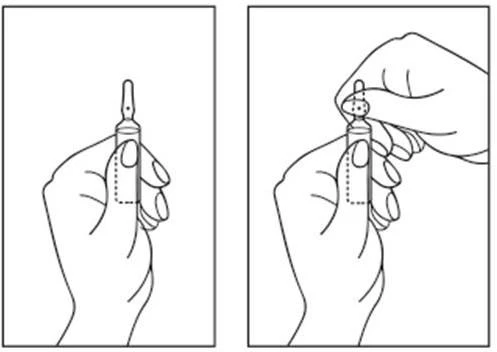
Instructions for opening the ampoule:
- Position the ampoule so that the coloured dot is at the top. If any solution is present in the upper part of the ampoule,
gently tap the ampoule with your finger so that all the solution collects in the lower part. - Use both hands to open; hold the lower part of the ampoule in one hand and snap off the top part with the other hand,
in the direction away from the coloured dot (see illustrations below).
Use of a higher than recommended dose of Maracex
If a higher than recommended dose of this medicine has been taken, aspiration pneumonia caused by vomit or foreign bodies may occur.
Symptoms may include shortness of breath, cough, and fever.
Additionally, symptoms of overdose may include breathing difficulties leading to loss of consciousness, and even death.
You should immediately contact the nearest emergency department or your doctor.
Stopping treatment with Maracex
Do not stop using this medicine unless your doctor advises otherwise. To discontinue treatment with this medicine, consult your doctor,
who will decide how to gradually reduce the dose to avoid withdrawal symptoms. Withdrawal symptoms may include body aches, tremors,
diarrhea, stomach pain, nausea, flu-like symptoms, rapid heartbeat, and dilated pupils. Psychological symptoms include intense feelings of
dissatisfaction, anxiety, and irritability.
If you have any further doubts regarding the use of this medicine, consult your doctor, nurse, or pharmacist.
4. Possible adverse reactions
Like any medicine, this medicine may cause adverse reactions, although they do not occur in everyone.
The most common adverse reactions are fatigue, constipation, nausea and vomiting, and sweating.
You should contact your doctor immediately if severe allergic reactions occur,
causing difficulty in breathing or dizziness.
Other adverse reactions associated with the use of this medicine are listed below, classified by frequency of occurrence:
Very common (may affect more than 1 in 10 people):
Urinary retention after intrathecal administration.
Common (may affect up to 1 in 10 people):
Fatigue, drowsiness, dizziness, constipation, nausea, vomiting, urinary retention after intramuscular, intravenous, or subcutaneous administration.
Uncommon (may affect up to 1 in 100 people):
Hypoventilation (due to effects on the central nervous system), euphoria, vestibular dizziness, headache, sleep disturbances, anxiety, transient hallucinations, disorientation, balance problems, visual disturbances, increased intracranial pressure, mood changes, restlessness, tremor, muscle spasms, convulsions, muscle rigidity, dry mouth, psychological and physical dependence, withdrawal symptoms in newborns whose mothers received morphine during pregnancy, such as restlessness, vomiting, increased appetite, irritability, hyperexcitability, tremor or shivering, nasal mucosal congestion, convulsions, crying with high-pitched sounds.
Rare (may affect up to 1 in 1,000 people):
Slow heart rate (bradycardia), fast heartbeat (tachycardia), palpitations, low blood pressure, high blood pressure, facial flushing, hypoventilation, itching, urticaria, rash, redness and hardening of the skin at the injection site after intravenous administration.
Very rare (may affect more than 1 in 10,000 people):
Biliary spasm, phlebitis, pulmonary edema, anaphylactic reaction. High doses may cause central nervous system stimulation, which may manifest as convulsions.
Frequency not known (frequency cannot be estimated from available data):
Increased sensitivity to pain, sweating, withdrawal symptoms or dependence (information on symptoms - see section 3: If you stop taking Maracex).
Reporting of adverse reactions
If any adverse reactions occur, including any not listed in this leaflet, inform your doctor, nurse, or pharmacist. Adverse reactions can be reported directly to the Department of Monitoring Adverse Drug Reactions of the Office for Registration of Medicinal Products, Medical Devices and Biocidal Products
Al. Jerozolimskie 181C
02-222 Warsaw
Phone: +48 22 49 21 301
Fax: +48 22 49 21 309
Website: https://smz.ezdrowie.gov.pl
Adverse reactions can also be reported to the marketing authorization holder.
Reporting adverse reactions helps to provide more information on the safety of the medicine.
5. How to store Maracex
Keep this medicine out of sight and reach of children.
Do not use this medicine after the expiry date stated on the carton after: EXP. The expiry date refers to the last day of the stated month.
There are no special temperature requirements for storage of this medicine. Store the ampoules in the outer packaging to protect them from light. Do not freeze.
Do not use the medicine if visible particles are present.
For storage conditions after dilution, see section 6 "Information intended exclusively for healthcare professionals".
Medicines must not be disposed of via wastewater or household waste. Ask your pharmacist how to dispose of medicines no longer required. These measures will help protect the environment.
6. Contents of the pack and other information
What Maracex contains
- The active substance is morphine hydrochloride. 1 ml of solution contains 20 mg of morphine hydrochloride, equivalent to 15.2 mg of morphine. One 1 ml ampoule contains 20 mg of morphine hydrochloride, equivalent to 15.2 mg of morphine.
- Other ingredients: sodium chloride, hydrochloric acid concentrated (for pH adjustment), water for injections.
What Maracex looks like and contents of the pack
This medicine is a clear, colourless or slightly yellow injection/infusion solution, free from
visible particles.
Maracex is available in 1 ml ampoules made of colourless type I glass, packed in PVC blisters,
placed in a cardboard box.
Pack size:
10 ampoules of 1 ml
Not all pack sizes may be marketed.
Marketing Authorisation Holder and Manufacturer
AS KALCEKS
Krustpils iela 71E
1057 Rīga
Latvia
Tel.: +371 67083320
E-mail: [email protected]
Information intended exclusively for medical professionals:
The medicinal product should be used immediately after opening.
For single use only; any remaining contents should be discarded after use.
Do not use the medicinal product if visible particles are present.
Maracex 20 mg/ml solution for injection/infusion must not be mixed with other medicinal products.
Morphine salts are sensitive to pH changes and may precipitate in alkaline environments. Substances incompatible with morphine salts include aminophylline, sodium barbiturates, phenytoin, and ranitidine hydrochloride.
After dilution:
Maracex 20 mg/ml solution for injection/infusion is compatible with 0.9% sodium chloride solution in a polyethylene container.
Chemical and physical stability has been demonstrated for 28 hours when administered at 25 °C and between 2 °C and 8 °C in 0.9% sodium chloride solution in a polyethylene container.
From a microbiological standpoint, the diluted solution should be used immediately. If the product is not used immediately, the user is responsible for the storage duration and conditions prior to use, which should generally not exceed 24 hours at a temperature of 2 °C to 8 °C, unless the dilution was carried out under controlled and validated aseptic conditions.