Manti
Poland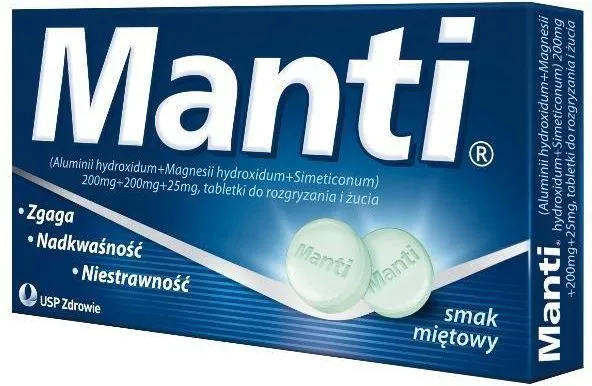
Table of Contents
Package leaflet: Information for the patient
Manti
200 mg + 200 mg + 25 mg, chewable tablets
(Aluminii hydroxidum + Magnesii hydroxidum + Simeticonum)
Please read this leaflet carefully before using the medicine, as it contains important information for the patient.
This medicine should always be used exactly as described in this patient leaflet or as directed by a doctor or pharmacist.
- Keep this leaflet for future reference.
- If you need advice or further information, please contact your pharmacist.
- If you experience any adverse reactions, including any possible side effects not listed in this leaflet, inform your doctor or pharmacist. See section 4.
- If there is no improvement after a few days, or if you feel worse, consult your doctor.
Table of contents
1. What Manti is and what it is used for
2. Important information before taking Manti
3. How to take Manti
4. Possible side effects
5. How to store Manti
6. Contents of the pack and other information
1. What Manti is and what it is used for
Manti contains the active substances: aluminium hydroxide, magnesium hydroxide, and simethicone.
Aluminium and magnesium hydroxides neutralize gastric hydrochloric acid. As a result of this reaction, the acidity of gastric juice decreases, thereby reducing its damaging effect on the gastric mucosa.
Simethicone contained in the preparation reduces discomfort associated with excessive accumulation of gas in the gastrointestinal tract.
Indications for Manti include symptomatic treatment of heartburn, as well as bloating and abdominal pain caused by excessive gas production in the intestines, accompanying disorders of the upper gastrointestinal tract: peptic ulcer of the stomach or duodenum, gastritis, hyperacidity, hiatal hernia, dyspepsia, and other gastrointestinal disorders.
The onset of therapeutic action in the form of neutralization of hydrochloric acid occurs rapidly, within 10 to 15 minutes after administration. Similarly rapid relief of heartburn pain has been observed in patients.
2. Important information before taking Manti
Do not take Manti if:
- you are allergic to the active substances or any of the other ingredients of this medicine (listed in section 6),
- in severe renal insufficiency, especially if undergoing dialysis,
- in patients with phenylketonuria due to the presence of aspartame,
- in patients diagnosed with intolerance to certain sugars due to the presence of sorbitol.
Warnings and precautions
Before starting Manti, inform your doctor or pharmacist if you are taking non-steroidal anti-inflammatory drugs, as acid-neutralizing agents may mask symptoms of gastrointestinal bleeding.
Prolonged use of Manti with insufficient phosphate intake may lead to phosphate deficiency (hypophosphatemia), as well as to renal insufficiency due to deposition of ammonium-magnesium phosphate.
Children
Manti should not be used in children under 6 years of age.
Manti and other medicines
Acid-neutralizing agents may alter the absorption of many drugs. To avoid interactions, at least a 2-hour interval should be maintained between taking Manti and other orally administered medicines.
Inform your doctor or pharmacist about all medicines you are currently taking or have recently taken, as well as any medicines you plan to take.
Due to reduced gastric acidity, Manti may affect the solubility, absorption, bioavailability, and excretion of certain concomitantly administered drugs.
Manti may decrease the absorption of: antibiotics, including tetracyclines, macrolide antibiotics (azithromycin), antiprotozoal and antibacterial agents (metronidazole), fluorinated quinolones (ciprofloxacin, ofloxacin), drugs used in arterial hypertension (angiotensin-converting enzyme inhibitors), β-adrenolytics (atenolol, propranolol), sedatives and hypnotics (benzodiazepine derivatives and phenothiazine neuroleptics), drugs used in gastric ulcer disease (H\textsubscript{2} receptor antagonists), iron preparations, antifungal drugs (ketoconazole), antituberculosis drugs (isoniazid), glucocorticosteroids (e.g. cortisol, cortisone, corticosterone), salicylates (e.g. acetylsalicylic acid), drugs used, among others, in heart failure and atrial fibrillation (digoxin), antiepileptic drugs (phenytoin), and drugs used in hypothyroidism (levothyroxine).
Manti may increase the absorption of: oral antidiabetic sulfonylureas (glipizide, glibenclamide, chlorpropamide, tolbutamide), anticoagulants (coumarin derivatives), antibiotics (amoxicillin), drugs used in ischemic heart disease and arterial hypertension (nifedipine), drugs used in cerebral circulation disorders (pentoxifylline), and drugs used, among others, in nasal congestion and sinusitis (pseudoephedrine).
Taking Manti with food, drink, and alcohol
Taking the medicine immediately after a meal may prolong its duration of action.
Pregnancy, breastfeeding, and fertility
The use of Manti during pregnancy requires strict medical consultation and should only be considered when the benefits outweigh the risks.
The use of Manti during breastfeeding is not recommended, as it is unknown whether acid-neutralizing agents pass into breast milk.
The effect of aluminium hydroxide, magnesium hydroxide, and simethicone on human fertility is unknown.
Driving and operating machinery
Manti does not affect the ability to drive or operate machinery.
Manti contains aspartame, sorbitol, glucose (from maltodextrin), and sodium:
Each tablet contains 6.3 mg of aspartame. Aspartame is a source of phenylalanine. It may be harmful to patients with phenylketonuria. This is a rare genetic disorder in which phenylalanine accumulates in the body due to impaired excretion.
Each tablet contains up to 703.6 mg of sorbitol (E 420). Sorbitol is a source of fructose. If intolerance to certain sugars has previously been diagnosed in the patient (or their child), or if hereditary fructose intolerance—a rare genetic disorder in which the body cannot metabolize fructose—has been diagnosed, the patient should consult a doctor before taking the medicine or giving it to a child. Sorbitol may cause gastrointestinal discomfort and may have a mild laxative effect.
The medicine contains glucose derived from maltodextrin. If intolerance to certain sugars has previously been diagnosed in the patient, the patient should consult a doctor before taking the medicine.
The medicine contains less than 1 mmol (23 mg) of sodium per tablet; therefore, the medicine is considered "sodium-free."
3. How to take Manti
This medicine should always be taken exactly as described in the patient leaflet or as directed by a pharmacist. If in doubt, consult a doctor or pharmacist.
Adults and children over 6 years of age:
The recommended dose is 1 to 3 tablets between meals, before bedtime, and when gastrointestinal symptoms occur.
Do not swallow the tablets whole. Do not exceed a daily dose of 12 tablets.
Do not use the maximum dose for longer than 2 weeks.
Taking more Manti than recommended
In case of a single, significant overdose, the aluminium hydroxide, magnesium hydroxide, and simeticone contained in the medicine do not pose a significant toxicological risk due to their minimal absorption. However, nausea and gastrointestinal disturbances may occur.
If more medicine than recommended has been taken, seek immediate advice from a doctor or pharmacist.
If you forget to take Manti
If a dose is missed, take the next dose as scheduled. Do not take a double dose to make up for the missed dose.
Stopping Manti
If you have any further doubts regarding the use of this medicine, consult your doctor or pharmacist.
4. Possible adverse effects
Like all medicines, Manti may cause adverse effects, although they do not occur in everyone.
Manti is generally well tolerated in most cases, but as with other medicines, it may cause the following undesirable effects, particularly with long-term use:
Uncommon adverse effects (may affect fewer than 1 in 100 people):
- diarrhoea, constipation, bloating, excessive flatulence
Adverse effects with unknown frequency (cannot be estimated from available data):
- immune system disorders: hypersensitivity reactions, such as itching, urticaria, angioedema and anaphylactic reactions;
- metabolic and nutritional disorders: disturbances in water and electrolyte balance: hypophosphataemia (reduced phosphate concentration in blood serum), hypocalcaemia (reduced total calcium concentration in blood serum), hypercalciuria (increased urinary excretion of calcium), hypermagnesaemia (increased magnesium concentration in blood serum) in patients with renal impairment;
- psychiatric disorders: dementia (reduced activity, memory disturbances) during long-term use in patients with renal impairment, particularly in dialysed patients;
- nervous system disorders: encephalopathy (brain damage resulting in behavioural disturbances) during long-term use in patients with renal impairment, particularly in dialysed patients;
- musculoskeletal and connective tissue disorders: osteomalacia (inadequate mineralization leading to loss of calcium and phosphate from bone tissue) and osteodystrophy (disturbance in bone tissue remodelling and mineralization) in patients receiving high doses of the drug over a prolonged period.
Reporting of adverse effects
If any adverse effects occur, including any adverse effects not listed in this leaflet, consult a physician or pharmacist.
Adverse effects can be reported directly to the Department of Monitoring of Adverse Drug Reactions, Office for Registration of Medicinal Products, Medical Devices and Biocidal Products,
ul. Al. Jerozolimskie 181C,
02-222 Warsaw,
tel.: + 48 22 49 21 301,
fax: + 48 22 49 21 309,
website: https://smz.ezdrowie.gov.pl
Adverse effects can also be reported to the marketing authorization holder.
Reporting adverse effects helps to provide more information on the safety of the medicine.
5. How to store Manti
Keep the medicine below 25°C.
Store in a place out of sight and reach of children.
Do not use Manti after the expiry date stated on the cardboard box and primary packaging.
The expiry date refers to the last day of the specified month.
Blister labelling: EXP – expiry date, Lot – batch number.
Medicines must not be disposed of via the sewage system or household waste. Ask your pharmacist how to dispose of medicines no longer required. This will help protect the environment.
6. Contents of the pack and other information
What Manti contains
The active substances are: aluminium hydroxide 200 mg, magnesium hydroxide 200 mg,
simeticone 25 mg.
The other ingredients are: magnesium stearate, stearic acid, aspartame (E 951), blue colour
(FD&C Blue No 1) (E 133), yellow colour (FD&C Yellow 10) (E 104), mint flavour SD 297,
sodium croscarmellose, sorbitol (E 420), maltodextrin (contains glucose).
What Manti looks like and contents of the pack
The tablet is light green in colour with visible white and darker specks, round, flat on both sides, with bevelled edges, and has a slightly minty odour. It is marked with the imprint “MANTI” on one side.
Each tablet has a diameter of approximately 16 mm and a thickness of 5 mm.
The medicine is available in packs containing 2, 4, 6, 8, 10, 16, 20, 30 or 32 tablets, packed in blisters made of PVC/Aluminium or PVC/PVDC/Aluminium, with a cardboard carton and patient leaflet. Not all pack sizes may be marketed.
Marketing Authorisation Holder and Manufacturer
US Pharmacia Sp. z o.o., ul. Ziębicka 40, 50-507 Wrocław
For further information, please contact:
USP Zdrowie Sp. z o.o., ul. Poleczki 35, 02-822 Warsaw, tel. +48 (22) 543 60 00.