Mannitol 15% baxter
Poland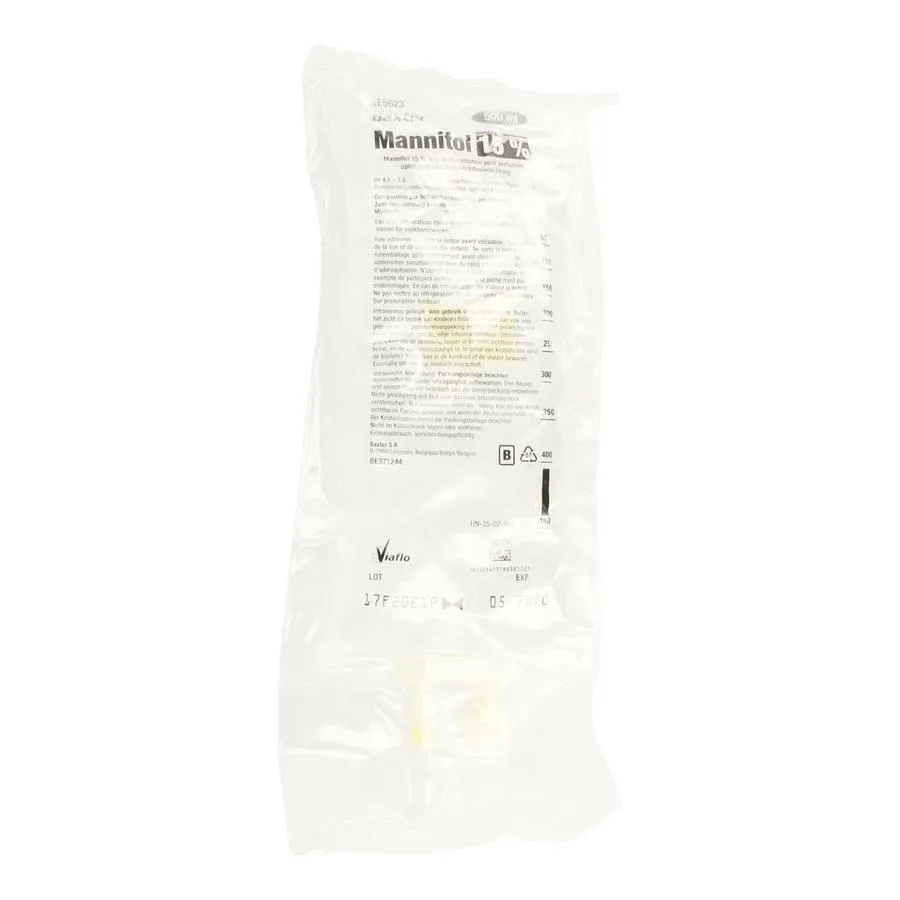
Table of Contents
- PACKAGE LEAFLET: INFORMATION FOR THE USER
- 1. What Mannitol 15% Baxter is and what it is used for
- 2. Important information before using Mannitol 15% Baxter
- 3. How to use Mannitol 15% Baxter
- 4. Possible adverse reactions
- 5. How to store Mannitol 15% Baxter
- 6. Contents of the pack and other information
PACKAGE LEAFLET: INFORMATION FOR THE USER
Mannitol 15% Baxter, infusion solution
mannitol
Please read all of this leaflet carefully before using this medicine because it contains important information for you.
- Keep this leaflet. You may need to read it again.
- If you have any further questions, ask your doctor or pharmacist.
- This medicine has been prescribed for you only. Do not pass it on to others. It may harm someone else, even if their symptoms are the same as yours.
- If you experience any side effects, including any not listed in this leaflet, tell your doctor or pharmacist. See section 4.
Leaflet contents
- What Mannitol 15% Baxter is and what it is used for
- Important information before using Mannitol 15% Baxter
- How to use Mannitol 15% Baxter
- Possible side effects
- How to store Mannitol 15% Baxter
- Contents of the pack and other information
1. What Mannitol 15% Baxter is and what it is used for
Mannitol 15% Baxter is an aqueous solution of mannitol.
Mannitol 15% Baxter is used:
- to increase urine production (diuresis) in patients with impaired kidney function;
- to reduce intracranial pressure caused by fluid accumulation within the brain (edema) or following head injury;
- to reduce intraocular pressure (pressure within the eye);
- for the treatment of certain types of poisoning or drug overdose.
2. Important information before using Mannitol 15% Baxter
Do not use Mannitol 15% Baxter:
- if the patient is allergic to mannitol;
- if the patient has increased salt concentration in the body;
- if the patient has severe dehydration;
- if the patient's kidneys are unable to produce urine;
- if the patient has severe heart disease (heart failure);
- if the patient has excessive accumulation of fluid in the lungs (pulmonary edema) due to heart failure;
- if the patient has active intracranial bleeding or certain types of severe head injuries;
- if the patient's response to a test dose administered by the doctor or nurse is abnormal (see section 3);
- if the patient's kidneys gradually lose their function after starting mannitol administration.
If there is any doubt whether any of the above conditions applies to the patient, consult a doctor.
Warnings and precautions
Before starting treatment with Mannitol 15% Baxter, discuss the following with a doctor:
- if the patient has kidney disease or impaired kidney function;
- if the patient is taking medications that may be harmful to the kidneys (e.g. certain antibiotics or anticancer drugs);
- if the patient has severe dehydration (loss of body water, e.g. due to vomiting, diarrhoea, excessive sweating, or use of certain medications). Symptoms include dry mouth and dizziness;
- if the doctor has informed the patient about low sodium (salt) levels in the blood (hyponatremia);
- if the patient is allergic to mannitol (since mannitol occurs naturally and is used in other medicines, patients may be allergic even without prior intravenous mannitol treatment). The infusion must be stopped immediately if any signs of hypersensitivity occur; see section 4.
If monitoring is necessary, the doctor may perform tests to confirm that the dose is appropriate. These tests may include:
- heart, lung, and kidney function;
- fluid intake;
- urine output;
- central venous pressure (blood pressure in the veins leading to the heart);
- blood and urine concentrations of chemical substances such as sodium and potassium (electrolytes);
- blood and urine acidity (acid-base balance).
This solution must not be administered through the same needle as blood transfusion. This may cause damage to red blood cells or their aggregation.
Mannitol 15% Baxter and other medicines
Inform the doctor or nurse about all medicines currently used or recently used, as well as any medicines the patient plans to take.
The following medicines are known to interact with Mannitol 15% Baxter or may be affected by it. Inform the doctor if the patient is taking any of the following:
- diuretics (medicines that increase urine production);
- cyclosporine (used to prevent transplant rejection);
- lithium (used in the treatment of psychiatric disorders);
- aminoglycosides (a type of antibiotic);
- depolarizing neuromuscular blocking agents (used during anaesthesia to induce muscle paralysis). Administration of these drugs will be controlled by an anaesthesiologist;
- oral anticoagulants (blood-thinning medicines, e.g. warfarin);
- digoxin (a heart medication).
Use of Mannitol 15% Baxter with food, drink, and alcohol
Ask the doctor what the patient may eat or drink.
Pregnancy and breastfeeding
If the patient is pregnant, breastfeeding, suspects she may be pregnant, or is planning to have a child, she should consult a doctor or nurse before using this medicine.
It is unknown whether mannitol affects the unborn child or the course of pregnancy. It is also unknown whether mannitol passes into breast milk. Therefore, Mannitol 15% Baxter will be used in pregnant women or breastfeeding mothers only if clearly necessary.
Driving and operating machinery
Mannitol 15% Baxter has no effect on the ability to drive or operate machinery.
3. How to use Mannitol 15% Baxter
Your doctor will decide how much of the medicine to administer and when to give it. The doctor(s) will make this decision based on the patient's age, body weight, medical condition, and any other medicines being taken.
Mannitol 15% Baxter is usually administered intravenously via an infusion line.
In patients with impaired kidney function, the doctor may first administer a small test dose of the solution. The amount of urine produced by the patient will then be measured. If the kidneys do not produce an adequate amount of urine in response to the test dose, the patient will receive alternative treatment.
Mannitol 15% Baxter can also be used in children and elderly patients (over 65 years of age). The doctor will adjust the dose according to individual needs.
DO NOT use Mannitol 15% Baxter if visible particles are present in the solution or if the container is damaged in any way.
Administration of a higher than recommended dose of Mannitol 15% Baxter
If too much Mannitol 15% Baxter is administered (overdose) or if the infusion is given too rapidly, the following symptoms may occur:
- excessive blood volume in the circulatory system (hypervolemia). Symptoms include swelling of the hands and feet (peripheral edema), difficulty breathing (pulmonary edema and dyspnea), fluid accumulation in the abdominal cavity (ascites), and imbalance of chemicals in the body (electrolyte disturbances);
- excessive acidity of the blood (acidosis);
- headache;
- feeling of nausea;
- chills;
- confusion;
- fatigue;
- seizures;
- reduced consciousness (stupor) or loss of consciousness (coma);
- kidney failure (acute renal failure).
If any of these symptoms occur, inform the doctor immediately. The infusion will be stopped and appropriate treatment initiated depending on the symptoms.
If another medicine has been added to Mannitol 15% Baxter, read the Patient Information Leaflet provided with that medicine to become familiar with the list of possible side effects.
Discontinuation of Mannitol 15% Baxter
The doctor will decide when to stop the infusion.
If you have any questions about the use of this medicine, consult your doctor.
4. Possible adverse reactions
Like all medicines, this medicine can cause adverse reactions, although not everyone will experience them.
If any of the adverse reactions listed below occur, inform your doctor or nurse immediately.
These may be symptoms of a very severe or even life-threatening allergic reaction called anaphylactic shock:
- difficulty breathing;
- low blood pressure (hypotension);
- swelling of the skin of the face and throat;
- urticaria;
- skin rash.
The treatment will depend on the symptoms.
Other possible adverse reactions include:
- kidney damage, which may affect water excretion, or decrease or increase the amount of urine produced;
- presence of blood in the urine;
- heart failure;
- high blood pressure;
- rapid or irregular heartbeat (palpitations, arrhythmia);
- fluid accumulation in the lungs causing shortness of breath;
- coma, seizures, feeling of fatigue (lethargy) due to damage to the central nervous system;
- swelling of ankles, fingers, and face due to fluid retention in the body;
- dehydration;
- increased or decreased concentration of potassium and (or) sodium in the blood;
- dryness of the mouth, thirst;
- nausea, vomiting;
- malaise;
- increased blood acid concentration (metabolic acidosis, see section 3 "Use of a higher than recommended dose of Mannitol 15% Baxter");
- chest pain;
- chills, fever;
- increased intracranial pressure causing headache, nausea, vomiting, back pain, blurred vision and other visual disturbances such as difficulty moving the eyeball (ophthalmoplegia);
- dizziness, headache;
- fatigue and weakness (asthenia);
- cramps;
- visual disturbances;
- catarrh;
- skin necrosis;
- reactions related to the infusion technique, which may include inflammation, pain, itching, rash or redness at the infusion site or along the entire length of the vein;
- leakage of the infusion solution into the surrounding tissue (extravasation). This may cause burning and pain at the infusion site. In severe cases, blood flow will be reduced and the surrounding tissue will be damaged (compartment syndrome).
Reporting of adverse reactions
If any adverse reactions not listed in this leaflet occur, tell your doctor, pharmacist, or nurse.
Adverse reactions can be reported directly to the Department of Monitoring Adverse Drug Reactions, Office for Registration of Medicinal Products, Medical Devices and Biocidal Products
Al. Jerozolimskie 181C
02-222 Warszawa
Tel.: +48 22 49 21 301
Fax: +48 22 49 21 309
Website: https://smz.ezdrowie.gov.pl
Adverse reactions can also be reported to the marketing authorization holder.
Reporting adverse reactions helps to provide more information on the safety of the medicine.
5. How to store Mannitol 15% Baxter
This product should not be stored in the refrigerator or frozen.
The medicine should be stored in a place invisible and inaccessible to children.
Do not remove the Mannitol 15% Baxter medicine from its outer protective packaging until the time of use.
DO NOT use the Mannitol 15% Baxter medicine after the expiry date stated on the bag. The expiry date refers to the last day of the specified month.
After opening, with or without addition of other substances:
From a microbiological point of view, the product should be used immediately. If the solution is not used immediately, the user is responsible for the storage conditions and duration.
Mannitol 15% Baxter should not be administered if visible particles are present or if the packaging is in any way damaged.
6. Contents of the pack and other information
What Mannitol 15% Baxter contains
The active substance is mannitol.
The only excipient is water for injections.
Each 1000 ml of solution contains 150 grams of mannitol.
What Mannitol 15% Baxter looks like and contents of the pack
Mannitol 15% Baxter is a clear, particle-free solution. It is available in polyolefin/polyamide plastic bags (Viaflo). Each bag is enclosed in a sealed protective outer plastic packaging.
Pack sizes:
- 100 ml
- 250 ml
- 500 ml
Bags are supplied in cardboard boxes. Each cardboard box contains one of the following quantities:
- 50 bags of 100 ml
- 60 bags of 100 ml
- 30 bags of 250 ml
- 20 bags of 500 ml
Not all pack sizes may be marketed.
Marketing Authorisation Holder and Manufacturer
Marketing Authorisation Holder:
Baxter Polska Sp. z o.o.
ul. Kruczkowskiego 8
00-380 Warszawa
Poland
Manufacturers:
Baxter S.A. Vantive Manufacturing Limited
Boulevard R. Branquart, 80 Moneen Road
7860 Lessines Castlebar – County Mayo
Belgium Ireland
Bieffe Medital S.A.
Ctra de Biescas-Senegüé
22666 Sabiñànigo (Huesca)
Spain
Baxter and Viaflo are trademarks of Baxter International Inc.
The following information is intended exclusively for medical personnel or healthcare professionals:
Handling and preparation instructions
Use only if the solution is clear, free from visible particles or discoloration, and the seal is intact. Administer immediately after connecting an infusion set containing an in-line final filter, due to the potential for mannitol crystal precipitation.
Hyperosmolar mannitol solutions may cause venous irritation. Osmolality of the solution should be taken into consideration.
Do not remove the bag from its outer protective packaging until ready for use.
The inner bag ensures product sterility.
Do not connect plastic containers in series. Such use could result in air embolism due to residual air remaining in the first container before completion of fluid delivery from the second container.
The solution must be administered using a sterile, pyrogen-free infusion set with a filter, employing aseptic technique. The infusion set should be primed with the solution to prevent air from entering the system.
Additional substances may be incompatible with Mannitol 15% Baxter.
Additional medications may be added to the solution before or during infusion via the medication addition port.
Careful and thorough mixing under aseptic conditions is required with each added substance. Solutions containing added substances should be used immediately and must not be stored.
The addition of other drugs or improper administration techniques may cause febrile reactions due to potential introduction of pyrogens. In case of an adverse reaction, discontinue infusion immediately.
Mannitol solutions may crystallize at low temperatures. Higher concentration solutions have a greater tendency to crystallize. Before administration, check for the presence of crystals. If crystals are visible, dissolve them by warming the solution to 37°C, followed by gentle mixing. Do not heat the solution in a water bath or microwave oven, due to the risk of product contamination or damage. After warming, cool the solution to room temperature or body temperature before re-checking for crystals and use.
Discard after single use.
Discard any unused portion of the solution.
Do not re-enter partially used bags.
1. Opening
a. Remove the Viaflo bag from the protective outer packaging immediately before use.
b. Check bag integrity by firmly squeezing it. If leakage is detected, discard the solution, as the contents may no longer be sterile.
c. Check whether the solution is clear and free from insoluble particles. If the solution is not clear or contains insoluble particles, discard it.
2. Preparation for administration
Sterile materials must be used during preparation and administration.
a. Hang the bag by the hanger.
b. Remove the plastic cover from the administration port located at the bottom of the bag:
- Hold the smaller wing on the neck of the port with one hand,
- Hold the larger wing on the cap with the other hand and twist,
- The cap will pop off.
c. Prepare the infusion according to aseptic principles.
d. Connect the infusion set. Refer to all instructions provided with the set regarding connection, priming, and administration of the solution.
3. Methods for adding additional medications
Warning: Added medications may be incompatible (see section 5 below, "Incompatibilities with added medications").
Adding medications before administration
a. Disinfect the medication addition port.
b. Using a syringe with a needle between 19G (1.10 mm) and 22G (0.70 mm), insert the needle through the self-sealing medication addition port and inject the medication.
c. Mix the solution thoroughly with the medication. For dense preparations such as potassium chloride, gently tap the ports with the bag held port-up and mix well.
Warning: Do not store bags containing added medications.
Adding medications during administration
a. Close the clamp on the infusion set.
b. Disinfect the medication addition port.
c. Using a syringe with a needle between 19G (1.10 mm) and 22G (0.70 mm), insert the needle through the self-sealing medication addition port and inject the medication.
d. Remove the bag from the infusion stand and (or) invert it so that the ports are facing upward.
e. Clear both ports by gently tapping while holding the bag with ports upward.
f. Mix the solution thoroughly with the medication.
g. Rehang the bag in its original position, reopen the clamp, and continue administration.
4. In-use stability: Added substances
Prior to use, the chemical and physical stability of each added substance in the mannitol solution (pH 4.5 to 7.0) in Viaflo-type bags must be established.
From a microbiological standpoint, the diluted product should be used immediately. If not used immediately, the user is responsible for the duration and conditions of storage prior to use.
5. Incompatibilities with added medications
Mannitol 15% Baxter must not be administered simultaneously, before, or after blood transfusion through the same infusion set due to the risk of pseudoagglutination.
Before adding any additional medication, its compatibility with the solution in Viaflo-type bags must be assessed.
Refer to the instructions for use of the added medication.
Before adding a medication, verify its solubility and stability in water at the pH of the mannitol solution (4.5 to 7.0). For example, cefepime, imipenem, cilastatin, and filgrastim are incompatible with mannitol solutions, but this list is not exhaustive.
Adding potassium chloride or sodium chloride to Mannitol 15% Baxter may cause precipitation of mannitol.
Baxter and Viaflo are trademarks of Baxter International Inc.