Malarone
Poland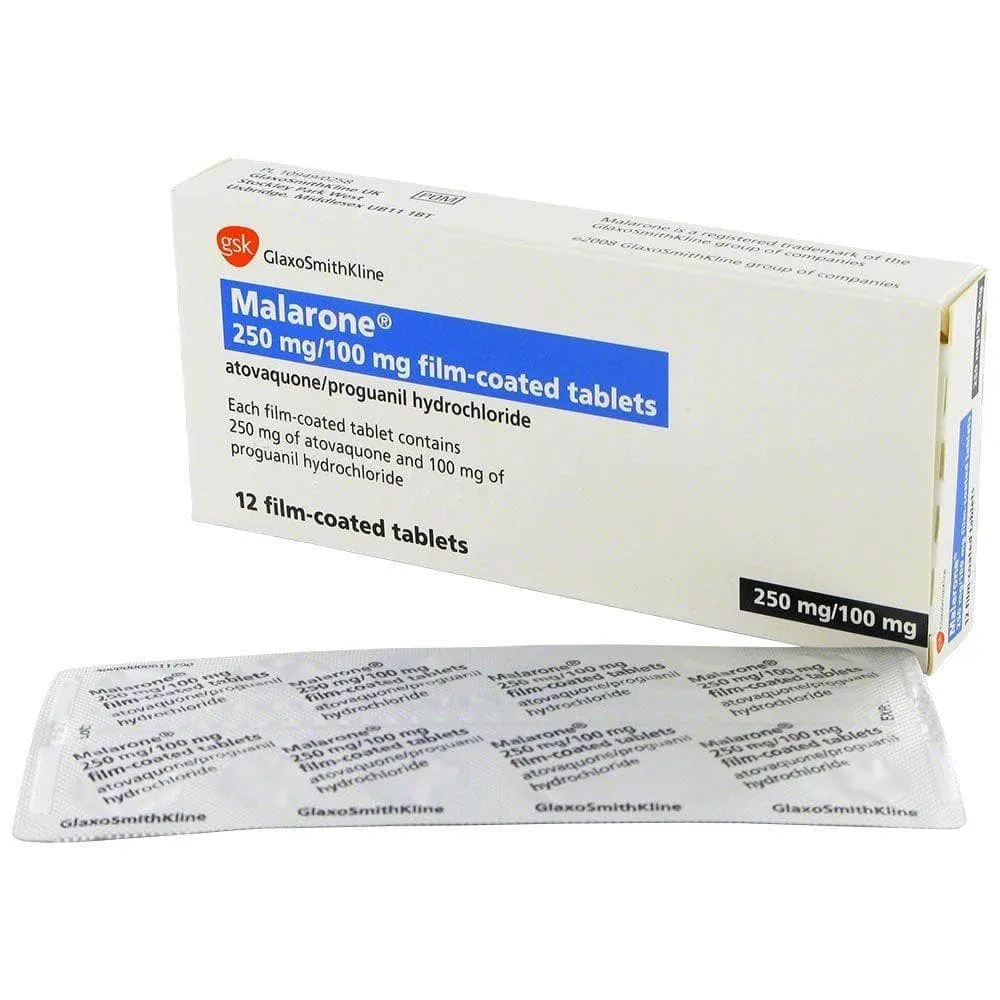
Table of Contents
Package leaflet: Information for the patient
Warning! Keep this leaflet! The information on the immediate packaging is in a foreign language.
Malarone, 250 mg + 100 mg, film-coated tablets
Atovaquonum + Proguanili hydrochloridum
Please read this leaflet carefully before using the medicine, as it contains important information for the patient.
- Keep this leaflet so that you can read it again if necessary.
- If you have any questions, please consult your doctor or pharmacist.
- This medicine has been prescribed for a specific individual. Do not give it to others. This medicine may harm someone else, even if their symptoms are similar.
- If you experience any adverse reactions, including any adverse reactions not listed in this leaflet, inform your doctor or pharmacist. See section 4.
Table of contents of the leaflet
- What Malarone is and what it is used for
- Important information before taking Malarone
- How to take Malarone
- Possible side effects
- How to store Malarone
- Contents of the package and other information
1. What Malarone is and what it is used for
Malarone belongs to a group of medicines called antimalarials. It contains two active substances: atovaquone and proguanil hydrochloride.
Indications for Malarone
Malarone has two uses:
- for the prevention of malaria;
- for the treatment of malaria.
Dosage recommendations for each indication are provided in section 3. How to take Malarone.
Malaria is transmitted through bites from infected mosquitoes, which carry the parasite (Plasmodium falciparum) into the bloodstream. Malarone prevents malaria by destroying the cells of this parasite. In individuals already infected with malaria, Malarone also destroys the cells of these parasites.
You should protect yourself against malaria infection.
Malaria can affect people of any age. It is a serious illness, but it can be prevented. It is very important to take measures to prevent mosquito bites in addition to taking Malarone.
- Apply insect repellent to exposed skin.
- Wear light-colored clothing covering most of the body, especially after sunset, as mosquitoes are particularly active at this time.
- Sleep in a protected room or under a mosquito net impregnated with insecticide.
- Close windows and doors at sunset if they are not protected by a mesh screen.
- Consider using an insecticide (mats, aerosols, plug-in devices) to eliminate insects from the room or prevent mosquitoes from entering. → If you have further doubts, consult your doctor or pharmacist.
Infection with malaria may occur despite taking all necessary precautions.
In some types of malaria, the time between infection and the appearance of symptoms may be long, so the disease may manifest several days, weeks, or even months after returning from abroad.
→ If, after returning from abroad, symptoms such as high fever, chills, headache, and fatigue occur, seek medical advice immediately.
2. Important information before using Malarone
When not to use Malarone
- If the patient is allergic to atovaquone, proguanil hydrochloride or any of the other ingredients of this medicine (listed in section 6).
- For malaria prevention in patients with severe kidney disease.
→ If any of these situations apply to the patient, tell the doctor.
When to take special care with Malarone
Before starting to take Malarone, tell the doctor or pharmacist if:
- the patient has severe kidney disease;
- treating malaria in a child weighing less than 11 kg. Children weighing 11 kg or less should be treated with tablets containing different amounts of active substances (see section 3).
→ If any of the above situations apply to the patient, tell the doctor or
pharmacist.
Malarone and other medicines
Tell the doctor or pharmacist about all medicines the patient is currently taking or has recently taken, as well as any medicines the patient plans to take, including those available without a prescription.
Some medicines may affect how Malarone works, or Malarone may enhance or reduce the effects of other medicines taken at the same time. These include:
- metoclopramide, used to treat nausea and vomiting;
- antibiotics, tetracycline, rifampicin, and rifabutin;
- efavirenz or certain boosted protease inhibitors used in the treatment of HIV;
- warfarin and other anticoagulant medicines;
- etoposide, used in cancer treatment. → If the patient is taking any of these medicines, tell the doctor. The doctor may decide that Malarone should not be taken or may recommend additional monitoring during treatment. → If the patient starts taking any other medicines while using Malarone, remember to tell the doctor.
Taking Malarone with food and drink
Malarone should be taken with food or a milky drink, if possible.
This will increase the absorption of Malarone and improve treatment effectiveness.
Pregnancy and breastfeeding
If the patient is pregnant, she should not take Malarone unless the doctor advises otherwise.
→ Before taking Malarone, consult the doctor or pharmacist.
Breastfeeding should be avoided while taking Malarone, because the components of Malarone pass into breast milk and may harm the infant.
Driving and operating machinery
Do not drive if dizziness occurs.
Malarone may cause dizziness in some people. If this symptom occurs, the patient should not drive, operate machinery, or perform any activities that could pose a risk to themselves or others.
Malarone contains sodium
This medicine contains less than 1 mmol (23 mg) of sodium per tablet; therefore, this medicine is considered "sodium-free".
3. How to use Malarone
This medicine should always be taken exactly as directed by your doctor or pharmacist. If you are
unsure, consult your doctor or pharmacist.
Malarone should preferably be taken with food or a milk drink.
It is best to take Malarone at the same time each day.
If the patient vomits
When preventing malaria
- If the patient vomits within 1 hour after taking Malarone, an additional dose should be taken immediately.
- It is important to complete the full course of treatment with Malarone. If additional doses have been taken due to vomiting, an extra prescription may be needed.
- If the patient vomits, it is especially important to use additional protective measures, such as insect repellents and mosquito nets. Malarone may not be effective, as the amount of medicine absorbed may be reduced.
When treating malaria
- If the patient vomits or has diarrhoea, inform the doctor, who will recommend regular blood tests. Malarone may not be effective, as the amount of medicine absorbed may be reduced. Blood tests will help confirm whether the malaria parasite has been eliminated from the patient's blood.
Prevention of malaria
The recommended dose of Malarone for adults is one tablet once daily, taken as follows.
Malarone is not recommended for malaria prevention in children or in adults weighing
less than 40 kg.
In adults and children weighing 40 kg or less, Malarone paediatric tablets are recommended.
To prevent malaria in adults, you should:
- start taking Malarone 1 to 2 days before travelling to a malaria-risk area;
- continue taking it daily during your stay;
- continue taking it for 7 more days after returning to a malaria-free area.
Treatment of malaria
The recommended dose of Malarone for adults is 4 tablets once daily for 3 days.
Dosage in children depends on body weight:
- 11–20 kg – 1 tablet once daily for three days;
- 21–30 kg – 2 tablets as a single daily dose for three days;
- 31–40 kg – 3 tablets as a single daily dose for three days;
- above 40 kg – same dosage as for adults.
This medicine is not recommended for the treatment of malaria in children weighing less than 11 kg.
If a child weighs less than 11 kg, inform your doctor. In some countries, Malarone tablets with different strengths may be available.
Taking more Malarone than recommended
Consult your doctor or pharmacist immediately. If possible, bring the Malarone packaging with you.
If a dose of Malarone is missed
It is important to complete the full course of treatment with Malarone.
If a dose of Malarone is missed, take it as soon as possible and continue treatment as directed.
Do not take a double dose to make up for a missed dose. Take the next dose at the usual time.
Do not stop taking Malarone without your doctor's advice.
Continue taking the medicine for 7 days after returning to a malaria-free area. To achieve maximum protection, complete the full course of Malarone treatment. Stopping treatment early may put the patient at risk of malaria, as it takes 7 days to ensure that all parasites that may have entered the bloodstream following a bite from an infected mosquito have been eliminated.
If you have any further questions about the use of this medicine, consult your doctor or pharmacist.
4. Possible adverse reactions
Like all medicines, this medicine can cause adverse reactions, although not everyone experiences them.
The following serious adverse reactions should be noted. They have occurred in a small number of people, but the exact frequency of occurrence is unknown.
Severe allergic reactions – symptoms include:
- rash and itching;
- sudden onset of wheezing, tightness in the chest or throat, or difficulty breathing;
- swelling of the eyelids, face, lips, tongue, or other parts of the body.
If any of the above symptoms of an allergic reaction occur in a patient, seek immediate medical advice. Do not take any further tablets.
Severe skin reactions:
- rash, which may be blistering and resemble target-like lesions (dark spots in the center, surrounded by a paler area with a dark ring around it) (erythema multiforme);
- severe widespread rash with blisters and peeling skin, particularly affecting areas around the mouth, nose, eyes, and genitals (Stevens-Johnson syndrome).
If a patient develops any of these symptoms, seek urgent medical advice.
Other adverse reactions were mostly mild and transient.
Very common adverse reactions
May occur in more than 1 in 10 patients:
- headache;
- nausea and vomiting;
- abdominal pain;
- diarrhoea.
Common adverse reactions
May occur in less than 1 in 10 patients:
- dizziness;
- sleep disturbances (insomnia);
- unusual dreams;
- depression;
- loss of appetite;
- fever;
- rash, which may be itchy;
- cough.
Common adverse reactions that may be detected in blood tests:
- decrease in red blood cells (anaemia), which may cause fatigue, headache, and shortness of breath;
- decrease in white blood cells (neutropenia), which may increase susceptibility to infections;
- decreased blood sodium levels (hyponatraemia);
- increased liver enzyme activity.
Uncommon adverse reactions
May occur in less than 1 in 100 patients:
- anxiety;
- sensation of irregular heartbeat (palpitations);
- swelling and redness of the mouth;
- hair loss;
- itchy blistering rash (urticaria).
Uncommon adverse reactions that may be detected in blood tests:
- increased amylase activity (an enzyme produced by the pancreas).
Rare adverse reactions
May occur in less than 1 in 1,000 patients:
- seeing or hearing things that are not real (hallucinations).
Other adverse reactions
Other adverse reactions that occurred in a small number of people, but for which the exact frequency is unknown:
- hepatitis;
- blockage of bile ducts (cholestasis);
- increased heart rate (tachycardia);
- inflammation of blood vessels, which may appear as red or purple lumps on the skin, but may also affect other parts of the body;
- seizures;
- panic attacks, crying;
- nightmares;
- serious mental health disorders, during which the patient loses touch with reality and is unable to think clearly or assess situations;
- indigestion;
- mouth ulcers;
- blisters;
- skin peeling;
- increased sensitivity of the skin to sunlight.
Other adverse reactions that may be detected in blood tests:
- decrease in all types of blood cells (pancytopenia).
Reporting of adverse reactions
If any adverse reactions occur, including any not listed in this leaflet, inform a doctor or pharmacist. Adverse reactions can be reported directly to the Department of Monitoring Adverse Drug Reactions of the Office for Registration of Medicinal Products, Medical Devices and Biocidal Products, Al. Jerozolimskie 181 C, 02-222 Warsaw, phone: +48 22 49 21 301, fax: +48 22 49 21 309, website: https://smz.ezdrowie.gov.pl.
Reporting adverse reactions helps to provide more information on the safety of the medicine.
5. How to store Malarone
Keep this medicine out of the sight and reach of children.
Do not use this medicine after the expiry date stated on the packaging.
The expiry date refers to the last day of the stated month.
No special storage conditions apply.
Medicines must not be disposed of via wastewater or household waste. Ask your pharmacist how to dispose of medicines no longer required. These measures will help protect the environment.
6. Contents of the packaging and other information
What Malarone contains
The active substances in this medicine are: atovaquone 250 mg and proguanil hydrochloride 100 mg in each tablet.
Other ingredients are:
tablet core: poloxamer 188, microcrystalline cellulose, low-substituted hydroxypropyl cellulose, povidone K 30, sodium carboxymethyl starch (type A), magnesium stearate;
tablet coating: hypromellose, titanium dioxide (E 171), iron oxide red (E 172), macrogol 400, macrogol 8000.
- If the patient is allergic to any of these ingredients, before starting treatment with Malarone, inform your doctor.
What Malarone looks like and contents of the pack
Malarone film-coated tablets are pink and round, with the imprint "GX CM3" on one side.
They are packed in PVC/aluminum/paper blisters containing 12 tablets, in a cardboard carton.
For more detailed information, please contact the marketing authorisation holder or the parallel importer.
Marketing authorisation holder in Spain, the country of export:
GlaxoSmithKline, S.A.
PTM – C/Severo Ochoa, 2
28760 Tres Cantos (Madrid)
Spain
Manufacturer:
Aspen Bad Oldesloe GmbH
Industriestrasse 32-36
23843 Bad Oldesloe
Germany
Glaxo Wellcome S.A.
Avenida de Extremadura, 3
09400 Aranda de Duero (Burgos)
Spain
Parallel importer:
InPharm Sp. z o.o.
ul. Strumykowa 28/11
03-138 Warsaw
Repackaged by:
InPharm Sp. z o.o. Services sp. k.
ul. Chełmżyńska 249
04-458 Warsaw
Marketing authorisation number in Spain, the country of export: 653915.6
Parallel import authorisation number: 6/17
This medicinal product is authorised for sale in all European Economic Area countries under the name Malarone.