Magnesium sulfate kalceks
Poland
Table of Contents
- Package leaflet: Information for the user
- 1. What Magnesium sulfate Kalceks is and what it is used for
- 2. Important information before using Magnesium sulfate Kalceks
- 3. How to use Magnesium sulfate Kalceks
- 4. Possible adverse reactions
- 5. How to store Magnesium sulfate Kalceks
- 6. Contents of the pack and other information
- Information intended exclusively for healthcare professionals:
Package leaflet: Information for the user
Magnesium sulfate Kalceks, 200 mg/ml, solution for injection/infusion
Magnesii sulfas heptahydricus
Please read all of this leaflet carefully before using this medicine, because it contains
important information for the patient.
- Keep this leaflet, as you may need to read it again.
- If you have any further questions, ask your doctor, pharmacist or nurse.
- This medicine has been prescribed for a specific individual. Do not pass it on to others. It may harm other people, even if their symptoms are the same.
- If you experience any adverse effects, including any not listed in this leaflet, tell your doctor, pharmacist or nurse. See section 4.
Leaflet contents
- What Magnesium sulfate Kalceks is and what it is used for
- Important information before using Magnesium sulfate Kalceks
- How to use Magnesium sulfate Kalceks
- Possible side effects
- How to store Magnesium sulfate Kalceks
- Contents of the pack and other information
1. What Magnesium sulfate Kalceks is and what it is used for
Magnesium sulfate Kalceks contains magnesium (in the form of magnesium sulfate heptahydrate).
Magnesium sulfate heptahydrate (referred to hereinafter as magnesium sulfate) is a magnesium salt. It is used:
- in the treatment of magnesium deficiency;
- in the prevention and treatment of low blood magnesium levels in patients receiving total parenteral nutrition (nutrients administered directly into the bloodstream);
- in the treatment of a heart rhythm disorder called torsade de pointes;
- in the treatment and prevention of epileptic seizures in severe pre-eclampsia (a serious pregnancy complication characterized by high blood pressure and protein in the urine);
- in the treatment and prevention of recurrent convulsions in eclampsia (convulsions due to pre-eclampsia).
This medicine is indicated for use in adults, adolescents and children.
2. Important information before using Magnesium sulfate Kalceks
When not to take Magnesium sulfate Kalceks
- if the patient is hypersensitive to magnesium, its salts, or any of the excipients of this medicine (listed in section 6);
- if the patient has high levels of magnesium in the blood;
- if the patient has severe renal impairment or kidney failure (when dialysis or other blood-cleansing methods are unavailable).
If in doubt whether any of the above situations apply to the patient, contact a doctor or nurse before administering Magnesium sulfate Kalceks.
Warnings and precautions
Before starting treatment with Magnesium sulfate Kalceks, discuss with a doctor, pharmacist, or nurse:
- if the patient has a disease causing muscle weakness and fatigue, called myasthenia gravis;
- if the patient has kidney disorders (a lower dose may be required);
- if the patient is predisposed to kidney stone formation (risk of calcium-magnesium-ammonium-phosphate stones);
- if the patient has liver disorders;
- if the patient has heart disorders.
Too rapid administration may lead to rapid vasodilation and a drop in blood pressure.
Inform the doctor or nurse if skin flushing or sweating occurs.
Following intramuscular or intravenous injections of magnesium sulfate, the literature describes pain, redness, swelling, or warmth at the injection site, leakage at the injection site, prolonged bleeding, connective tissue inflammation, aseptic abscess, allergic reactions such as difficulty breathing or facial swelling, and damage to nearby structures (blood vessels, bones, or nerves). Accidental intra-arterial or intraosseous injection may cause tissue necrosis; impaired absorption may occur due to the large volume of the solution.
Like all parenteral medicines, this medicine may irritate veins; leakage of the drug from the blood vessel into surrounding tissue may cause tissue damage.
During treatment, serum levels of magnesium and calcium will be monitored.
Reflexes, respiration, and urine output will also be monitored during magnesium sulfate administration.
Magnesium sulfate Kalceks and other medicines
Inform the doctor or pharmacist about all medicines currently used or recently used, as well as any medicines the patient plans to use.
Medicines that may interact with magnesium sulfate include:
- muscle relaxants, e.g. vecuronium;
- nifedipine (used in the treatment of hypertension or chest pain);
- calcium channel blockers (medicines used in the treatment of high blood pressure and chest pain);
- diuretics (medicines increasing urine excretion), such as thiazides and furosemide;
- calcium salts;
- cardiac glycosides, e.g. digoxin (a medicine used in the treatment of heart conditions);
- aminoglycoside antibiotics (medicines used in the treatment of bacterial infections);
- barbiturates (medicines used in the treatment of anxiety disorders, insomnia);
- opioids (medicines used in the treatment of chronic pain), such as morphine;
- hypnotics (medicines used in sleep disorders).
Pregnancy, breastfeeding, and effects on fertility
If the patient is pregnant, breastfeeding, suspects she may be pregnant, or is planning to become pregnant, she should consult a doctor before using this medicine.
Magnesium sulfate may be used in the treatment of seizures associated with severe pre-eclampsia and eclampsia, serious complications of pregnancy. If the patient is pregnant and receiving magnesium sulfate, the fetal heartbeat will be closely monitored; administration of magnesium sulfate should be avoided within 2 hours before delivery. Magnesium sulfate has no effect on fertility.
Driving and operating machinery
It is unlikely that magnesium sulfate will affect the ability to drive or operate machinery. However, some individuals may experience dizziness or drowsiness after receiving a dose of magnesium sulfate. If such side effects occur, do not drive or operate machinery.
Magnesium sulfate Kalceks contains sodium
The medicine contains less than 1 mmol (23 mg) of sodium per 1 ml, meaning the medicine is considered "sodium-free".
3. How to use Magnesium sulfate Kalceks
Magnesium sulfate Kalceks will be administered intravenously as a slow injection or infusion, intramuscularly, or subcutaneously.
The doctor will determine the dose of magnesium sulfate required. The dose depends on individual needs and response to treatment.
Adults
Treatment of magnesium deficiency
The usual recommended dose is 8 to 12 g of magnesium sulfate within the first 24 hours, followed by 4 to 6 g/day for 3 or 4 days to replenish body stores. Typically, 10 to 20 ml of Magnesium sulfate Kalceks 200 mg/ml solution for injection/infusion is administered multiple times as needed.
For patients receiving total parenteral nutrition, the dose is strictly individualized. As a general guideline, 1 to 3 g/day is administered intravenously.
Prevention and treatment of seizures in severe pre-eclampsia and eclampsia
After an initial loading dose of 4 g of magnesium sulfate, diluted to an appropriate volume and administered intravenously, either a continuous intravenous infusion of 1 to 2 g/hour is initiated, or regular intramuscular injections are given until seizures cease.
Torsade de pointes
A single dose of 2 g administered over 2–3 minutes. Intravenous infusion is initiated at a rate of 2 to 4 mg/min. In case of recurrence of torsade de pointes, an additional 2 g is administered, and the infusion rate is increased to 6 to 8 mg/min.
Patients with renal impairment
Patients with impaired kidney function usually require a reduced dose.
Patients with hepatic impairment
There are no specific dosage recommendations.
Elderly patients
There are no specific dosage recommendations. However, caution is advised, as this age group more frequently has kidney and/or liver disorders, and adverse reactions are more likely.
Use in children and adolescents
In children, magnesium sulfate at a concentration of 100 mg/ml may be administered intravenously to correct deficiencies. In children receiving total parenteral nutrition, the dose is adjusted according to age, body weight, and individual needs.
Overdose of Magnesium sulfate Kalceks
Since this medicine will be administered by a doctor or nurse, it is unlikely that the patient will receive an excessive dose. In case of any doubts, inform the attending doctor or nurse.
Missed dose of Magnesium sulfate Kalceks
Missing a dose is unlikely, as it will be administered by a doctor or nurse. Do not administer a double dose to make up for a missed dose. Ask the doctor or nurse when the next dose will be given.
4. Possible adverse reactions
Like all medicines, this medicine can cause adverse reactions, although not everybody will experience them.
Frequency unknown (cannot be estimated from available data)
- Allergic reactions
- High magnesium blood levels
- Disturbances in water and electrolyte balance
- Breathing difficulties
- Nausea or vomiting
- Drowsiness
- Confusion
- Slurred speech
- Double vision
- Loss of tendon reflexes
- Irregular heartbeat
- Cardiac arrest
- Abnormal electrocardiogram
- Slowed heart rate
- Skin flushing and low blood pressure due to blood vessel dilation
- Muscle weakness
- Thirst
- Coma
Very rarely, with the use of high doses of magnesium sulfate, low calcium blood levels have been reported in pregnant women and their unborn babies.
Reporting of adverse reactions
If any adverse reactions occur, including any adverse reactions not listed in this leaflet, inform your doctor, pharmacist or nurse. Adverse reactions can be reported directly to the Department of Monitoring of Adverse Drug Reactions at the Office for Registration of Medicinal Products, Medical Devices and Biocidal Products:
Al. Jerozolimskie 181C
PL-02 222 Warsaw
Phone: +48 22 49 21 301
Fax: +48 22 49 21 309
Website: https://smz.ezdrowie.gov.pl
Adverse reactions can also be reported to the marketing authorization holder.
Reporting adverse reactions helps provide more information on the safety of the medicine.
5. How to store Magnesium sulfate Kalceks
Keep the medicine out of the sight and reach of children.
Do not freeze.
Shelf-life after first opening
The medicinal product should be used immediately after opening the ampoule.
Shelf-life after dilution
Chemical and physical stability has been demonstrated for 72 hours at 30°C and at a temperature
between 2°C and 8°C after dilution with 0.9% sodium chloride solution or 5% glucose solution.
From a microbiological standpoint, the product should be used immediately. If not used
immediately, the user is responsible for the storage duration and conditions during use, and this
time should normally not exceed 24 hours at a temperature between 2°C and 8°C,
unless dilution was carried out under controlled and validated aseptic conditions.
Do not use this medicine after the expiry date stated on the label after “EXP” and
on the carton after “Expiry date (EXP)”. The expiry date refers to the last day of the stated month.
Do not use this medicine if visible signs of deterioration are observed (e.g. visible particles).
Medicines should not be disposed of via wastewater or household waste. Ask your
pharmacist how to dispose of medicines no longer required. Such measures will help
protect the environment.
6. Contents of the pack and other information
What Magnesium sulfate Kalceks contains
The active substance is magnesium sulfate heptahydrate.
Magnesium sulfate Kalceks 200 mg/ml
Each 1 ml of solution contains 200 mg of magnesium sulfate heptahydrate.
Each 10 ml ampoule contains 2000 mg of magnesium sulfate heptahydrate.
The other ingredients are: sulfuric acid (for pH adjustment), sodium hydroxide (for pH adjustment), water for injections.
What Magnesium sulfate Kalceks looks like and contents of the pack
A clear, colourless solution, free from visible particles.
10 ml of solution in colourless glass ampoules with a break point.
The ampoules are packed in polyvinyl chloride foil blisters. The blisters are placed in a cardboard box.
Pack sizes:
5, 10 or 100 ampoules.
Not all pack sizes may be marketed.
Marketing Authorisation Holder
AS KALCEKS
Krustpils iela 71E
LV-1057 Rīga
Latvia
Tel.: +371 67083320
E-mail: [email protected]
Manufacturer
Akciju sabiedrība “Kalceks”
Krustpils iela 71E
LV-1057 Rīga
Latvia
Information intended exclusively for healthcare professionals:
Dosage
1 g of heptahydrate magnesium sulfate = 98.6 mg or 8.1 mEq or 4.1 mmol of magnesium.
Therapeutic concentration is achieved almost immediately after appropriate intravenous doses
and within 60 minutes after intramuscular injection.
Adults
Hypomagnesemia
The dose is strictly individual. As a general guideline, 8 to 12 g of magnesium sulfate may be administered within the first 24 hours, followed by 4 to 6 g daily for the next 3 or 4 days to replenish body stores. The maximum infusion rate should not exceed 2 g/h. The goal should be to maintain serum magnesium concentration above 0.4 mmol/L.
Typically, 10 to 20 mL of the medicinal product Magnesium sulfate Kalceks 200 mg/mL solution for injection/infusion is administered slowly intravenously (at a rate of 300 mg/min, i.e., 1.5 mL/min), intramuscularly, or, in exceptional cases, subcutaneously (painful), repeated as necessary.
Prevention and treatment of hypomagnesemia in total parenteral nutrition
The dose is strictly individual. As a general guideline, 1 to 3 g/day of magnesium sulfate administered intravenously may be given.
Severe pre-eclampsia or eclampsia
An initial intravenous loading dose of 4 g, diluted to an appropriate volume, may be administered by infusion, e.g., 4 g of magnesium sulfate in 250 mL of 5% glucose solution or 0.9% sodium chloride, at a maximum rate of 4 mL/min (= 64 mg/min). This is followed by either a maintenance infusion of 1 to 2 g/hour, e.g., 5 g of magnesium sulfate dissolved in 1 liter of 5% glucose or 0.9% sodium chloride solution at a rate of 200 mL/hour (= 1 g/hour), or regular intramuscular injections, depending on the continuous presence of patellar reflex, adequate respiratory function, and urine output. Therapy should be continued until seizures cease.
It is important that prior to each administration of magnesium sulfate according to any of these regimens, the following clinical assessments are performed:
- deep tendon reflexes must be present;
- respiratory rate must be at least 16 breaths per minute; and
- at least 100 mL of urine has been excreted since the previous dose.
Additionally, 1 g of calcium gluconate should be readily available as an antidote for hypermagnesemia.
Intramuscular injections are painful and may result in local abscess formation in 0.5% of cases. Therefore, the intravenous route is preferred. However, the intramuscular regimen may be preferable when intravenous infusion pumps are unavailable, continuous monitoring is not feasible, or when the patient needs to be transferred to another facility.
Torsade de pointes
As a general guideline, a single intravenous bolus of 2 g should be administered over 2 to 3 minutes. An intravenous magnesium infusion should be initiated at a rate of 2 to 4 mg/min. In case of recurrence of torsade de pointes, an additional 2 g dose should be administered, and the infusion rate increased to 6 to 8 mg/min. A third 2 g bolus is rarely required.
Use in children and adolescents
Hypomagnesemia
Magnesium sulfate at a concentration of 100 mg/mL may be administered intravenously to children. In children receiving intravenous administration, the rate of infusion should not exceed 0.1 mL/kg/min (10 mg/kg body weight/min) of 100 mg/mL magnesium sulfate solution (corresponding to 0.04 mmol/kg body weight/min of magnesium = 0.001 g/kg body weight/min of magnesium).
Prevention and treatment of hypomagnesemia in total parenteral nutrition
The dose is strictly individual. As a general guideline, the following intravenous doses of magnesium sulfate may be administered:
| Age | Magnesium (mg/kg b.w./day) |
| Preterm infants in the first days of life | 2.5 to 5 |
| Preterm infants in later days of life | 5 to 7.5 |
| 0–6 months | 2.4 to 5 |
| 7–12 months | 4 |
| 1–18 years | 2.4 |
Patients with renal function disorders
Patients with renal insufficiency should receive 25 to 50% of the initial recommended dose for
patients with normal renal function. ECG monitoring is recommended with high doses and
in elderly patients.
Patients with hepatic function disorders
Due to insufficient data, there are no specific dosing recommendations for patients with hepatic
function disorders.
Elderly patients
There are no specific dosing recommendations for elderly patients. However, magnesium sulfate for parenteral administration should be used with caution in the elderly, as renal and/or hepatic impairment occurs more frequently in this age group, and tolerance to adverse effects may be reduced.
Route of administration
Intravenous, intramuscular, or subcutaneous administration, according to information provided for each indication.
The drug should not be administered into emaciated or atrophic muscles. When administering intramuscularly, gluteal muscles and the sciatic nerve should be avoided.
If the total dose to be administered exceeds 5 ml, the injection volume should be divided into more than one deep intramuscular injection site.
Pain, redness, swelling, or warmth at the injection site, drainage at the injection site, prolonged bleeding, connective tissue inflammation, sterile abscess, symptoms of allergic reaction such as difficulty breathing or facial swelling, damage to nearby structures (blood vessels, bones, or nerves), inadvertent intravascular or intraosseous injection, tissue necrosis, poor absorption due to large injection volume have been reported in the literature in association with magnesium sulfate injections.
Caution should be exercised in elderly or thin patients, who may tolerate only up to 2 ml per single injection. Injection sites showing signs of infection or injury should not be used. When repeated intramuscular doses are required, injection sites should be rotated to avoid muscle damage or discomfort.
Too rapid administration may lead to rapid-onset vasodilation and hypotension. Like all parenteral medications, magnesium sulfate injections may irritate veins; extravasation may cause tissue damage.
Incompatibilities
Magnesium sulfate is incompatible with calcium salts (glucoheptonate, gluconate), alkali carbonates (forming insoluble magnesium carbonate), bicarbonates, alkali hydroxides (forming insoluble magnesium hydroxide), phosphates, salicylates, polymyxin B sulfate, tobramycin sulfate, streptomycin sulfate, amphotericin B, tetracycline, aminoglycosides, clindamycin, benzylpenicillin, nafcillin, dobutamine, sodium succinate hydrocortisone, procaine, lipid emulsions.
Instructions for use, disposal, and other procedures
For single use only.
May be diluted with 0.9% sodium chloride or 5% glucose solution.
The medicinal product should be used immediately after opening the ampoule. Any unused portion should be discarded.
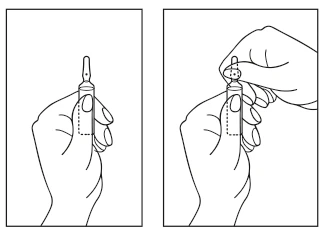
Instructions for opening the ampoule:
- Turn the ampoule with the coloured dot upwards. If any solution is present in the upper part of the ampoule, gently tap with a finger to ensure all solution moves to the lower part of the ampoule.
- Use both hands to open; holding the lower part of the ampoule in one hand, break off the top part of the ampoule with the other hand, in the direction away from the coloured dot (see images below).
An antidote in the form of calcium gluconate injection solution should be immediately available.
Any unused medicinal product or waste material should be disposed of in accordance with local regulations.