Madopar 250 mg
Poland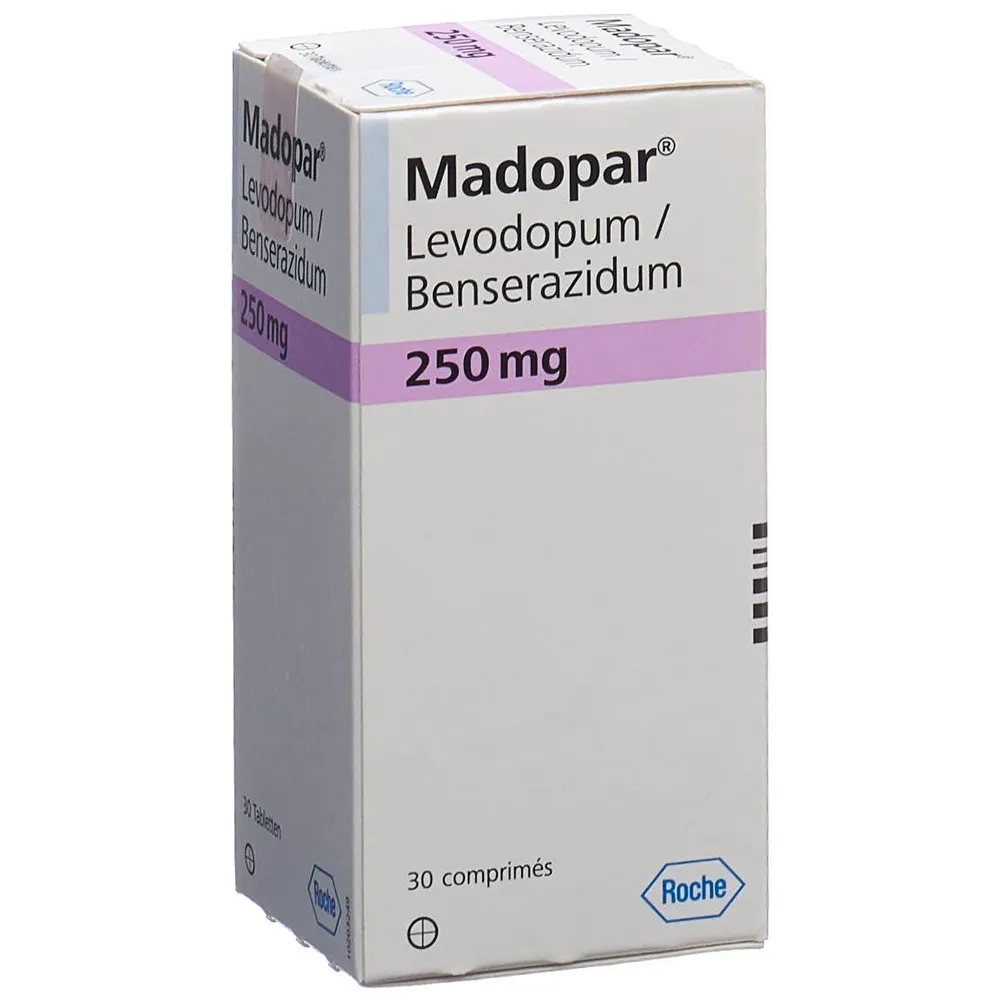
Table of Contents
Package leaflet: information for the patient
Warning! Keep this leaflet! Information on the immediate packaging is in a foreign language.
Madopar 250 mg (Madopar 200 mg/50 mg)
200 mg + 50 mg, tablets
Levodopa + Benserazide
Madopar 250 mg and Madopar 200 mg/50 mg are different trade names for the same medicine.
Please read this leaflet carefully before taking the medicine, as it contains important information for the patient.
- Keep this leaflet, so that you can read it again if necessary.
- If you have any questions, please consult your doctor or pharmacist.
- This medicine has been prescribed for a specific individual. Do not pass it on to others. The medicine may harm another person, even if their symptoms are the same.
- If you experience any side effects, including any not listed in this leaflet, tell your doctor or pharmacist. See section 4.
Contents of the leaflet:
- What Madopar 250 mg is and what it is used for
- Important information before taking Madopar 250 mg
- How to take Madopar 250 mg
- Possible side effects
- How to store Madopar 250 mg
- Contents of the package and other information
1. What Madopar 250 mg is and what it is used for
Madopar 250 mg is a combination medicine containing two active substances: levodopa and benserazide
(as the hydrochloride salt).
Madopar 250 mg is indicated for the treatment of Parkinson's disease.
Parkinson's disease is characterized by slowness of movement, muscle stiffness, and tremor.
These symptoms are caused by insufficient dopamine levels in specific areas of the brain.
The severity of symptoms varies among individual patients.
The goal of Parkinson's disease treatment is to compensate for the dopamine deficiency in the brain.
The difficulty in treatment lies in the fact that dopamine does not cross from the bloodstream into the brain.
However, its chemical precursor—levodopa—readily crosses into the brain. Unfortunately, most of the
levodopa is converted into dopamine before it enters the brain. Dopamine formed outside the brain
causes unpleasant side effects.
Madopar 250 mg contains two substances: levodopa and benserazide, which inhibits the conversion of
levodopa into dopamine outside the brain. After administration, the following processes occur in the body:
levodopa (the first component of Madopar 250 mg) cannot be converted into dopamine outside the brain
due to benserazide (the second component of Madopar 250 mg). Thanks to benserazide, more levodopa
reaches the brain, where it is converted into dopamine, and conversion of levodopa into dopamine in
extracerebral tissues is prevented, resulting in fewer side effects. Thus, Madopar 250 mg can beneficially
affect symptoms associated with Parkinson's disease. However, it does not cure the disease, as it does not
eliminate the underlying cause of dopamine deficiency in the brain. Causal treatment of the disease is
currently not possible.
2. Important information before taking Madopar 250 mg
When not to take Madopar 250 mg:
- if the patient is allergic to levodopa, benserazide, or any of the other ingredients of this medicine (listed in section 6);
- in patients treated with non-selective monoamine oxidase inhibitors (MAO), due to the risk of hypertensive crisis. Concomitant use of Madopar 250 mg with selective MAO-B inhibitors, such as selegiline or rasagiline, or selective MAO-A inhibitors, such as moclobemide, is not contraindicated; however, care must be taken not to use both selective MAO-A and MAO-B inhibitors simultaneously with Madopar 250 mg;
- in patients with uncontrolled disorders: endocrine (pheochromocytoma, hyperthyroidism, Cushing's syndrome), renal function (except patients undergoing dialysis for RLS), or liver function, heart disease (e.g. severe cardiac arrhythmias and heart failure), psychiatric disorders with psychotic symptoms, or closed-angle glaucoma;
- in patients under 25 years of age (skeletal development must be complete);
- in pregnant women or women of childbearing potential who do not use effective contraceptive methods. If pregnancy occurs in a woman being treated with Madopar 250 mg, the medicine should be discontinued immediately.
Warnings and precautions
Before starting Madopar 250 mg, discuss with your doctor or pharmacist if:
- the patient has diabetes – blood glucose levels should be monitored more frequently and antidiabetic medication doses adjusted accordingly;
- the patient has open-angle glaucoma – intraocular pressure should be measured regularly;
- the patient is scheduled for surgery under general anesthesia. In such cases, Madopar 250 mg should be continued as long as possible before surgery, except when using halothane anesthesia. With halothane anesthesia, Madopar 250 mg should be discontinued 12–48 hours before the procedure due to the risk of blood pressure fluctuations and/or cardiac arrhythmias (dysrhythmias). After surgery, treatment can be resumed, gradually increasing the dose until the previously used dose is reached;
- the patient has previously had coronary artery disease, cardiac arrhythmias, or heart failure – cardiac function should be closely monitored, especially at the beginning of treatment, and regularly during therapy;
- the patient is elderly and concurrently taking antihypertensive drugs or other medications that may cause orthostatic hypotension, or if the patient has previously experienced hypotension;
- the patient is taking sympathomimetic drugs (stimulants of the sympathetic nervous system), as their effects may be intensified;
- the patient is taking a catechol-O-methyltransferase (COMT) inhibitor;
- the patient is taking anticholinergic drugs such as amantadine, selegiline, bromocriptine, dopamine agonists; concomitant use of these drugs with Madopar 250 mg may enhance both therapeutic and adverse effects.
During the dose adjustment phase, liver and kidney function, cardiovascular function, and blood counts should be periodically monitored.
During treatment with Madopar 250 mg, depression may occur, although it may also be related to the underlying disease. Patients taking Madopar 250 mg should be closely monitored for psychological changes and depression, with or without suicidal thoughts.
Cognitive and behavioral disorders may occur in patients taking Madopar 250 mg.
Rarely, during levodopa treatment, drowsiness and/or sudden sleep attacks may occur. Very rarely, episodes of sleep attacks have been reported, which may occur even during routine daily activities, sometimes without warning or preceding drowsiness. Therefore, caution should be exercised when driving or operating machinery while taking Madopar 250 mg. Patients who have previously experienced drowsiness and/or sleep attacks must not drive or operate machinery. If drowsiness or sleep attacks occur, the doctor should consider reducing the dose or discontinuing treatment.
Hypersensitivity reactions may occur in predisposed individuals.
Inform your doctor if the patient or their family members notice unusual behaviors resulting from irresistible impulses, compulsions, or repetitive actions harmful to the patient or others. These behaviors are known as impulse control disorders and may include gambling addiction, compulsive or binge eating, increased sexual drive, or intense sexual thoughts and feelings. Re-evaluation of the treatment by the doctor may be necessary.
Patients with Parkinson's disease have an increased risk of developing melanoma. It is unclear whether this increased risk is due to Parkinson's disease itself or other factors, such as levodopa used in the treatment of Parkinson's disease. Regular periodic skin examinations for melanoma should be performed during treatment with Madopar 250 mg, regardless of the indication.
Do not stop taking Madopar 250 mg abruptly
Sudden discontinuation of the medicine may lead to a potentially life-threatening condition resembling neuroleptic malignant syndrome (high fever, muscle rigidity, possible mental changes). If such symptoms occur, the patient should be under medical supervision, possibly in a hospital, and receive appropriate symptomatic treatment promptly.
Potential for drug dependence or misuse
Cognitive and behavioral disorders may occur in a small number of patients, which may be directly related to taking higher than recommended doses (doses significantly exceeding those required for treating motor impairment).
Madopar 250 mg and other medicines
Tell your doctor or pharmacist about all medicines you are currently taking or have recently taken, as well as any medicines you plan to take.
If a doctor prescribes Madopar 250 mg for patients who have been taking a non-selective MAO inhibitor, at least two weeks should elapse between stopping the non-selective MAO inhibitor and starting Madopar 250 mg. Concomitant use of Madopar 250 mg with selective MAO-B inhibitors such as selegiline and rasagiline, or selective MAO-A inhibitors such as moclobemide, is permitted. However, simultaneous administration of a selective MAO-A inhibitor and a selective MAO-B inhibitor is equivalent to non-selective MAO inhibition and therefore should not be used concomitantly with Madopar 250 mg.
Concomitant use of iron sulfate reduces the maximum plasma concentration of levodopa.
Metoclopramide increases the absorption rate of levodopa. Domperidone may enhance levodopa absorption in the intestine.
When antihypertensive medicines are used concomitantly with Madopar 250 mg, blood pressure should be monitored regularly to allow dose adjustments.
Neuroleptics, opioids, and antihypertensive preparations containing reserpine inhibit the effect of Madopar 250 mg.
Concomitant use of Madopar 250 mg with anti-Parkinson's medicines (amantadine, selegiline, bromocriptine, dopamine agonists, anticholinergic drugs such as trihexyphenidyl) is permitted, but it should be noted that both desired and adverse effects may be enhanced. Care should be taken not to abruptly discontinue anticholinergic drugs at the beginning of Madopar 250 mg treatment, as the effect of levodopa may take some time to manifest.
Concomitant use of antipsychotics with drugs that block dopamine receptors may counteract the anti-Parkinson effect of Madopar 250 mg.
Levodopa may counteract the effect of antipsychotics. Caution should be exercised when administering these medicines together, and patients should be closely observed for reduced anti-Parkinson effects and worsening of Parkinson's symptoms.
Levodopa contained in Madopar 250 mg may affect laboratory test results for catecholamines, creatinine, uric acid, and glucosuria.
Patients taking Madopar 250 mg may have falsely positive Coombs test results and falsely positive urine ketone tests.
During general anesthesia with halothane, Madopar 250 mg should be discontinued 12–48 hours before the procedure, as concomitant use of Madopar 250 mg and halothane may cause blood pressure fluctuations and/or cardiac dysrhythmias.
Taking Madopar 250 mg with food and drink
Concomitant intake of high-protein meals may reduce the effectiveness of the medicine.
Pregnancy and breastfeeding
Madopar 250 mg must not be used during pregnancy or in women of childbearing potential who do not use effective contraceptive methods.
A pregnancy test should be performed before starting treatment to exclude pregnancy.
If a woman taking Madopar 250 mg becomes pregnant, the medicine should be discontinued (after consultation with the attending physician).
Breastfeeding must not be performed during treatment with Madopar 250 mg, as the active substances may pass into breast milk and harm the infant.
Driving and operating machinery
Drowsiness may occur during treatment with Madopar 250 mg, and in rare cases, sudden sleep attacks. Therefore, caution should always be exercised when driving or operating machinery while taking Madopar 250 mg. Patients who experience drowsiness or sleep attacks during treatment with Madopar 250 mg must refrain from driving motor vehicles or performing certain other activities (such as operating machinery), as impaired concentration may pose a risk of serious injury or death to themselves or others.
Madopar 250 mg contains sodium
Madopar 250 mg contains less than 1 mmol (23 mg) of sodium per tablet, meaning the medicine is considered "sodium-free."
3. How to take Madopar 250 mg
This medicine should always be taken exactly as directed by your doctor or pharmacist. If in doubt,
you should consult your doctor or pharmacist.
Dosing in Parkinson's disease
A patient with Parkinson's disease must remain under strict medical supervision and must not
initiate any other treatment for this condition without prior agreement with the doctor. If a change
of doctor or a visit to another physician becomes necessary, the treating physician must be
promptly informed about the therapy with Madopar 250 mg.
Madopar 250 mg must never be taken without a doctor's prescription. Under no circumstances
should the dosage be changed without the doctor's consent.
Madopar 250 mg should preferably be taken 30 minutes before a meal or one hour after a meal.
Gastrointestinal side effects, which mainly occur during the initial phase of treatment, can usually be
avoided by taking Madopar 250 mg with a small meal (e.g. biscuits) or with a drink, or by gradually
increasing the dose.
For effective treatment, it is important to take the correct amount of medicine at the right time.
Your doctor will individually determine the appropriate dose and frequency of administration and,
in close cooperation with the patient, establish the optimal treatment regimen. Therefore, it is essential
to strictly follow the doctor's instructions. Generally, at the beginning of treatment, the doctor will
prescribe a lower dose of Madopar 250 mg and gradually increase it. This approach allows the
patient's body to adapt to the medicine, thereby minimizing adverse effects as much as possible.
Madopar is available in various strengths and formulations:
- Madopar 62.5 mg, 50 mg + 12.5 mg, capsules
- Madopar 125 mg, 100 mg + 25 mg, capsules
- Madopar, 200 mg + 50 mg, capsules
- Madopar HBS, 100 mg + 25 mg, capsules
- Madopar 250 mg, 200 mg + 50 mg, tablets
- Madopar 62.5 mg, 50 mg + 12.5 mg, oral suspension tablets
- Madopar 125 mg, 100 mg + 25 mg, oral suspension tablets.
Typical dosage:
In the early stage of Parkinson's disease, treatment usually begins with one capsule of Madopar
62.5 mg (50 mg levodopa + 12.5 mg benserazide) taken three to four times daily.
Optimal therapeutic effect is usually achieved with a daily dose of Madopar corresponding to
300–800 mg levodopa + 75–200 mg benserazide, administered in at least three divided doses over
a period of 4 to 6 weeks.
Average maintenance dose corresponds to one capsule of Madopar 125 mg taken three to six times
daily. The number of divided doses and their distribution throughout the day should be individually
determined by the doctor for each patient, depending on the clinical condition. Madopar HBS and
Madopar oral suspension tablets may be used interchangeably with standard formulations of Madopar
(capsules and tablets) to achieve optimal therapeutic effect.
Special dosing instructions
Parkinson's disease:
The dose must be carefully determined for all patients. Patients previously treated with other
anti-parkinsonian drugs may be switched to Madopar 250 mg. As the patient's condition improves
with Madopar 250 mg, the doses of other medications may be reduced or gradually discontinued.
Madopar oral suspension tablets are particularly indicated in patients with dysphagia (swallowing
difficulties) or when a faster onset of action is desired.
Patients who experience significant fluctuations in drug effect during the day should receive
smaller doses more frequently throughout the day, or a switch to Madopar HBS is recommended.
Switching from standard formulation to Madopar HBS should be done from one day to the next,
starting with the first morning dose. The same total daily dose and the same distribution of doses as
with the standard formulation should be maintained.
After 2–3 days, the dose should be gradually increased by approximately 50%. A temporary
worsening of symptoms may occur.
The properties of Madopar HBS result in a later onset of action compared to standard formulations.
The desired effect may be achieved more quickly by administering Madopar HBS together with the
standard formulation or with Madopar oral suspension tablets. This approach may be particularly
useful for the first morning dose, which is usually higher than subsequent doses taken during the day.
The dosing regimen for Madopar HBS should be individually determined by the doctor, slowly and
with particular caution, with intervals of at least 2–3 days between each dose adjustment.
In patients with reduced motor function at night, positive effects can be achieved by gradually
increasing the last evening dose of Madopar HBS up to 250 mg, taken immediately before sleep.
Excessive response (dyskinesias) following administration of Madopar HBS is best managed by
extending the interval between doses rather than by reducing individual doses.
If an adequate clinical response is not achieved with Madopar HBS, a return to previous standard
Madopar therapy is recommended.
Taking Madopar 250 mg
If your doctor has prescribed Madopar 250 mg, the prescribed amount may be crushed as needed to
facilitate swallowing.
If you feel that the effect of Madopar 250 mg is too strong or too weak, you should consult your doctor.
Taking a higher than recommended dose of Madopar 250 mg
If a higher than recommended dose is taken, you should immediately contact your doctor or
pharmacist.
The most common symptoms of overdose may include cardiovascular effects (e.g. cardiac arrhythmia),
psychiatric disturbances (e.g. disorientation and insomnia), gastrointestinal symptoms (e.g. nausea and
vomiting), and involuntary movements.
Overdose with Madopar 250 mg requires immediate medical attention, possibly in a hospital setting
or intensive care unit. Monitoring of vital functions and other parameters according to the clinical
condition is indicated. Patients may require treatment for cardiovascular symptoms (e.g. cardiac
arrhythmias) or central nervous system dysfunction. Antiarrhythmic drugs and/or respiratory
stimulants or neuroleptics may be necessary.
Missing a dose of Madopar 250 mg
Do not take a double dose to make up for a missed dose. Continue taking the medicine according to
the schedule prescribed by your doctor.
Stopping Madopar 250 mg
Do not stop taking Madopar 250 mg abruptly. See section 2: Warnings and precautions.
If you have any further doubts about using this medicine, consult your doctor or pharmacist.
4. Possible side effects
Like all medicines, this medicine can cause side effects, although not everyone will experience them.
Frequency categories
Very common: may affect more than 1 in 10 patients
Common: may affect up to 1 in 10 patients
Uncommon: may affect up to 1 in 100 patients
Rare: may affect up to 1 in 1,000 patients
Very rare: may affect up to 1 in 10,000 patients
Not known (frequency cannot be estimated from available data)
In clinical trials using levodopa/benserazide in restless legs syndrome, frequent reports included
headache, worsening of restless legs syndrome symptoms, dizziness, feverish infection, cold,
bronchitis, dry mouth, diarrhoea, nausea, ECG changes (arrhythmia), and increased blood pressure.
The following side effects have been reported during treatment with Madopar 250 mg, all with
unknown frequency.
Blood and lymphatic system disorders: blood disorders such as haemolytic anaemia, leukopenia,
thrombocytopenia. For this reason – as always during long-term levodopa therapy – periodic monitoring
of blood counts and liver and kidney function is recommended.
Metabolism and nutrition disorders: decreased appetite.
Psychiatric disorders: dopamine dysregulation syndrome (cognitive and behavioural disturbances
that may be directly related to taking higher than recommended doses of the medicine), confusion,
depression, restlessness, anxiety, insomnia, hallucinations, delusions, disorientation, pathological
gambling, increased libido, increased sexual drive, compulsive spending or shopping, binge eating,
eating disorders.
Nervous system disorders: loss of taste, taste disturbances, involuntary movements (e.g. movements
disrupting normal motor coordination). These can usually be eliminated or reduced by decreasing the
dose. Fluctuations in response to treatment during the day can be minimized by appropriate dose
adjustment or by administering smaller doses at shorter intervals. Other effects include drowsiness,
sudden sleep attacks, and freezing (sudden immobility).
Cardiac disorders: arrhythmia (irregular heartbeat).
Vascular disorders: orthostatic hypotension (blood pressure drop related to changing from lying or
sitting to standing position). Orthostatic disturbances can usually be reduced by decreasing the dose
of Madopar 250 mg.
Gastrointestinal disorders: nausea, vomiting, diarrhoea, discoloration of saliva, tongue, teeth, and
oral mucosa.
Gastrointestinal side effects mainly occur during the early phase of treatment and can be largely
reduced by taking Madopar 250 mg with a small, low-protein meal, taking the medicine with a drink,
or gradually increasing the dose.
Hepatobiliary disorders: increased transaminase activity, increased alkaline phosphatase activity,
increased gamma-glutamyl transferase activity.
Skin and subcutaneous tissue disorders: itching, rash.
Musculoskeletal and connective tissue disorders: in restless legs syndrome, symptom augmentation
may occur (symptoms shift from evening/night to early afternoon and evening before the next
night-time dose).
Investigations: increased blood urea concentration, chromaturia (discoloration of urine. Urine usually
becomes red and darkens upon standing). Discoloration may also affect other body fluids and tissues,
including saliva, tongue, teeth, and oral mucosa.
Please note that the following side effects may also occur:
- dopamine dysregulation syndrome (cognitive and behavioural disturbances that may be directly related to taking higher than recommended doses of the medicine);
- inability to resist impulses, urges, or compulsions to perform actions that may be harmful to the patient or others; this includes:
- a strong impulse to gamble compulsively, despite serious personal or family consequences,
- altered or increased sexual interests and behaviours of significant concern to the patient or others, e.g. activities related to heightened sexual drive,
- compulsive, uncontrolled spending or shopping,
- binge eating (consuming large amounts of food in a short time) or compulsive eating (eating more food than normal and more than needed to satisfy hunger).
You should inform your doctor if you experience any of these behaviours so that ways to manage or reduce these symptoms can be discussed. If any side effect worsens or if you experience any side effects not listed in this leaflet, inform your doctor or pharmacist.
Reporting of side effects
If you experience any side effects, including those not listed in this leaflet, you should inform your
doctor or pharmacist. Side effects can be reported directly to the Department of Monitoring of Adverse
Drug Reactions, Office for Registration of Medicinal Products, Medical Devices and Biocidal Products,
Al. Jerozolimskie 181C, 02-222 Warsaw, tel.: +48 22 49 21 301, fax: +48 22 49 21 309, website:
https://smz.ezdrowie.gov.pl.
Reporting side effects helps provide more information on the safety of this medicine.
5. How to store Madopar 250 mg
Keep this medicine out of the sight and reach of children.
Store below 25°C. Keep the bottle tightly closed to protect from light and moisture.
Do not use this medicine after the expiry date stated on the packaging. The expiry date refers to the last day of the stated month.
Medicines must not be disposed of via wastewater or household waste. Ask your pharmacist how to dispose of medicines no longer required. Such measures help protect the environment.
6. Contents of the pack and other information
What Madopar 250 mg contains
- The active substances are levodopa and benserazide. Each Madopar 250 mg tablet contains 200 mg of levodopa and 50 mg of benserazide (as hydrochloride).
- Other ingredients are: mannitol, calcium hydrogen phosphate, microcrystalline cellulose, pregelatinized corn starch, crospovidone, ethylcellulose, iron oxide red, colloidal anhydrous silica, sodium docucyl sulfate, magnesium stearate.
What Madopar 250 mg looks like and contents of the pack
The pack contains 100 tablets. Madopar 250 mg, 200 mg + 50 mg, tablets are round, biconvex, light red, slightly speckled tablets with a cross-score and engraved ROCHE code and logo on one side.
For more detailed information, please contact the responsible entity or parallel importer.
Responsible entity in the Czech Republic, country of export:
Roche s. r. o.
Sokolovská 685/136f
186 00 Prague 8
Czech Republic
Manufacturer:
Roche s. r. o.
Sokolovská 685/136f
186 00 Prague 8
Czech Republic
Parallel importer:
InPharm Sp. z o.o.
ul. Strumykowa 28/11
03-138 Warsaw
Repackaged in:
InPharm Sp. z o.o. Services sp. k.
ul. Chełmżyńska 249
04-458 Warsaw
Marketing authorisation number in the Czech Republic, country of export: 27/391/01-C
Parallel import authorisation number: 289/22