Macmiror
Poland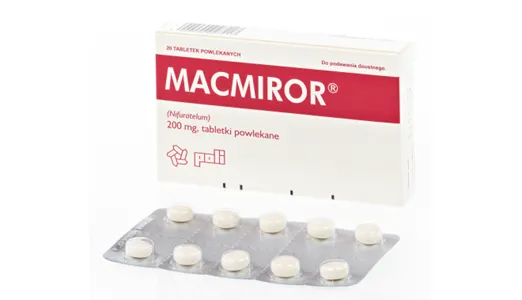
Table of Contents
Package leaflet: Information for the patient
Macmiror, 200 mg, coated tablets
Nifuratelum
Please read this leaflet carefully before taking this medicine, as it contains
important information for you.
- Keep this leaflet, as you may need to read it again.
- If you have any further questions, ask your doctor or pharmacist.
- This medicine has been prescribed for a specific individual. Do not pass it on to others. It may harm other people, even if their symptoms are the same.
- If you experience any adverse reactions, including any not listed in this leaflet, inform your doctor or pharmacist. See section 4.
Table of contents:
- What Macmiror is and what it is used for
- What you need to know before taking Macmiror
- How to take Macmiror
- Possible side effects
- How to store Macmiror
- Contents of the pack and other information
1. What Macmiror is and what it is used for
Macmiror contains the active substance nifuratel. Nifuratel is a synthetic compound that acts effectively against protozoa, bacteria, and fungi most commonly causing vaginal infections.
Indications for Macmiror:
- Treatment of urinary tract infections caused by microorganisms sensitive to nifuratel.
- Treatment of vaginal and vulvar infections caused by Trichomonas vaginalis, Candida spp., and aerobic and anaerobic bacteria sensitive to nifuratel.
- Treatment of intestinal amoebiasis and intestinal giardiasis (lambliasis).
Macmiror is effective in all types of urogenital infections.
Nifuratel exerts antibacterial activity against both aerobic and anaerobic Gram-negative and Gram-positive bacteria: Gardnerella vaginalis, Escherichia coli, Shigella, Salmonella spp., Bacillus sp., Proteus spp., Klebsiella pneumoniae.
Nifuratel does not act against Lactobacillus spp., which is a physiological component of normal vaginal bacterial flora, thus facilitating and accelerating the treatment of vaginal infections and reducing their recurrence rate.
Nifuratel does not cause cross-resistance of microorganisms to other drugs used in infections.
During 30 years of nifuratel use, no such resistance has been reported.
2. Important information before taking Macmiror
When not to take Macmiror
- if the patient is allergic to the active substance or to any of the other ingredients of this medicine (listed in section 6).
Warnings and precautions
Before starting treatment with Macmiror, consult your doctor or pharmacist.
During treatment, patients should avoid sexual intercourse.
Concomitant use of nifuratel by the sexual partner may help prevent recurrence of the infection.
Children
Macmiror is not recommended for children under 6 years of age.
Elderly patients
Macmiror may be used by elderly individuals.
Macmiror and other medicines
Inform your doctor or pharmacist about all medicines you are currently taking or have recently taken, as well as any medicines you plan to take.
To date, no interactions between nifuratel and other medicines have been reported.
Macmiror with food, drink and alcohol
Macmiror tablets should be swallowed whole (without chewing) after meals.
Alcohol consumption should be avoided during treatment with Macmiror, as it may cause sudden facial flushing, discomfort or nausea, although these symptoms resolve spontaneously.
Pregnancy and breastfeeding
If the patient is pregnant, breastfeeding, suspects she may be pregnant, or is planning to become pregnant, she should consult her doctor or pharmacist before using this medicine.
The decision to use Macmiror during pregnancy or breastfeeding is made by the physician.
As a precautionary measure, Macmiror should be avoided during pregnancy and breastfeeding unless absolutely necessary and only under direct medical supervision.
Driving and using machines
Macmiror has no influence on the ability to drive or operate machinery.
Macmiror contains sucrose. If the patient has been previously diagnosed with intolerance to certain sugars, the patient should consult their doctor before taking this medicine.
If you have any further doubts regarding the use of this medicine, consult your doctor or pharmacist.
3. How to take Macmiror
This medicine should always be taken according to the recommendations of your doctor or pharmacist.
If in doubt, consult your doctor or pharmacist.
The dosage of the medicine largely depends on the type of disease, so it is essential to follow your doctor's instructions regarding treatment. In certain situations, your doctor may recommend appropriate tests, the results of which may influence the treatment regimen.
If you feel that the effect of the medicine is too strong or too weak, consult your doctor.
Recommended doses:
- Treatment of urinary tract infections caused by microorganisms sensitive to nifuratel
Adult patients
The recommended dose is 1 to 2 coated tablets three times daily, taken after meals. The dose should be adjusted according to the severity and etiology of the infection. Treatment should continue for 7 to 14 days, until subjective symptoms have resolved and urine test results—including bacteriological tests—are normal.
Children over 6 years of age
The recommended daily dose is 10 mg/kg body weight to 20 mg/kg body weight, administered in two divided doses after meals. Treatment should continue for 7 to 14 days, until subjective symptoms have resolved and urine test results—including bacteriological tests—are normal.
Macmiror is a safe medicine, and if necessary, the treatment course may be repeated.
- Treatment of vaginal and vulvar infections caused by: Trichomonas vaginalis, Candida spp., aerobic and anaerobic bacteria sensitive to nifuratel
Adult women
The recommended daily dose is 4 coated tablets (800 mg) or 6 coated tablets (1200 mg), administered in two or three divided doses of 2 tablets (400 mg) each. Treatment lasts 7 days, but if necessary, the medicine should be administered for a longer period or the treatment course repeated.
In cases of severe infection, topical treatment should be used concomitantly. In such cases, both the patient and her sexual partner should be treated, with 3 tablets (600 mg) of Macmiror daily for 7 days, in three divided doses of 1 tablet (200 mg) each.
Macmiror should be taken after meals.
Girls over 6 years of age
The recommended daily dose is 10 mg/kg body weight, administered in two divided doses. Treatment usually lasts 7 days. The medicine should be taken after meals.
- Treatment of intestinal amoebiasis and intestinal giardiasis (lambliasis)
Intestinal amoebiasis
Adult patients
The recommended daily dose is 6 coated tablets (1200 mg), administered in three divided doses of 2 tablets (400 mg) each, after meals. Treatment should continue for 10 days.
Children over 6 years of age
The recommended daily dose is 30 mg/kg body weight, administered in three divided doses after meals for 10 days.
Intestinal giardiasis
Adult patients
The recommended daily dose is 4 coated tablets (800 mg) or 6 coated tablets (1200 mg), administered in two or three divided doses of 2 tablets (400 mg) each. The medicine should be taken after meals for 7 days.
Children over 6 years of age
The recommended daily dose is 30 mg/kg body weight, administered in two divided doses after meals for 7 days.
Method of administration
The medicine should always be taken orally, after meals, with a large amount of fluid, and without chewing.
Appropriate testing should be performed in individuals in close contact with patients (e.g. family members, sexual partners).
If parasitic forms (cysts or trophozoites) are detected in microscopic stool examination, treatment should be initiated. After completing the treatment course, efficacy should be confirmed by microscopic examination of stool.
In case of reinfection or if treatment was ineffective, the treatment should be extended or repeated.
Taking more than the recommended dose of Macmiror
No cases of Macmiror overdose have been reported.
If more than the recommended dose is taken, consult a doctor immediately.
Stopping treatment with Macmiror
Do not discontinue treatment without consulting your doctor, as this may result in ineffective treatment.
If you have any further doubts regarding the use of this medicine, consult your doctor or pharmacist.
4. Possible adverse reactions
Like all medicines, this medicine can cause adverse reactions, although not everyone will experience them.
Rare (may affect more than 1 in 10,000 people but less than 1 in 1,000 people):
- nausea.
Very rare (may affect less than 1 in 10,000 people):
- vomiting, dyspepsia,
- allergic reactions such as skin rash, urticaria, or localised swelling.
Reporting of adverse reactions
If any adverse reactions occur, including any adverse reactions not listed in this leaflet, inform a doctor or pharmacist. Adverse reactions can be reported directly to the Department of Monitoring Adverse Drug Reactions at the Office for Registration of Medicinal Products, Medical Devices and Biocidal Products, Al. Jerozolimskie 181C, 02-222 Warsaw, tel. +48 22 49 21 301, fax: +48 22 49 21 309, website: https://smz.ezdrowie.gov.pl
Adverse reactions can also be reported to the marketing authorisation holder.
Reporting adverse reactions helps provide more information on the safety of the medicine.
5. How to store Macmiror
Keep this medicine out of sight and reach of children.
Store below 25°C.
Do not use this medicine after the expiry date stated on the packaging.
The expiry date refers to the last day of the stated month.
Medicines must not be disposed of via wastewater or household waste. Ask your pharmacist
how to dispose of medicines no longer required. This will help protect the environment.
6. Contents of the package and other information
What Macmiror contains
- The active substance is nifuratel. One coated tablet contains 200 mg of nifuratel.
- Other ingredients are: maize starch, polyethylene glycol 6000, talc, magnesium stearate, sucrose, magnesium carbonate, rice starch, gelatin, arabic gum, titanium dioxide, wax E.
What Macmiror looks like and contents of the pack
Macmiror is a coated tablet.
The medicine is packaged in Al/PVC blisters in a cardboard box.
The pack contains 20 coated tablets.
Marketing Authorisation Holder and Manufacturer
Marketing Authorisation Holder:
Polichem S.A.
50, Val Fleuri
L – 1526 Luxembourg
Manufacturer:
Doppel Farmaceutici S.r.l
Via Volturno 48
Quinto De’Stampi
20089 Rozzano (Milano)
Italy
Representative of the Marketing Authorisation Holder:
Angelini Pharma Polska Sp. z o.o.
Aleje Jerozolimskie 181B, 02-222 Warsaw
tel.: (22) 702 82 00
e-mail: [email protected]
representative of the marketing authorisation holder.