Luxfen
Poland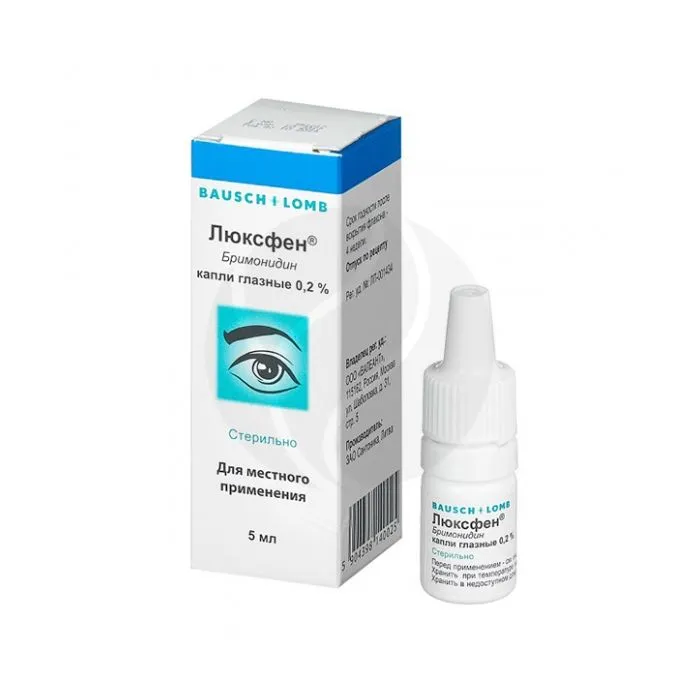
Table of Contents
Luxfen, 2 mg/ml, eye drops, solution
brimonidini tartras
Please read the entire leaflet before using the medicine, as it contains
important information for the patient
- Keep this leaflet, as you may need to read it again.
- If you have any further questions, please consult your doctor or pharmacist.
- This medicine has been prescribed for a specific individual. Do not pass it on to others. The medicine may harm other people, even if their symptoms appear identical.
- If any adverse reactions occur, including any not listed in this leaflet, inform your doctor or pharmacist. See section 4.
Table of contents of the leaflet:
- What Luxfen is and what it is used for
- Important information before using Luxfen
- How to use Luxfen
- Possible side effects
- How to store Luxfen
- Contents of the pack and other information
1. What Luxfen is and what it is used for
Luxfen is used to reduce intraocular pressure. Luxfen may be used as monotherapy in patients for whom treatment with β-adrenergic receptor-blocking eye drops is contraindicated, or as an adjunctive therapy together with other eye drops when intraocular pressure is not sufficiently controlled with single agents in the treatment of open-angle glaucoma or ocular hypertension. The active substance in Luxfen is brimonidine tartrate, which reduces intraocular pressure.
2. Important information before using Luxfen medicine
When not to use Luxfen:
- If the patient has hypersensitivity to brimonidine tartrate or to any of the other components of this medicine (listed in section 6).
- If the patient is taking monoamine oxidase inhibitors (MAOIs) or certain antidepressant medicines. Inform the doctor if taking any antidepressant medicines.
- In newborns, infants, and children under 2 years of age.
- Breastfeeding is not recommended during treatment with Luxfen.
Warnings and precautions
Before starting treatment with Luxfen, discuss the following with your doctor or pharmacist:
- If the patient has or has previously had depression, impaired mental function, cerebrovascular disorders, heart disorders, circulatory disorders in the limbs, or blood pressure disorders.
- If the patient has or has previously had kidney or (and) liver function disorders.
- If Luxfen is to be used in children aged between 2 and 12 years, because Luxfen is not recommended in this age group.
Consult your doctor if any of the above situations apply to the patient!
Children and adolescents
Brimonidine is not recommended for use in children (aged 2 to 12 years).
Luxfen is contraindicated in newborns, infants, and children under 2 years of age.
Luxfen and other medicines
Inform your doctor or pharmacist about all medicines the patient is currently taking or has recently taken, as well as any medicines the patient plans to take.
Inform the doctor if the patient is taking any of the following medicines:
- Analgesics, sedatives, opioid painkillers, barbiturates, or if alcohol is regularly consumed;
- Anaesthetics;
- Medicines for heart conditions or medicines that lower blood pressure;
- Chlorpromazine, methylphenidate, reserpine;
- Medicines acting on the same receptor as Luxfen, e.g., isoprenaline and prazosin;
- Monoamine oxidase inhibitors (MAOIs) and other antidepressant medicines;
- Any other medicines, even if their use is not related to eye disease;
- Or if the doses of currently used medicines have changed. These may affect treatment with Luxfen.
Pregnancy and breastfeeding
If the patient is pregnant or breastfeeding, suspects she may be pregnant, or is planning to become pregnant, she should consult a doctor or pharmacist before using this medicine.
Breastfeeding should not be performed during treatment with Luxfen.
Driving and operating machinery
- Luxfen may cause blurred and/or impaired vision. These symptoms may worsen at night or in dim light.
- In some patients, Luxfen may cause drowsiness or fatigue.
- Do not drive or operate machinery until these symptoms have resolved.
Luxfen contains benzalkonium chloride.
The medicine contains 0.05 mg of benzalkonium chloride per ml, equivalent to 0.025 mg/5 ml.
Benzalkonium chloride may be absorbed by soft contact lenses and may alter their color. Contact lenses should be removed before instillation and at least 15 minutes should elapse before reinsertion.
Benzalkonium chloride may also cause eye irritation, particularly in patients with dry eye syndrome or corneal disorders (the transparent layer at the front of the eye). If abnormal sensations, stinging, or eye pain occur after using the medicine, contact a doctor.
3. How to use Luxfen
This medicine should always be used exactly as directed by your doctor or pharmacist.
If in doubt, consult your doctor or pharmacist.
Use in adults
The usual dose is one drop in each eye requiring treatment, administered twice daily, approximately 12 hours apart.
Use in children under 12 years of age
Luxfen should not be used in newborns, infants, and children under 2 years of age.
Use of Luxfen is not recommended in children (2–12 years of age).
Method of administration
Brimonidine is intended for ophthalmic use only as eye drops. Do not take this medicine by mouth.
Always wash your hands before instilling the drops. Information on the number of drops to be administered per dose is provided on the prescription. If you are using Luxfen together with other eye drops, wait at least 5–15 minutes between instillation of Luxfen and the other eye drops.
To instill the drops, follow these steps:
- Tilt your head backward and look upward at the ceiling.
- Gently pull down the lower eyelid to form a small pocket.
- Hold the bottle upside down and squeeze to release one drop into the eye.
- Immediately after instilling each drop, close the eye and press gently with the fingertip on the inner corner of the eye (near the nose) for 1 minute. This helps reduce systemic absorption of brimonidine.
Avoid touching the eye or any surface with the dropper tip.
Use of a higher than recommended dose of Luxfen
Adults
In adults who received more drops than recommended, adverse reactions reported were consistent with those currently known to occur with Luxfen.
In adults who accidentally swallowed Luxfen, a drop in blood pressure occurred, followed in some patients by a rise in blood pressure.
Children
Severe adverse reactions have been reported in children who accidentally swallowed Luxfen. Observed symptoms included: drowsiness, reduced muscle tone, lowered body temperature, pallor, and breathing difficulties. If any of these symptoms occur, contact a doctor immediately.
Adults and children
In case of accidental ingestion or use of a higher than recommended dose of Luxfen, contact a doctor immediately.
Missed dose of Luxfen
If you miss a dose, instill it as soon as possible. However, if it is almost time for the next dose, skip the missed dose and continue with your regular dosing schedule. Do not use a double dose to make up for a missed dose.
Stopping Luxfen
For treatment to be effective, Luxfen must be used daily. Do not stop using Luxfen without consulting your doctor.
If you have any further questions about the use of this medicine, consult your doctor or pharmacist.
4. Possible adverse reactions
Like all medicines, this medicine can cause adverse reactions, although not
everyone will experience them. The likelihood of occurrence of an adverse
reaction is described below:
Very common: may affect more than 1 in 10 people
Common: may affect up to 1 in 10 people
Uncommon: may affect up to 1 in 100 people
Rare: may affect up to 1 in 1,000 people
Very rare: may affect up to 1 in 10,000 people
Not known: frequency cannot be estimated from the
available data
The following adverse reactions may be observed during treatment with
the medicine Luxfen
Eye-related:
Very common:
- Eye irritation (eye redness, burning, stinging, foreign body sensation in the eye, itching, granules or white spots on the transparent layer covering the eye surface)
- Blurred vision
- Allergic eye reactions (allergic blepharitis and conjunctivitis, allergic conjunctivitis)
- Allergic eyelid reactions (allergic blepharitis)
Common:
- Local irritation (inflammation, redness and swelling of the eyelids, conjunctival swelling, presence of discharge in the conjunctival sac, eye pain and tearing)
- Light sensitivity
- Corneal erosion and spots on the eye surface
- Dry eye
- Conjunctival pallor
- Visual disturbances
- Conjunctivitis
Very rare:
- Iritis
- Pupillary constriction
Frequency not known:
- Eyelid itching
- Iritis and ciliary body inflammation
Whole body:
Very common:
- Headache
- Dry mouth
- Fatigue/somnolence
Common:
- Dizziness
- Influenza-like symptoms
- Gastrointestinal symptoms
- Taste disturbances
- General weakness
Uncommon:
- Depression
- Palpitations or irregular heartbeat
- Nasal dryness
- Generalized allergic reactions
Rare:
- Dyspnea
Very rare:
- Insomnia
- Fainting
- High blood pressure
- Low blood pressure
Frequency not known:
- Skin reactions including skin redness, facial swelling, itching, rash, and blood vessel dilation.
Reporting of adverse reactions
If any adverse reactions occur, including any adverse reactions not listed
in this leaflet, inform your doctor or pharmacist. Adverse reactions can be
reported directly to the Department of Monitoring Adverse Drug Reactions
of the Office for Registration of Medicinal Products, Medical Devices and
Biocidal Products:
Al. Jerozolimskie 181C, 02-222 Warsaw, tel.: 22 49-21-301, fax: 22 49-21-309,
website: https://smz.ezdrowie.gov.pl
Adverse reactions can also be reported to the marketing authorization holder.
Reporting adverse reactions helps to provide more information on the safety of the medicine.
5. How to store Luxfen
Keep this medicine out of sight and reach of children.
Do not use this medicine after the expiry date stated on the carton and bottle.
The expiry date refers to the last day of that month.
After first opening, Luxfen can be stored for a maximum of 28 days.
Medicines must not be disposed of via wastewater or household waste.
Ask your pharmacist how to dispose of medicines no longer in use.
This will help protect the environment.
6. Contents of the package and other information
What Luxfen contains:
- The active substance is brimonidine tartrate. 1 ml of solution contains 2 mg of brimonidine tartrate, equivalent to 1.3 mg of brimonidine.
- Other components are: benzalkonium chloride, polyvinyl alcohol, sodium chloride, sodium citrate, citric acid monohydrate, water for injections, sodium hydroxide, and hydrochloric acid (used for pH adjustment).
What Luxfen looks like and contents of the pack
Luxfen is a clear, slightly yellowish-green solution. The eye drops are available in 5 ml and 10 ml bottles with a dropper, in packs containing 1, 3 or 6 bottles.
Not all pack sizes may be marketed.
Marketing Authorisation Holder:
BAUSCH + LOMB IRELAND LIMITED
3013 Lake Drive
Citywest Business Campus
Dublin 24, D24PPT3, Ireland
Manufacturer:
Pharma Stulln GmbH
Werksstraße 3
92551 Stulln
Germany
This medicinal product is authorised in the Member States of the European Economic Area under the following names:
Bulgaria: Луксфен 2 mg/ml капки за очи, разтвор
Czech Republic: Luxfen
Latvia: Luxfen, 2 mg/ml Acu pilieni, šķīdums
Lithuania: Luxfen 2 mg/ml akių lašai, tirpalas
Poland: Luxfen
Slovakia: Luxfen 2 mg/ml