Lutinus
Poland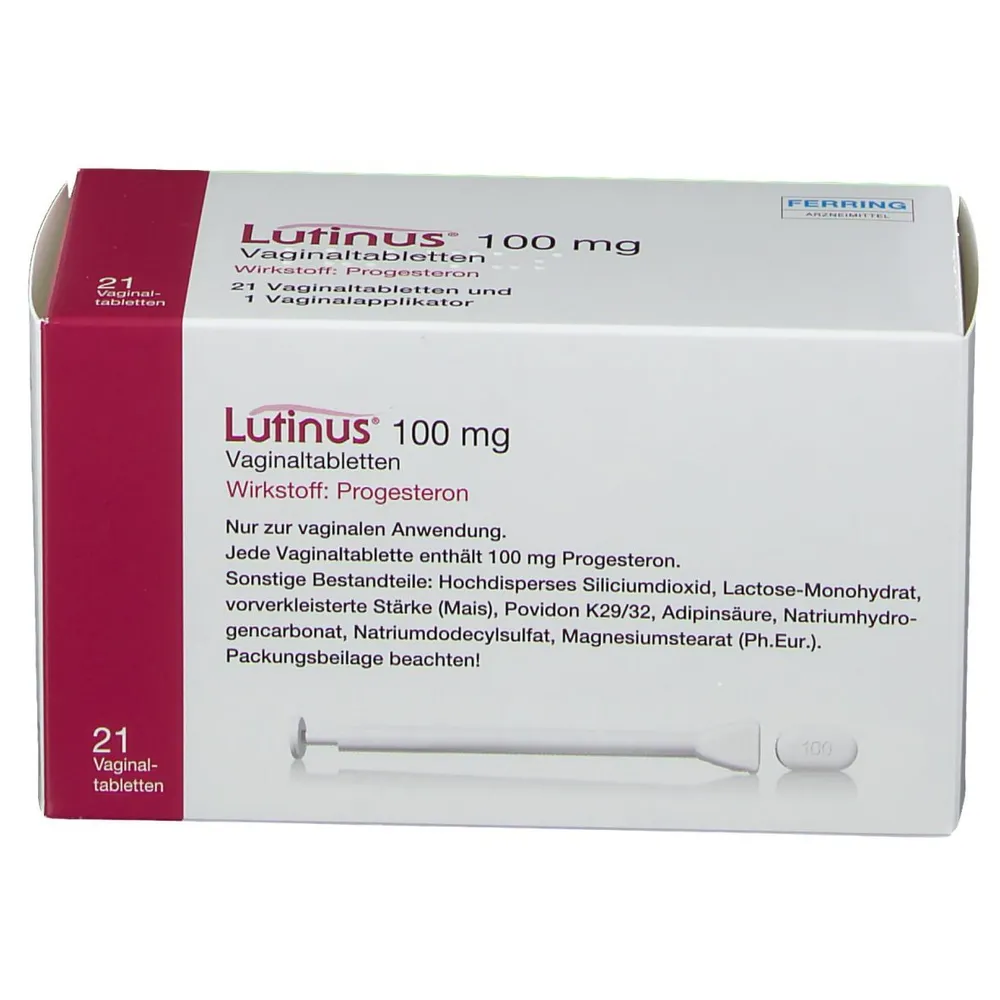
Table of Contents
Package leaflet: information for the patient
Warning! Keep the leaflet. Information on the immediate packaging in a foreign language.
Lutinus, 100 mg, vaginal tablets
Progesteronum
Please read the entire leaflet carefully before using the medicine, as it contains
important information for the patient.
- Keep this leaflet, as you may need to read it again.
- If you have any questions, ask your doctor or pharmacist.
- This medicine has been prescribed for a specific individual. Do not pass it on to others. The medicine may harm others, even if their symptoms are the same.
- If the patient experiences any adverse reactions, including any not listed in this leaflet, inform the doctor, pharmacist, or nurse. See section 4.
Contents of the leaflet:
- What Lutinus is and what it is used for
- Important information before using Lutinus
- How to use Lutinus
- Possible side effects
- How to store Lutinus
- Contents of the pack and other information
1. What Lutinus is and what it is used for
Lutinus is a vaginal tablet containing the natural female sex hormone progesterone.
Lutinus is intended for women who require additional progesterone during treatment in an assisted reproductive technology (ART) programme.
Progesterone acts on the endometrium, facilitating conception and maintenance of pregnancy in women treated for infertility.
2. Important information before using Lutinus
Lutinus may only be used in women participating in an assisted reproductive technology fertility programme. Treatment begins on the day of oocyte retrieval. The patient will be informed by the physician of the date to start treatment.
When not to use Lutinus:
- if the patient is allergic to progesterone or to any of the other ingredients of this medicine (listed in section 6),
- if there is unexplained vaginal bleeding not yet investigated by a physician,
- if a miscarriage has occurred and there is suspicion that some tissue remains in the uterus, or if the pregnancy is ectopic (develops outside the uterus),
- if there are or have been severe liver disease in the past,
- if there is or has been breast cancer or cancer of the genital organs, or suspicion of such cancers,
- if there are or have been blood clots in the legs, lungs, eyes or other parts of the body,
- if the patient has porphyria (a group of inherited or acquired disorders affecting certain enzymes).
Warnings and precautions
Before starting treatment with Lutinus, discuss this with your doctor.
Be particularly cautious and inform your doctor immediately if any of the following symptoms occur during treatment or even several days after the last dose:
- pain in the calves or chest, sudden shortness of breath or coughing up blood, which may indicate blood clots in the legs, heart or lungs,
- severe headache, vomiting, dizziness, weakness, visual disturbances or speech disorders, general weakness or numbness of the arms or legs, which may indicate blood clots in the brain or eyes,
- worsening symptoms of depression.
Before starting treatment with Lutinus, inform your doctor if you currently have or have had any of the following conditions in the past:
- epilepsy,
- migraine,
- asthma,
- heart or kidney disorders,
- diabetes.
Children
Lutinus is not indicated for use in children.
Lutinus and other medicines
Inform your doctor about all medicines you are currently taking or have recently taken, as well as any medicines you plan to take.
Some medicines may interact with vaginal tablets containing progesterone. For example, carbamazepine, rifampicin, and herbal products containing St. John's wort (Hypericum perforatum) may reduce effectiveness, while products containing ketoconazole and vaginal antifungal creams may alter the action of progesterone.
Pregnancy and breastfeeding
Lutinus may be used during the first trimester of pregnancy in women who require additional progesterone as part of an assisted reproductive technology programme.
The risk of congenital malformations (present at birth), including genital abnormalities in male and female children, due to exposure to exogenous progesterone during pregnancy has not been fully established.
Lutinus must not be used during breastfeeding.
Driving and using machines
Lutinus has a minor or moderate influence on the ability to drive and operate machinery. The medicine may cause drowsiness and/or dizziness; therefore, caution is advised for drivers and machine operators.
3. How to use Lutinus
This medicine should always be used exactly as directed by your doctor. If you have any doubts,
please consult your doctor.
The usual dose is 100 mg administered directly into the vagina three times daily, starting on the
day of egg retrieval. If pregnancy is confirmed, treatment with Lutinus should be continued for
30 days.
Instructions for use
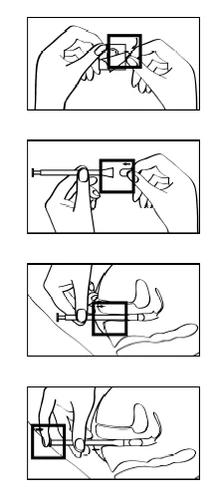
Lutinus should be placed directly into the vagina using the provided applicator.
- Remove one blister from the strip by peeling it along the perforation.
- To remove the sealing foil from the bottom of the blister, start at the corner of the blister marked with a printed arrow.
- Unpack the applicator.
- Place one tablet into the designated space at the end of the applicator. The tablet must be securely positioned and should not fall out.
- The applicator with the tablet may be inserted into the vagina while standing, sitting, or lying on your back with knees bent. Gently insert the flattened end of the applicator containing the tablet deep into the vagina.
- Press the plunger to release the tablet from the applicator.
Remove the applicator, thoroughly rinse it under warm running water, dry it completely with a soft
towel, and keep it for reuse.
Use of more than the recommended dose of Lutinus
If more than the recommended dose of Lutinus has been used, consult your doctor or pharmacist.
Missed dose of Lutinus
If a dose is missed, take it as soon as you remember, then continue as before. Do not use a double
dose to make up for a forgotten dose.
Stopping Lutinus treatment
If you stop or plan to stop using Lutinus, consult your doctor or pharmacist. Abruptly stopping
progesterone may cause increased anxiety, mood swings, and increased susceptibility to seizures.
4. Possible adverse reactions
Like all medicines, this medicine can cause adverse reactions, although not everyone experiences them.
The most common adverse reactions are headache, vaginal disorders, and uterine contractions.
The following common adverse reactions occur in 1 to 10 out of every 100 treated patients:
- headache,
- abdominal distension (bloating),
- abdominal pain,
- nausea,
- uterine contractions.
The following uncommon adverse reactions occur in 1 to 10 out of every 1,000 treated patients:
- dizziness,
- insomnia,
- diarrhoea,
- constipation,
- urticaria (allergic rash),
- rash,
- vaginal disorders (e.g. vaginal discomfort, burning sensation, discharge, dryness, and bleeding),
- fungal infection of the vagina,
- breast disorders (e.g. breast pain, breast swelling, and breast tenderness),
- genital pruritus (itching in the genital area),
- peripheral oedema (fluid retention causing swelling).
The following adverse reactions have been observed after the medicine was placed on the market; frequency is unknown (cannot be estimated based on available data):
- feeling of fatigue,
- vomiting,
- allergic reactions.
Reporting of adverse reactions
If any adverse reactions occur, including any adverse reactions not listed in this leaflet, inform your doctor, pharmacist, or nurse. Adverse reactions can be reported directly to the Department for Monitoring Adverse Drug Reactions, Office for Registration of Medicinal Products, Medical Devices and Biocidal Products, Al. Jerozolimskie 181C, 02-222 Warsaw, Tel.: +48 22 49 21 301, Fax: +48 22 49 21 309, website: https://smz.ezdrowie.gov.pl
Reporting adverse reactions helps to provide more information on the safety of the medicine.
5. How to store Lutinus
Keep this medicine out of sight and reach of children.
Do not use this medicine after the expiry date stated on the packaging. The expiry date refers to the last day of the stated month.
Store in the original packaging to protect from light.
Medicines must not be disposed of via wastewater or household waste. Ask your pharmacist how to dispose of medicines no longer required. Such measures help protect the environment.
6. Contents of the packaging and other information
What Lutinus contains
- The active substance is progesterone. Each vaginal tablet contains 100 mg of progesterone.
- Other ingredients are:
- colloidal anhydrous silica,
- lactose monohydrate,
- pregelatinized corn starch,
- povidone K 29/32,
- adipic acid,
- sodium bicarbonate,
- sodium lauryl sulfate,
- magnesium stearate.
What Lutinus looks like and contents of the pack
Lutinus is a vaginal tablet. It is a white or off-white, elongated, convex tablet, with the imprint “FPI” on one side and “100” on the other side.
Pack size: 21 vaginal tablets and one polyethylene tablet applicator.
For further information, please contact the marketing authorisation holder or the parallel importer.
Marketing authorisation holder in Romania, the country of export:
Ferring GmbH
Wittland 11
D-24109 Kiel
Germany
Manufacturer:
Ferring GmbH
Wittland 11
D-24109 Kiel
Germany
Parallel importer:
Delfarma Sp. z o.o.
ul. Św. Teresy od Dzieciątka Jezus 111
91-222 Łódź
Repackaged in:
Delfarma Sp. z o.o.
ul. Św. Teresy od Dzieciątka Jezus 111
91-222 Łódź
Marketing authorisation number in Romania, the country of export: 7218/2014/01
Parallel import authorisation number: 284/23
This medicinal product is authorised in the following names in the European Economic Area countries:
Bulgaria, Denmark, Finland, Greece, Spain, the Netherlands, Ireland, Iceland, Germany, Norway, Poland, the Czech Republic, Slovakia, Sweden, Hungary: Lutinus
Portugal: Luferti
Romania: Lutinus 100 mg, comprimate vaginale
Slovenia: Lutinus 100 mg vaginalne tablete