Luminalum
Poland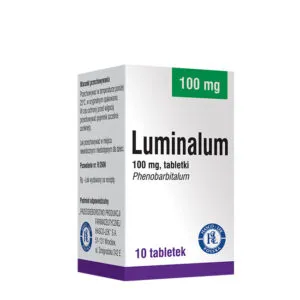
Table of Contents
Patient Information Leaflet
Luminalum, 100 mg, tablets
Phenobarbitalum
Please read this leaflet carefully before taking this medicine, as it contains important information for you.
- Keep this leaflet. You may need to read it again.
- If you have any further questions, please ask your doctor or pharmacist.
- This medicine has been prescribed for you personally. Do not pass it on to others. It may harm them, even if their symptoms are the same as yours.
- If you experience any side effects, including any not listed in this leaflet, please inform your doctor or pharmacist. See section 4.
Leaflet Contents:
- What Luminalum is and what it is used for
- Important information before taking Luminalum
- How to take Luminalum
- Possible side effects
- How to store Luminalum
- Contents of the pack and other information
1. What Luminalum is and what it is used for
Luminalum contains the active substance phenobarbital.
Luminalum has a calming effect, and at higher doses, a hypnotic and anticonvulsant effect. It suppresses the production of thyroid-stimulating hormone and reduces tension in smooth muscles.
Luminalum is used in the treatment of:
- generalized tonic-clonic seizures,
- simple partial seizures, particularly in drug-resistant epilepsy.
2. Important information before using Luminalum
When not to use Luminalum
Do not use this medicine in the following cases:
- if the patient is allergic to the active substance or to any of the other ingredients of this medicine (listed in section 6);
- if the patient has porphyria (a disorder characterized by abnormal production of heme – a component of hemoglobin);
- if the patient is pregnant or breastfeeding;
- if the patient has alcohol-related disease;
- if the patient has respiratory insufficiency;
- if the patient has acute poisoning with central nervous system depressants (such as sedatives, hypnotics, certain antiepileptic drugs, analgesics, and drugs used in psychiatric disorders);
- if the patient has severe liver insufficiency or hepatic encephalopathy.
Warnings and precautions
Before starting treatment with Luminalum, discuss this with your doctor or pharmacist.
1/7
Phenobarbital may cause:
- psychological and physical dependence, especially after long-term use of high doses. Abrupt discontinuation of the drug may then lead to withdrawal symptoms;
- skin reactions:
- life-threatening skin reactions such as Stevens-Johnson syndrome (SJS) and toxic epidermal necrolysis (TEN) have been reported in association with the use of Luminalum;
- patients should be informed about subjective and objective symptoms related to skin reactions. The highest risk of developing SJS or TEN occurs during the first weeks of treatment;
- if subjective or objective symptoms of SJS or TEN appear (e.g. progressive rash often with blisters or mucosal erosions), treatment with Luminalum should be discontinued;
- the best outcomes in reducing the risk of SJS or TEN are achieved by early diagnosis and immediate discontinuation of any suspected drug. Early withdrawal of the drug is associated with a better prognosis;
- if SJS or TEN develops in a patient during treatment with Luminalum, this drug must not be used again in that patient;
- paradoxical reactions:
- paradoxical reactions such as agitation, depression, anxiety, and confusion may occur in patients with acute pain;
- behavioral disturbances:
- the use of this medicine may cause changes in patient behavior, including suicidal thoughts and tendencies. Therefore, patients should be monitored for the emergence of suicidal thoughts and tendencies. The treating physician will inform the patient (and their caregiver) about the need to seek immediate medical advice if suicidal thoughts or tendencies occur.
Patients with renal insufficiency:
- long-term treatment with phenobarbital should be avoided in patients with renal insufficiency. In short-term treatment, the doctor will prescribe significantly reduced doses.
Patients with hepatic insufficiency:
- Luminalum should be used with great caution in patients with hepatic insufficiency. The doctor will prescribe a significantly reduced initial dose.
Elderly patients:
- Luminalum should be used with great caution in elderly patients. They may be more sensitive to the effects of phenobarbital due to age-related changes in hepatic metabolism. The doctor may consider reducing the dose.
Luminalum should be used cautiously in patients with bronchial asthma or other conditions associated with dyspnea or airway narrowing.
Caution is advised in patients with depression and suicidal tendencies, drug abuse, cerebral circulation disorders, severe anemia, hyperkinesia (increased motor excitability), hyperthyroidism, acute or chronic pain (due to the possibility of masking diagnostically important symptoms), diabetes, hypothyroidism.
If the patient has previously been diagnosed with intolerance to certain sugars, they should consult their doctor before taking the medicine.
Children and adolescents
For safety reasons, Luminalum should not be used in children.
2/7
Luminalum and other medicines
Inform your doctor or pharmacist about all medicines currently used, recently used, or planned for use.
Luminalum interacts with many other medicines. This particularly includes:
- anticoagulants,
- anti-inflammatory drugs,
- certain antibiotics and antimicrobial agents,
- sedatives and hypnotics,
- antidepressants, antipsychotics, and drugs used in Parkinson's disease,
- drugs used in adrenal insufficiency,
- drugs used in heart diseases,
- oral contraceptives (their effectiveness may be reduced),
- drugs used in cancer,
- anesthetics,
- anticonvulsants,
- drugs used in hypertension and glaucoma,
- analgesic and anti-inflammatory drugs,
- antipyretics,
- drugs used in folic acid deficiency,
- drugs used in hypothyroidism,
- drugs used in bronchial asthma,
- a drug used in asthma treatment (montelukast).
Use of Luminalum with food, drink, and alcohol
Food does not affect the efficacy of the medicine. Luminalum may be taken with food or independently of meals. Alcohol consumption is contraindicated during treatment. Concurrent use of phenobarbital with alcohol may enhance the central nervous system depressant effect, increasing or prolonging the drug's action.
Pregnancy and breastfeeding
If the patient is pregnant or breastfeeding, suspects she may be pregnant, or plans to become pregnant, she should consult her doctor or pharmacist before using this medicine.
Pregnancy
Luminalum is contraindicated during pregnancy. The active substance of this medicine – phenobarbital – may cause fetal damage when administered during pregnancy.
After oral administration, phenobarbital readily crosses the placental barrier and distributes into fetal tissues, reaching the highest concentrations in the placenta, fetal liver, and fetal brain. It has been shown that the risk of congenital malformations during administration of antiepileptic drugs to pregnant women is 2–3 times higher than in the general population. The most common developmental defects include craniofacial abnormalities, cleft palate, and cardiovascular malformations.
Teratogenic effects of phenobarbital have not been demonstrated in animal studies.
Do not abruptly discontinue treatment with phenobarbital.
In cases where a woman has taken this medicine during pregnancy, both the mother and the newborn should receive vitamin K prophylactically during the last month of pregnancy and immediately after birth. In newborns whose mothers took phenobarbital during pregnancy, withdrawal symptoms such as seizures or excessive excitability may develop, appearing up to 14 days after birth, as well as abnormal movements, feeding difficulties, and disturbances in calcium-phosphate metabolism and bone mineralization.
Breastfeeding
Phenobarbital passes into breast milk and may exert a depressant effect on the central nervous system of the infant.
Driving and operating machinery
-
Do not drive motor vehicles during treatment, as Luminalum impairs psycho-physical performance, including concentration ability and reaction speed.
-
Do not operate machinery or use tools.
Luminalum contains lactose
Luminalum contains the excipient lactose in an amount of 34 mg per 1 tablet. If the patient has previously been diagnosed with intolerance to certain sugars, they should consult their doctor before taking the medicine.
3. How to use Luminalum
This medicine should always be taken exactly as directed by the physician. In case of doubt, consult
your doctor.
Recommended dose:
Adults – orally 50 mg to 250 mg per day, as a single dose or in divided doses.
The dosage should be individually adjusted for each patient.
The tablet may be divided into equal doses.
Method of administration
Swallow the tablet with water.
Luminalum may be taken with food or independently of meals.
Use of a higher than recommended dose of Luminalum
If a higher than recommended dose of Luminalum is taken, seek immediate advice from a doctor or
pharmacist.
In case of acute overdose, symptoms such as pronounced drowsiness, coma, respiratory disturbances,
loss of reflexes, pupillary constriction, oliguria, increased heart rate, decreased arterial blood pressure,
and body temperature may occur. Shock (apnea, marked decrease in arterial blood pressure, respiratory
arrest, and death) may also develop.
If any of the listed symptoms occur, discontinue the use of the medicine immediately and urgently
seek medical assistance or go to the nearest hospital.
Missed dose of Luminalum
Do not take a double dose to make up for a missed dose.
Take the missed dose as soon as possible, unless the time for the next dose is approaching.
In that case, skip the missed dose and continue treatment according to the recommended dosing
schedule.
Discontinuation of Luminalum
Phenobarbital may cause psychological and physical dependence. Abrupt discontinuation of the
medicine may lead to withdrawal symptoms.
If you have any further questions concerning the use of this medicine, consult your doctor or
pharmacist.
4. Possible adverse effects
Like all medicines, this medicine can cause adverse effects, although not everyone will experience them.
The frequency of the possible adverse effects listed below is defined as follows:
4/7
- very common: (may occur in more than 1 in 10 people);
- common: (may occur in 1 to 10 in 100 people);
- uncommon: (may occur in 1 to 10 in 1,000 people);
- rare: (may occur in 1 to 10 in 10,000 people);
- very rare: (may occur in fewer than 1 in 10,000 people);
- not known: (frequency cannot be estimated from the available data).
Within each frequency group, adverse reactions are listed in order of decreasing severity.
- Nervous system disorders - common: drowsiness, excitement, disorientation, hyperkinesia (increased motor activity), depression, ataxia (difficulty with coordination and balance), nightmares, nervousness, hallucinations, insomnia, anxiety, headache and dizziness, disturbances in thinking.
- Respiratory, thoracic and mediastinal disorders - rare: hypoventilation, apnoea, interstitial emphysema.
- Cardiac disorders - rare: slowing of heart rate (bradycardia).
- Vascular disorders - rare: hypotension, fainting.
- Gastrointestinal disorders - rare: nausea, vomiting, constipation.
- Immune system disorders - frequency not known: hypersensitivity reactions: fever, rash, lymphadenopathy, eosinophilia, facial swelling, eyelid or lip swelling, blood and liver abnormalities, general organ damage.
- Hepatobiliary and biliary tract disorders - very rare: hepatitis and impaired liver function, liver damage. In elderly patients, reduced liver function is an indication for dose reduction. If latent or manifest hepatic porphyria or impaired liver function occurs, administration of the medicine should be restricted to situations where the benefit-risk balance justifies it. The appearance of intolerance reactions, including liver function abnormalities, is an indication for discontinuation of treatment. However, it is important to differentiate drug hypersensitivity syndrome from symptoms of liver damage and transient increases in aminotransferases and/or alkaline phosphatase, which do not require discontinuation of treatment.
- Blood and lymphatic system disorders - rare: megaloblastic anaemia, agranulocytosis, thrombocytopenia.
- Musculoskeletal and connective tissue disorders:
- rare: osteopenia, rickets; in patients treated long-term with phenobarbital, decreased bone mineral density, osteopenia and osteoporosis and bone fractures have been reported. The mechanism of bone metabolism disturbances has not been identified;
- frequency not known: joint pain, Dupuytren's contracture.
- Psychiatric disorders:
- rare: withdrawal symptoms - sleep disturbances, tremor, visual disturbances, nausea, vomiting, anxiety, nightmares, weakness, orthostatic hypotension, dizziness, seizures, hallucinations;
- frequency not known: personality disorders; excitement, depression, confusion in elderly patients.
- Renal and urinary disorders - rare: reduced renal function in elderly patients. This is an indication for dose reduction.
- Skin and subcutaneous tissue disorders:
- very rare: serious cutaneous adverse reactions (SCARs): Stevens-Johnson syndrome (SJS); toxic epidermal necrolysis (TEN), exfoliative dermatitis;
- frequency not known: nodular or membranous erythema, Lyell's syndrome. 5/7
If skin reactions occur, barbiturates should be discontinued.
Luminalum may cause psychological and physical dependence, especially after long-term use of high doses. Symptoms of sudden withdrawal may be severe and may even lead to death.
Reporting of adverse effects
If any adverse effects occur, including any adverse effects not listed in this leaflet, inform your doctor or pharmacist. Adverse effects can be reported directly to the Department of Monitoring of Adverse Drug Reactions of the Office for Registration of Medicinal Products, Medical Devices and Biocidal Products
Aleje Jerozolimskie 181C, 02-222 Warsaw
Tel.: + 48 22 49 21 301
Fax: + 48 22 49 21 309
Website: https://smz.ezdrowie.gov.pl
Adverse effects can also be reported to the marketing authorisation holder.
Reporting adverse effects helps to provide more information on the safety of the medicine.
5. How to store Luminalum
Store below 25°C in the original packaging.
For the vial, keep the container tightly closed to protect from moisture.
Keep the medicine out of the sight and reach of children.
Do not use this medicine after the expiry date stated on the carton. The expiry date refers to the last day of the stated month.
Do not use this medicine if signs of deterioration are observed, such as discoloration of the tablets.
Medicines must not be disposed of via wastewater or household waste. Ask your pharmacist how to dispose of medicines no longer required. This will help protect the environment.
6. Contents of the packaging and other information
What Luminalum contains
- The active substance is phenobarbital. Each tablet contains 100 mg of phenobarbital.
- The excipients are: lactose, potato starch, talc, stearic acid, sodium carboxymethyl starch type A, purified water.
What Luminalum looks like and contents of the pack
Luminalum is in the form of white tablets which can be divided into halves.
The immediate packaging consists of a polypropylene bottle closed with a cap or a PVC/PVDC/Aluminium foil blister pack. The immediate container is placed in an outer package made of cardboard box containing the patient leaflet. The pack contains 10 tablets.
Marketing Authorisation Holder and Manufacturer
„PRZEDSIĘBIORSTWO PRODUKCJI FARMACEUTYCZNEJ HASCO-LEK” S.A.
51-131 Wrocław, Żmigrodzka 242 E Street
Medicinal product information
tel. 22 742 00 22
e-mail: [email protected]
6/7
7/7