Lotemax 0.5%
Poland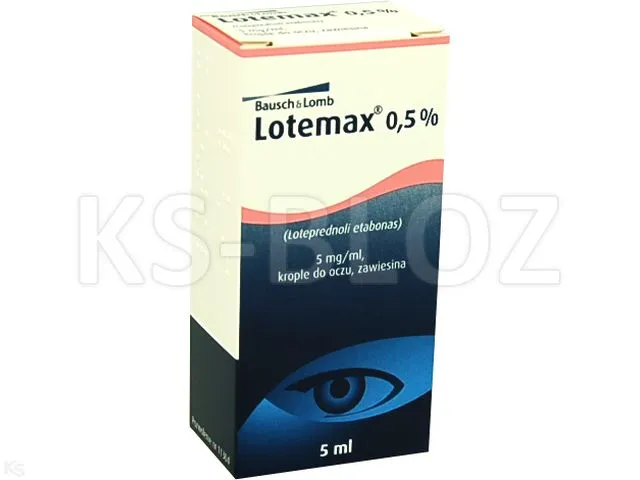
Table of Contents
Patient Information Leaflet
Warning! Keep this leaflet. Information on the immediate packaging is in a foreign language.
Lotemax 0.5% (Lotemax)
0.5% (5 mg/ml), eye drops, suspension
Loteprednol etabonate
Lotemax 0.5% and Lotemax are different trade names for the same medicine.
Please read this leaflet carefully before using the medicine, as it contains
important information for the patient.
- Keep this leaflet, as you may need to read it again.
- If you have any questions, consult your doctor or pharmacist.
- This medicine has been prescribed for a specific individual. Do not share it with others. The medicine may harm another person, even if their symptoms are the same.
- If you experience any adverse reactions, including any adverse reactions not listed in this leaflet, inform your doctor, pharmacist, or nurse. See section 4.
Table of contents
- What Lotemax 0.5% is and what it is used for
- Important information before using Lotemax 0.5%
- How to use Lotemax 0.5%
- Possible side effects
- How to store Lotemax 0.5%
- Contents of the pack and other information
1. What Lotemax 0.5% is and what it is used for
Lotemax 0.5% is an eye drop suspension.
Lotemax 0.5% is used to treat inflammatory conditions of the eye following surgical procedures.
Sometimes, inflammation (redness and pain) may occur in the eye. Loteprednol etabonate is a medicine belonging to a group called corticosteroids. It reduces inflammation and relieves its symptoms. Because it is used in small doses directly where needed, its action is localized to that area.
2. Important information before using Lotemax 0.5% medicine
When not to use Lotemax 0.5%:
- if the patient is allergic to the active substance or to any of the other ingredients of this medicine (listed in section 6).
- if the patient has hypersensitivity (allergy) to other corticosteroids.
- if the patient has been diagnosed with viral eye diseases such as herpes simplex, varicella, or herpes zoster.
- if the patient has been diagnosed with tuberculosis or fungal infections of the eye.
- if the patient is breastfeeding.
Warnings and precautions
- Inform the doctor if the patient has cataracts.
- If the patient experiences blurred vision or other visual disturbances, contact the doctor.
- Inform the doctor if pain increases or if redness, itching, or inflammation worsens.
- Contact the doctor if there is no improvement within 2 days. The doctor may wish to reassess the patient's condition.
- Do not use Lotemax 0.5% for longer than 10 days without having intraocular pressure examined by a doctor.
- Prolonged use of Lotemax 0.5% or other eye drops containing corticosteroids may lead to the development of glaucoma or increased intraocular pressure, which may result in optic nerve damage, visual disturbances, and cataracts.
- Prolonged use of Lotemax 0.5% or other eye drops containing corticosteroids may reduce the ability to fight infections and may increase the risk of developing eye infections, including infection with herpes simplex virus.
- Use of corticosteroid-containing eye drops, such as Lotemax 0.5%, may exacerbate viral eye infections and lead to prolonged duration of the infection.
Contact lenses
It is not recommended to wear contact lenses after cataract surgery. If the patient usually wears contact lenses, the doctor will advise using glasses after cataract surgery. This approach will allow recovery after the procedure. The doctor will inform when it is safe to resume wearing contact lenses (see also "Lotemax 0.5% contains benzalkonium chloride").
Lotemax 0.5% and other medicines
Tell the doctor about all medicines the patient is currently taking or has recently taken, including those obtained without a prescription. Especially inform the doctor if the patient is using:
- medicines known as anticholinergic agents (used in the treatment of various conditions such as stomach and intestinal spasms, muscle spasms, urge incontinence, or asthma)
- eye drops used to reduce intraocular pressure. Some medicines may enhance the effect of Lotemax 0.5%, and the doctor may wish to monitor the patient closely when such medicines are used (including certain HIV medications: ritonavir, cobicistat).
Pregnancy and breastfeeding
If the patient is pregnant or breastfeeding, suspects she may be pregnant, or is planning to have a child, she should consult a doctor or pharmacist before using this medicine.
It is possible that Lotemax 0.5% may still be used, but alternative treatment may also be considered.
Do not use Lotemax 0.5% during breastfeeding.
Driving and operating machinery
Using eye drops may cause visual disturbances. These effects usually pass quickly. Do not drive or operate machinery until vision returns to normal.
Lotemax 0.5% contains benzalkonium chloride
This medicine contains 0.0152 mg of benzalkonium chloride per dose (2 drops), equivalent to 0.20 mg/ml.
Benzalkonium chloride may be absorbed by soft contact lenses and may change their color. Contact lenses should be removed before instillation and at least 15 minutes should be waited before reinserting them.
Benzalkonium chloride may also cause eye irritation, especially in individuals with dry eye syndrome or corneal disorders (the transparent layer at the front of the eye). If abnormal sensations in the eye, stinging, or eye pain occur after using the medicine, contact the doctor.
3. How to use Lotemax 0.5%
This medicine should always be used exactly as directed by the physician or pharmacist. If in doubt,
consult the physician or pharmacist.
The recommended dose for adult and elderly patients is one to two drops four times
daily.
Treatment with Lotemax 0.5% usually begins 24 hours after surgery and continues
for 2 weeks.
Use in adults:
- Shake the Lotemax 0.5% bottle well before use.
- Look upwards and gently pull down the lower eyelid of the affected eye.
- Instill 1 or 2 drops of Lotemax 0.5% into the space between the eyeball and the eyelid, 4 times daily or as directed by the physician.
- Avoid contact between the dropper tip and any surface, as this may contaminate the suspension.
- Close the container immediately after use.
- The physician will inform you how long treatment with Lotemax 0.5% should continue.
- Do not stop treatment without consulting the physician.
Use in children and adolescents
Lotemax 0.5% should not be used in children and adolescents until further data are available.
Use of a higher than recommended dose of Lotemax 0.5%
Consult a physician or pharmacist.
Missed dose of Lotemax 0.5%
Do not use a double dose to make up for a missed dose.
Wait until the next scheduled dose and continue treatment as before.
Stopping treatment with Lotemax 0.5%
This medicine should always be used according to the physician's instructions. Do not stop using Lotemax 0.5% without first discussing it with the physician.
If you have any further questions about the use of this medicine, consult your physician or pharmacist.
4. Possible adverse reactions
Like all medicines, this medicine can cause adverse reactions, although not everyone will experience them.
If the patient experiences any of the following symptoms: redness, itching, swelling of the membrane covering the white part of the eye and/or eyelids, or general symptoms such as: difficulty breathing, difficulty swallowing, flushing or redness of the face, swelling of the face, tongue, they should stop using this medicine and seek immediate medical help. These may be symptoms of severe allergic reactions.
If any of the following adverse reactions occur, immediately contact a doctor, as urgent medical assistance may be required:
- Worsening of eye pain, especially when exposed to bright light, and eye redness during treatment with this medicine. This may be due to inflammation of the colored part of the eye, the iris – an uncommon adverse reaction (may occur in no more than 1 in 100 patients).
- Lump or thickening in the breast, change in size, shape or texture of the breast, swelling or lump under the arm, or change in the shape of the nipple. These may be symptoms of breast cancer, a rare adverse reaction (may occur in no more than 1 in 1000 patients).
- Involuntary muscle spasms (muscle twitching) – rare adverse reaction (may occur in no more than 1 in 1000 patients).
- Nervousness – rare adverse reaction (may occur in no more than 1 in 1000 patients).
- Noise (ringing in the ears), tinnitus – rare adverse reaction (may occur in no more than 1 in 1000 patients).
- Chest pain – rare adverse reaction (may occur in no more than 1 in 1000 patients).
The following adverse reactions may also occur during treatment with this medicine:
Common adverse reactions (may affect up to 1 in 10 people):
- Eye disorders: corneal damage, eye discharge, eye discomfort, dry eye, tearing, sensation of a foreign body in the eye, eye redness, eye itching, burning sensation at the site of instillation, and increased intraocular pressure.
- General adverse reactions: headache.
Uncommon adverse reactions (may affect up to 1 in 100 people):
- Eye disorders: visual disturbance, conjunctival itching, conjunctivitis, eye irritation, eye pain, conjunctival papillae, photophobia, eye inflammation, keratoconjunctivitis, eye infections, and lens opacity.
- General adverse reactions: fatigue, nasal discharge, and sore throat.
Rare adverse reactions (may affect up to 1 in 1000 people):
- General adverse reactions: migraine, taste disturbances, dizziness, numbness, chills, fever and pain, cough, urinary tract infection or inflammation, urticaria, rash, dry skin, skin eruption, diarrhea, nausea, vomiting, weight gain.
Frequency not known (frequency cannot be estimated from available data):
- Eye disorders: blurred vision.
Reporting of adverse reactions
If any adverse reactions occur, including any not listed in this leaflet, inform your doctor, pharmacist, or nurse. Adverse reactions can be reported directly to the Department of Monitoring Adverse Drug Reactions of the Office for Registration of Medicinal Products, Medical Devices and Biocidal Products
Al. Jerozolimskie 181 C
02-222 Warsaw
Phone: +48 22 49 21 301
Fax: +48 22 49 21 309
Website: https://smz.ezdrowie.gov.pl
Reporting adverse reactions helps to provide more information on the safety of the medicine.
5. How to store Lotemax 0.5% medicine
Keep the medicine out of the sight and reach of children.
Store the container in an upright position.
Do not store at temperatures above 25°C. Do not freeze.
Do not use this medicine after the expiry date stated on the carton and bottle. The expiry date refers to the last day of the stated month.
Discard any unused contents 28 days after first opening the bottle.
Medicines must not be disposed of via wastewater or household waste. Ask your pharmacist how to dispose of medicines no longer required. Such measures help protect the environment.
DO NOT USE IF THE SEAL IS DAMAGED
6. Contents of the pack and other information
What Lotemax 0.5% contains
- The active substance is loteprednol etabonate. Each ml of suspension contains 5 mg (0.5%) of loteprednol etabonate.
- The other ingredients are: edetate disodium, glycerol, povidone, purified water, tyloxapol, benzalkonium chloride (0.01%) added as a preservative.
- Hydrochloric acid and/or sodium hydroxide are added to adjust the pH.
What Lotemax 0.5% looks like and contents of the pack
Lotemax 0.5% is a milky-white eye drop suspension.
Lotemax 0.5% is available in bottles containing 5 ml.
For more detailed information, please contact the responsible party or parallel importer.
Marketing Authorisation Holder in Lithuania, country of export:
Dr. Gerhard Mann, Chem.-pharm. Fabrik GmbH
Brunsbütteler Damm 165/173, 13581 Berlin, Germany
Manufacturer:
Dr. Gerhard Mann, Chem.-pharm. Fabrik GmbH
Brunsbütteler Damm 165/173, 13581 Berlin, Germany
Bausch Health Poland sp. z o.o.
ul. Przemysłowa 2, 35-959 Rzeszów, Poland
Bausch Health Poland sp. z o.o.
ul. Kosztowska 21, 41-409 Mysłowice, Poland
Bausch + Lomb Ireland Limited
3013 Lake Drive, Citywest Business Campus,
Dublin 24, D24 PPT3, Ireland
Parallel Importer:
Delfarma Sp. z o.o.
ul. Św. Teresy od Dzieciątka Jezus 111
91-222 Łódź
Repackaged in:
Delfarma Sp. z o.o.
ul. Św. Teresy od Dzieciątka Jezus 111
91-222 Łódź
Marketing Authorisation Number in Lithuania, country of export: LT/1/05/0388/002
Parallel Import Authorisation Number: 185/19