Loperamide aurovitas
Poland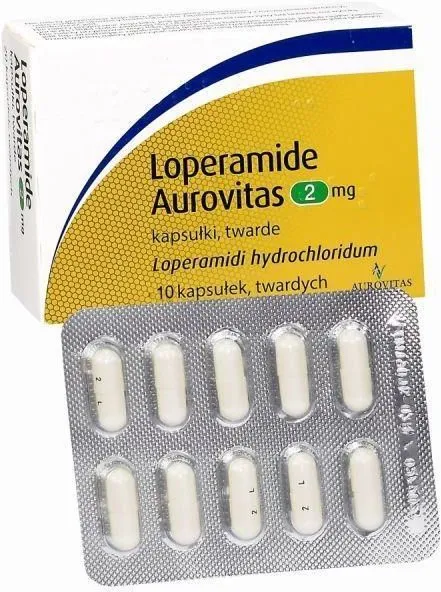
Table of Contents
- Package leaflet: Information for the patient
- 1. What Loperamide Aurovitas is and what it is used for
- 2. Important information before using Loperamide Aurovitas
- 3. How to use Loperamide Aurovitas
- 4. Possible adverse reactions
- 5. How to store Loperamide Aurovitas
- 6. Contents of the packaging and other information
Package leaflet: Information for the patient
Loperamide Aurovitas, 2 mg, hard capsules
Loperamidi hydrochloridum
Please read this leaflet carefully before using this medicine, because it contains
important information for you.
This medicine should always be used exactly as described in this patient leaflet or as directed by your
doctor or pharmacist.
- Keep this leaflet, so that you can read it again if necessary.
- If you need advice or further information, please contact your pharmacist.
- If you experience any side effects, including any not listed in this leaflet, tell your doctor or pharmacist. See section 4.
- If there is no improvement after 2 days, or if you feel worse, you should contact your doctor.
Leaflet contents:
- What Loperamide Aurovitas is and what it is used for
- Important information before taking Loperamide Aurovitas
- How to take Loperamide Aurovitas
- Possible side effects
- How to store Loperamide Aurovitas
- Contents of the pack and other information
1. What Loperamide Aurovitas is and what it is used for
The medicine contains loperamide, which helps stop diarrhoea by making the stools firmer
and reducing the frequency of bowel movements.
This medicine is used to treat sudden, short-term (acute) episodes of diarrhoea in adults and
adolescents over 12 years of age. Do not use this medicine for longer than 2 days without consulting
a doctor.
If after 2 days of treatment you do not feel better or feel worse, you should consult your doctor.
2. Important information before using Loperamide Aurovitas
When not to use Loperamide Aurovitas
-
If the patient is allergic to loperamide or any of the other ingredients of this medicine (listed in section 6). Hypersensitivity may be recognized, for example, by the occurrence of skin rash, itching, chest tightness or swollen face. If such symptoms occur, use of Loperamide Aurovitas must be discontinued and medical advice sought.
-
In children under 12 years of age.
-
If the patient has colonic dilatation (markedly dilated colon), acute megacolon (acute toxic colitis with colonic dilatation), or intestinal obstruction, a serious condition that may occur in patients with Hirschsprung's disease, Crohn's disease or ulcerative colitis, characterized by severe abdominal distension, fever and rapid heartbeat.
-
If the patient suffers from intestinal obstruction which causes "leakage" of watery stools. This occurs in certain intestinal disorders.
-
If the patient experiences persistent abdominal pain, high fever and (or) stools containing mucus and (or) blood. These symptoms may be caused by food poisoning, infection or
-
inflammation of the large intestine.
-
If the patient has bacterial infection of the large intestine and (or) small intestine caused by invasive organisms, including Salmonella, Shigella and Camphylobacter.
-
If the patient has severe intestinal inflammation (e.g. ulcerative colitis or pseudomembranous colitis caused by certain antibiotics).
-
In all cases where normal defecation should not be suppressed.
Warnings and precautions
Before starting to take Loperamide Aurovitas, discuss this with your doctor or pharmacist.
- Loperamide Aurovitas only stops diarrhoea, but does not treat its underlying cause. If possible, the cause of diarrhoea should always be treated as well. In case of doubt, always consult a doctor.
- During diarrhoea, the patient loses fluids (dehydration). Along with fluids, other important substances are also lost. Symptoms of dehydration may include dry mouth, dizziness and (or) vomiting. The risk of dehydration is particularly high in young children and elderly people. It is therefore essential to replenish and retain fluids in the body, which means drinking plenty of fluids and replacing sugar and salt. A special mixture of salt and sugar (oral rehydration solution) is available from pharmacies or drugstores, which should be dissolved in water. Ask your doctor or pharmacist for advice.
- If diarrhoea persists for more than 48 hours, stop taking the capsules and consult a doctor.
- If the patient has liver disease. If there are liver function disorders or the disease persists, Loperamide Aurovitas should be taken only after consulting a doctor, as loperamide metabolism may be delayed and the risk of adverse reactions may be higher.
- If the patient has AIDS and is being treated for diarrhoea with Loperamide Aurovitas. Stop taking Loperamide Aurovitas immediately if abdominal distension occurs. In such a case, contact your doctor. In patients with AIDS and severe intestinal infection (infectious colitis) who were taking loperamide (the active substance also used in Loperamide Aurovitas), several cases of constipation with increased risk of toxic colitis have been reported. This is a markedly dilated colon, recognizable by severe abdominal distension, fever and rapid heartbeat.
- If the patient has impaired liver function. In such a case, contact your doctor before taking Loperamide Aurovitas. When using Loperamide Aurovitas, increased monitoring of the patient's health status may be necessary. Furthermore, to avoid adverse effects on the nervous system, a different dose may need to be used.
- If intestinal obstruction occurs, stop taking the capsules and consult a doctor. Never exceed the recommended dose (see section 3). Serious heart problems (such as rapid or irregular heartbeat) have been reported in patients who took too much loperamide.
Loperamide Aurovitas and other medicines
Tell your doctor or pharmacist if you are taking, have recently taken or might take any other medicines, including medicines obtained without a prescription, especially:
- Ritonavir (used in the treatment of HIV infection).
- Quinidine (used in the treatment of cardiac arrhythmias or malaria).
- Oral desmopressin (used in the treatment of excessive urination).
- Itraconazole or ketoconazole (used in the treatment of fungal infections).
- Gemfibrozil (used in the treatment of high blood lipid levels). Consult your doctor before using Loperamide Aurovitas if you are taking any of the above medicines.
Medicines with a similar mechanism of action to Loperamide Aurovitas may enhance its effect, while medicines that accelerate gastrointestinal transit may reduce its effect.
Loperamide Aurovitas with food and drink
Loperamide Aurovitas can be taken with food and drink.
Pregnancy, breastfeeding and fertility
If the patient is pregnant or breastfeeding, suspects she may be pregnant, or is planning to have a child, she should consult her doctor or pharmacist before using this medicine.
Pregnancy
Loperamide should be avoided during the first trimester of pregnancy; however, it may be used during the second and third trimesters.
Breastfeeding
This medicine is not recommended if the patient is breastfeeding. Small amounts may pass into breast milk. Consult your doctor regarding appropriate treatment.
Driving and operating machinery
This medicine may cause dizziness, fatigue or drowsiness. The patient may also lose consciousness, feel weak or less alert. If such symptoms occur, do not drive or operate machinery.
Loperamide Aurovitas contains lactose
If the patient has previously been diagnosed with intolerance to certain sugars, he or she should contact the doctor before taking this medicine.
3. How to use Loperamide Aurovitas
This medicine should always be taken exactly as described in this leaflet or as directed by your doctor or pharmacist. If in doubt, consult your doctor or pharmacist.
Adults, elderly and adolescents aged over 12 years
How to take:
Swallow the capsules whole with water.
Dosage and frequency of administration:
After the first loose stool (bowel movement), take 2 capsules with water.
After each subsequent loose stool, take 1 capsule.
Sachets containing powder for oral rehydration solution, which helps prevent dehydration, are available as a separate product.
- Do not give to children under 12 years of age.
- Do not take more than 6 capsules within 24 hours.
- If symptoms persist for longer than 48 hours, stop taking the capsules and consult your doctor.
- Replace lost fluids by drinking more than usual.
- DO NOT EXCEED THE STATED DOSE.
Taking more Loperamide Aurovitas than recommended
Overdose means that the patient or someone close to the patient has taken more Loperamide Aurovitas than indicated in this leaflet (see section "How to use Loperamide Aurovitas").
If an excessive amount of Loperamide Aurovitas has been taken, contact a doctor or hospital immediately for advice. Symptoms may include increased heart rate, irregular heartbeat, changes in heart rhythm (these symptoms may have potentially serious, life-threatening consequences), muscle stiffness, uncoordinated movements, drowsiness, difficulty passing urine, or shallow, labored breathing, pinpoint pupils, abdominal pain, nausea, vomiting or constipation.
Children are more sensitive to large amounts of Loperamide Aurovitas than adults. If a child has taken too much of the medicine or shows any of the above symptoms, contact a doctor immediately.
Information for the doctor in case of overdose
Symptoms of loperamide hydrochloride overdose may also occur after relative overdose due to impaired liver function. Treatment depends on the symptoms of overdose and clinical diagnosis.
During medical observation, ECG monitoring for QT interval prolongation should be initiated.
If central nervous system symptoms occur after overdose, naloxone, an opioid receptor antagonist, may be administered as an antidote. Because loperamide has a longer duration of action than naloxone, repeated doses of naloxone may be necessary. Therefore, the patient should be closely monitored for at least 48 hours to detect possible onset or recurrence of overdose symptoms.
If the patient forgets to take Loperamide Aurovitas
This medicine should only be taken according to the dosing instructions provided. If the patient forgets to take a dose, take the next dose after the next loose stool (bowel movement). Do not take a double dose to make up for a missed dose.
If you have any further questions about the use of this medicine, consult your doctor or pharmacist.
4. Possible adverse reactions
Like all medicines, this medicine can cause adverse reactions, although not everyone experiences them.
If any of the adverse symptoms worsen or if any adverse reactions not listed in this leaflet occur,
inform your doctor or pharmacist.
Serious adverse reactions
If any of the following occur, stop taking the medicine immediately
and seek medical help right away:
Seek immediate medical assistance.
Rare: may affect up to 1 in 1,000 people
- Allergic reactions, including anaphylactic shock, unexplained wheezing, shortness of breath, swelling of the face and throat.
- Loss of consciousness or reduced level of consciousness (feeling weak or decreased alertness), increased muscle tone, abnormal coordination.
- Intestinal obstruction, enlargement of the colon, abdominal bloating.
- Severe skin and mucous membrane allergic reactions with redness, blistering and peeling of the skin (bullous eruptions (including Stevens-Johnson syndrome, Lyell’s syndrome and erythema multiforme)), facial swelling, urticaria, itching.
- Skin rash, which may be severe and involve blistering and skin peeling.
- Dilation of the large intestine (colonic distension).
- Constipation (intestinal obstruction).
Frequency unknown (frequency cannot be estimated from available data)
Upper abdominal pain, abdominal pain radiating to the back, abdominal tenderness, fever,
rapid pulse, nausea, vomiting – which may be symptoms of pancreatitis (acute pancreatitis).
Other adverse reactions
If any of the following occur, stop taking the medicine
and contact your doctor:
Common: may affect up to 1 in 10 people
- Headache, dizziness
- Nausea (feeling sick), constipation, bloating (gas).
Uncommon: may affect up to 1 in 100 people
- Fatigue, drowsiness
- Abdominal pain, discomfort in the abdominal cavity, upper abdominal pain, vomiting, dyspepsia and heartburn, dry mouth.
Rare: may affect up to 1 in 1,000 people
- Constriction of the pupils
- Difficulty passing urine
- Fatigue.
Reporting suspected adverse reactions
If any adverse reactions occur, including any not listed in this leaflet, inform your doctor or pharmacist. Adverse reactions can be reported directly to the Department of Monitoring Adverse Drug Reactions of the Office for Registration of Medicinal Products, Medical Devices and Biocidal Products,
Al. Jerozolimskie 181C, 02-222 Warsaw, phone: +48 22 49 21 301, fax: +48 22 49 21 309,
website: https://smz.ezdrowie.gov.pl
Adverse reactions can also be reported to the marketing authorization holder.
Reporting adverse reactions helps to provide more information on the safety of this medicine.
5. How to store Loperamide Aurovitas
Keep this medicine out of sight and reach of children.
Do not use this medicine after the expiry date stated on the carton after EXP. The expiry date refers to the last day of the stated month.
Store below 30°C.
Keep in the original packaging to protect from moisture.
Medicines must not be disposed of via wastewater or household waste. Ask your pharmacist how to dispose of medicines no longer required. These measures will help protect the environment.
6. Contents of the packaging and other information
What Loperamide Aurovitas contains
- The active substance is loperamide hydrochloride. Each hard capsule contains 2 mg of loperamide hydrochloride.
- The other ingredients are:
Capsule contents: monohydrate lactose, corn starch, talc, magnesium stearate.
Capsule shell: titanium dioxide (E 171), gelatin.
Printing ink: shellac, black iron oxide (E 172).
What Loperamide Aurovitas looks like and contents of the pack
Hard capsule.
White, opaque cap / white, opaque body, hard gelatin capsule of size '4', printed with "2" on the cap and "L" on the body in black ink, filled with white or off-white powder.
Loperamide Aurovitas hard capsules are available in PVC/Aluminium blisters and in HDPE bottles, packed in a cardboard box.
Pack sizes:
Blister: 6, 10, 12 and 20 hard capsules.
HDPE bottle: 30, 60, 200, 250 and 500 (packs of 250 and 500 capsules are intended exclusively for hospital use or dose dispensing) hard capsules.
Not all pack sizes may be marketed.
Marketing Authorisation Holder and Manufacturer
Marketing Authorisation Holder:
Aurovitas Pharma Polska Sp. z o.o.
ul. Sokratesa 13D lokal 27
01-909 Warsaw
Poland
Manufacturer/Importer:
APL Swift Services (Malta) Ltd
HF26 Hal Far Industrial Estate, Hal Far
Birzebbugia BBG 3000
Malta
Generis Farmacêutica, S.A.
Rua João de Deus, n. 19, Venda Nova
2700-487 Amadora
Portugal
This medicinal product is authorised in the Member States of the European Economic Area under the following names:
Belgium: Loperamide AB 2 mg hard capsules
Germany: Loperamid PUREN akut 2 mg Hartkapseln
Netherlands: Loperamide HCL Sanias 2 mg, harde capsules
Poland: Loperamide Aurovitas
01/2025