Locoid
Poland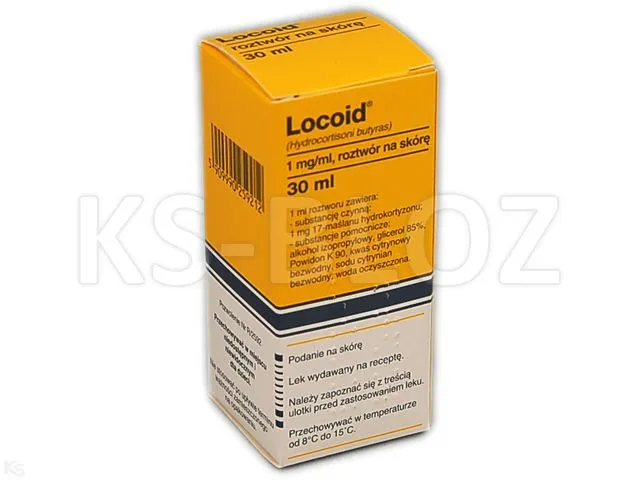
Table of Contents
Package leaflet: Information for the patient
Locoid, 1 mg/ml, cutaneous solution
(Hydrocortisoni butyras)
Please read carefully the entire leaflet before using the medicine, as it contains
important information for the patient.
- Keep this leaflet, so that you can read it again if necessary.
- If you have any doubts, please consult your doctor or pharmacist.
- This medicine has been prescribed for a specific individual. Do not pass it on to others. The medicine may harm another person, even if their symptoms are the same.
- If any adverse reactions occur in the patient, including any adverse reactions not listed in this leaflet, inform your doctor or pharmacist. See section 4.
Table of contents of the leaflet:
- What Locoid is and what it is used for
- Important information before using Locoid
- How to use Locoid
- Possible side effects
- How to store Locoid
- Contents of the pack and other information
1. What Locoid is and what it is used for
Locoid cutaneous solution contains the active substance hydrocortisone 17-butyrate, a corticosteroid with anti-inflammatory and vasoconstrictive properties. The medicine relieves symptoms of inflammatory skin conditions, often accompanied by itching.
Indications for use of Locoid
- Inflammatory conditions of the hairy scalp (not caused by microorganisms), such as eczema and psoriasis;
- Maintenance treatment of inflammatory skin diseases previously treated with stronger corticosteroids.
Locoid is indicated for use in adults, children and infants over 3 months of age.
2. Important information before using Locoid
When not to use Locoid
- in skin lesions caused by bacterial infections (e.g. syphilitic or tuberculous lesions), viral infections (e.g. chickenpox, herpes simplex, shingles), fungal infections, or parasitic infestations;
- in skin ulcers, wounds;
- in perioral dermatitis;
- in acne vulgaris, rosacea;
- if the patient is allergic to the active substance or to any of the other ingredients of this medicine (listed in section 6).
Warnings and precautions
Before starting treatment with Locoid, consult your doctor or pharmacist.
Protect the eyes and mucous membranes from contact with the medicine.
Avoid contact of the medicine with the eyes and its use around the eye area, as the solution coming into contact with the conjunctiva may cause primary glaucoma or subcapsular cataract.
Locoid should be used cautiously on the facial skin and genital area, as these areas are particularly sensitive to corticosteroids. Hands should be washed after each application, unless Locoid is being used to treat the hands.
There is an increased risk of systemic and local adverse effects when the medicine is used for prolonged periods, over large skin areas, especially under occlusive dressings (e.g. under plastic film, diapers), and in skin folds and creases. The possibility of adrenal cortex suppression should be considered. In children, this may occur rapidly and lead to suppression of growth hormone secretion.
In some patients with psoriasis, the use of topical corticosteroids may lead to disease recurrence due to development of tolerance, generalized pustular psoriasis, or local and systemic toxic effects resulting from impaired skin integrity.
After discontinuation of the medicine, a "rebound" effect may occur. This is a transient condition of return or worsening of symptoms that originally necessitated treatment.
Contact your doctor if blurred vision or other visual disturbances occur during treatment.
Due to the higher body surface area to body weight ratio in children, Locoid should be used cautiously and strictly according to the doctor's instructions.
Special caution is also required in infantile dermatoses, including diaper dermatitis.
Locoid and other medicines
Inform your doctor or pharmacist about all medicines the patient is currently taking or has recently taken, as well as any medicines planned for future use.
Interactions with other medicines are not known.
Pregnancy and breastfeeding
If the patient is pregnant, breastfeeding, suspects she may be pregnant, or is planning to become pregnant, she should consult her doctor or pharmacist before using this medicine.
During pregnancy, the medicine should only be used if, in the opinion of the doctor, the potential benefit justifies the potential risk.
If the doctor prescribes the use of the medicine during breastfeeding, it may be used on a small skin area for a short duration. In case of prolonged treatment or application over a large skin area, breastfeeding should be discontinued.
Driving and operating machinery
There is no information available regarding the effects of Locoid on the ability to drive or operate machinery.
3. How to use Locoid
This medicine should always be used as directed by a physician. If in doubt, consult your
doctor or pharmacist.
Usually, a small amount of the medicine should be evenly applied to the affected areas of the
scalp once or twice daily. Once improvement has been achieved, treatment can usually be reduced
to once daily or two to three times per week.
Locoid in the form of a solution is used for the treatment of lesions on the hairy scalp.
The weekly dose should not exceed 30 to 60 g.
In children and infants, large doses, occlusion, and prolonged treatment should be avoided. In
infants, treatment duration should usually not exceed 7 days.
Use of a higher than recommended dose of Locoid
There are no reports of overdose. With prolonged use, suppression of adrenal cortex function may
occur.
If you have any further questions about the use of this medicine, consult your doctor or pharmacist.
4. Possible side effects
Like all medicines, this medicine can cause side effects, although not everybody will experience them.
Skin irritation and hypersensitivity have been reported in clinical trials.
The most commonly reported side effects after marketing are hypersensitivity and
skin reactions such as erythema, pruritus, and skin infection.
Rare side effects (may occur in fewer than 1 in 1,000 people):
- Skin atrophy, often irreversible with epidermal thinning
- Dilatation of small blood vessels
- Purpura
- Striae cutis
- Acne
- Perioral dermatitis
- Rebound phenomenon, which may lead to dependence on topical corticosteroids
- Skin discoloration
- Dermatitis and rash, including contact dermatitis
Very rare side effects (may occur in fewer than 1 in 10,000 people):
- Suppression of adrenal cortex function
Frequency not known (cannot be estimated from available data):
- Skin infection
- Hypersensitivity
- Blurred vision
- Itching, erythema, rash
- Pain at the application site
Systemic side effects following topical application of corticosteroids are rare, but may be severe. Suppression of adrenal cortex function may occur, particularly during long-term treatment.
The risk of systemic corticosteroid side effects increases during:
- Use under occlusive dressing (e.g. under plastic film, under diapers), or in skin folds;
- Application over large skin areas;
- Prolonged treatment;
- Use in children (children's skin is thinner and has a larger surface area relative to body weight).
Reporting of side effects
If any side effects occur, including any not listed in this leaflet, inform your doctor. Side effects can be reported directly to the Department of Monitoring of Adverse Drug Reactions of the Office for Registration of Medicinal Products, Medical Devices and Biocidal Products
Al. Jerozolimskie 181C
PL-02 222 Warsaw
Tel.: +48 22 49 21 301
Fax: +48 22 49 21 309
Website: https://smz.ezdrowie.gov.pl
Side effects can also be reported to the marketing authorization holder.
Reporting of side effects helps to provide more information on the safety of this medicine.
5. How to store Locoid
Keep this medicine out of the sight and reach of children.
Do not use this medicine after the expiry date stated on the carton and bottle:
{EXP}. The expiry date refers to the last day of the stated month.
Store below 25°C.
Medicines should not be disposed of via wastewater or household waste. Ask your pharmacist how to dispose of medicines no longer required. This will help protect the environment.
6. Contents of the package and other information
What Locoid contains
- The active substance is hydrocortisone 17-butyrate.
- The other ingredients are: isopropyl alcohol, glycerol 85%, Povidone K 90, anhydrous citric acid, anhydrous sodium citrate, purified water.
What Locoid looks like and contents of the pack
Locoid is a clear, colourless solution.
The pack contains 30 ml of solution.
Marketing Authorisation Holder and Manufacturer
Marketing Authorisation Holder:
CHEPLAPHARM Arzneimittel GmbH
Ziegelhof 24
17489 Greifswald
Germany
Manufacturer:
Temmler Italia S.R.L.
Via Delle Industrie 2
20061 Carugate (MI)
Italy