Lipofundin mct/lct 20%
Poland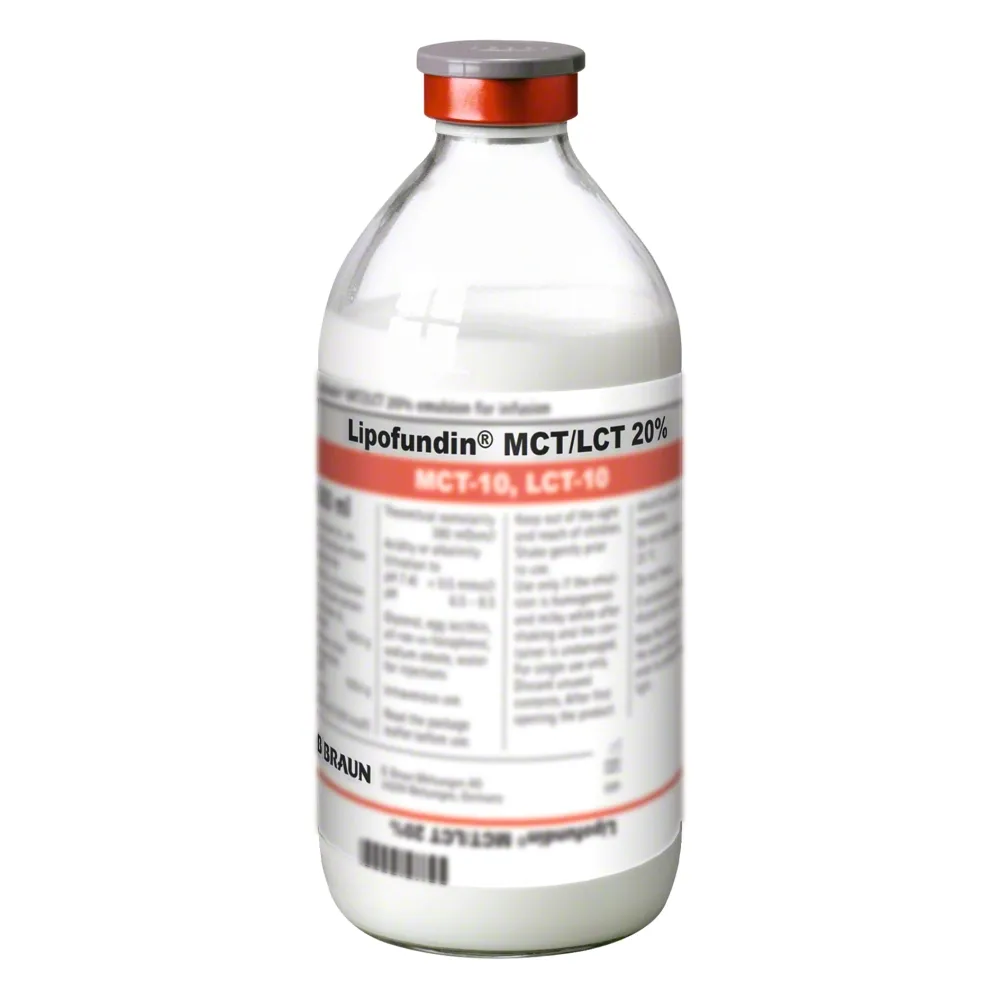
Table of Contents
Package leaflet: Information for the user
Lipofundin MCT/LCT 20% (100 mg/ml + 100 mg/ml) emulsion for infusion
Please read all of this leaflet carefully before this medicine is administered, as it contains important information for the patient.
- Keep this leaflet, as you may need to read it again.
- Consult your doctor or pharmacist if you have any further questions.
- This medicine has been prescribed for a specific individual. Do not pass it on to others.
- It may harm other people, even if their symptoms are the same.
- If any of the side effects worsen, or if you experience any side effects not listed in this leaflet, inform your doctor, pharmacist, or nurse.
Contents:
- What Lipofundin MCT/LCT 20% is and what it is used for
- Before you are given Lipofundin MCT/LCT 20%
- How to use Lipofundin MCT/LCT 20%
- Possible side effects
- How to store Lipofundin MCT/LCT 20%
- Contents of the pack and other information
1. What Lipofundin MCT/LCT 20% is and what it is used for
Lipofundin MCT/LCT 20% is an oil-in-water emulsion. The fats contained in Lipofundin MCT/LCT 20% provide energy and essential fatty acids necessary for growth and recovery.
Lipofundin MCT/LCT 20% is administered intravenously (by infusion) as a component of nutritional support when oral or enteral feeding is not possible.
2. Before using Lipofundin MCT/LCT 20%
When not to use Lipofundin MCT/LCT 20%:
- if the patient is allergic to egg white or soy, soy products, peanuts, or to any of the other ingredients of this medicine (listed in section 6).
Lipofundin MCT/LCT 20% must also not be used in the following cases:
- high levels of fat in the blood (severe hyperlipidemia);
- severe blood clotting disorders (severe coagulopathy, worsening hemorrhagic diathesis);
- severe liver failure;
- blockage of blood vessels by blood clots or fat (acute thromboembolic disease, fat embolism);
- acidosis (metabolic acidosis);
- life-threatening circulatory disturbances, such as may occur in collapse or shock;
- unstable metabolism due to severe trauma or surgery (post-trauma syndrome), systemic infections (sepsis), or coma of unknown origin;
- severe heart attack or stroke;
- severe kidney failure without access to kidney dialysis;
- uncorrected fluid or electrolyte imbalances, for example low levels of water and electrolytes (hypotonic dehydration) or low potassium levels (hypokalemia) in the blood;
- severe heart failure (decompensated heart failure);
- accumulation of fluid in the lungs (acute pulmonary edema).
Warnings and precautions
Before starting treatment with Lipofundin MCT/LCT 20%, consult a doctor,
pharmacist, or nurse.
During infusion, plasma lipid levels (plasma triglyceride concentration) should be monitored regularly.
If blood fat levels are too high, the doctor may reduce or stop the infusion rate.
Before starting administration of this medicine, fluid and electrolyte imbalances as well as acid-base imbalances should be corrected.
During administration of this medicine, fluid balance, blood electrolyte concentrations, acid-base balance, and heart function should be monitored. The doctor may decide to administer this medicine for several weeks. In such cases, liver function, coagulation factors, and blood cell counts should be monitored.
Hypersensitivity reactions to this medicine are extremely rare. If any allergic reactions occur—such as fever, chills, rash, or difficulty breathing—during administration of this medicine, the infusion must be stopped immediately.
To prevent acidosis (metabolic acidosis), carbohydrates and amino acids should be administered concurrently with Lipofundin MCT/LCT 20%.
To ensure complete parenteral nutrition, solutions of carbohydrates and amino acids should also be administered. Nursing staff may also take appropriate measures to ensure the patient's body receives adequate amounts of fluids, electrolytes, vitamins, and trace elements.
Elderly patients
In certain situations, the ability to properly metabolize fats may be impaired, particularly in elderly patients with concomitant diseases such as heart or kidney dysfunction.
Patients with fat metabolism disorders
In certain situations, the ability to properly metabolize fats may be impaired. Therefore, inform the doctor if the patient has:
- diabetes;
- pancreatitis;
- impaired liver or kidney function (kidney failure, liver failure);
- blood poisoning (sepsis);
- reduced thyroid activity (hypothyroidism).
In cases of impaired fat metabolism, blood fat levels (triglyceride concentration) should be closely monitored.
Children
In children at risk of jaundice, blood levels of fats (triglycerides) and bilirubin should be monitored. Modification of the daily fat dose may be necessary.
During infusion, this medicine should be protected from phototherapeutic light, as it may lead to the formation of potentially harmful compounds (triglyceride hydroperoxides).
When used in children from premature infants up to 2 years of age, the emulsion (and administration set) must be protected from light from the moment of preparation for infusion until the end of administration. Exposure of parenteral nutrition mixtures containing Lipofundin MCT/LCT 20% to light, especially after addition of trace elements and/or vitamins, leads to the formation of peroxides and other degradation products, which can be minimized by providing protection from light.
Other medicines and Lipofundin MCT/LCT 20%
Tell your doctor about all medicines currently used, recently used, or planned for use.
Lipofundin MCT/LCT 20% may interact with other medicines. Inform your doctor if the patient is taking medications affecting blood coagulation, specifically:
- heparin;
- coumarin derivatives, such as warfarin.
Pregnancy, breastfeeding, and fertility
If the patient is pregnant, breastfeeding, suspects she may be pregnant, or is planning to have a child, she should consult a doctor or pharmacist before using this medicine.
There are no adequate data on the use of Lipofundin MCT/LCT 20% in pregnant women.
The medicine will be administered to a pregnant woman only if the doctor considers it necessary to save her life or to prevent more serious harm.
Breastfeeding is not recommended if the woman is receiving parenteral nutrition.
Driving and operating machinery
Lipofundin MCT/LCT 20% is usually administered to bedridden patients in hospital or clinic settings, which excludes driving and operating machinery.
Lipofundin MCT/LCT 20% contains less than 1 mmol/l (23 mg) of sodium per litre, meaning it is essentially "sodium-free".
3. How to use Lipofundin MCT/LCT 20%
This medicine is administered as an intravenous infusion (drip) via an infusion set into a vein.
The doses given below are intended as recommended values. The physician will determine the required
dose and duration of treatment for each individual patient.
Adults
The standard dose is 0.7 to 1.5 g of fats per kg of body weight per day. The maximum dose of 2.0 g of fats per kg of body weight per day should not be exceeded, although this may be given in situations such as high energy requirements or increased fat utilization (e.g. patients with cancer).
The dose should not exceed 1.0 g per kg of body weight per day in the following patient groups:
- Long-term home parenteral nutrition (> 6 months);
- Patients with short bowel syndrome.
For a patient weighing 70 kg, a daily dose of 2.0 g per kg of body weight per day corresponds to a maximum daily dose of Lipofundin MCT/LCT 20% of 700 ml.
Children
Gradual increase in fat intake within the range of 0.5–1.0 g per kg of body weight per day may be beneficial. This approach facilitates monitoring of serum triglyceride levels by the physician and helps prevent excessively high blood fat levels (hyperlipidemia).
Premature infants, term newborns, infants, and young children
In premature infants, the initial dose should be 0.5 to 1.0 g/kg body weight/day, gradually increased by increments of 0.5 to 1.0 g/kg body weight/day up to a maximum dose of 3 g/kg body weight/day.
In infants and young children, a daily fat dose not exceeding 3.0 (max. 4.0) g/kg body weight/day is recommended.
In this age group, the daily dose should be administered as a continuous 24-hour infusion.
Children and adolescents
A daily fat dose of 2.0–3.0 g per kg of body weight should not be exceeded.
When used in children from premature infants up to 2 years of age, the emulsion (and administration set) must be protected from light from the moment of preparation until completion of the infusion (see section 2).
Infusion rate
The infusion rate should be as low as possible. During the first 15 minutes, the infusion rate should not exceed 50% of the maximum planned infusion rate.
The patient should be closely monitored for the occurrence of adverse reactions.
Maximum infusion rate:
Adults
Up to 0.15 g of fats per kg of body weight per hour.
This means that for a 70 kg patient, the maximum infusion rate is 52.5 ml of Lipofundin MCT/LCT 20% per hour, corresponding to 10.5 g of fat per hour.
Premature infants, term newborns, infants, and young children
Up to 0.17 g of fats per kg of body weight per hour.
Children and adolescents
Up to 0.13 g of fats per kg of body weight per hour.
Administration of a higher than recommended dose of Lipofundin MCT/LCT 20%
If an excessive dose of Lipofundin MCT/LCT 20% is administered, a significant increase in blood fat levels (hyperlipidemia) may occur, as well as metabolic acidosis or fat overload syndrome. For symptoms of fat overload syndrome, see section 4 "Possible side effects".
If an excessive dose of Lipofundin MCT/LCT 20% has been administered, the infusion should be stopped immediately. The infusion may be resumed only after symptoms of overdose have resolved. The physician may decide to adjust the daily dose and determine whether additional treatment is necessary.
4. Possible adverse reactions
Like all medicines, this medicine can cause adverse reactions, although not everyone will experience them.
The following adverse reactions may be serious. If any of the following
adverse symptoms occur, inform your doctor immediately, who will discontinue the administration of the medicine:
Very rare (occur in less than 1 in 10,000 patients):
- hypersensitivity reactions, such as skin reactions, shallow breathing, swelling of the lips, mouth and throat, difficulty breathing;
- breathing difficulties (dyspnoea);
- bluish discoloration of the skin and mucous membranes (cyanosis).
Other adverse reactions:
Very rare (occur in less than 1 in 10,000 patients):
- fat overload syndrome (see "Fat overload syndrome" below);
- increased tendency for blood to clot (hypercoagulability);
- abnormally high levels of fats in the blood (hyperlipidaemia);
- abnormally high levels of sugar in the blood (hyperglycaemia);
- metabolic condition characterised by acidification of the blood (metabolic and ketotic acidosis);
- increase or decrease in blood pressure;
- dizziness;
- nausea, vomiting, loss of appetite;
- headache;
- hot flushes;
- redness of the skin (flushing);
- elevated body temperature;
- sweating;
- feeling of cold, chills;
- back, chest, bone or lower back pain.
Frequency not known (frequency cannot be determined from available data):
- impaired bile flow (cholestasis);
- decreased number of white blood cells (leucopenia);
- decreased number of platelets (thrombocytopenia).
Fat overload syndrome
In case of overdose of Lipofundin MCT/LCT 20%, the so-called "fat overload syndrome" may occur, meaning the body has difficulty utilising fats.
Impaired fat metabolism may be caused by a sudden change in health status (kidney problems or infection).
These symptoms are usually reversible if the fat emulsion infusion is stopped.
Fat overload syndrome is characterised by the following symptoms:
- high levels of fats in the blood (hyperlipidaemia);
- fever;
- fat deposition in the liver and other organs (fatty infiltration);
- enlargement of the liver (hepatomegaly), which in some cases may be accompanied by jaundice;
- enlargement of the spleen (splenomegaly);
- decreased number of red blood cells (anaemia);
- decreased number of white blood cells (leucopenia);
- decreased number of platelets (thrombocytopenia);
- blood coagulation disorders;
- breakdown of red blood cells (haemolysis);
- increased number of immature red blood cells (reticulocytosis);
- abnormal liver function test results;
- loss of consciousness.
Reporting of adverse reactions
If any adverse reactions occur, including any adverse reactions not listed in this leaflet, inform your doctor, pharmacist or nurse. Adverse reactions can be reported directly to the Department for Monitoring Adverse Drug Reactions of the Office for Registration of Medicinal Products, Medical Devices and Biocidal Products
Al. Jerozolimskie 181C, 02-222 Warsaw
Tel.: + 48 22 49 21 301
Fax: + 48 22 49 21 309
Website: https://smz.ezdrowie.gov.pl.
Reporting adverse reactions helps to provide more information on the safety of the medicine.
5. How to store Lipofundin MCT/LCT 20%
Keep out of the reach and sight of children.
Do not use this medicine after the expiry date stated on the label. The expiry date refers to the last day of the stated month.
Store below 25°C. Protect from light; do not freeze. In case of accidental freezing, discard the product.
The medicine may be used only if the container is intact and the emulsion is homogeneous, milky-white, and without visible oil droplets.
Bottles are intended for single use only. Any unused contents should be discarded.
When used in children from premature infants up to 2 years of age, the emulsion (and the infusion set) must be protected from light from the moment of preparation for infusion until the end of administration (see section 2).
6. Contents of the pack and other information
What Lipofundin MCT/LCT 20% contains
The amount of active substances in 1000 ml of Lipofundin MCT/LCT 20% is:
Purified soybean oil 100.0 g
Medium-chain triglycerides 100.0 g
Content of essential fatty acids
Linoleic acid: 48.0 – 58.0 g/l
α-Linolenic acid: 5.0 – 11.0 g/l
Calorific value [kJ/l (kcal/l)]: 8095 (1935)
Theoretical osmolarity [mOsm/l]: 380
Titratable acidity or alkalinity (to pH 7.4) [mmol/l] < 0.5
pH: 6.0 – 8.8
The other ingredients are glycerol, egg phospholipids for injection, α-tocopherol, sodium oleate, and water for injection.
What Lipofundin MCT/LCT 20% looks like and contents of the pack
Lipofundin MCT/LCT 20% is a milky-white emulsion. It is an emulsion for infusion, meaning it is administered through an infusion set.
The medicine is supplied in glass bottles closed with rubber stoppers, containing 100 ml, 250 ml or 500 ml.
Not all pack sizes may be marketed.
Marketing Authorisation Holder and Manufacturer
B. Braun Melsungen AG
Carl-Braun-Strasse 1 Postal address
34212 Melsungen 34209 Melsungen, Germany
Germany
Telephone +49-5661-71-0
Fax +49-5661-71-4567
<-------------------------------------------------------------------------------------------------------------------
Information intended for healthcare professionals only:
Additional Special Warnings and Precautions for Use
Combining substances that are not compatible may lead to emulsion breakdown or particle precipitation, which may significantly increase the risk of embolism.
In fat-containing solutions with high fat content (e.g. Lipofundin MCT/LCT 20%), the ratio of emulsifier (phospholipids) to oil is lower than in emulsions with lower fat content. The use of such solutions results in more favorable plasma concentrations of triglycerides, phospholipids, free fatty acids, and pathological lipoprotein X. Therefore, the use of higher fat content emulsions such as Lipofundin MCT/LCT 20% is recommended.
Exposure to light of parenteral nutrition mixtures, particularly after addition of trace elements and/or vitamins, may lead to undesirable clinical effects in neonates due to the formation of peroxides and other degradation products. When administering to children from preterm infants up to 2 years of age, Lipofundin MCT/LCT 20% must be protected from light from the moment of preparation for infusion until the end of administration.
Effect on laboratory test results
Lipids may interfere with the results of certain diagnostic tests (such as bilirubin, lactate dehydrogenase, oxygen saturation measurements) if blood is drawn before lipids have been cleared from the plasma, which may take 4 to 6 hours.
Incompatibilities
Lipofundin MCT/LCT 20% must not be used as a solvent for electrolyte concentrates or other medicinal products, and must not be mixed with other infusion solutions in an uncontrolled manner, as this cannot guarantee adequate emulsion stability.
Special precautions for disposal and preparation of the medicinal product for use
Gently shake before use.
Before starting the infusion, warm the emulsion to room temperature, but do not use heating devices (such as an oven or microwave oven).
If filters are used, ensure they are lipid-permeable.
Before starting simultaneous infusion of the fat emulsion with other solutions via a Y-connector or another infusion set, compatibility of the solutions must be confirmed, particularly when medicinal products are administered simultaneously. Particular caution is required when solutions containing divalent ions (such as calcium or magnesium) are administered simultaneously.
When used in children from preterm infants up to 2 years of age, parenteral nutrition mixtures containing Lipofundin MCT/LCT 20% must be protected from light from the moment of preparation until the end of administration. Exposure of such mixtures to light, especially after addition of trace elements and/or vitamins, leads to formation of peroxides and other degradation products, which can be minimized by providing protection from light.
Method of administration
Fat emulsions may be administered via peripheral or central veins and may be given through peripheral or central veins as part of parenteral nutrition.
If the fat emulsion is administered simultaneously with amino acid or carbohydrate solutions, the Y-connector or infusion site should be placed as close as possible to the catheter insertion site.
The duration of administration of Lipofundin MCT/LCT 20% is usually 1 to 2 weeks. If continued use of a fat emulsion is indicated during parenteral nutrition, Lipofundin MCT/LCT 20% may be administered for a longer period provided appropriate monitoring is in place.
When used in children from preterm infants up to 2 years of age, the emulsion (and administration set) must be protected from light from the moment of preparation until the end of administration.