Ligosan
Poland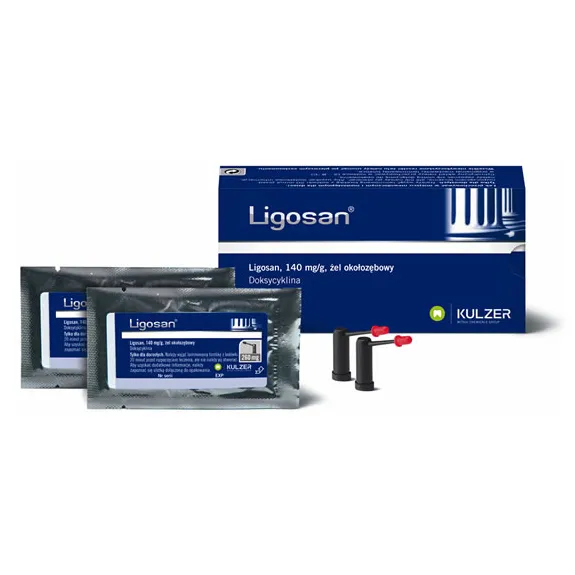
Table of Contents
- Package leaflet: Information for the user
- 1. What Ligosan is and what it is used for
- 2. Important information before using Ligosan
- 3. How to use Ligosan
- 4. Possible adverse reactions
- 5. How to store Ligosan
- 6. Contents of the package and other information
- Information intended exclusively for healthcare professionals:
Package leaflet: Information for the user
Ligosan, 140 mg/g, periodontal gel
For adults only
Doxycycline
Please read all of this leaflet carefully before using this medicine, because it contains
important information for the patient.
- Keep this leaflet, as you may need to read it again.
- If you have any questions, please consult your dentist or pharmacist.
- This medicine has been prescribed for a specific individual. Do not give it to others. This medicine may harm other people, even if their symptoms are the same.
- If the patient experiences any adverse reactions, including any not listed in this leaflet, inform the dentist or pharmacist. See section 4.
Contents of the leaflet
- What Ligosan is and what it is used for
- Important information before using Ligosan
- How to use Ligosan
- Possible side effects
- How to store Ligosan
- Contents of the pack and other information
1. What Ligosan is and what it is used for
Ligosan contains the active substance doxycycline, which is an antibiotic belonging to the tetracycline group.
Ligosan is indicated for the treatment of chronic and aggressive periodontitis, where the periodontal pocket depth is ≥ 5 mm, and is intended for use in adults as an adjunct to conventional non-surgical periodontal therapy.
Official guidelines on the appropriate use of antibacterial agents should be taken into account.
2. Important information before using Ligosan
When not to use Ligosan
- if the patient is allergic to doxycycline, other tetracycline antibiotics, or any of the other ingredients of this medicine (listed in section 6);
- in patients treated with antibiotics acting not only locally (systemic antibiotics) shortly before starting or during treatment of periodontitis using Ligosan; the dentist should be informed if the patient has taken antibiotics but is unsure whether they were systemic antibiotics;
- during pregnancy and breastfeeding;
- in children and adolescents;
- in patients at increased risk of developing acute disease associated with impaired production of haem pigment (acute porphyria);
- in patients with acute liver failure.
Warnings and precautions
Before starting treatment with Ligosan, discuss this with your dentist or pharmacist.
-
Treatment with tetracycline antibiotics, including doxycycline, may increase sensitivity to light and cause hypersensitivity reactions following exposure to light. If skin changes occur, e.g. skin redness, the patient should inform the dentist, who will discontinue treatment.
-
Caution should be exercised when using tetracycline antibiotics, including doxycycline, in patients with liver impairment or those receiving hepatotoxic drugs.
-
In patients with renal impairment, accumulation of tetracycline antibiotics such as doxycycline may occur, which could lead to impaired liver function or liver damage. However, since plasma concentrations of doxycycline after administration of Ligosan were very low, occurrence of these effects with Ligosan is unlikely.
-
In patients with a history of fungal infections (candidiasis), treatment with doxycycline may increase the risk of oral candidiasis. As with other antibiotics, use of Ligosan may lead to increased resistance of microorganisms (including fungi) to tetracyclines.
-
Tetracycline antibiotics may reduce the activity of blood coagulation factor II (plasma prothrombin). Therefore, if the patient is concurrently treated with anticoagulant drugs, a dose reduction may be necessary. Although occurrence of such effects is unlikely with Ligosan due to low plasma concentrations of doxycycline, particular caution is advised in these patients.
Children and adolescents
Ligosan must not be administered to children and adolescents under 18 years of age.
Ligosan and other medicines
Inform your doctor, dentist or pharmacist about all medicines the patient is currently taking or has recently taken, as well as any medicines the patient plans to take.
Some medicinal products may interact with Ligosan. Possible interactions include:
- with beta-lactam antibiotics; therefore, concomitant administration of doxycycline to patients receiving beta-lactam antibiotics is not recommended;
- concomitant use of tetracycline antibiotics such as doxycycline and anaesthesia using methoxyflurane may lead to (potentially fatal) renal failure;
- doxycycline may enhance the toxic effect of cyclosporine A.
Systemic exposure to doxycycline in body areas other than the treated site (systemic exposure to doxycycline) after administration of Ligosan is very low.
It is unlikely that the interactions mentioned above will occur in untreated areas due to the low concentration of doxycycline in blood after administration of Ligosan.
Pregnancy and breastfeeding
If the patient is pregnant or breastfeeding, suspects she may be pregnant, or is planning to have a child, she should consult a doctor, dentist or pharmacist before using this medicine.
Pregnancy
Use of Ligosan during pregnancy is contraindicated.
Administration of tetracycline antibiotics during tooth development may cause permanent tooth discoloration and enamel damage.
Breastfeeding
Tetracycline antibiotics such as doxycycline pass into breast milk; therefore, use of Ligosan during breastfeeding is not recommended.
Driving and operating machinery
Ligosan has no effect on the ability to drive or operate machinery.
3. How to use Ligosan
Ligosan should be administered exclusively by dentists.
Recommended dose
The dosage of Ligosan varies depending on the size, shape, and depth of periodontal pockets.
Method of administration
The medicinal product is intended solely for periodontal use.
It should be applied by dentists directly into periodontal pockets using the designated device.
Duration of treatment
Ligosan is intended for single use only.
Use of a higher than recommended dose of Ligosan
There is no risk of acute overdose. If an excessive amount of Ligosan is administered, it should be removed from the periodontal pocket.
Adverse health effects (acute toxicity) associated with drugs containing doxycycline are minimal, even after ingestion of relatively high doses. In case of accidental overdose, administration of medicinal products that neutralize excess hydrochloric acid in the stomach (antacids) or magnesium or calcium salts will prevent gastrointestinal absorption. This occurs because the active substance, doxycycline, is converted into compounds that cannot be absorbed by the body (non-absorbable chelate complexes). If necessary, further symptomatic and supportive treatment should be undertaken. Doxycycline cannot be removed from the bloodstream by blood purification techniques (dialysis).
Any additional questions regarding this medicinal product should be directed to your dentist or pharmacist.
4. Possible adverse reactions
Like all medicines, this medicine can cause adverse reactions, although not everyone will experience them.
Uncommon (affects up to 1 in 100 patients)
- gingival swelling
- taste disturbance described as chewing gum taste
Unknown frequency (cannot be estimated from available data)
- urticaria with blister formation, transient localized subcutaneous edema, and mucosal swelling (angioedema), hypersensitivity reactions (anaphylaxis), purpuric skin lesions (allergic purpura).
Complete cross-resistance occurs within the tetracycline class of antibiotics.
Adverse reactions associated with orally administered doxycycline have not been listed in this leaflet.
Reporting of adverse reactions
If any adverse reactions occur, including any adverse reactions not listed in this leaflet, inform your dentist or pharmacist.
Adverse reactions can be reported directly to the Department of Monitoring Adverse Drug Reactions at the Office for Registration of Medicinal Products, Medical Devices and Biocidal Products,
Al. Jerozolimskie 181C, PL-02-222 Warsaw
Tel: +48 22 49 21 301
Fax: +48 22 49 21 309
Website: https://smz.ezdrowie.gov.pl
Adverse reactions can also be reported to the Marketing Authorisation Holder.
Reporting adverse reactions helps provide more information on the safety of this medicine.
5. How to store Ligosan
Keep the medicine out of the sight and reach of children.
Do not use this medicine after the expiry date stated on the laminated pouch and
the carton following the abbreviation "EXP". The expiry date refers to the last day of the stated month.
Store in a refrigerator (2°C – 8°C).
After first opening the laminated pouch: use immediately.
Signs of unsuitability: Do not use this medicine if the laminated pouch containing the cylindrical insert is damaged.
Any unused gel residue should be discarded after first use.
6. Contents of the package and other information
What Ligosan contains
- The active substance is doxycycline. 1 g of periodontal gel contains 140 mg of doxycycline (as doxycycline hyclate). One filled cylindrical insert containing 260 mg of periodontal gel contains 36.40 mg of doxycycline.
- The other ingredients are: polyglycolide, polyethylene glycol-DL-lactide-glycolide copolymer (high viscosity), polyethylene glycol-DL-lactide-glycolide copolymer (low viscosity).
What Ligosan looks like and contents of the pack
Ligosan is an opaque, yellow periodontal gel.
Available in packs containing 2, 4, 8, 10 or 16 filled cylindrical inserts, each containing 260 mg of periodontal gel.
Not all pack sizes may be marketed.
Marketing Authorisation Holder
Kulzer GmbH
Leipziger Straße 2
63450 Hanau (Germany)
Manufacturer
Artesan Pharma GmbH & Co. KG
Wendlandstr. 1
29439 Lüchow (Germany)
This medicinal product is authorised in the European Economic Area countries under the following names:
Germany, Austria, Liechtenstein, Poland, Italy Ligosan
Information intended exclusively for healthcare professionals:
Method of use
The medicinal product Ligosan must be administered exclusively using the pre-filled gel-containing cylindrical Ligosan cartridge supplied with the dosing gun.
- Remove the laminated pouch from the refrigerator 20 minutes before application. Keep the pouch closed and allow the product to reach room temperature to prevent condensation of moisture.
- Open the sealed laminated pouch immediately before use and remove the cylindrical cartridge containing the gel.
- Insert the cylindrical cartridge into the gun and remove the cap from the tip of the cartridge.
- Squeeze the handle of the gun until the gel starts to emerge from the cartridge tip.
- The medicinal product is now ready for application.
- Clean and dry the periodontal pocket as usual.
- Gently insert the tip of the cartridge into the periodontal pocket. Position the tip at the base of the pocket and squeeze the handle of the gun to extrude the gel. Slowly withdraw the cartridge tip from the periodontal pocket while continuing to express the gel.
Continue gel application until excess gel appears at the gingival margin, indicating complete filling of the pocket. Excess gel may be removed using a moistened dental applicator or absorbent paper point.
For 7 days following application, avoid mechanical tooth cleaning of teeth treated with Ligosan gel, except for brushing the occlusal surfaces and the tongue.