Lignox
Poland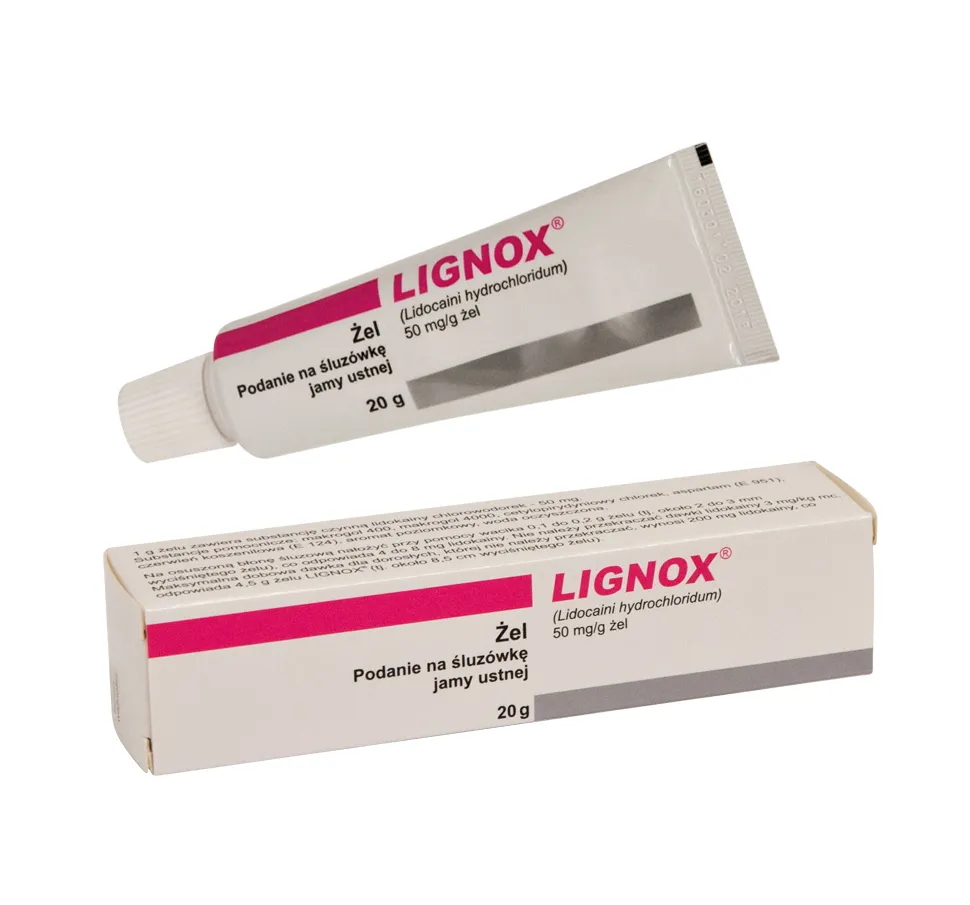
Table of Contents
Package leaflet: information for the user
LIGNOX, 50 mg/g, gel
Lidocaini hydrochloridum
Please read the entire leaflet carefully before using the medicine, as it contains
important information for the patient.
- Keep this leaflet, so that you can read it again if necessary.
- If you have any doubts, consult your doctor or pharmacist.
- This medicine has been prescribed for a specific individual. Do not share it with others. The medicine may harm another person, even if their symptoms are identical.
- If any adverse reactions occur in the patient, including any adverse reactions not listed in this leaflet, inform your doctor or pharmacist. See section 4.
Table of contents of the leaflet
- What Lignox is and what it is used for
- Important information before using Lignox
- How to use Lignox
- Possible side effects
- How to store Lignox
- Contents of the pack and other information
1. What Lignox is and what it is used for
Lignox gel is used for topical anaesthesia of mucous membranes and skin:
- for topical anaesthesia of mucous membranes prior to injection to reduce pain associated with needle insertion, especially in pain-sensitive patients;
- for topical anaesthesia in dental procedures, e.g. scaling (removal of dental calculus), superficial incisions of abscesses;
- during extraction of severely loose deciduous and permanent teeth (in periodontal diseases);
- in prosthodontics: prophylactically to suppress the patient's gag reflex during impression taking in the oral cavity.
Lidocaine, the active substance in Lignox, is an amide-type local anaesthetic with a short duration of action. Topical anaesthetics penetrate the mucosal epithelium and reach pain receptors located in the submucosal layer. They produce local, superficial blockade of pain sensation in mucous membranes (e.g. oral cavity), wound surfaces, and skin. When applied in small amounts to the skin or mucous membranes, they exert only local anaesthetic effects, without systemic action.
2. Important information before using Lignox
When not to use Lignox:
- if the patient is allergic to lidocaine hydrochloride or to any other amide-type local anaesthetics, or to any of the other ingredients of this medicine (listed in section 6);
- in children under 4 years of age.
Relative contraindications include: shock, second- and third-degree atrioventricular conduction block, myasthenia gravis, severe liver impairment.
Warnings and precautions
Do not swallow the gel; any excess should be spat out.
NOTE: This medicinal product contains an active substance that may cause a positive result in doping tests.
Lignox and other medicines
Tell your doctor about all medicines you are currently taking, have recently taken, or plan to take.
Lidocaine potentiates the effect of skeletal muscle relaxants. It reduces the effectiveness of sulfonamides.
Use with caution in patients treated with tricyclic antidepressants and MAO inhibitors.
Pregnancy and breastfeeding
If the patient is pregnant or breastfeeding, suspects she may be pregnant, or is planning to become pregnant, she should consult a doctor before using this medicine.
There are insufficient data on the safety of Lignox during pregnancy. This medicine should not be used in pregnant women.
The safety of use during breastfeeding has not been established.
Driving and operating machinery
Lignox may cause mild, transient impairment of psychomotor performance, including the ability to drive motor vehicles and operate machinery.
Your doctor will advise you when you may resume activities requiring heightened attention after treatment.
Lignox contains cochineal red (E 124).
It may cause allergic reactions.
Lignox contains ethanol.
This medicine contains 0.544 – 1.088 mg of alcohol (ethanol) per single dose of 0.1 g to 0.2 g of gel (approximately 2 to 3 mm of expressed gel), equivalent to 5.44 mg/g.
It may cause a burning sensation on damaged skin.
Special warnings regarding excipients, relevant in case of gel ingestion in amounts not exceeding the recommended dose
Lignox contains aspartame (E 951).
The product contains 0.8 – 1.6 mg of aspartame per single dose of 0.1 g to 0.2 g of gel (approximately 2 to 3 mm of expressed gel), equivalent to 8 mg/g. Aspartame is a source of phenylalanine. It may be harmful to patients with phenylketonuria. This is a rare genetic disorder in which phenylalanine accumulates in the body due to impaired excretion.
Lignox contains ethanol.
This medicine contains 0.544 – 1.088 mg of alcohol (ethanol) per single dose of 0.1 g to 0.2 g of gel (approximately 2 to 3 mm of expressed gel), equivalent to 5.44 mg/g. The amount of alcohol in a single dose of this medicine is equivalent to less than 1 ml of beer or 1 ml of wine.
The small amount of alcohol in this medicine will not produce noticeable effects.
3. How to use Lignox
This medicine should always be used according to the doctor's instructions. If in doubt, consult your doctor or pharmacist.
Apply 0.1 to 0.2 g of gel (i.e. approximately 2 to 3 mm of extruded gel) using a swab onto the dry mucous membrane, corresponding to 4 to 8 mg of lidocaine.
Do not exceed the dose of 3 mg/kg body weight.
Lidocaine is readily and rapidly absorbed from mucous membranes – when used in children, in low-body-weight adult patients, or when large amounts are used, dose calculation based on patient body weight is recommended.
In children and patients in poor general condition, the maximum daily dose is 2.9 mg/kg body weight and should be calculated individually for each case.
The maximum daily dose for adults, which must not be exceeded, is 200 mg of lidocaine, corresponding to 4.5 g of Lignox gel (i.e. approximately 8.5 cm of extruded gel).
Lidocaine administered in gel form begins to act within 2–5 minutes; the effect lasts for 10 to 15 minutes.
Use of a higher than recommended dose of Lignox
If toxic symptoms affecting the nervous, respiratory, or cardiovascular systems occur, immediate resuscitation measures must be initiated: ensure adequate ventilation with oxygen, administer anticonvulsant drugs and agents to raise arterial blood pressure.
If such symptoms occur, discontinue use of the medicine and contact your doctor immediately.
4. Possible adverse reactions
Like all medicines, this product can cause adverse reactions, although not everyone experiences them.
The medicine may occasionally cause an allergic reaction; anaphylactic shock is rare.
If an allergic reaction occurs, discontinue use of Lignox immediately and contact a doctor without delay
to obtain urgent medical assistance.
Adverse symptoms (taste disturbances, numbness of the tongue, pain and dizziness, feeling of anxiety,
rapid breathing) may occur in cases of overdose, i.e. when too high a dose is administered relative to body weight.
Symptoms related to systemic effects depend on the serum concentration of lidocaine, which in turn depends on
the administered dose, site of administration, local blood flow, body weight, and the patient's general condition.
The likelihood of cardiovascular or central nervous system symptoms following correct use of the gel is negligible.
Drowsiness of varying severity may occur as an adverse effect after administration of lidocaine.
Reporting of adverse reactions
If any adverse reactions occur, including any adverse reactions not listed in this leaflet, inform a doctor, pharmacist, or nurse.
Adverse reactions can be reported directly to the Department of Monitoring Adverse Drug Reactions at the Office for Registration of Medicinal Products, Medical Devices and Biocidal Products
Al. Jerozolimskie 181 C
02-222 Warsaw
Phone: +48 22 49 21 301
Fax: +48 22 49 21 309
Website: https://smz.ezdrowie.gov.pl
Adverse reactions can also be reported to the marketing authorization holder.
Reporting adverse reactions helps provide more information on the safety of the medicine.
5. How to store Lignox
Store below 25°C. Do not freeze.
Keep the tube tightly closed.
Keep Lignox out of the sight and reach of children.
Pay attention to the expiry date of the medicine.
Do not use this medicine after the expiry date stated on the tube and the cardboard package.
The expiry date refers to the last day of the stated month.
Medicines must not be disposed of via wastewater or household waste. Ask your pharmacist how to dispose of medicines no longer in use. This will help protect the environment.
6. Contents of the pack and other information
What Lignox contains
- The active substance is lidocaine hydrochloride. 1 g of gel contains 50 mg of lidocaine hydrochloride.
- The other ingredients are: macrogol 400, macrogol 4000, cetylpyridinium chloride, aspartame (E 951), carmine red (E 124), strawberry flavour (containing ethanol 96%, propylene glycol (E 1520)), purified water.
What Lignox looks like and contents of the pack
Lignox is a uniform, soft, opaque gel ranging in colour from light pink to red, with a strawberry odour.
The pack consists of a tube containing 20 g of gel. The tube together with the leaflet is placed in a cardboard box.
Marketing Authorisation Holder and Manufacturer
CHEMA-ELEKTROMET
Labour Cooperative
Przemysłowa Street 9
35-105 Rzeszów
Phone: +48 17 862 05 90
E-mail: [email protected]