Lidbree
Poland
Table of Contents
- Package leaflet: Information for the user
- 1. What Lidbree is and what it is used for
- 2. Important information before using Lidbree
- 3. How to use Lidbree
- 4. Possible side effects
- 5. How to store Lidbree
- 6. Contents of the pack and other information
- The following information is intended exclusively for healthcare professionals:
Package leaflet: Information for the user
Lidbree, 42 mg/ml, topical gel
Lidocaine
Please read all of this leaflet carefully before using this medicine, because it contains
important information for the patient.
- Keep this leaflet, as you may need to read it again.
- If you have any further questions, please ask your doctor, pharmacist, or nurse.
- This medicine has been prescribed for a specific individual. Do not pass it on to others. It may harm other people, even if their symptoms are the same.
- If the patient experiences any adverse reactions, including any adverse reactions not listed in this leaflet, she should inform her doctor, pharmacist, or nurse. See section 4.
Contents of the leaflet
- What Lidbree is and what it is used for
- What you need to know before using Lidbree
- How to use Lidbree
- Possible side effects
- How to store Lidbree
- Contents of the pack and other information
1. What Lidbree is and what it is used for
Lidbree is an anaesthetic gel used to prevent pain during gynaecological procedures, such as the insertion of intrauterine contraceptive devices and the collection of biopsy samples for laboratory evaluation in gynaecological examinations, in adults and adolescents aged over 15 years. It contains the active substance – lidocaine, an amide-type local anaesthetic (numbs the part of the body where it is applied).
How Lidbree works
After application of the gel, it takes between 2 and 5 minutes for the genital area (mucous membrane) to become anaesthetised. The gel has been shown to reduce pain discomfort during gynaecological procedures and for at least 30 minutes after the procedure. After 1 hour, the pain-relieving effect disappears.
2. Important information before using Lidbree
When not to use Lidbree:
- if the patient is allergic to lidocaine or any of the other ingredients of this medicine (listed in section 6).
Warnings and precautions
For cervical and intrauterine use only. After application of the gel prior to insertion of
intrauterine contraceptives (intrauterine contraceptive devices), bleeding and/or excessive pain
may occur in some cases following difficult procedures. In such cases, a physical examination and
ultrasound examination should be performed immediately to rule out uterine or cervical
perforation. On average, 1 in 1,000 intrauterine device insertion procedures has been reported
to result in perforation.
Inform the person who will administer Lidbree to the patient:
- If the patient has an irregular heartbeat (partial or complete conduction block in the heart muscle), as local anaesthetics may affect it.
- If the patient is being treated for heart rhythm disorders (so-called potassium channel blockers or Class III antiarrhythmics (e.g. amiodarone)), because cardiac effects may be enhanced.
- If the patient has acute porphyria (a hereditary condition related to one of the blood proteins). Lidocaine may trigger attacks of porphyria and should be prescribed to patients with acute porphyria only in severe or emergency situations.
- If the patient is in poor general health.
Children and adolescents
Children under 15 years of age should not receive this medicine due to the risk of adverse effects caused by high blood concentrations of lidocaine.
Lidbree with other medicines
Inform the doctor or healthcare professional if the patient has recently used any other medicines containing lidocaine or medicines for irregular heartbeat (antiarrhythmics, such as mexiletine or Class III antiarrhythmics such as amiodarone), as their effects on the heart could increase the effects of lidocaine.
Pregnancy and breastfeeding
Based on many years of experience, there is no evidence that the use of lidocaine during pregnancy causes adverse effects in the newborn.
Lidocaine may pass into breast milk, but in such small amounts that there is generally no risk of effects on the breastfed newborn. Therefore, breastfeeding can be continued during treatment with Lidbree.
There is no evidence that lidocaine has adverse effects on fertility.
Driving and using machines
Lidbree has no effect or has negligible effect on the ability to drive and use machines.
Lidbree contains macrogol glycerol ricinoleate (polyoxylated castor oil) and butylated hydroxytoluene (E 321).
Macrogol glycerol ricinoleate may cause severe allergic reactions.
Butylated hydroxytoluene (E 321) may cause irritation of mucous membranes.
3. How to use Lidbree
The anaesthetic gel will be applied by a doctor or midwife (nurse) gradually, starting from
the entrance to the uterus.
Use in adolescents
Adolescents with low body weight, below 30 kg, should receive a reduced dose.
Use of a higher than recommended dose of Lidbree
This is not expected when recommended doses are used; however, if the patient experiences
numbness of the lips or tongue, feeling of emptiness in the head, ringing in the ears (tinnitus), or
difficulty speaking or blurred vision (visual disturbances), it should be reported immediately to the doctor or nurse, as these may be early signs of high blood concentration of lidocaine. Sometimes muscle spasms or tremors, or respiratory arrest (apnoea) may occur; in such cases, the doctor or nurse should immediately ensure appropriate breathing (respiratory support) and administer anticonvulsant medication to the patient.
4. Possible side effects
Like all medicines, this medicine can cause side effects, although not everybody will experience them.
The side effects observed after administration of Lidbree prior to insertion of intrauterine contraceptives are similar to those occurring during insertion of contraceptives without prior use of Lidbree.
Possible side effects include:
- Very common side effects (affecting more than 1 in 10 people): nausea.
- Common side effects (may occur in up to 1 in 10 people): dizziness, headache, abdominal discomfort.
Reporting of side effects
If any side effects occur, including any side effects not listed in this leaflet, inform your doctor or midwife (nurse). Side effects can be reported directly to the Department of Monitoring Adverse Drug Reactions of the Office for Registration of Medicinal Products, Medical Devices and Biocidal Products,
Al. Jerozolimskie 181C,
02-222 Warsaw,
tel.: + 48 22 49 21 301,
fax: + 48 22 49 21 309,
Website: https://smz.ezdrowie.gov.pl
Side effects can also be reported to the responsible entity.
Reporting side effects helps provide more information on the safety of this medicine.
5. How to store Lidbree
Keep this medicine out of sight and reach of children.
Do not use this medicine after the expiry date (month-year) stated on the cardboard
pack and syringe. The expiry date refers to the last day of the stated month.
No special storage conditions are required for this medicine.
Medicines must not be disposed of via wastewater or household waste. Ask your
pharmacist how to dispose of medicines no longer required. These measures will help
protect the environment.
6. Contents of the pack and other information
- The active substance is lidocaine. Each ml of intravaginal gel contains 42 mg of lidocaine.
- The other ingredients are:
- Macrogol glycerol ricinoleate (polyoxylated castor oil)
- Poloxamer (contains butylhydroxytoluene (E 321))
- Sodium ascorbate (E 301)
- Hydrochloric acid concentrated (for pH adjustment)
- Sodium hydroxide (for pH adjustment)
- Water for injections
What Lidbree looks like and contents of the pack
Lidbree is an intravaginal gel, which is a sterile, clear or almost clear, slightly brownish-yellow viscous liquid at room temperature, containing 42 mg/ml of lidocaine. Lidbree exhibits a reversible temperature-dependent change from liquid to gel. At body temperature, it becomes a gel (thermogelling).
Lidbree, 42 mg/ml, intravaginal gel is available in a sterile 10 ml pre-filled syringe made of cyclic olefin copolymer with a Tip-Cap and a bromobutyl rubber stopper, packed together with a polypropylene plunger in a PP/Paper blister. A sterile polypropylene applicator with a Luer lock connector, compatible with the pre-filled syringe, is packed in a PP/Paper blister. The complete pack is contained in a cardboard box. From the syringe applicator, 8.5 ml of gel can be expelled (pushed out).
Pack size: 1x10 ml intravaginal gel in a pre-filled syringe
Symbols on the applicator label for Lidbree
 |  |  |  |  |
| Catalogue number | Batch number | Do not use if packaging is damaged | Do not reuse | CE marking |
 |  |  | ||
| Manufacturer | Use before expiry date | Sterilized by irradiation | Read instructions for use |
Marketing Authorisation Holder
Gedeon Richter Plc.
Gyömrői út 19-21
1103 Budapest
Hungary
Manufacturer
Gedeon Richter Plc.
Gyömrői út 19-21
1103 Budapest
Hungary
Recipharm Karlskoga AB
Björkbornsvägen 5
Karlskoga 691 33
Sweden
This medicinal product is authorised in the European Economic Area countries under the following names:
Austria: Lidbree 42 mg/ml Gel zur intrauterinen Anwendung
Belgium: Lidbree 42 mg/ml gel voor intra-uterien gebruik
Lidbree 42 mg/ml gel intra-utérin
Lidbree 42 mg/ml Gel zur intrauterinen Anwendung
Bulgaria: Lidbree 42 mg/ml intrauterine gel
Croatia: Lidbree 42 mg/ml intrauterini gel
Cyprus: Lidbree
Czech Republic: Lidbree
Denmark: Lidbree
Estonia: Lidbree
Finland: Lidbree 42 mg/ml Geeli kohtuun
France: LIDBREE 42 mg/ml gel intra-utérin
Germany: Lidbree 42 mg/ml Gel zur intrauterinen Anwendung
Greece: Lidbree
Hungary: Lidbree 42 mg/ml intrauterin gél
Iceland: Lidbree
Ireland: Lidbree
Italy: Lidbree
Latvia: Lidbree 42 mg/ml gimdos ertmės gels
Lithuania: Lidbree 42 mg/ml intrauterīnais gelis
Luxembourg: Lidbree 42 mg/ml gel intra-utérin
Netherlands: Lidbree 42 mg/ml gel voor intra-uterien gebruik
Norway: Lidbree
Poland: Lidbree
Portugal: Lidbree 42 mg/ml gel intrauterino
Malta: Lidbree 42 mg/mL intrauterine gel
Romania: Lidbree 42 mg/ml gel cu cedera intrauterină
Slovakia: Lidbree 42 mg/ml intrauterini gel
Slovenia: Lidbree 42 mg/ml intrauterinný gél
Spain: Lidbree 42 mg/ml gel intrauterino
Sweden: Lidbree 42 mg/ml intrauterin gel
United Kingdom: Lidbree 42 mg/mL intrauterine gel
For further information about this medicine, please contact:
GEDEON RICHTER POLSKA Sp. z o.o.
Medical Department
ul. Ks. J. Poniatowskiego 5
05-825 Grodzisk Mazowiecki
tel. +48 (22)755 96 48
[email protected]
fax: +48 (22) 755 96 24
The following information is intended exclusively for healthcare professionals:
For intra-cervical and intrauterine use only.
After administration of the medicinal product Lidbree, in case of difficulty inserting
intrauterine contraceptive devices and/or excessive pain or bleeding during or after insertion,
a physical and ultrasonographic examination should be performed immediately to exclude
perforation of the uterine corpus or cervix, as under effective local anaesthesia the patient may
not feel pain in the event of perforation.
Thermogelling formulation: The medicinal product Lidbree is a preservative-free, thermogelling,
viscous local anaesthetic liquid. The product forms a gel when its temperature rises to body
temperature, enabling it to adhere to the mucosal tissues of the cervical canal and endometrial
tissues (thereby minimizing leakage that would occur with a liquid formulation).
During administration, the medicinal product Lidbree should be in liquid form. If a gel has formed,
the product should be placed in a refrigerator until it becomes liquid again. An air bubble will then
be visible in the syringe, which will move when the syringe is tilted.
The product should be assembled step by step and the viscous liquid applied using the supplied sterile
applicator:
- Check the appearance of the syringe by tilting it. The air bubble in the syringe will move when
tilted if the product is in liquid form and ready for use. If the air bubble does not move, the
product has gelled—place it in a refrigerator until it becomes liquid again. - Attach the plunger and applicator to the syringe and ensure they are securely connected.

- Expel the air bubble and fill the applicator with gel by gently pressing the syringe plunger.
- Use the centimeter scale on the applicator to determine the volume of the medicinal product Lidbree.
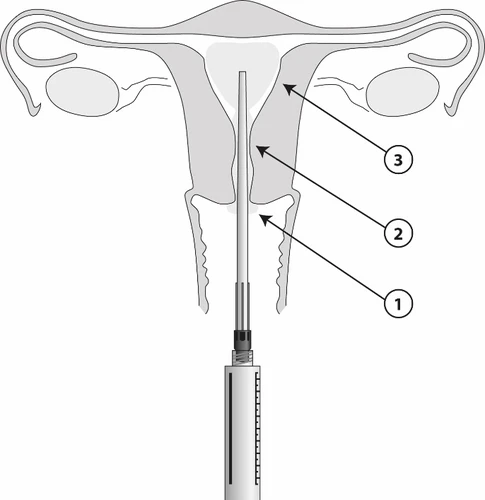
After positioning the applicator at the administration site, up to 8.5 ml of gel can be administered from the syringe. One ml contains 42 mg of lidocaine. The gel should be administered gradually (steps 1 to 3), as shown in the figure.
Cervical procedures
- Apply 2 to 3 ml as a thick layer to the vaginal portion of the cervix using a sterile applicator.
- Administer 3 ml into the cervical canal 5 minutes before the procedure using a sterile applicator.
Intrauterine procedures
- Apply 1 to 2 ml to the anterior lip of the cervix using a sterile applicator.
- Administer 2 to 3 ml into the cervical canal using the applicator. Wait 2 minutes for effect on the internal muscular tissue.
- Then insert the applicator into the uterine cavity and administer 3 to 5 ml, 5 minutes before the procedure. The applicator is marked with a centimeter scale. A smaller volume may be administered, e.g., in nulliparous patients, if the patient experiences discomfort before the full volume is administered.
The single intrauterine dose should not exceed a total of 10 ml. Discard any unused components.
Children and adolescents above 15 years of age
In adolescents with low body weight, below 30 kg, the dose should be proportionally reduced, and the single dose should not exceed the maximum recommended parenteral dose (6 mg/kg body weight of lidocaine hydrochloride, equivalent to 5.2 mg/kg body weight of lidocaine contained in the medicinal product Lidbree, i.e., 1.2 ml per 10 kg body weight). In adolescents weighing 30 kg, the maximum dose of the medicinal product Lidbree is a total of 3.6 ml.
Duration of effect
The gel has been shown to reduce pain during gynecological procedures and for at least 30 minutes after the procedure. After 1 hour, the analgesic effect has disappeared.