Levosol
Poland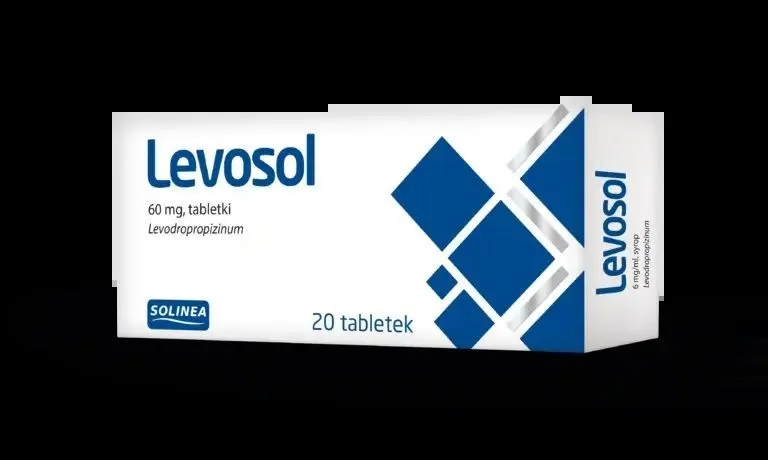
Table of Contents
Package leaflet: Information for the patient
Levosol, 60 mg, tablets
Levodropropizinum
Please read the entire leaflet carefully before taking this medicine, as it contains
important information for the patient.
This medicine should always be used exactly as described in this patient leaflet or as directed by
the doctor or pharmacist.
- Keep this leaflet so that you can read it again if necessary.
- If you need advice or further information, please consult your pharmacist.
- If you experience any adverse reactions, including any possible adverse reactions not listed in this leaflet, inform your doctor or pharmacist. See section 4.
- If there is no improvement after 7 days or if your condition worsens, consult your doctor.
Contents of the leaflet
- What Levosol is and what it is used for
- Important information before taking Levosol
- How to take Levosol
- Possible side effects
- How to store Levosol
- Contents of the pack and other information
1. What Levosol is and what it is used for
Levosol contains the active substance levodropropizine, which has antitussive and bronchospasmolytic properties.
Levosol is indicated for the symptomatic treatment of non-productive (dry) cough.
Numerous data indicate that this medicine effectively suppresses cough of various origins, such as cough associated with lung cancer, cough related to upper and lower respiratory tract infections, or whooping cough.
If there is no improvement after 7 days or if your condition worsens, consult your doctor.
2. Information before using Levosol
When not to use Levosol:
- if the patient is allergic to the active substance or to any of the other ingredients of this medicine (listed in section 6);
- in patients with excessive bronchial secretion and impaired bronchial ciliary function (Kartagener syndrome, ciliary dyskinesia);
- in pregnant and breastfeeding women;
- in children with body weight below 30 kg.
Warnings and precautions
Before starting treatment with Levosol, consult your doctor or pharmacist.
Levosol is a medicine used for symptomatic treatment of non-productive (dry) cough and should only be used while awaiting diagnosis of the underlying cause of cough and/or response to treatment of the disease causing the cough.
Children and adolescents
Levosol should not be used in children with body weight below 30 kg.
Elderly patients
Particular caution is advised when administering levodropropizine to elderly patients, as there is evidence of altered sensitivity to many drugs in this patient group.
Patients with renal impairment
Caution is recommended when administering this medicine to patients with severe renal impairment (creatinine clearance < 35 ml/min).
Levosol and other medicines
Inform your doctor or pharmacist about all medicines you are currently taking, have recently taken, or plan to take.
Human studies have not shown changes in EEG tracings during administration of levodropropizine in combination with benzodiazepines.
Caution should be exercised in particularly sensitive individuals when taking sedative medicines concomitantly.
Levosol with food and drink
Due to lack of information on the effect of food on drug absorption, administration between meals is recommended.
Pregnancy and breastfeeding
If the patient is pregnant, suspects she may be pregnant, plans to become pregnant, or is breastfeeding, she should consult her doctor or pharmacist before using this medicine.
The medicine is contraindicated in women who are pregnant or planning to become pregnant, as well as during breastfeeding.
Driving and using machines
Studies evaluating the ability to drive and/or operate machinery have not been conducted.
However, since the medicine may rarely cause drowsiness (see also section 4. Possible side effects), caution should be exercised in patients intending to drive or operate mechanical equipment, and they should be informed of this possibility.
3. How to take Levosol
This medicine should always be taken exactly as described in this patient information leaflet or as directed by a doctor or pharmacist. If in doubt, consult a doctor or pharmacist.
Do not take Levosol for longer than 7 days without consulting a doctor.
Adults and children weighing over 30 kg (approximately 9 years of age)
1 tablet orally every 6 hours between meals (maximum of 3 tablets per day).
Do not crush or chew the tablets. To facilitate swallowing, the tablet may be taken with water.
If a child has difficulty swallowing the tablet, it is recommended to use a syrup containing the same active substance at an equivalent strength.
Treatment should be continued until cough subsides or as directed by a doctor.
In all cases, if cough persists beyond 7 days of treatment, discontinue use of the medicine and consult a doctor. Remember that cough is a symptom of disease and the underlying condition causing it should be diagnosed and treated appropriately.
Overdose of Levosol
If more than the recommended dose has been taken, inform a doctor or pharmacist immediately.
In case of overdose with clinical symptoms, the doctor will immediately initiate symptomatic treatment and, if necessary, apply standard emergency procedures (e.g. gastric lavage, activated charcoal, intravenous fluid replacement, etc.).
Missed dose of Levosol
Do not take a double dose to make up for a missed dose.
If a patient forgets to take Levosol, they should take the next dose at the usual time.
If there are any further doubts concerning the use of this medicine, consult a doctor or pharmacist.
4. Possible adverse reactions
Like all medicines, this medicine can cause adverse reactions, although not everyone will experience them.
Adverse reactions during the use of Levosol occur very rarely. In most cases, they are not severe complications, and symptoms resolve after discontinuation of treatment, sometimes requiring only specific pharmacological treatment.
Treatment with Levosol should be discontinued and immediate medical help sought if any of the following symptoms occur in the patient:
- severe skin reactions (urticaria, itching) or skin diseases, for example those involving blister formation (epidermolysis);
- irregular heartbeat (risk of atrial bigeminy);
- allergic/anaphylactic reaction, manifesting as swelling, shortness of breath, vomiting, and diarrhea;
- hypoglycemic coma (blood sugar level too low).
Immediate medical advice must be sought if any of the listed adverse reactions occur, as they may lead to life-threatening consequences.
Very rare (less than 1 in 10,000 patients):
- urticaria, erythema, exanthema, itching, angioedema (swelling usually affecting the face or throat, potentially life-threatening), skin reactions;
- stomach pain, abdominal pain, nausea, vomiting, diarrhea;
- allergic reactions, including immediate reactions, general malaise;
- dizziness, balance disorders, tremors, tingling, numbness;
- palpitations, tachycardia, hypotension;
- irritability, drowsiness, depersonalization (disturbance in the perception of self and surroundings);
- shortness of breath, cough, edema of the respiratory mucosa;
- lack of energy or weakness (asthenia) and lower limb weakness.
Additionally, the following adverse reactions have been reported:
- glossitis and aphthous stomatitis with fever;
- inflammation due to impaired bile flow from the liver (cholestatic hepatitis);
- cases of generalized edema, fainting, and weakness;
- epileptic seizures – grand mal seizures (clonic-tonic seizures) and petit mal seizures (non-convulsive, so-called petit mal seizures);
- pupil dilation and loss of vision. In both cases, symptoms resolved after discontinuation of the drug;
- cases of eyelid edema, which in most cases can be considered angioedema, considering the concurrent occurrence of urticaria;
- drowsiness, decreased muscle tone, and vomiting in newborns, attributed to the transfer of levodropropizine to the infant via breast milk from nursing mothers. Symptoms appeared after breastfeeding and resolved spontaneously after skipping several feeds.
Using Levosol according to the recommendations provided in the patient leaflet reduces the risk of adverse reactions.
Reporting adverse reactions
If any adverse symptoms occur, including any adverse symptoms not listed in this leaflet, inform a doctor or pharmacist. Adverse reactions can be reported directly to the Department of Monitoring Adverse Drug Reactions at the Office for Registration of Medicinal Products, Medical Devices and Biocidal Products:
Al. Jerozolimskie 181C, 02-222 Warsaw, phone: +48 22 49 21 301, fax: +48 22 49 21 309,
website: https://smz.ezdrowie.gov.pl
Adverse reactions can also be reported to the marketing authorization holder.
Reporting adverse reactions helps to gather further information on the safety of the medicine.
5. How to store Levosol
Keep this medicine out of sight and reach of children.
No special storage conditions are required for this medicine.
Do not use this medicine after the expiry date stated on the packaging.
The expiry date refers to the last day of the stated month.
Medicines must not be disposed of via the sewage system or household waste. Ask your pharmacist how to dispose of medicines no longer required. This will help protect the environment.
6. Contents of the package and other information
What Levosol contains
- The active substance is levodropropizine. One tablet contains 60 mg of levodropropizine.
- The other ingredients are: colloidal anhydrous silica, calcium hydrogen phosphate, magnesium stearate, microcrystalline cellulose, pregelatinized maize starch, sucralose (E955).
What Levosol looks like and contents of the pack
Levosol is a white, round, biconvex tablet.
One package of the medicine contains 10, 20 or 30 tablets in a cardboard box.
Marketing Authorisation Holder:
Solinea Sp. z o.o.
Elizówka, ul. Szafranowa 6
21-003 Ciecierzyn
{logo of the marketing authorisation holder}
Manufacturer:
Mako Pharma Sp. z o.o.
ul. Władysława Reymonta 2
05-092 Dziekanów Leśny
Medicofarma S.A.
ul. Tarnobrzeska 13
26-613 Radom