Levonor
Poland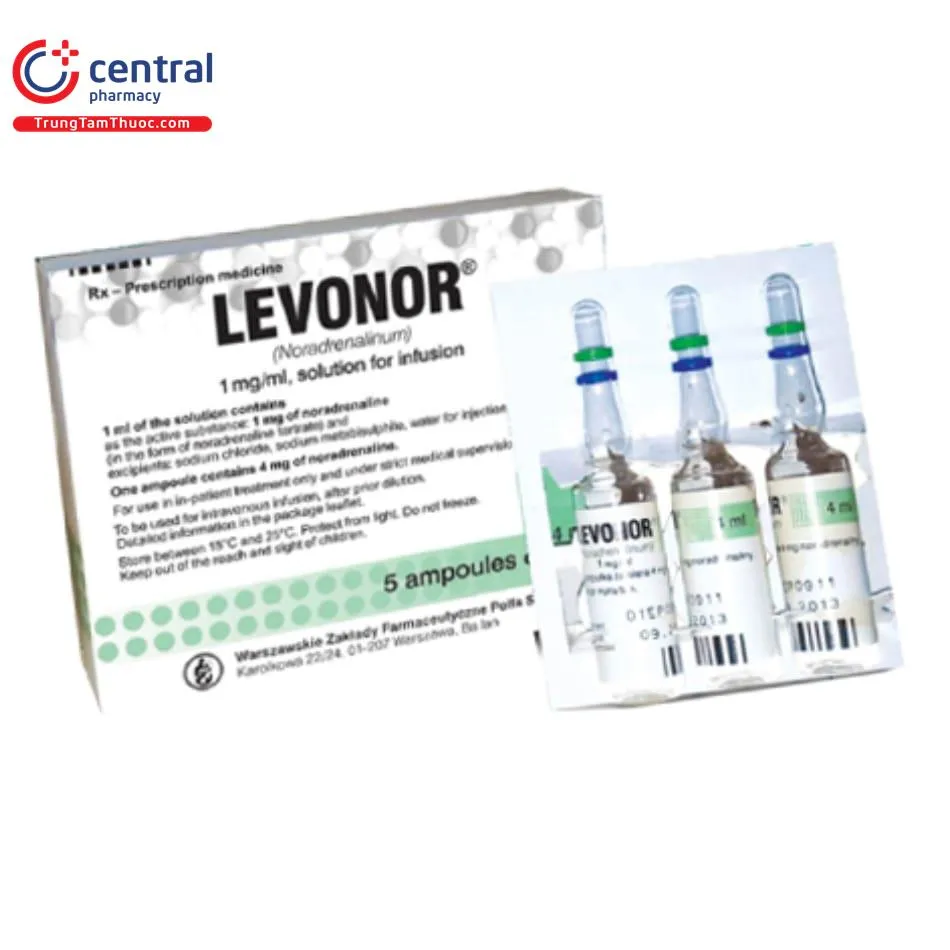
Table of Contents
Package leaflet: information for the patient
LEVONOR, 1 mg/ml, concentrate for solution for infusion
Noradrenalinum
Please read carefully all the information in this leaflet before using this medicine, as it contains
important information for the patient.
- Keep this leaflet, so that you can read it again if necessary.
- If you have any questions, please consult your doctor or pharmacist.
- This medicine has been prescribed for a specific individual. Do not pass it on to others. It may harm other people, even if their symptoms are the same.
- If you experience any adverse reactions, including any not listed in this leaflet, inform your doctor or pharmacist. See section 4.
Contents of the leaflet
- What Levonor is and what it is used for
- Important information before using Levonor
- How to use Levonor
- Possible side effects
- How to store Levonor
- Contents of the package and other information
1. What Levonor is and what it is used for
Levonor contains noradrenaline as the active substance and belongs to a group of medicines affecting
adrenergic and dopaminergic receptors.
Levonor causes constriction of peripheral blood vessels, increases blood pressure, and stimulates
heart function. This effect is used when administering the medicine in life-threatening conditions
associated with a sudden drop in blood pressure.
Levonor is used:
- intravenously in dangerous hypotensive conditions to restore normal blood pressure.
2. Important information before using Levonor
Warning: In life-threatening conditions, there are no absolute contraindications to administration of Levonor.
When not to use Levonor
- if the patient is allergic to noradrenaline or any of the other ingredients of this medicine (listed in section 6);
- if the patient has very low blood pressure following a heart attack;
- if the patient has been diagnosed with a variant form of angina known as Prinzmetal's angina;
- if the patient has thrombotic disorders (blood vessel thrombosis, e.g. in the heart or intestines);
- if certain inhaled anaesthetic medicines (halothane, cyclopropane) are being used simultaneously;
- if the patient has hypoxia (reduced oxygen supply to organs) or excessive carbon dioxide levels.
Warnings and precautions
Before starting Levonor, discuss this with a doctor.
The doctor will exercise particular caution when administering Levonor and will take appropriate measures:
- if the patient is elderly or debilitated.
Children
Levonor is not intended for use in children.
Levonor and other medicines
Tell the doctor about all medicines the patient is currently taking or has recently taken, as well as any medicines the patient plans to take, if possible and the patient's condition allows.
If possible, the patient should inform the doctor if they have taken or are taking certain antidepressant medicines from the group known as monoamine oxidase inhibitors or tricyclic antidepressants.
Pregnancy and breastfeeding
If the patient is pregnant or breastfeeding, suspects she may be pregnant, or is planning to have a child, she should consult a doctor before using this medicine.
If the patient is pregnant, the doctor will decide whether Levonor can be administered, as noradrenaline may be harmful to the unborn child.
There are no data on the use of noradrenaline in breastfeeding women.
Driving and operating machinery
Not applicable – Levonor is used in life-threatening conditions.
Levonor contains sodium metabisulfite and sodium
The medicine contains sodium metabisulfite (E 223), which may rarely cause severe hypersensitivity reactions and bronchospasm.
1 ml ampoule
The medicine contains 3.39 mg of sodium (main component of table salt) per 1 ml ampoule.
This corresponds to 0.17% of the maximum recommended daily dietary intake of sodium in adults.
4 ml ampoule
The medicine contains 13.56 mg of sodium (main component of table salt) per 4 ml ampoule.
This corresponds to 0.68% of the maximum recommended daily dietary intake of sodium in adults.
The medicine may be diluted with: 0.9% sodium chloride solution, 5% glucose solution, or isotonic glucose-saline solution (5% glucose and 0.9% sodium chloride in a 1:1 ratio). The sodium content originating from the diluent should be taken into account when calculating the total sodium content in the prepared diluted solution. For accurate information on the sodium content in the solution used for dilution, refer to the patient leaflet of the diluent used.
3. How to use Levonor
Levonor is always administered by qualified medical personnel.
The medicine should be given after prior dilution, slowly, as an intravenous infusion (using
appropriate equipment with controlled infusion rate).
The dose of the medicine is determined by the physician. The dose used depends on the patient's age, body weight, and general health condition.
Use of a higher than recommended dose of Levonor
After administration of large doses of the medicine exceeding the recommended doses, especially over several hours, severe hypertension, bradycardia, and other cardiac function disorders have been reported. These may be accompanied by severe headache, photophobia, vomiting, chest pain, pallor, and excessive sweating.
4. Possible adverse effects
Like all medicines, this medicine can cause adverse effects, although not everyone experiences them.
The following adverse effects have been reported:
Frequency unknown (frequency cannot be estimated from the available data):
- excessive increase in blood pressure, which may be accompanied by peripheral tissue ischemia;
- headache, limb ischemia (which may lead to necrotic changes known as limb gangrene);
- excessive slowing of heart rate (below 60 beats per minute);
- disturbances in cardiac function (in patients with reduced oxygen supply to organs or excessive carbon dioxide levels in the body, during administration of inhaled medicines used for anesthesia), stress-induced cardiomyopathy (most commonly manifested by: chest pain, shortness of breath, anxiety, fainting, cardiac arrhythmias);
- reduction in plasma volume (the fluid component of blood).
Reporting of adverse effects
If any adverse effects occur, including any adverse effects not listed in this leaflet, inform your doctor or nurse. Adverse effects can be reported directly to the Department of Monitoring Adverse Drug Reactions at the Office for Registration of Medicinal Products, Medical Devices and Biocidal Products
Al. Jerozolimskie 181C
02-222 Warsaw
Phone: +48 22 49 21 301
Fax: +48 22 49 21 309
Website: https://smz.ezdrowie.gov.pl
Adverse effects can also be reported to the marketing authorization holder.
Reporting adverse effects helps to provide more information on the safety of the medicine.
5. How to store Levonor
Store in a refrigerator (2°C–8°C). Protect from light. Do not freeze.
Keep the medicine out of the sight and reach of children.
Do not use this medicine after the expiry date stated on the ampoule and packaging. The expiry date refers to the last day of the stated month.
The label on the packaging shows the expiry date after the abbreviation EXP, and the batch number after the abbreviation Lot.
Medicines must not be disposed of via wastewater or household waste. Ask your pharmacist how to dispose of medicines no longer required. This will help protect the environment.
6. Contents of the package and other information
What Levonor contains
- The active substance is noradrenaline. Each ml of concentrate contains 1 mg of noradrenaline (as noradrenaline bitartrate). A 1 ml ampoule contains 1 mg of noradrenaline. A 4 ml ampoule contains 4 mg of noradrenaline.
- Other ingredients: sodium chloride, sodium metabisulphite (E223), water for injections.
What Levonor looks like and contents of the pack
Levonor is a colourless concentrate.
Colourless glass ampoules containing either 1 ml or 4 ml of concentrate, packed in cardboard boxes.
Each cardboard box contains: 10 ampoules of 1 ml or 5 ampoules of 4 ml.
Marketing Authorisation Holder and Manufacturer
Zakłady Farmaceutyczne POLPHARMA S.A.
ul. Pelplińska 19, 83-200 Starogard Gdański
tel. + 48 22 364 61 01
Information intended exclusively for healthcare professionals:
LEVONOR, 1 mg/ml, concentrate for solution for infusion
Noradrenalinum
Instructions for preparing Levonor for administration
- The following infusion solutions are permitted for dilution of the medicinal product:
- 5% glucose solution,
- 0.9% NaCl solution,
- isotonic glucose-saline solution (5% glucose solution and 0.9% NaCl solution 1:1).
- Dilution must be prepared under controlled and validated aseptic conditions.
- Due to the possibility of pharmaceutical incompatibilities, the product should not be mixed with alkaline solutions or oxidizing agents, barbiturates, chlorpheniramine, chlorothiazide, nitrofurantoin, novobiocin, phenytoin, sodium bicarbonate, sodium iodide, or streptomycin.
Instructions for opening the ampoule
Before opening the ampoule, ensure that all the solution is in the lower part of the ampoule.
Gently shake the ampoule or tap it with your finger to help the solution flow down.
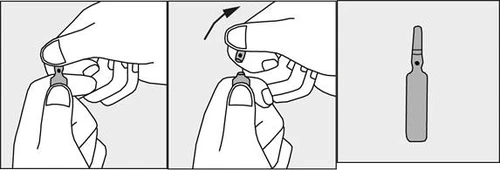
Each ampoule has a coloured dot (see Figure 1) indicating the score line located beneath it.
To open the ampoule, hold it vertically in both hands with the coloured dot facing towards you – see Figure 2.
Grasp the upper part of the ampoule so that the thumb is positioned above the coloured dot.
Press in the direction of the arrow shown in Figure 3.
Ampoules are for single use only and should be opened immediately before use. Any unused portion of the product must be discarded in accordance with applicable regulations.
Figure 1 Figure 2 Figure 3
Method of administration of Levonor
Levonor must be administered intravenously by infusion after prior dilution (dilution method – see below) via a central venous catheter or through a cannula placed in a sufficiently large peripheral vein such as forearm veins, antecubital veins, or external jugular vein, in order to minimize the risk of extravasation and subsequent tissue necrosis. The infusion rate should be controlled using a syringe pump, infusion pump, or drip counter.
Dilution method
- If noradrenaline is to be administered using a syringe pump: add 2 mg of noradrenaline (2 ml of Levonor 1 mg/ml) to 48 ml of diluent.
- If noradrenaline is to be administered using a drip counter: add 20 mg of noradrenaline (20 ml of Levonor 1 mg/ml) to 480 ml of diluent.
The resulting concentration of noradrenaline after dilution is 40 mg/l in both cases. If a different dilution is required, doses must be recalculated precisely.
When administering noradrenaline via peripheral veins, a concentration of 20 mg/l (e.g. 1 ml of product added to 49 ml of diluent) or lower should be used.
Dilution must be prepared under controlled and validated aseptic conditions.
The prepared solution, within the concentration range of 10 mg/l (0.01 mg/ml) to 40 mg/l (0.04 mg/ml), is chemically and physically stable for 24 hours at temperatures below 30°C and does not require protection from light.
From a microbiological standpoint, the solution should be prepared immediately before use.
WARNING: The medicinal product with altered colour is not suitable for use.
Dosage
Adults
Dosage must be individually determined depending on the patient's condition.
Continuous monitoring of arterial blood pressure is required during administration.
Initial dose: 10 ml/hour to 20 ml/hour (0.16 ml/min to 0.33 ml/min), corresponding to 0.4 mg/hour to 0.8 mg/hour of noradrenaline.
When administering noradrenaline via a peripheral vein, the dose should not exceed 0.1 μg/kg body weight/min. Higher doses may be administered only transiently until central venous access is established.
If noradrenaline administration is required for longer than 12 hours, central venous access should also be considered.
Maintenance doses – the infusion rate depends on arterial blood pressure values. The goal of treatment is to achieve systolic blood pressure at the lower limit of normal (100–120 mm Hg) or an adequate mean arterial pressure (above 80 mm Hg).
Duration of treatment: Noradrenaline should be administered until improvement in the patient's condition is achieved. The patient must be continuously monitored during administration.
Elderly patients
See section 2, subsection "Warnings and precautions".
Children
Use is not recommended.
During administration of Levonor, the following should be observed:
- frequently monitor arterial blood pressure and infusion rate. When administering noradrenaline peripherally, the blood pressure cuff must not be placed on the limb with the vascular access;
- administer noradrenaline only to patients with adequately filled intravascular volume (adequately hydrated);
- frequently monitor the infusion site and avoid extravascular administration, as tissue necrosis may occur. The site of extravasation should be infiltrated with phentolamine.
When administering noradrenaline peripherally, the anatomical structure of the vein used influences the safety of administration. A higher incidence of extravasation has been observed when administered into sites with smaller veins or slower circulation, such as the wrist or ankle area. Larger veins (such as forearm veins, antecubital veins, or external jugular vein) provide adequate dilution of noradrenaline and are less prone to vasoconstriction.
When administering a continuous infusion of noradrenaline via a peripheral vein, do not administer other medicinal products through the same access.