Levomer
Poland
Table of Contents
- Package leaflet: Information for the user
- 1. What Levomer eye drops, solution is and what it is used for
- 2. Important information before using Levomer eye drops, solution
- 3. How to use Levomer eye drops, solution
- 4. Possible adverse reactions
- 5. How to store Levomer eye drops, solution
- 6. Contents of the package and other information
Package leaflet: Information for the user
Levomer, 5 mg/ml, eye drops, solution
Levofloxacin (as hemihydrate)
Please read all of this leaflet carefully before using this medicine because it contains
important information for you.
- Keep this leaflet. You may need to read it again.
- If you have any further questions, ask your doctor, pharmacist, or nurse.
- This medicine has been prescribed for you only. Do not pass it on to other people. It may harm them, even if their symptoms are the same as yours.
- If you get any side effects, including any not listed in this leaflet, tell your doctor, pharmacist, or nurse. See section 4.
Leaflet contents
- What Levomer eye drops, solution is and what it is used for
- What you need to know before using Levomer eye drops, solution
- How to use Levomer eye drops, solution
- Possible side effects
- How to store Levomer eye drops, solution
- Contents of the pack and other information
1. What Levomer eye drops, solution is and what it is used for
Each bottle of Levomer 5 mg/ml eye drops contains 5 ml of solution with an active substance called levofloxacin.
Each drop corresponding to 0.05 ml contains 0.256 mg of levofloxacin hemihydrate, equivalent to 0.250 mg of levofloxacin.
Levofloxacin is an antibiotic belonging to a group called fluoroquinolones (sometimes referred to simply as quinolones). The medicine works by killing certain types of bacteria that may cause infections.
Levofloxacin in the form of eye drops is used in children aged 1 year and older, as well as in adults, for the treatment of bacterial infections affecting the front part of the eye. One such infection is bacterial conjunctivitis, which is an infection of the surface layer of the front part of the eye (conjunctiva).
Levomer eye drops are not suitable for treating infections involving deeper layers of the eye or the fluid inside the eyeball. Treatment of such deeper and more serious infections requires the use of antibiotics in tablet form or by injection.
Use of Levomer eye drops is not recommended in children under 1 year of age.
If there is no improvement or if you feel worse after 5 days, consult your doctor.
2. Important information before using Levomer eye drops, solution
When not to use Levomer eye drops, solution:
- if the patient is allergic to levofloxacin, other quinolones, or any of the other
ingredients of this medicine (listed in section 6); - if in doubt, consult a doctor or pharmacist.
Warnings and precautions
Before starting treatment with Levomer eye drops, discuss this with your doctor, pharmacist, or
nurse:
- if an allergic reaction occurs, even after a single dose, discontinue use of the medicine immediately;
- if during treatment the patient notices worsening of eye-related symptoms, contact a doctor as soon as possible;
- if after a period of treatment as determined by the doctor there are no signs of improvement, contact a doctor immediately;
- during an eye infection, wearing any type of contact lenses is generally not recommended;
- Levomer eye drops contain a preservative, benzalkonium chloride, which may cause eye irritation.
Tendon swelling and tendon rupture have been reported in patients receiving oral or intravenous fluorochinolones,
particularly in elderly patients and in patients treated concomitantly with corticosteroids. Treatment with Levomer eye drops
should be discontinued if tendon pain or swelling (tendonitis) occurs.
Children and adolescents
Special warnings and precautions for use are the same for adults, adolescents, and children aged one year and above.
Levomer eye drops, solution and other medicines
Inform your doctor or pharmacist about all medicines you are currently taking or have recently taken, including those
without a prescription, as well as any medicines you plan to take.
It is particularly important to inform your doctor or pharmacist about the use of any other eye drops or eye ointments
before starting treatment with Levomer eye drops.
If the patient is using other eye drops, wait at least 15 minutes between the application of Levomer eye drops and other eye drops.
Pregnancy, breastfeeding, and fertility
If the patient is pregnant or breastfeeding, suspects she may be pregnant, or is planning to have a child, she should consult
a doctor or pharmacist before using this medicine.
Levomer eye drops may be used in pregnant women only if the expected benefit justifies the potential risk to the developing
fetus.
Although levofloxacin passes into the bloodstream and breast milk in very small amounts after ocular administration, it is highly
unlikely that these eye drops would have a harmful effect on the developing child.
The doctor is informed about the potential risks and will advise the patient whether to use Levomer eye drops in such a situation.
When used as directed, Levomer does not affect fertility (the ability to become pregnant or father a child).
Driving and operating machinery
Levomer has a minor influence on the ability to drive and operate machinery.
If the eye drops cause blurred vision, wait until vision is fully restored before driving or operating machinery.
Important information about certain ingredients of Levomer medicine
Levomer medicine contains benzalkonium chloride
The medicine contains 0.05 mg of benzalkonium chloride per ml of solution, equivalent to 0.25 mg in 5 ml.
Benzalkonium chloride may be absorbed by soft contact lenses and may change their color. Remove contact lenses before instilling the drops and wait at least 15 minutes before reinserting them. Benzalkonium chloride may also cause eye irritation, especially in patients with dry eye syndrome or corneal disorders (the transparent layer at the front of the eye). If abnormal sensations in the eye, such as stinging or pain, occur after using the medicine, contact a doctor.
3. How to use Levomer eye drops, solution
This medicine should always be used exactly as directed by your doctor or pharmacist. If in doubt, consult
your doctor or pharmacist.
Levomer eye drops are intended for ocular use and must be applied to the external surface of the eye. In patients over one year of age, the recommended dosage is:
Day 1–2
- One to two drops into the infected eye(s) every two hours.
- Use the medicine up to a maximum of eight times per day. Day 3–5
- One to two drops into the infected eye(s).
- Use the medicine up to a maximum of four times per day.
There is no need to adjust the dose in elderly patients.
Treatment usually lasts five days. Your doctor will inform you how long you should continue using the drops.
If you are using any other eye medication, wait at least 15 minutes between applying the different eye drops.
Use in children and adolescents
There is no need to adjust the dose in children over one year of age and adolescents. Levomer should not be used in children under one year of age.
Before administering the drops:
If possible, ask another person to administer the drops. Before application, ask that person to read these instructions in the presence of the patient.
- Wash your hands.
- Open the bottle. Be careful to avoid contact between the dropper tip and the eye, skin around the eye, or fingers. If such contact occurs, contact your doctor or pharmacist to obtain a new, sterile bottle. Tilt the head backward while sitting or lying down on the back.
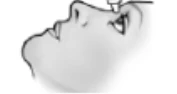
- Bring the dropper tip close to the eye.
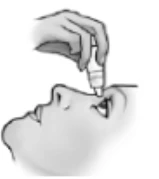
- Gently pull down the lower eyelid and look upward.
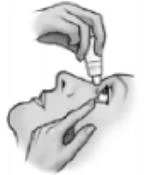
- Gently squeeze the bottle so that one drop falls into the space between the lower eyelid and the eye.
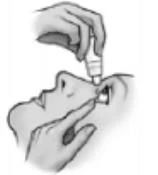
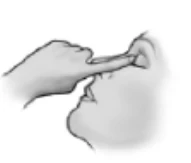
- Close the eye briefly and press with the index finger on the inner corner of the eye for about one minute. This helps prevent the drops from draining through the tear duct.
- Wipe away any remaining solution from the skin around the eye.
If a second drop is required, or if treatment involves the other eye, repeat steps 3 to 6.
After use, close the bottle tightly with the cap.
Levomer must not be injected into the interior of the eyeball.
Use of a higher than recommended dose of Levomer eye drops, solution
If more than the recommended dose of Levomer eye drops is used, rinse the eye(s) with water and inform your doctor or pharmacist.
Missed dose of Levomer eye drops, solution
If you miss a dose of eye drops, apply the next dose as soon as you remember. Do not use a double dose to make up for a missed dose.
Accidental swallowing of Levomer eye drops, solution
The amount of levofloxacin contained in the bottle is too small to cause adverse effects.
However, if in doubt, consult your doctor or pharmacist, who will advise on necessary measures.
Stopping Levomer eye drops, solution earlier than prescribed by your doctor may prolong the healing process.
If you have any further questions about the use of this medicine, consult your doctor, pharmacist, or nurse.
4. Possible adverse reactions
Like all medicines, this medicine can cause adverse reactions, although they do not occur in everyone.
They occur in about one out of ten people using Levomer eye drops. Most of these
adverse reactions affect only the eye and usually do not last long. If the patient experiences any
severe or persistent adverse reaction, use of Levomer eye drops should be discontinued and
medical advice should be sought immediately.
The frequency of adverse reactions is defined as follows:
| very common | occur in more than 1 in 10 patients |
| common | occur in 1 to 10 patients in 100 |
| uncommon | occur in 1 to 10 patients in 1,000 |
| rare | occur in 1 to 10 patients in 10,000 |
| very rare | occur in less than 1 patient in 10,000 |
| unknown | frequency cannot be estimated based on available data |
In very rare cases, the medicine may cause severe allergic reactions.
The following symptoms may occur even after administration of a single dose of Levomer eye drops:
- swelling and a feeling of tightness in the throat,
- difficulty breathing.
In rare cases, other allergic reactions may occur. Symptoms include:
- increased redness and itching of the eyes,
- worsening or sudden onset of eyelid swelling.
If any of these symptoms occur, discontinue use of Levomer eye drops immediately and contact your doctor without delay.
Frequent adverse reactions (occur in 1 to 10 patients out of 100):
- burning sensation in the eye,
- blurred vision or mucous discharge in the eye.
Uncommon adverse reactions (occur in 1 to 10 patients out of 1,000):
- stinging or irritation of the eyes,
- eye pain,
- dryness or discomfort of the eyes,
- swelling or redness (bloodshot eyes) of the conjunctiva (the front layer covering the eye) or eyelids,
- sensitivity to light,
- itching of the eyes,
- sticky eyelids,
- headache,
- rash around the eyes,
- nasal congestion or nasal discharge.
Rare adverse reactions (occur in 1 to 10 patients out of 10,000):
- allergic reactions, including skin rash.
Very rare adverse reactions (occur in less than 1 patient out of 10,000):
- swelling and a feeling of tightness in the throat,
- difficulty breathing.
Additional adverse reactions in children and adolescents
The frequency, type, and severity of adverse reactions expected in children and adolescents are considered to be the same as in adults.
If any adverse reactions occur, including those not listed in this leaflet, inform your doctor or pharmacist.
Reporting of adverse reactions
If any adverse reactions occur, including those not listed in this leaflet, inform your doctor or pharmacist. Adverse reactions can be reported directly to the Department of Monitoring Adverse Drug Reactions, Office for Registration of Medicinal Products, Medical Devices and Biocidal Products
Al. Jerozolimskie 181C, 02-222 Warsaw
Tel: +48 22 49 21 301
Fax: +48 22 49 21 309
Website: https://smz.ezdrowie.gov.pl
Adverse reactions can also be reported to the Marketing Authorization Holder.
Reporting adverse reactions helps to enhance the safety information available for this medicine.
5. How to store Levomer eye drops, solution
Keep the medicine out of the sight and reach of children.
The bottle should be tightly closed.
Do not use this medicine after the expiry date stated on the bottle. The expiry date refers to the last day of the stated month.
Levomer eye drops may be used for up to 28 days after first opening the bottle. After this time, the bottle containing the remaining solution should be returned to a pharmacist for safe disposal.
To prevent infections, the bottle used so far should be discarded and a new one started after 28 days from first opening.
Medicines must not be disposed of via wastewater or household waste. Ask your pharmacist how to dispose of medicines no longer required. This will help protect the environment.
6. Contents of the package and other information
What Levomer Eye Drops, solution contains
- The active substance is levofloxacin (as hemihydrate) 5 mg/ml.
- The other components are: benzalkonium chloride, sodium chloride, sodium hydroxide (for pH adjustment), hydrochloric acid (for pH adjustment), and water for injections.
What Levomer Eye Drops, solution looks like and contents of the pack
A clear, greenish-yellow aqueous solution.
5 ml solution in an LDPE bottle with a tamper-evident seal, equipped with an LDPE dropper and HDPE screw cap.
Marketing Authorisation Holder:
Adamed Pharma S.A.
Pieńków, ul. M. Adamkiewicza 6A
05-152 Czosnów
Manufacturer:
RAFARM S.A.
Thiesi Pousi-Xatzi
Agiou Louka
19002 Paiania, Attiki
Greece
Adamed Pharma S.A.
Pieńków, ul. M. Adamkiewicza 6A
05-152 Czosnów
This medicinal product is authorised in the Member States of the European Economic Area under the following names:
Portugal: Levofloxacina Velka Hellas
Poland: Levomer
Italy: VISULFOX
United Kingdom: Levofloxacin 5 mg/ml Eye Drops, Solution