Lekoklar mite
Poland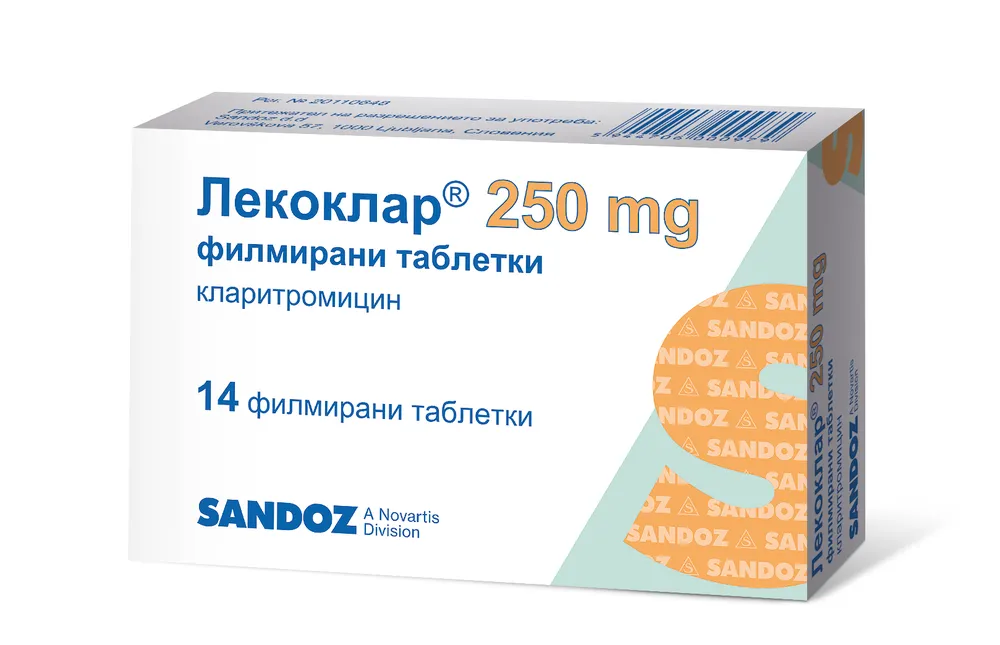
Table of Contents
Package leaflet: Information for the patient
Lekoklar mite, 250 mg, film-coated tablets
Clarithromycinum
Please read all of this leaflet carefully before taking this medicine, because it contains
important information for you.
- Keep this leaflet. You may need to read it again.
- If you have any further questions, please ask your doctor or pharmacist.
- This medicine has been prescribed for a specific individual. Do not pass it on to others. It may harm someone else, even if their symptoms are the same.
- If you experience any adverse effects, including any not listed in this leaflet, inform your doctor or pharmacist. See section 4.
Contents of the leaflet:
- What Lekoklar mite is and what it is used for
- Important information before taking Lekoklar mite
- How to take Lekoklar mite
- Possible side effects
- How to store Lekoklar mite
- Contents of the pack and other information
1. What Lekoklar mite is and what it is used for
Clarithromycin is an antibiotic belonging to the macrolide class. It works by inhibiting the growth of certain bacteria.
Lekoklar mite is used in adults and adolescents (aged at least 12 years) to treat bacterial infections caused by clarithromycin-sensitive organisms, such as:
infections of the throat and sinuses,
infections of the chest, such as bronchitis and pneumonia,
infections of the skin and soft tissues,
stomach ulcers caused by Helicobacter pylori bacteria.
2. Important information before using Lekoklar mite
When not to use Lekoklar mite
if the patient is allergic to clarithromycin, other macrolide antibiotics, or to any of the
other components of this medicine (listed in section 6);
if the patient (or a family member) has previously experienced certain heart rhythm disorders
(ventricular arrhythmia, including torsade de pointes type arrhythmia) or abnormalities
in the electrocardiogram (ECG, recording of the heart's electrical activity) known as "long QT syndrome";
if the patient has severe liver impairment and at the same time has kidney function disorders;
if the patient has abnormally low blood levels of potassium or magnesium (hypokalemia or
hypomagnesemia);
if the patient is taking:
- ticagrelor, ivabradine, or ranolazine (used to treat angina or to reduce the risk of heart attack or stroke)
- ergotamine or dihydroergotamine (medicines used to treat migraine)
- orally administered midazolam (anxiolytic or sedative medicine)
- cisapride and domperidone (medicines used for stomach disorders)
- pimozide (an antipsychotic medicine)
- terfenadine, astemizole (medicines for hay fever, antihistamines)
- lovastatin or simvastatin (medicines used to lower cholesterol levels)
- a medicine containing lomitapide
- colchicine (medicine used to treat gout)
- other medicines known to cause serious heart rhythm disturbances.
Warnings and precautions
Before taking clarithromycin, discuss with your doctor or pharmacist if:
the patient is pregnant, suspects she may be pregnant, or plans to become pregnant
the patient has been diagnosed with liver or kidney function disorders
the patient has diabetes
the patient has experienced severe or persistent diarrhea during or after treatment with Lekoklar mite (pseudomembranous colitis). In such case, immediate consultation with a doctor is required. Colitis (pseudomembranous colitis) has been reported with nearly all antibacterial agents, including clarithromycin.
the patient has heart function disorders.
Lekoklar mite and other medicines
Tell your doctor or pharmacist about all medicines the patient is currently taking or has recently taken, as well as any medicines the patient plans to take, including those available without a prescription.
Lekoklar mite must not be used with ergot alkaloids, astemizole, terfenadine, cisapride, domperidone, pimozide, ticagrelor, ranolazine, colchicine, certain medicines used to treat high cholesterol levels, and medicines known to cause serious heart rhythm disturbances (see " When not to use Lekoklar mite ").
Some other medicines and Lekoklar mite may affect each other’s effectiveness.
These include:
Lekoklar mite may increase the effect of the following medicines:
ibrutinib (used to treat chronic lymphocytic leukemia);
alprazolam, triazolam, intravenously or sublingually administered midazolam (anxiolytic or sedative medicines);
digoxin, quinidine, disopyramide, verapamil, amlodipine, diltiazem (medicines used for heart conditions);
theophylline (an anti-asthma medicine);
warfarin or any other anticoagulant, e.g. dabigatran, rivaroxaban, apixaban, edoxaban (medicines used to thin the blood);
statins (other than contraindicated lovastatin and simvastatin), such as atorvastatin, rosuvastatin (cholesterol-lowering medicines);
cyclosporine, sirolimus, tacrolimus (immunosuppressive medicines);
carbamazepine, phenytoin, valproate (antiepileptic medicines);
cilostazol (medicine used to improve circulation in the legs);
insulin and other antidiabetic medicines (i.e. nateglinide, pioglitazone, rosiglitazone or repaglinide);
methylprednisolone (a corticosteroid used to treat inflammatory conditions);
omeprazole (medicine used for stomach disorders);
sildenafil, tadalafil, vardenafil (medicines used to treat erectile dysfunction);
tolterodine (medicine used to treat overactive bladder);
vinblastine (anticancer medicine);
medicines that may affect the patient's hearing, especially aminoglycoside antibiotics such as gentamicin or neomycin.
Lekoklar mite and the following medicines may mutually enhance their effects:
atazanavir, saquinavir (medicines used to treat HIV infection);
itraconazole (medicine used to treat fungal infections).
If your doctor has specifically prescribed taking Lekoklar mite together with any of the listed medicines, the patient will be monitored more closely.
The following medicines may reduce the effect of Lekoklar mite:
rifampicin, rifabutin, rifapentine (antibiotics);
efavirenz, etravirine, nevirapine (medicines used to treat HIV infection);
phenytoin, carbamazepine, phenobarbital (antiepileptic medicines);
St. John’s wort (a herbal medicine used to treat depression).
It is also important if the patient is taking medicines with the following names:
hydroxychloroquine or chloroquine (used, among others, to treat rheumatoid arthritis, or to treat or prevent malaria). Taking these medicines together with clarithromycin may increase the risk of heart rhythm disturbances and other serious adverse effects affecting the heart.
corticosteroids administered orally, by injection, or by inhalation (used to suppress the immune system, which is useful in treating many different conditions).
Note
Ritonavir (an antiviral medicine) and fluconazole (a medicine used to treat fungal infections) may enhance the effect of Lekoklar mite.
Lekoklar mite may reduce the effect of zidovudine (a medicine used to treat HIV infection).
To avoid this interaction, a 4-hour interval between administration of both medicines should be maintained.
Concurrent use of Lekoklar mite with digoxin, quinidine, disopyramide, or verapamil (medicines used for heart conditions) or other macrolide antibiotics may cause heart rhythm disturbances.
Taking Lekoklar mite together with disopyramide may cause low blood sugar levels (hypoglycemia).
Pregnancy and breastfeeding
If the patient is pregnant or breastfeeding, suspects she may be pregnant, or plans to have a child, she should consult her doctor or pharmacist before using this medicine.
Driving and operating machinery
Lekoklar mite generally does not affect the ability to drive or operate machinery, but it may cause adverse effects such as dizziness, confusion, and disorientation.
If these occur, the patient should not drive, operate machinery, or engage in activities that could put the patient or others at risk.
Visual disturbances and blurred vision may affect the ability to drive or operate machinery.
Lekoklar mite contains sodium
This medicine contains less than 1 mmol (23 mg) of sodium per dose, meaning the medicine is considered "sodium-free".
3. How to use Lekoklar mite
Your doctor will prescribe the appropriate dose of the medicine. This medicine should always be used exactly as instructed by your doctor. If in doubt, consult your doctor or pharmacist.
Dosage
Adults and adolescents (aged 12 years and older)
The recommended dose is 250 mg (1 tablet of Lekoklar mite) twice daily.
Your doctor may increase the dose to 500 mg (2 tablets of Lekoklar mite) twice daily.
For gastric ulcers caused by Helicobacter pylori bacteria:
500 mg (2 tablets of Lekoklar mite) twice daily, in combination with appropriate antibiotics and medicines used to treat excessive production of hydrochloric acid in the stomach.
Children (under 12 years of age)
Use in children under 12 years of age is not recommended.
An alternative pharmaceutical form, such as a suspension, is available for these patients.
Severe renal impairment
Your doctor will reduce the dose of the medicine.
Method of administration
This medicine is for oral use.
Tablets should be taken with a glass of water.
The medicine may be taken independently of meals.
Duration of treatment
Treatment usually lasts from 6 to 14 days. The medicine should be continued for at least 2 additional days after symptoms have resolved.
In streptococcal infections, treatment should last at least 10 days.
For treatment of Helicobacter pylori-induced gastric ulcers, the medicine should be taken for 7 days.
Accidental overdose of Lekoklar mite
If a patient has taken more Lekoklar mite than prescribed, contact a doctor or hospital as quickly as possible. Symptoms of overdose may include gastrointestinal disturbances.
Missed dose of Lekoklar mite
If a patient forgets to take a dose, continue according to the prescribed dosing schedule. Do not take a double dose to make up for a missed tablet.
Stopping Lekoklar mite
It is important to take the medicine as directed by your doctor. Do not stop taking Lekoklar mite suddenly without first discussing it with your doctor, as symptoms may return.
If you have any further questions about the use of this medicine, consult your doctor or pharmacist.
4. Possible adverse reactions
Like all medicines, this medicine can cause adverse reactions, although not everyone will experience them.
Serious adverse reactions
If the patient experiences any of the symptoms of a severe allergic reaction listed below, seek
immediate medical advice or go to the accident and emergency department of the nearest hospital:
sudden difficulty in breathing, speaking or swallowing, swelling of the lips, face and neck
severe dizziness or collapse
severe or itchy rash on the skin, especially if blisters develop and the eyes, mouth or genitals are painful
Severe and persistent diarrhoea during or after treatment, sometimes with blood and mucus and (or) cramping abdominal pain. This may be a sign of severe inflammation of the large intestine. Your doctor may advise stopping treatment. Do not take medicines that inhibit intestinal peristalsis.
Liver function disorders with symptoms such as:
- loss of appetite
- yellowing of the skin and whites of the eyes (jaundice)
- unusually dark urine, pale stools
- itching of the skin
- abdominal pain
feeling of pounding heartbeat or irregular heart rhythm
inflammation of the pancreas causing severe abdominal and back pain
redness and peeling of the skin with formation of subcutaneous nodules and blisters (erythema multiforme)
Other adverse reactions
Common (may affect up to 1 in 10 people):
insomnia
headache
changes in taste sensation or unpleasant taste in the mouth (e.g. metallic or bitter)
abdominal pain, nausea or vomiting, diarrhoea, indigestion
abnormal liver function test results
rash
excessive sweating
blood vessel dilation
Uncommon (may affect up to 1 in 100 people):
yeast infection (candidiasis), e.g. of the mouth
vaginal infection
decreased number of white blood cells (leukopenia, neutropenia)
increased number of certain white blood cells (eosinophilia)
allergic reactions
aversion to food, loss or decrease in appetite
anxiety, dizziness, drowsiness, tremor
sensation of spinning
hearing disorders, ringing in the ears (tinnitus)
changes in heart activity on electrocardiogram (ECG), known as QT interval prolongation
awareness of heartbeat
inflammation of the mucous membrane of the stomach, mouth and tongue
gas, constipation, belching, bloating
dryness in the mouth
biliary flow disorders
inflammation of the liver
increased liver enzyme activity
itching, hives
general malaise
weakness
chest pain
chills
fatigue
fainting
bullous skin inflammation (see "Serious adverse reactions" above)
Frequency not known (frequency cannot be estimated from available data):
inflammation of the large intestine, ranging from mild to severe (see above "Serious adverse reactions")
certain bacterial skin and subcutaneous tissue infections (erysipelas)
marked decrease in certain white blood cells (agranulocytosis)
decreased platelet count: symptoms may include unusual bruising and bleeding
severe allergic reaction (anaphylactic reaction, see above "Serious adverse reactions")
psychosis, feeling of loss of identity
feelings of unreality, confusion
depression, unusual dreams, disorientation, hallucinations, mania
seizures
smell disorders, loss of smell and taste
tingling or numbness of the skin
deafness
heart rhythm disorders, including life-threatening cases (ventricular arrhythmias, torsade de pointes arrhythmia, see above "Serious adverse reactions")
prolonged bleeding time
acute pancreatitis (see above "Serious adverse reactions")
discoloration of teeth and tongue
severe liver failure, including life-threatening cases (see above "Serious adverse reactions")
yellowing of the skin or whites of the eyes (jaundice)
severe skin diseases with discomfort, redness, peeling and swelling (Stevens-Johnson syndrome, toxic epidermal necrolysis [Lyell's syndrome], drug reaction with eosinophilia and systemic symptoms [DRESS], see above "Serious adverse reactions")
acne
muscle pain or weakness
kidney inflammation, kidney failure
abnormal urine colour
vision problems (blurred vision)
visual disturbances
Reporting of adverse reactions
If any adverse reactions occur, including any adverse reactions not listed in this leaflet, inform your doctor, pharmacist or nurse. Adverse reactions can be reported directly to the Department of Monitoring of Adverse Reactions of Medicinal Products at the Office for Registration of Medicinal Products, Medical Devices and Biocidal Products:
Al. Jerozolimskie 181C, 02-222 Warsaw
Tel.: +48 22 4921 301
Fax: +48 22 4921 309
Website: https://smz.ezdrowie.gov.pl
Adverse reactions can also be reported to the marketing authorization holder.
Reporting adverse reactions helps provide more information on the safety of this medicine.
5. How to store Lekoklar mite
Keep the medicine out of the sight and reach of children.
Do not use this medicine after the expiry date stated on the blister and carton following EXP.
The expiry date refers to the last day of the stated month.
The batch number on the packaging is marked as "Lot".
No special storage temperature requirements.
Store in the original packaging to protect from light.
Medicines should not be disposed of via wastewater or household waste. Ask your pharmacist how to dispose of medicines no longer required. Such measures will help protect the environment.
6. Contents of the package and other information
What Lekoklar mite contains
The active substance is clarithromycin.
Each coated tablet contains 250 mg of clarithromycin.
The other ingredients are: sodium croscarmellose, microcrystalline cellulose, povidone, magnesium stearate, colloidal anhydrous silica, talc.
Coating: hypromellose, propylene glycol, titanium dioxide (E171), hydroxypropylcellulose, sorbitan monooleate, quinoline yellow (E104), vanillin.
What Lekoklar mite looks like and contents of the pack
Dark yellow, coated, capsule-shaped tablets measuring 15.6 mm x 7.9 mm.
PVC/PVDC/Aluminium blisters in cardboard boxes containing 14 coated tablets.
Marketing Authorisation Holder and Manufacturer
Marketing Authorisation Holder
Sandoz GmbH
Biochemiestrasse 10
6250 Kundl, Austria
Manufacturers
Lek Pharmaceuticals d.d.
Verovškova 57
1526 Ljubljana, Slovenia
Lek Pharmaceuticals d.d.
Trimlini 2D
9220 Lendava, Slovenia
LEK S.A.
ul. Domaniewska 50 C
02-672 Warszawa, Poland
Salutas Pharma GmbH
Otto-von-Guericke-Allee 1
39179 Barleben, Germany
Novartis Pharmaceuticals S.R.L.
Str. Livezeni nr. 7A
540472 Targu-Mures, Romania
For further information about this medicinal product, please contact the local representative of the Marketing Authorisation Holder:
Sandoz Polska Sp. z o.o.
ul. Domaniewska 50 C
02-672 Warszawa, Poland
tel. 22 209 70 00
This medicinal product is authorised in the European Economic Area under the following names:
Netherlands: Claritromycine Sandoz 250 mg, filmomhulde tabletten
Belgium: Clarithromycine Sandoz 250 mg filmomhulde tabletten
Bulgaria: Lekoklar 250 mg film-coated tablets
Poland: LEKOKLAR MITE
Spain: Claritromicina Sandoz 250 mg comprimidos recubiertos con película EFG
Romania: LEKOKLAR 250 mg comprimate filmate
Slovakia: LEKOKLAR 250 mg filmom obalené tablety
(logo of the Marketing Authorisation Holder)