Lactulose mip
Poland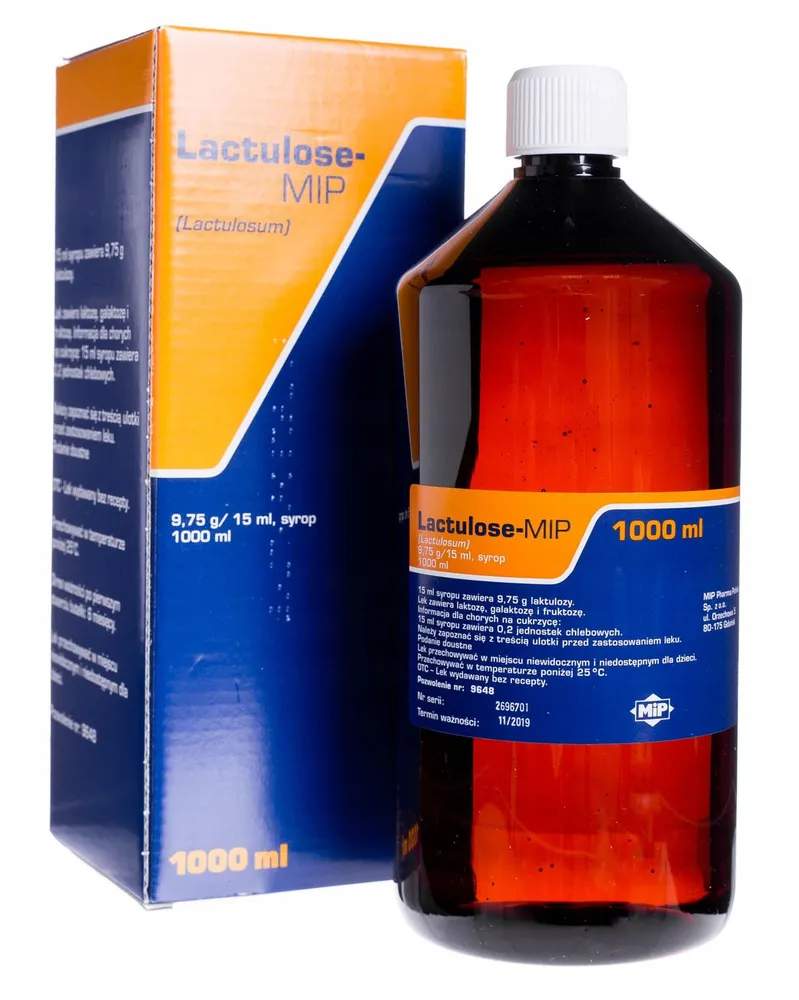
Table of Contents
Package leaflet: Information for the patient
Warning! Keep this leaflet! Information on the immediate packaging in a foreign language.
Lactulose-MIP, 9.75 g/15 ml (650 mg/ml), syrup
Lactulosum
Please read the entire leaflet carefully before using the medicine, as it contains
important information for the patient.
This medicine should always be used exactly as described in this patient leaflet or as directed by
a doctor or pharmacist.
- Keep this leaflet so that you can read it again if necessary.
- If you need advice or further information, consult your pharmacist.
- If you experience any adverse reactions, including any adverse reactions not listed in this leaflet, inform your doctor or pharmacist. See section 4.
- If there is no improvement after several days, or if you feel worse, contact your doctor.
Leaflet contents:
- What Lactulose-MIP is and what it is used for
- Important information before taking Lactulose-MIP
- How to take Lactulose-MIP
- Possible side effects
- How to store Lactulose-MIP
- Contents of the pack and other information
1. What Lactulose-MIP is and what it is used for
Lactulose is a disaccharide composed of D-galactose and fructose. It is a mild laxative with osmotic action. The laxative effect of lactulose is attributed to two processes:
- the sugar and acids cause changes in osmotic pressure (increasing the volume of intestinal contents), which indirectly stimulates intestinal peristalsis;
- the acids directly stimulate intestinal peristalsis.
It is believed that the following processes are responsible for lactulose's effect in reducing blood ammonia concentration:
- lactulose breakdown leads to a decrease in pH, resulting in ammonia ionization. This produces non-absorbable and non-toxic ammonium ions, thereby reducing ammonia absorption from the colon;
- increased carbohydrate concentration and the resulting acidic intestinal environment cause proteolytic intestinal bacteria to be replaced by saccharolytic bacteria, leading to reduced ammonia production;
- the lowered intestinal pH causes ammonia from the blood to pass directly into the acidic intestinal contents;
- administration of lactulose increases carbohydrate concentration in the colon. This creates a relative nitrogen deficiency for the entire bacterial flora, which is then compensated by utilizing ammonia derived from microbial breakdown.
In hepatic encephalopathy, lactulose reduces blood ammonia concentration by approximately 25–50%. Therapeutic effects may occur within several hours to several days.
Indications for use:
- constipation;
- prevention and treatment of hepatic encephalopathy.
2. Important information before using Lactulose-MIP
When not to use Lactulose-MIP
- if the patient is allergic to lactulose or any of the other ingredients of this medicine (listed in section 6);
- if the patient has intestinal obstruction;
- if the patient has gastrointestinal inflammation;
- if the patient has galactosemia;
- if the patient has fluid and electrolyte imbalance.
Warnings and precautions
Before starting treatment with Lactulose-MIP, consult a doctor or pharmacist.
Exercise caution in infants and young children with autosomal recessive hereditary fructose intolerance. In this condition, incomplete fructose metabolism leads to fructosuria (excretion of fructose in urine) and fructosemia, as well as hypoglycemia (reduced blood sugar levels below normal), and hypoglycemia-related disturbances in liver, kidney, and brain function.
15 ml of syrup contains up to 2.4 g of carbohydrates (including fructose, galactose, and lactose), equivalent to 0.2 carbohydrate exchange units; therefore, the medicine should be used with caution in patients with diabetes.
If the patient has previously been diagnosed with intolerance to certain sugars, the patient should consult a doctor before taking the medicine.
The medicine should not be used in patients with rare hereditary galactose intolerance, lactase deficiency, or glucose-galactose malabsorption syndrome.
If the patient has previously been diagnosed with hereditary fructose intolerance—a rare genetic disorder in which the patient's body does not metabolize fructose—the patient should consult a doctor before taking the medicine.
Other medicines and Lactulose-MIP
Tell your doctor or pharmacist about all medicines currently used, recently used, or planned to be used.
Lactulose lowers pH in the large intestine and may reduce the efficacy of drugs whose release depends on colonic pH. Lactulose may increase potassium loss caused by other medicines (diuretics, corticosteroids, and amphotericin B). Lactulose may cause decreased serum potassium levels, which may enhance the effects of cardiac glycosides.
Pregnancy and breastfeeding
According to current knowledge, this medicine may be used during pregnancy and lactation in accordance with recommendations.
Before using any medicine, consult a doctor.
Driving and operating machinery
Lactulose-MIP has no effect on the ability to drive motor vehicles or operate machinery.
3. How to use Lactulose-MIP
This medicine should always be taken exactly as described in the patient information leaflet, or as
advised by the doctor or pharmacist. If in doubt, consult the doctor or pharmacist.
The dosage should be individually adjusted according to the patient's needs, severity and course of the disease.
Lactulose should be taken orally. The provided measuring cup should be used to measure the syrup dose.
Unless otherwise directed by a doctor, the following dosing regimen should be followed:
Constipation
| Initial dose | Maintenance dose | |||
| Adults and adolescents (14-17 years) | 15-45 ml in 1 or 2 divided doses | corresponds to 9.75-29.25 g of lactulose | 15-30 ml | corresponds to 9.75-19.5 g of lactulose |
| Children (7-14 years) | 15 ml | corresponds to 9.75 g of lactulose | 10-15 ml | corresponds to 6.5-9.75 g of lactulose |
| Children (1-6 years) | 5-10 ml | corresponds to 3.25-6.5 g of lactulose | 5-10 ml | corresponds to 3.25-6.5 g of lactulose |
| Infants (below 1 year) | up to 5 ml | corresponds to up to 3.25 g of lactulose | up to 5 ml | corresponds to up to 3.25 g of lactulose |
The dosage should be adjusted so that the patient passes soft stools. The medicine can be administered as a single daily dose or divided into two doses. In the case of a single daily dose, it should be taken at the same time each day, e.g., during breakfast.
After several days, the initial dose may be adjusted to a maintenance dose based on the therapeutic response achieved. The therapeutic effect may occur after several days (2–3 days of treatment).
If there is no adequate therapeutic response after this period, the patient should contact their physician.
If a patient has been treated with laxatives for a prolonged period, they should be discontinued gradually.
Use in children
Laxative medicines may be used in children, infants, and newborns only in exceptional cases and under medical supervision, as they may affect the normal rhythm of bowel movements.
Lactulose-MIP should not be administered to children under 14 years of age without consulting a physician.
Elderly patients and patients with renal or hepatic impairment:
No special dosage recommendations are required.
Hepatic encephalopathy (adults only)
Initial dose: 30–45 ml (19.5–29.25 g of lactulose) 3–4 times daily.
This dose may be adjusted to a maintenance dose to achieve 2–3 soft bowel movements per day.
Use in children:
There are no available data on the use of Lactulose-MIP in children (up to 18 years of age) with hepatic encephalopathy.
Instructions for administration
Lactulose-MIP may be taken mixed with water or other liquids. The medicine may be taken independently of meals.
A single dose of lactulose should be swallowed without prolonged retention in the oral cavity.
During treatment with laxatives, it is recommended to drink plenty of fluids (approximately 1.5–2 L/day, i.e., 6–8 glasses).
The laxative effect may occur 2 to 10 hours after administration. If the dose is insufficient, the first bowel movement may occur after 24 to 48 hours. The duration of treatment depends on the course of the disease.
If the patient feels that the effect of Lactulose-MIP is too strong or too weak, they should consult their physician.
Use of a higher than recommended dose of Lactulose-MIP
Overdose may result in diarrhea, electrolyte loss, and abdominal cramps.
If necessary, the physician will administer symptomatic treatment.
4. Possible adverse reactions
Like all medicines, this medicine can cause adverse reactions, although not everybody will experience them.
Very common (may affect more than 1 in 10 people):
Abdominal pain, bloating. In case of excessive doses: nausea, vomiting, diarrhoea.
Very rare (affects less than 1 in 10,000 people):
Hypernatraemia (increased sodium concentration in blood, during treatment of hepatic encephalopathy), electrolyte imbalance (as a result of diarrhoea).
Frequency not known (frequency cannot be estimated from the available data):
Allergic reactions, rash, itching, urticaria.
Reporting of adverse reactions
If any adverse reactions occur, including any adverse reactions not listed in the leaflet, inform your doctor or pharmacist. Adverse reactions can be reported directly to the Department of Monitoring Adverse Drug Reactions of the Office for Registration of Medicinal Products, Medical Devices and Biocidal Products, Al. Jerozolimskie 181C, 02-222 Warsaw, tel.: + 48 22 49 21 301, fax: + 48 22 49 21 309, website: https://smz.ezdrowie.gov.pl.
Reporting adverse reactions enables better assessment of the medicine's safety profile.
5. How to store Lactulose-MIP
Store below 25°C.
Shelf life after first opening the bottle: 12 months.
Keep the medicine out of the sight and reach of children.
Do not use this medicine after the expiry date stated on the packaging.
The expiry date refers to the last day of the stated month.
Medicines must not be disposed of via wastewater or household waste. Ask your pharmacist how to dispose of medicines no longer required. This will help protect the environment.
6. Contents of the packaging and other information
What Lactulose-MIP contains
- The active substance is lactulose. 15 ml of syrup contains 9.75 g of lactulose.
- The medicine does not contain any other ingredients.
What Lactulose-MIP looks like and contents of the pack
The medicine is in the form of a syrup.
The syrup is packed in PET bottles with a screw cap made of PE or PE/PP, placed in a cardboard box.
The pack contains 200 ml of syrup. A PP dosing dispenser with a capacity of 5–30 ml is included.
For more detailed information, please contact the responsible party or parallel importer.
Responsible party in Austria, country of export:
MIP Pharma Austria GmbH
Maria-Theresien-Str. 7/II
6020 Innsbruck
Austria
Manufacturer:
Chephasaar GmbH
Mühlstr. 50
D-66386 St. Ingbert
Germany
Parallel importer:
InPharm Sp. z o.o.
ul. Strumykowa 28/11
03-138 Warsaw
Repackaged in:
InPharm Sp. z o.o. Services sp. k.
ul. Chełmżyńska 249
04-458 Warsaw
Marketing authorization number in Austria, country of export: 1-25932
Parallel import authorization number: 473/21