Klimicin
Poland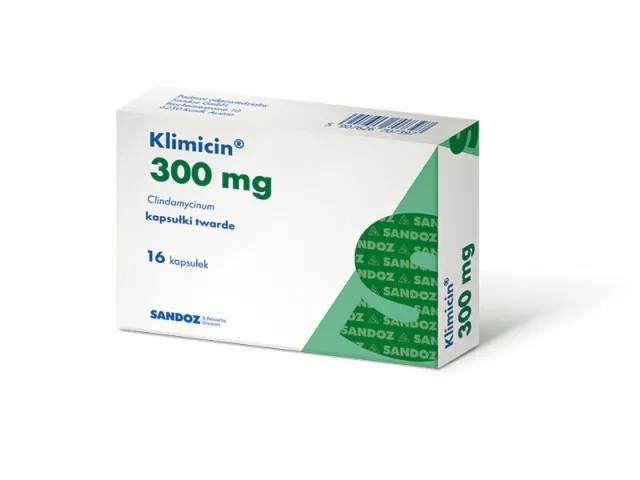
Table of Contents
Package leaflet: Information for the user
Klimicin, 300 mg, hard capsules
Clindamycinum
Please read all of this leaflet carefully before using this medicine, as it contains important information for you.
- Keep this leaflet, as you may need to read it again.
- If you have any further questions, please consult your doctor or pharmacist.
- This medicine has been prescribed for a specific individual. Do not pass it on to others. It may harm other people, even if their symptoms are the same.
- If you experience any adverse reactions, including any not listed in this leaflet, inform your doctor or pharmacist immediately. See section 4.
Leaflet contents:
- What Klimicin is and what it is used for
- Important information before taking Klimicin
- How to take Klimicin
- Possible side effects
- How to store Klimicin
- Contents of the pack and other information
1. What Klimicin is and what it is used for
Klimicin contains the active substance clindamycin – an antibiotic belonging to the lincosamide group, used in the treatment of infections. It works by inhibiting bacterial growth and destroying bacteria that may cause infections.
Klimicin in the form of hard capsules is indicated for the treatment of the following severe infections caused by bacteria sensitive to clindamycin:
respiratory tract infections caused by Streptococcus pneumoniae and other streptococci, Staphylococcus aureus, and anaerobic bacteria;
skin and soft tissue infections caused by Streptococcus pyogenes, Staphylococcus aureus, and anaerobic bacteria;
bone and joint infections caused by Staphylococcus aureus;
septicaemia caused by Staphylococcus aureus;
intra-abdominal infections caused by anaerobic bacteria;
female genital tract infections caused by anaerobic bacteria.
If the disease is severe, your doctor will administer the medicine intravenously.
In patients with septicaemia, the doctor will initiate treatment with intravenous clindamycin.
2. Information before using Klimicin
When not to use Klimicin:
if the patient is allergic to clindamycin, lincomycin, or to any of the other
ingredients of this medicine (listed in section 6);
If the patient has ever experienced symptoms such as rash, swelling of the face, neck or body, or difficulty breathing after receiving clindamycin, this may indicate an allergic reaction.
Warnings and precautions
Before starting treatment with Klimicin or during therapy, consult a doctor or pharmacist if:
the patient has previously experienced allergic reactions, especially severe ones. In case of an allergic reaction or severe skin reaction, inform the doctor immediately, as such reactions have been reported during treatment with clindamycin;
the patient is allergic to penicillin;
Klimicin has been used for a prolonged period and the patient develops diarrhoea or changes in the mucous membranes of the mouth and/or vagina, which may indicate overgrowth of microorganisms resistant to this medicine;
the patient has a gastrointestinal disorder (coeliac disease, diverticulosis, Crohn's disease, colitis) or AIDS;
the patient develops diarrhoea during or after treatment (this should be reported to the doctor); almost all antibiotics may cause pseudomembranous colitis and Clostridium difficile-associated diarrhoea, ranging from mild diarrhoea to life-threatening colitis; in such cases, drugs inhibiting intestinal peristalsis should not be used;
the patient has meningitis, because clindamycin penetrates poorly into cerebrospinal fluid;
the patient has severe renal impairment or liver disease – the doctor will adjust the dose accordingly and recommend blood tests to monitor kidney and liver function;
the patient has a disease associated with neuromuscular conduction disorders (e.g. myasthenia gravis, Parkinson's disease).
Severe kidney function disturbances may occur. Inform the doctor about all concomitantly used medicines and any kidney problems. If the patient produces less urine or experiences fluid retention causing swelling of the legs, ankles or feet, shortness of breath or nausea, contact the doctor immediately.
Consult a doctor if any of the above warnings apply currently or have applied in the past.
Klimicin and other medicines
Tell the doctor about all medicines currently or recently taken, as well as any medicines the patient plans to use.
Before planned surgery, electroconvulsive therapy, or in conditions where seizures may occur, it is essential to inform the doctor about taking Klimicin.
Additionally, if the patient is taking any of the following medicines, they should inform the doctor:
macrolide antibiotics (e.g. erythromycin) or chloramphenicol;
drugs that inhibit intestinal motility (peristalsis);
gentamicin (an antibacterial medicine);
primaquine (a medicine used in the treatment of malaria);
trovafloxacin (an antibacterial medicine);
levofloxacin (an antibacterial medicine);
warfarin and similar medicines used to thin the blood. Concurrent use with clindamycin may increase the tendency to bleed. The doctor may consider regular blood tests to monitor blood clotting necessary.
Klimicin with food and drink
This medicine can be taken independently of meals. Food may delay the absorption of clindamycin.
Pregnancy and breastfeeding
If the patient is pregnant or breastfeeding, suspects she may be pregnant, or is planning to have a child, she should consult a doctor or pharmacist before using this medicine.
Pregnancy
Klimicin may be used during pregnancy only if the doctor considers it necessary.
Breastfeeding
Clindamycin passes into human milk; therefore, breastfeeding should be avoided during treatment with Klimicin.
Driving and operating machinery
Klimicin has no effect or has negligible effect on the ability to drive vehicles and operate machinery.
Klimicin contains monohydrate lactose
If the patient has previously been diagnosed with intolerance to certain sugars, the patient should contact the doctor before taking this medicine.
3. How to use Klimicin
This medicine should always be used exactly as directed by the physician. In case of doubt, consult your doctor or pharmacist.
Dosage in adults
The recommended daily dose for moderate infections is 150 mg every 6 hours.
For severe infections, the recommended daily dose is 300 mg to 450 mg every 6 hours.
The maximum daily dose is 2700 mg.
Dosage in elderly patients
Dosage adjustment in elderly patients is not necessary.
Dosage in children weighing more than 10 kg
The recommended daily dose is 8 to 25 mg/kg body weight (b.w.) divided into 3 or 4 doses.
The maximum daily dose is 40 mg/kg b.w.
For infections caused by beta-haemolytic streptococci, the medicine should be administered for at least 10 days to minimize the risk of late complications such as rheumatic fever and glomerulonephritis.
Dosage in patients with renal impairment
For patients with severe renal impairment, the physician will adjust the dose based on serum drug concentration measurements.
Dosage adjustment is not necessary for patients undergoing hemodialysis, peritoneal dialysis, or hemofiltration.
Dosage in patients with hepatic impairment
The physician will adjust the dose based on serum drug concentration measurements.
Method of administration
Capsules should be taken with a glass of water.
Overdose of Klimicin
If more than the recommended dose has been taken, contact a physician immediately.
In case of overdose, the physician will administer symptomatic treatment. If the time elapsed since ingestion is not too long, gastric lavage may be performed. The patient should drink plenty of fluids. The drug cannot be removed from the body by hemodialysis or peritoneal dialysis.
Missed dose of Klimicin
Klimicin should be used exactly as prescribed by the physician. If a patient misses a dose, it should be taken as soon as possible. After that, continue taking the medicine according to the prescribed dosing schedule. Do not take a double dose to make up for a missed dose.
Discontinuation of Klimicin
It is very important to take the medicine for as long as directed by the physician. Do not stop treatment prematurely, even if the patient feels better. Stopping treatment too early may lead to recurrence of infection and even complications such as glomerulonephritis or rheumatic fever.
If there is no improvement in health status after 14 days of treatment, consult the physician again.
If you have any further questions about the use of this medicine, consult your doctor or pharmacist.
4. Possible adverse reactions
Like all medicines, this medicine can cause adverse reactions, although not everyone will experience them.
The most commonly occurring adverse reactions following administration of clindamycin are hypersensitivity reactions and gastrointestinal effects.
If any of the reactions described below occur, treatment with clindamycin must be stopped immediately
and medical help should be sought:
- swelling of the face, lips, mouth, throat or swelling at other sites, causing difficulty in swallowing or breathing;
- chills;
- dizziness, loss of consciousness;
- formation of blisters and peeling of the skin and mucous membranes;
- severe, persistent diarrhoea;
- muscle paralysis;
- erythema multiforme – a rash consisting of well-demarcated skin lesions (dark spots surrounded by lighter areas with a dark ring-shaped border), which may be accompanied by blister formation;
- drug reaction with eosinophilia and systemic symptoms (DRESS syndrome), characterised by fever, lymph node swelling or skin rash, which may be severe and life-threatening;
- acute generalised pustular eruption (AGEP) – a skin reaction characterised by sudden appearance of numerous pustules filled with white/yellow fluid, located on reddened skin.
These are very serious adverse reactions. Their occurrence may indicate a severe allergic reaction to Klimicin or another serious adverse reaction related to taking the medicine. Immediate medical assistance in a hospital may be necessary.
The doctor should be informed immediately if the patient develops:
- fluid retention causing swelling of the legs, ankles or feet, breathlessness or nausea.
Below is a list of adverse reactions that may occur after administration of Klimicin, classified according to their frequency of occurrence:
Very common (may affect more than 1 in 10 people): hypersensitivity reactions with rash, diarrhoea, oesophagitis, vomiting, abdominal pain, nausea.
Common (may affect up to 1 in 10 people): pseudomembranous colitis, changes in the number of certain blood cells, i.e. complete or near-complete absence of granulocytes (agranulocytosis), reduced number of white blood cells (leukopenia), reduced number of neutrophils (neutropenia), reduced number of platelets (thrombocytopenia), increased number of eosinophils (eosinophilia), maculopapular rash, urticaria, abnormal liver function test results.
Uncommon (may affect up to 1 in 100 people): taste disturbances, neuromuscular blockade.
Rare (may affect up to 1 in 1000 people): fever, erythema multiforme, severe skin reactions (e.g. Stevens-Johnson syndrome, toxic epidermal necrolysis, exfoliative dermatitis, bullous dermatitis, pruritus, angioedema (Quincke's oedema), joint oedema).
Very rare (may affect up to 1 in 10,000 people): severe, acute hypersensitivity reactions, anaphylactic reaction, transient hepatitis, polyarthritis.
Frequency not known (cannot be estimated from available data): vaginal infection, Clostridium difficile-induced colitis, anaphylactic shock, pseudoanaphylactic reactions, hypersensitivity, dizziness, somnolence, headache, drug rash with eosinophilia and systemic symptoms (most commonly affecting internal organs such as liver, kidneys, lungs, heart), loss of appetite, bloating, flatulence, oesophageal ulceration, stomatitis, jaundice, generalised pustular rash suddenly appearing over the entire body, varicella-like rash, angioedema (of the tongue, face, throat).
Prolonged treatment may lead to superinfections caused by resistant microorganisms, most commonly fungi.
Reporting of adverse reactions
If any adverse reactions occur, including any adverse reactions not listed in this leaflet, the patient should inform their doctor, pharmacist or nurse. Adverse reactions can be reported directly to the Department of Monitoring Adverse Drug Reactions at the Office for Registration of Medicinal Products, Medical Devices and Biocidal Products: Al. Jerozolimskie 181C, 02-222 Warsaw
Tel.: +48 22 49 21 301
Fax: +48 22 49 21 309
Website: https://smz.ezdrowie.gov.pl
Adverse reactions can also be reported to the marketing authorisation holder.
Reporting adverse reactions helps to provide more information on the safety of the medicine.
5. How to store Klimicin
Keep the medicine out of the sight and reach of children.
Store below 25°C.
Do not use the medicine after the expiry date stated on the packaging after EXP.
The expiry date refers to the last day of the stated month.
Store in the original packaging.
Medicines must not be disposed of via wastewater or household waste. Ask your pharmacist how to dispose of medicines no longer required. This will help protect the environment.
6. Contents of the pack and other information
What Klimicin contains
The active substance is clindamycin. One capsule contains 300 mg of clindamycin in the form of
clindamycin hydrochloride.
The other ingredients are: monohydrate lactose, magnesium stearate, talc, pregelatinized starch (corn).
Capsule shell composition: gelatin, titanium dioxide (E 171), yellow iron oxide (E 172), red iron oxide (E 172), black iron oxide (E 172).
What Klimicin looks like and contents of the pack
Klimicin capsules are brown and contain a crystalline, almost white powder.
PVC/PVDC/Aluminium blisters in cardboard packaging contain 16 or 100 capsules.
Marketing Authorisation Holder
Sandoz GmbH
Biochemiestrasse 10
6250 Kundl, Austria
Manufacturer
Salutas Pharma GmbH
Otto-von-Guericke-Allee 1
39179 Barleben, Germany
S.C. Sandoz S.R.L.
Str. Livezeni nr. 7
Târgu Mureș, Romania
For further information about this medicinal product, please contact:
Sandoz Polska Sp. z o.o.
ul. Domaniewska 50 C
02-672 Warsaw, Poland
Tel. +48 22 209 70 00
(logo of the marketing authorisation holder)