Klabion uno
Poland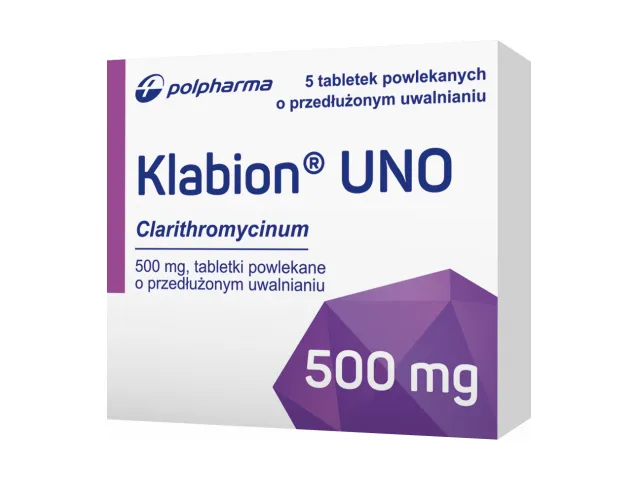
Table of Contents
Package leaflet: information for the patient
Klabion UNO, 500 mg, prolonged-release coated tablets
Clarithromycinum
Please read carefully the entire leaflet before using this medicine, as it contains
important information for the patient.
- Keep this leaflet, as you may need to read it again.
- If you have any questions, please consult your doctor or pharmacist.
- This medicine has been prescribed for a specific individual. Do not pass it on to others. The medicine may harm another person, even if their symptoms are the same.
- If you experience any adverse reactions, including any not listed in this leaflet, inform your doctor or pharmacist. See section 4.
Table of contents of the leaflet
- What is Klabion UNO and what is it used for
- Important information before taking Klabion UNO
- How to take Klabion UNO
- Possible side effects
- How to store Klabion UNO
- Contents of the pack and other information
1. What is Klabion UNO and what is it used for
Klabion UNO is an antibiotic belonging to a group of medicines called macrolides. Antibiotics
inhibit the growth of certain microorganisms causing infections. Its uses are described below.
Klabion UNO tablets are prolonged-release tablets, meaning that the active substance is released slowly from the tablet, allowing the medicine to be taken once daily.
What is Klabion UNO used for?
Klabion UNO is used to treat infections such as:
- chest infections, such as bronchitis or pneumonia,
- throat and sinus infections,
- skin and soft tissue infections, which may also be referred to as cellulitis, folliculitis, or erysipelas.
Klabion UNO is indicated for use in adults and adolescents aged 12 years and older.
2. Important information before taking Klabion UNO
When not to take Klabion UNO
- If the patient is allergic to clarithromycin or other antibiotics from the same group (macrolide antibiotics), such as erythromycin or azithromycin, or to any of the other ingredients of this medicine (listed in section 6).
- If the patient is taking ergot alkaloids (e.g. ergotamine or dihydroergotamine in tablets or ergotamine as an inhalation for the treatment of migraine), or oral midazolam (a medicine used for anxiety and insomnia).
- If the patient is taking other medicines that may cause severe heart rhythm disorders.
- If the patient is taking medicines such as astemizole or terfenadine (medicines used to treat hay fever or allergies), cisapride or domperidone (medicines used for gastrointestinal disorders), or pimozide (a medicine used for certain psychiatric disorders) – taking these medicines together with Klabion UNO may sometimes cause severe heart rhythm disturbances.
- If the patient is taking ticagrelor, ivabradine, or ranolazine (medicines used for angina or to reduce the risk of heart attack or stroke).
- If the patient has abnormally low levels of potassium or magnesium in the blood (hypokalemia or hypomagnesemia).
- If the patient is taking cholesterol-lowering medicines (such as lovastatin or simvastatin).
- If the patient is taking a medicine containing lomitapide.
- If the patient has severe impairment of liver and/or kidney function.
- If the patient has current or past history of heart rhythm disorders (ventricular arrhythmias, including torsade de pointes), or an abnormality on electrocardiogram (ECG) known as "prolonged QT interval".
- If the patient is taking colchicine (a medicine used to treat gout).
If any of these conditions apply to the patient, clarithromycin should be used only after consultation with a doctor.
Warnings and precautions
Before starting treatment with Klabion UNO, discuss with your doctor or pharmacist:
- if the patient is pregnant or breastfeeding (see "Pregnancy and breastfeeding");
- if the patient develops severe or persistent diarrhoea during or after treatment with Klabion UNO – in such case, contact a doctor immediately;
- if the patient has heart problems (coronary heart disease, severe heart failure, heart rhythm disorders, or extremely slow heart rate);
- if the patient has impaired kidney or liver function, as dose adjustment may be necessary.
Klabion UNO and other medicines
Tell your doctor or pharmacist about all medicines currently or recently taken, as well as any medicines planned for use, because dose adjustment or regular monitoring may be required.
Klabion UNO must not be used together with the following medicines: ergot alkaloids, astemizole, terfenadine, cisapride, domperidone, pimozide, ticagrelor, ranolazine, colchicine, certain cholesterol-lowering medicines, and medicines that may cause severe heart rhythm disturbances (see "When not to take Klabion UNO").
In particular, inform your doctor if the patient is taking any of the following medicines:
- Digoxin, quinidine, or disopyramide (heart medications).
- Warfarin or any other anticoagulant, e.g. dabigatran, rivaroxaban, apixaban, edoxaban (blood-thinning medicines).
- Eletriptan (a medicine used to treat migraine).
- Carbamazepine, valproic acid, phenobarbital, or phenytoin (medicines used for epilepsy or bipolar disorder).
- St. John’s wort (herbal products used for depression).
- Theophylline (a medicine used for asthma or chronic obstructive pulmonary disease).
- Triazolam, alprazolam, or intravenous or buccal midazolam (sedatives and sleeping pills).
- Omeprazole (a medicine used for stomach disorders).
- Quetiapine or ziprasidone (medicines used for schizophrenia or other psychiatric disorders).
- Zidovudine, ritonavir, atazanavir, saquinavir, nevirapine, efavirenz, or etravirine (medicines used to treat HIV infection).
- Rifabutin, rifapentine, or rifampicin (antibiotics used to treat certain infections, e.g. tuberculosis).
- Itraconazole or fluconazole (medicines used to treat fungal infections).
- Sildenafil, tadalafil, or vardenafil (medicines used to treat erectile dysfunction).
- Tolterodine (a medicine used to treat bladder disorders).
- Methylprednisolone (a steroid used to treat inflammatory conditions).
- Ibrutinib or vinblastine (medicines used to treat cancers).
- Aprepitant (a medicine used to prevent vomiting during chemotherapy).
- Cilostazol (a medicine improving blood circulation in the legs).
- Any beta-lactam antibiotic (penicillins and cephalosporin antibiotics).
- Tacrolimus, sirolimus, or cyclosporine (medicines used after organ transplantation).
- Nateglinide, repaglinide, sulfonylureas, or insulin (medicines used to treat diabetes).
- Aminoglycosides (a group of antibiotics used to treat bacterial infections).
- Calcium channel blockers (medicines used to treat high blood pressure).
It is also important when using the following medicines:
- Hydroxychloroquine or chloroquine (used to treat, among others, rheumatoid arthritis, and for treatment or prevention of malaria). Taking these medicines together with clarithromycin may increase the risk of heart rhythm disturbances and other serious adverse effects on the heart;
- Corticosteroids administered orally, by injection, or by inhalation (used to suppress the immune system, which is useful in treating many different conditions).
Pregnancy and breastfeeding
If the patient is pregnant or breastfeeding, suspects she may be pregnant, or is planning to have a child, she should consult a doctor or pharmacist before using this medicine. The safety of using Klabion UNO during pregnancy or breastfeeding has not been established.
Driving and operating machinery
Klabion UNO may cause dizziness, which may affect the ability to drive or operate machinery.
Klabion UNO contains lactose
This medicine contains lactose, which is a type of sugar. If the patient has been previously diagnosed with intolerance to certain sugars, the patient should consult a doctor before taking this medicine.
3. How to take Klabion UNO
This medicine should always be taken according to the doctor's instructions. If in doubt, consult
your doctor or pharmacist.
The usual dose of Klabion UNO for adults and adolescents over 12 years of age is 500 mg once daily for 6 to 14 days.
In severe infections, the doctor may increase the dose to two 500 mg tablets. Both tablets should be
taken at the same time.
Route and method of administration
Klabion UNO should be taken with food; tablets must be swallowed whole and must not be chewed.
Each dose should be taken at the same time every day throughout the treatment period.
Do not stop taking Klabion UNO even if you feel better. It is important to continue taking the tablets for as long as directed by your doctor; otherwise, the infection may not be completely cured and the problem may return.
Children
These tablets are not suitable for children under 12 years of age, as they may have difficulty swallowing tablets. Liquid formulations are usually more appropriate for children. The doctor will prescribe another suitable medicine for the child.
If you miss a dose of Klabion UNO
If a dose of Klabion UNO is missed, take it as soon as you remember. Do not take a double dose to make up for the missed dose.
If you take more Klabion UNO than recommended
If you accidentally take more than two Klabion UNO tablets in one day, or if a child accidentally swallows several tablets, contact your doctor immediately, even if there are no symptoms. Overdose of Klabion UNO may cause vomiting and abdominal pain, and allergic reactions may also occur.
4. Possible adverse reactions
Like all medicines, this medicine can cause adverse reactions, although not everyone will experience them.
You should stop taking the tablets and contact your doctor immediately if any of the following symptoms occur:
- Severe or prolonged diarrhoea with blood or mucus in the stool, abdominal pain and fever. Diarrhoea may occur up to two months after treatment with clarithromycin.
- Rash, difficulty breathing, fainting, or swelling of the face and throat. Contact your doctor immediately, as these may be symptoms of an allergic reaction and may require emergency treatment.
- Loss of appetite, yellowing of the skin (jaundice), dark urine, pale stools, itchy or tender abdomen. Contact your doctor immediately, as these may be symptoms of liver dysfunction.
- Severe, potentially life-threatening skin reactions, such as blisters on the skin, mouth, lips, eyes and genital organs (symptoms of a rare allergic reaction called Stevens-Johnson syndrome and/or toxic epidermal necrolysis) or red, peeling rash with nodules under the skin and blisters (symptoms of erythema multiforme). The frequency of this adverse reaction is unknown (cannot be determined from available data).
- Muscle pain or weakness known as rhabdomyolysis (a condition causing breakdown of muscle tissue which may lead to kidney damage).
Other adverse reactions
Common (occur in less than 1 in 10 patients):
- Insomnia
- Headache
- Altered sense of taste
- Diarrhoea
- Vomiting
- Nausea
- Indigestion, abdominal pain
- Abnormal blood test results (increased liver enzyme levels)
- Rash
- Excessive sweating
Uncommon (occur in less than 1 in 100 patients):
- Infections such as gastroenteritis, dermatitis, oral or vaginal candidiasis, and vaginal infections
- Low white blood cell count and other white blood cell disorders
- Allergic reactions such as rash, swelling, itching, urticaria
- Loss or absence of appetite
- Anxiety
- Restlessness
- Fainting, dizziness, tremor, drowsiness
- Tinnitus, vertigo (spinning sensation), and ear disturbances
- Lack of energy, chest pain, facial swelling, general discomfort, pain and thirst
- Changes in heart rhythm, QT interval prolongation on electrocardiogram (abnormal ECG)
- Asthma and shortness of breath
- Nosebleeds
- Constipation, anal pain, dry mouth, excess gas in the stomach, belching and bloating (flatulence)
- Heartburn, gastritis (inflammation of the stomach lining), stomatitis, glossitis
- Muscle pain, muscle cramps
- Chills, fatigue, fever
Frequency unknown (cannot be determined from available data):
- Bacterial infection of the outer layers of the skin
- Psychiatric disorders such as unusual dreams, confusion, depersonalization, disorientation, hallucinations (seeing things that are not there), psychotic disorders, depression, mania
- Seizures or convulsions, loss of taste, inability to correctly identify smells or loss of smell, tingling
- Deafness
- Ventricular fibrillation (uncoordinated contraction of the heart muscle)
- Bleeding
- Kidney disorders, including nephritis and presence of blood in urine
- Acute pancreatitis (pain in the upper abdomen radiating to the back, which may be associated with loss of appetite, nausea or vomiting)
- Tongue discoloration, tooth discoloration
- Acne
- Low blood cell count (symptoms may include pale skin and fatigue) and low levels of certain blood components that help fight infections (symptoms may include sore throat, fever, feeling very weak, easy bruising, bleeding)
- Muscle weakness
Blood tests performed during clarithromycin treatment may show decreased levels of clotting factors, increased levels of other enzymes, and detect protein in the urine.
If diarrhoea occurs during or after completion of clarithromycin treatment, consult your doctor immediately. Diarrhoea may be a reaction to the medicine or may indicate a more serious condition. Your doctor will determine the cause of the diarrhoea.
In the unlikely event that the infection is caused by a microorganism against which Klabion UNO is not effective, symptoms may worsen. In such a case, consult your doctor.
If adverse reactions worsen or if any adverse symptoms not listed in this leaflet occur, inform your doctor or pharmacist.
Reporting adverse reactions
If any adverse symptoms occur, including any not listed in this leaflet, inform your doctor or pharmacist. Adverse reactions can be reported directly to the Department of Monitoring Adverse Drug Reactions of the Office for Registration of Medicinal Products, Medical Devices and Biocidal Products
Al. Jerozolimskie 181C
02-222 Warsaw
Tel.: +48 22 49 21 301
Fax: +48 22 49 21 309
Website: https://smz.ezdrowie.gov.pl
Adverse reactions can also be reported to the marketing authorization holder.
Reporting adverse reactions helps to provide more information on the safety of the medicine.
5. How to store Klabion UNO
Keep this medicine out of the sight and reach of children.
Do not use this medicine after the expiry date stated on the carton.
The expiry date refers to the last day of the stated month.
The label on the packaging shows the expiry date after the abbreviation EXP, and the batch number after the abbreviation Lot.
After the expiry date, the medicine should be returned to a pharmacy and, if necessary, a new prescription should be obtained from a doctor.
There are no special storage instructions for this medicine.
Medicines must not be disposed of via wastewater or household waste. Ask your pharmacist how to dispose of medicines no longer required. Such measures help protect the environment.
6. Contents of the packaging and other information
What the medicine Klabion UNO contains
- The active substance is citrate clarithromycin. Each prolonged-release coated tablet contains 500 mg of clarithromycin.
- Other components are:
Tablet core:
Monohydrate lactose
Hypromellose
Hypromellose phthalate
Magnesium stearate
Talc
Tablet coating:
Hypromellose 15cP
Monohydrate lactose
Titanium dioxide (E171)
Macrogol 4000
Talc
Macrogol 400
Quinoline yellow, lake (E104)
What Klabion UNO looks like and contents of the pack
Yellow, elongated, biconvex prolonged-release coated tablets.
Klabion UNO is available in blister packs containing:
5, 7, 10, 14 prolonged-release coated tablets.
Not all pack sizes may be marketed.
Marketing Authorisation Holder and Importer
Marketing Authorisation Holder
Zakłady Farmaceutyczne POLPHARMA S.A.
ul. Pelplińska 19, 83-200 Starogard Gdański
Importer
FARMAPROJECTS S.A.U.
Parc Cientific de Barcelona
C/Baldiri Reixac, 4/12 and 15
08028 Barcelona
Spain