Karnidin
Poland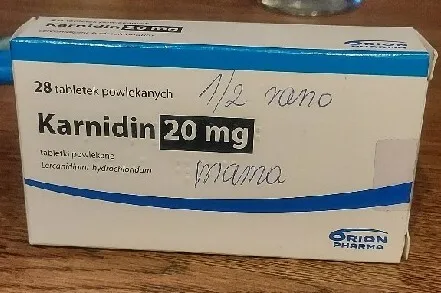
Table of Contents
Karnidin, 10 mg, film-coated tablets
Karnidin, 20 mg, film-coated tablets
Lercanidipini hydrochloridum
Please read the package leaflet carefully before taking this medicine, as it contains
important information for the patient.
- Keep this leaflet, as you may need to read it again.
- If you have any further questions, please consult your doctor or pharmacist.
- This medicine has been prescribed for a specific individual and must not be given to others. It may harm other people, even if their symptoms are similar.
- If you experience any adverse reactions, including those not listed in this leaflet, inform your doctor or pharmacist. See section 4.
Package leaflet contents:
- What Karnidin is and what it is used for
- Important information before taking Karnidin
- How to take Karnidin
- Possible side effects
- How to store Karnidin
- Contents of the pack and other information
1. What Karnidin is and what it is used for
Karnidin belongs to a group of medicines known as calcium channel blockers (dihydropyridine class).
Karnidin is used in the treatment of mild to moderate high blood pressure (hypertension).
2. Important information before using Karnidin
When not to use Karnidin
- if the patient has a known allergy (hypersensitivity) to lercanidipine hydrochloride or to any of the other ingredients of this medicine (listed in section 6).
- if the patient has certain heart conditions:
- untreated heart failure
- aortic stenosis (narrowing of the outflow tract from the heart)
- unstable angina (chest pain at rest or with increasing frequency or severity)
- within one month after a heart attack
- if the patient has severe liver disease
- if the patient has severe kidney impairment or is undergoing dialysis
- if the patient is taking the following medicines, which are inhibitors of hepatic metabolism:
- antifungal medicines (such as ketoconazole or itraconazole)
- macrolide antibiotics (such as erythromycin, troleandomycin or clarithromycin)
- antiviral medicines (such as ritonavir)
- if the patient is taking a medicine called cyclosporine (used after organ transplantation to prevent organ rejection)
- if the patient consumes grapefruit or grapefruit juice
Warnings and precautions
Before starting Karnidin, consult your doctor or pharmacist if the patient:
- has heart disease
- has liver or kidney disease
Inform your doctor if you are pregnant, suspect you may be pregnant, planning pregnancy, or breastfeeding (see section "Pregnancy, breastfeeding and fertility").
Children and adolescents
The safety and efficacy of Karnidin in children and adolescents under 18 years of age have not been established.
Karnidin with other medicines
Tell your doctor or pharmacist about all medicines the patient is currently taking or has recently taken, as well as any medicines the patient plans to take. If Karnidin is taken together with other medicines, its effect or the effect of other medicines may be altered, and the frequency of adverse reactions may increase (see also section 2).
Tell your doctor or pharmacist if the patient is taking any of the following medicines:
- phenytoin, phenobarbital or carbamazepine (medicines used to treat epilepsy)
- rifampicin (a medicine used to treat tuberculosis)
- astemizole or terfenadine (antihistamines)
- amiodarone, quinidine or sotalol (medicines used for fast heart rate)
- midazolam (a sedative medicine)
- digoxin (a medicine used to treat heart conditions)
- beta-blockers, e.g. metoprolol (medicines used to treat high blood pressure, heart failure and heart rhythm disorders)
- cimetidine (in doses exceeding 800 mg per day; a medicine used for peptic ulcer disease, indigestion or heartburn)
- simvastatin (a medicine that lowers blood cholesterol levels)
- other medicines used to treat high blood pressure
Karnidin with food, drink and alcohol
- A high-fat meal significantly increases the concentration of the medicine in the blood (see section 3).
- Alcohol may enhance the effect of Karnidin. Alcohol should not be consumed during treatment with Karnidin.
- Do not take Karnidin together with grapefruit or grapefruit juice (this may enhance the blood pressure-lowering effect). See section 2.
Pregnancy, breastfeeding and fertility
Karnidin is not recommended during pregnancy and should not be used during breastfeeding. There are no data on the use of lerkanidipine in pregnant or breastfeeding women.
If the patient is pregnant or breastfeeding, not using contraception, suspects she may be pregnant, or is planning to have a child, she should consult a doctor or pharmacist before using this medicine.
Driving and operating machinery
If the patient experiences dizziness, weakness or drowsiness while taking this medicine, driving or operating machinery should be avoided.
Excipients
This medicine contains less than 1 mmol (23 mg) of sodium per tablet, i.e. this medicine is considered "sodium-free".
3. How to use Karnidin
This medicine should always be taken as directed by a doctor or pharmacist. If in
doubt, consult a doctor or pharmacist.
Adults
The recommended dose is one 10 mg Karnidin tablet once daily, taken every day
at the same time, preferably in the morning, at least 15 minutes before breakfast. If necessary, the doctor
may recommend increasing the dose to one 20 mg Karnidin tablet or 2 tablets
of Karnidin 10 mg. See section 2.
The tablet should be swallowed whole with sufficient liquid (e.g. one glass of water).
The break line on the tablet is intended only to facilitate breaking the tablet for easier swallowing, and does not indicate division into equal doses.
Use in children and adolescents
This medicine should not be used in children and adolescents under 18 years of age.
Elderly patients
Adjustment of the daily dose is not necessary. However, particular caution should be exercised at the beginning of treatment.
Patients with hepatic or renal impairment
Particular caution should be exercised at the beginning of treatment and when increasing the daily dose to 20 mg.
Taking more Karnidin than recommended
Do not take more than the recommended dose. If you have taken more than the recommended amount, contact your doctor immediately or go to the nearest hospital emergency department.
Take the medicine package with you.
Taking more than the recommended dose may cause excessive lowering of blood pressure and irregular or rapid heart rate.
Missing a dose of Karnidin
If you forget to take a tablet, skip the missed dose and take the next dose at the usual time. Do not take a double dose to make up for a missed dose.
Stopping Karnidin treatment
If you stop taking Karnidin, your blood pressure may rise again. Do not discontinue use without consulting your doctor.
If you have any further questions about the use of this medicine, consult your doctor or pharmacist.
4. Possible adverse reactions
Like any medicine, this medicine may cause adverse reactions, although not everyone will experience them.
Some adverse reactions may be serious. If any of the following symptoms occur,
contact your doctor immediately:
Rare ( may occur in less than 1 in 1,000 people ): angina (e.g. chest pain due to insufficient blood flow to the heart), allergic reactions (with symptoms such as: itching, rash, urticaria), fainting.
In patients who have previously experienced angina, treatment with medicines from the group to which Karnidin belongs may lead to an increase in frequency, prolonged duration, or worsening of angina attacks. In isolated cases, myocardial infarction may occur.
Other possible adverse reactions:
Common ( may occur in less than 1 in 10 people ): headache, rapid heartbeat, sensation of rapid or irregular heartbeat (palpitations), sudden flushing of the face, neck, or upper chest, swelling of the ankle area.
Uncommon ( may occur in less than 1 in 100 people ): dizziness, low blood pressure, heartburn, nausea, stomach pain, skin rash, itching, muscle pain, increased urination, weakness, fatigue.
Rare ( may occur in less than 1 in 1,000 people ): drowsiness, vomiting, diarrhoea, urticaria, more frequent urination than usual, chest pain.
Frequency not known ( frequency cannot be determined from available data ): gum swelling, liver function abnormalities (detected in blood tests), clouding of the fluid (during dialysis using a catheter placed in the abdominal cavity), swelling of the face, lips, tongue, or throat, which may cause difficulty in breathing or swallowing.
Reporting of adverse reactions
If any adverse reactions occur, including any adverse reactions not listed in this leaflet, inform your doctor or pharmacist. Adverse reactions can be reported directly to the Department of Monitoring Adverse Drug Reactions at the Office for Registration of Medicinal Products, Medical Devices and Biocidal Products, Al. Jerozolimskie 181 C, 02-222 Warsaw, Tel.: +48 22 49 21 301, Fax: +48 22 49 21 309, Website: https://smz.ezdrowie.gov.pl
Adverse reactions can also be reported to the marketing authorization holder.
Reporting adverse reactions helps provide more information on the safety of this medicine.
5. How to store Karnidin
Keep the medicine out of sight and reach of children.
Do not use this medicine after the expiry date stated on each blister and carton
after: Expiry date (EXP). The expiry date refers to the last day of the stated month.
Do not store above 25°C. Store in the original packaging to protect from light.
Medicines must not be disposed of via wastewater or household waste. Ask your pharmacist how to dispose of medicines you no longer use. This will help protect the environment.
6. Contents of the packaging and other information
What Karnidin contains
The active substance is lercanidipine hydrochloride.
Each film-coated tablet contains 10 mg of lercanidipine hydrochloride, equivalent to 9.4 mg of lercanidipine,
or 20 mg of lercanidipine hydrochloride, equivalent to 18.8 mg of lercanidipine.
Other ingredients:
Film-coated tablet of 10 mg strength
Core:
Corn starch, sodium carboxymethyl starch (type A), anhydrous colloidal silica, microcrystalline cellulose,
poloxamer 188, sodium stearyl fumarate, macrogol 6000.
Coating:
Hypromellose, macrogol 6000, iron oxide yellow (E 172), titanium dioxide (E 171).
Film-coated tablet of 20 mg strength
Core:
Microcrystalline cellulose, corn starch, sodium carboxymethyl starch (type A), anhydrous colloidal silica,
povidone (K-30), sodium stearyl fumarate.
Coating:
Hypromellose, macrogol 6000, iron oxide red (E 172), titanium dioxide (E 171).
What Karnidin looks like and contents of the pack
Karnidin 10 mg is a yellow, round, biconvex film-coated tablet with a diameter of 6.5 mm, with a break line on one side and smooth on the other.
Karnidin 20 mg is a pink, round, biconvex film-coated tablet with a diameter of 8.5 mm, with a break line on one side and smooth on the other.
Pack sizes: 7, 14, 28, 35, 42, 50, 56, 98, 100, 280 film-coated tablets.
Not all pack sizes may be marketed.
Marketing Authorisation Holder and Manufacturer
Marketing Authorisation Holder
Orion Corporation
Orionintie 1
FI-02200 Espoo
Finland
Manufacturer
Orion Corporation, Orion Pharma
Orionintie 1
FI-02200 Espoo
Finland
Orion Corporation Orion Pharma
Joensuunkatu 7
FI-24100 Salo
Finland
For further information about this medicinal product, please contact the local representative of the Marketing Authorisation Holder:
Orion Pharma Poland Sp. z o.o.
[email protected]
This medicinal product is authorised in the European Economic Area countries under the following names:
Czech Republic: Oridip 20 mg
Denmark: Lercanidipine Orion 10 mg
Lercanidipine Orion 20 mg
Finland: Oridip 10 mg tabletti, kalvopäällysteinen
Oridip 20 mg tabletti, kalvopäällysteinen
Lithuania: Lercanidipin Orion 10 mg plėvele dengtos tabletės
Norway: Lercanidipine Orion 10 mg
Lercanidipine Orion 20 mg
Poland: Karnidin
Sweden: Lercanidipine Orion 10 mg
Lercanidipine Orion 20 mg