Kalium chloratum 15% kabi
Poland
Table of Contents
- Package leaflet: Information for the user
- 1. What Kalium chloratum 15% Kabi is and what it is used for
- 2. Important information before using Kalium chloratum 15% Kabi
- 3. How to use Kalium chloratum 15% Kabi
- 4. Possible adverse reactions
- 5. How to store Kalium chloratum 15% Kabi
- 6. Contents of the pack and other information
Package leaflet: Information for the user
Kalium chloratum 15% Kabi, 150 mg/ml, concentrate for solution for infusion
Potassium chloride
Please read all of this leaflet carefully before this medicine is administered, because it contains
important information for you.
- Keep this leaflet, as you may need to read it again.
- If you have any further questions, please ask your doctor, pharmacist, or nurse.
- This medicine has been prescribed for a specific individual. Do not pass it on to others. It may harm others, even if their symptoms are the same.
- If you experience any adverse reactions, including any not listed in this leaflet, tell your doctor, pharmacist, or nurse. See section 4.
Contents of the leaflet
- What Kalium chloratum 15% Kabi is and what it is used for
- Important information before administration of Kalium chloratum 15% Kabi
- How to use Kalium chloratum 15% Kabi
- Possible side effects
- How to store Kalium chloratum 15% Kabi
- Contents of the pack and other information
1. What Kalium chloratum 15% Kabi is and what it is used for
This medicine belongs to the group of "Intravenous replenishing solutions: Electrolyte solutions" and is available only on prescription.
Kalium chloratum 15% Kabi is indicated for the treatment of potassium deficiency in patients in whom dietary measures or oral therapy are insufficient.
If there is no improvement or if the patient feels worse, consult a doctor.
2. Important information before using Kalium chloratum 15% Kabi
When not to use Kalium chloratum 15% Kabi
Do not use Kalium chloratum 15% Kabi if the patient has increased potassium levels in the blood (hyperkalemia).
Warnings and precautions
Before starting treatment with Kalium chloratum 15% Kabi, discuss this with the physician.
Kalium chloratum 15% Kabi is administered under the supervision of a physician who should be aware that:
- direct injection of concentrated potassium chloride solutions without adequate dilution may result in immediate death;
- the solution must be administered slowly (usually 10 mmol/hour, not exceeding 20 mmol/hour) and under continuous cardiac monitoring;
- urine output must be monitored to ensure adequate renal excretion;
- serum electrolyte levels and acid-base balance must be monitored, and dosage should be adjusted according to individual patient needs;
- patients with heart disease, severe fluid deficiency (severe dehydration), heat-induced muscle cramps due to dehydration and salt loss, extensive tissue damage such as in severe burns, and elderly patients should be carefully monitored due to the risk of impaired kidney function or other factors predisposing to increased potassium levels in the blood (hyperkalemia);
- at the beginning of potassium replacement therapy, glucose solutions should not be added to the infusion, as glucose may further reduce serum potassium levels;
- if signs of kidney failure occur, intravenous administration of potassium-containing solutions should be discontinued.
The physician may exercise particular caution and decide whether to administer Kalium chloratum 15% Kabi if the patient has:
- uncompensated heart failure in patients treated with cardiac glycosides (medications used in heart disease) and severe or complete atrioventricular conduction block;
- conditions typically associated with elevated potassium levels in the blood (hyperkalemia), e.g., hyperkalemic periodic paralysis (a form of periodic paralysis), sickle cell anemia, adrenal dysfunction (adrenal insufficiency), impaired kidney function (renal failure), reduced urine output after surgery (postoperative oliguria), shock with hemolysis and (or) fluid deficiency (shock with hemolytic reactions and (or) dehydration), metabolic acidosis (acidic blood condition), treatment with potassium-sparing diuretics (diuretic drugs that retain potassium in the blood), increased chloride ion concentration in the blood (hyperchloremia).
The physician should be cautious during intravenous administration, as leakage of infused fluid outside the vessel (extravasation) may cause tissue necrosis (necrotic tissue damage).
Children and adolescents
The safety and efficacy of potassium chloride in children and adolescents have not been fully established.
Kalium chloratum 15% Kabi and other medicines
Inform the physician or pharmacist about all medicines currently used, recently used, or planned to be used.
Combinations not recommended (except in cases of severe potassium deficiency):
- potassium-sparing diuretics (medications used to increase urine output while retaining potassium in the blood), simple or complex, such as: amiloride, spironolactone, triamterene, potassium canrenoate, eplerenone – due to the risk of life-threatening hyperkalemia (increased potassium levels in the blood), especially in patients with impaired kidney function (increased potassium effect);
- angiotensin-converting enzyme (ACE) inhibitors, angiotensin II receptor antagonists, nonsteroidal anti-inflammatory drugs (NSAIDs), cyclosporine, tacrolimus, suxamethonium – due to the risk of life-threatening hyperkalemia, especially in patients with impaired kidney function (increased potassium effect);
- blood-derived products, potassium penicillin – due to the possible risk of hyperkalemia caused by the presence of potassium in these medications.
Combinations possible with special precautions:
- quinidine: potassium may enhance the antiarrhythmic effect of quinidine;
- thiazides, adrenocorticosteroids, glucocorticoids, mineralocorticoids: potassium supplementation may have reduced efficacy;
- digoxin: increased potassium levels (hyperkalemia) may be dangerous in patients receiving cardiac glycosides for heart disease;
- ion-exchange resins: serum potassium levels may decrease due to sodium replacing potassium.
If compatibility studies are lacking, this medicine must not be mixed with other medicinal products.
Physical incompatibility of Kalium chloratum 15% Kabi, concentrate for solution for infusion, has been reported with the following active substances: amikacin, amphotericin B, dobutamine, fat emulsions, 20% to 25% mannitol solutions, and sodium penicillin G.
Pregnancy, breastfeeding, and fertility
If the patient is pregnant, breastfeeding, suspects she may be pregnant, or is planning to have a child, she should consult her physician or pharmacist before using this medicine.
There are no data or limited data on the use of potassium chloride in pregnant women. Use of Kalium chloratum 15% Kabi during pregnancy may be considered if clinically justified.
Potassium chloride passes into human milk in amounts that may affect newborns/infants who are breastfed.
Risk to newborns/infants cannot be ruled out.
The treating physician will decide whether to discontinue breastfeeding or to discontinue (withhold) treatment with Kalium chloratum 15% Kabi, taking into account the benefits of breastfeeding for the child and the benefits of treatment for the woman.
Driving and operating machinery
There is no information indicating that this medicine may affect the ability to drive or operate machinery.
3. How to use Kalium chloratum 15% Kabi
Kalium chloratum 15% Kabi will be administered by or under the direct supervision of a physician,
who will carefully monitor the amount of Kalium chloratum 15% Kabi given to the patient.
The physician will determine the appropriate dose for the patient.
Recommended dosage for adult patients
For intravenous administration only after dilution in a suitable solution, to a maximum potassium chloride concentration of 3 g/L (or 40 mmol/L of potassium). Higher concentrations may be required in the treatment of severe hypokalemia or diabetic ketoacidosis; in such cases, infusion into a large vein is necessary and ECG monitoring of the patient is recommended.
1 g of potassium chloride corresponds to 13.4 mmol or 524 mg of potassium.
The dose depends on serum electrolyte levels and acid-base balance. Potassium deficit should be calculated using the following formula:
Potassium deficit (mmol) = body weight (kg) x 0.2 x 2 x (4.5 mmol/L – serum potassium concentration)
(Extracellular fluid volume is calculated as body weight in kg x 0.2)
The standard daily dose is approximately 0.8 to 2 mmol of potassium per kg of body weight.
Typically, the maximum dose in adult patients should not exceed 150 mmol per day.
Use in children
Intravenous administration after dilution in a suitable solution is recommended, up to a maximum concentration of 3 mmol/kg body weight or 40 mmol/m² body surface area. In children weighing 25 kg or more, adult dosing regimens should be used.
The maximum dose in children is 3 mmol/kg body weight per day.
Dosage should be reduced in patients with impaired renal function.
Method of administration
The patient will receive this medicine as a diluted infusion into a vein (intravenous infusion). The infusion rate will be slow, and the amount of potassium chloride administered will depend on the individual needs of the patient.
A safe infusion rate is considered to be 10 mmol/hour. The infusion rate should not exceed 20 mmol/hour.
Infusion pump administration is recommended, especially for solutions with higher concentrations.
The physician will inform the patient how long treatment with Kalium chloratum 15% Kabi should continue.
If the patient feels that the effect of Kalium chloratum 15% Kabi is too strong or too weak, they should inform the physician or pharmacist.
Overdose of Kalium chloratum 15% Kabi
Overdose due to increased potassium concentration in the blood may cause abnormalities in the ECG, reduced heart rate (bradycardia), irregular heart rhythm with rapid ventricular fibrillation (ventricular fibrillation), other cardiac rhythm disturbances (arrhythmias), up to cardiac arrest, confusion, fatigue, diarrhea, swallowing difficulties, abnormal skin sensations in the hands or feet (peripheral paresthesia), breathing difficulties, skeletal muscle paralysis, and death.
If any of the above symptoms occur, treatment should be stopped immediately, and any food containing potassium should be avoided. Potassium-sparing diuretics (medications used to increase urine output that retain potassium in the blood) should not be used.
In case of overdose or accidental administration, contact the hospital immediately, providing the name of the medicine and the amount administered.
If the patient experiences any of the symptoms listed above or suspects that an excessive dose of Kalium chloratum 15% Kabi has been administered, the physician or medical personnel should be informed immediately.
If there are any further doubts regarding the use of this medicine, consult the physician or pharmacist.
4. Possible adverse reactions
Like all medicines, this medicinal product can cause adverse reactions, although not everybody will experience them.
Excessive administration of potassium may lead to increased potassium blood levels (hyperkalaemia), which may result in neuromuscular disturbances and cardiac function disorders, particularly cardiac rhythm disturbances, and even cardiac arrest.
Other adverse reactions:
Metabolism and nutrition disorders:
- acidic blood reaction (acidosis);
- increased concentration of chloride ions in blood (hyperchloraemia).
Vascular disorders:
- blood clot in blood vessels (venous thrombosis).
General disorders and administration site conditions:
- nausea;
- pain at the site of administration;
- tissue necrosis in case of leakage of the infusion solution outside the vessel (extravasation);
- phlebitis in case of local, excessively high concentration of the solution.
Reporting of adverse reactions
If any adverse reactions occur, including any adverse reactions not listed in this leaflet, inform your doctor, pharmacist, or nurse. Adverse reactions can be reported directly to the Department of Monitoring of Adverse Reactions to Medicinal Products, Office for Registration of Medicinal Products, Medical Devices and Biocidal Products
Al. Jerozolimskie 181C
02-222 Warsaw
tel.: + 48 22 49 21 301
fax: + 48 22 49 21 309
e-mail: [email protected].
Adverse reactions can also be reported to the marketing authorization holder.
Reporting adverse reactions helps to provide more information on the safety of the medicine.
5. How to store Kalium chloratum 15% Kabi
Keep the medicine out of the sight and reach of children.
Do not use this medicine after the expiry date stated on the ampoule and the cardboard
package after "EXP". The expiry date refers to the last day of the stated month.
No special storage conditions are required for this medicine.
Do not use this medicine if the solution is cloudy, contains any visible particles, or shows
any change in colour.
Medicines must not be disposed of via wastewater or household waste. Ask your
pharmacist how to dispose of medicines no longer required. Such measures will help
protect the environment.
6. Contents of the pack and other information
What Kalium chloratum 15% Kabi contains
- The active substance is potassium chloride.
- The other ingredient is: water for injections.
1 ml of solution contains 150 mg of potassium chloride (15% w/v), equivalent to 2 mmol of potassium ions.
5 ml of solution contains 750 mg of potassium chloride (15% w/v), equivalent to 10 mmol of potassium ions.
10 ml of solution contains 1500 mg of potassium chloride (15% w/v), equivalent to 20 mmol of potassium ions.
20 ml of solution contains 3000 mg of potassium chloride (15% w/v), equivalent to 40 mmol of potassium ions.
Ion content: K 2000 mmol/l
Cl 2000 mmol/l
Theoretical osmolarity: 4000 mosm/l
What Kalium chloratum 15% Kabi looks like and contents of the pack
Kalium chloratum 15% Kabi, concentrate for solution for infusion, is a clear, colourless solution.
Kalium chloratum 15% Kabi, concentrate for solution for infusion, is available in the following pack sizes:
20 ampoules of 5 ml
50 ampoules of 5 ml
20 ampoules of 10 ml
50 ampoules of 10 ml
20 ampoules of 20 ml.
Not all pack sizes may be marketed.
Instructions for correct administration
Kalium chloratum 15% Kabi is a sterile solution containing potassium chloride for intravenous infusion. Before use, the medicinal product must be diluted in not less than a 50-fold volume of 0.9% sodium chloride isotonic solution (w/v) for intravenous infusion or in another suitable infusion solution.
Before dilution, compatibility of potassium chloride with the other infusion solution must be verified.
To avoid inadequate homogenisation of the diluted solution, the concentrated solution of Kalium chloratum 15% Kabi must not be added directly to suspended infusion bottles/bags.
After adding the concentrated solution to the infusion bottle/bag, the solution must be thoroughly mixed before use. Therefore, the bottle/bag should be gently shaken 3 to 5 times to ensure proper homogenisation. Then, hang the bottle/bag and begin the infusion process.
For single use only. Always use after dilution!
After opening the ampoule, its outlet fits precisely onto Luer and Luer-Lock syringe tips; therefore, there is no need to use a needle.
Instructions for use
Break off one ampoule by twisting it in the opposite direction from the rest, without touching the tip or neck of the ampoule (1). Shake the ampoule once with a single motion as shown below to remove the solution from the tip of the ampoule (2). To open the ampoule, twist the tip in the opposite direction from the body of the ampoule until the tip breaks off (3). Connect the ampoule to a Luer or Luer-Lock syringe as shown in the figure (4).
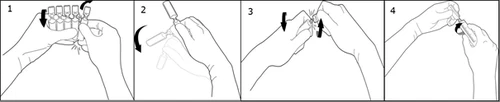
There is no need to use a needle. Always use after dilution.
Marketing Authorisation Holder and Manufacturer
Marketing Authorisation Holder
Fresenius Kabi Polska Sp. z o.o.
Al. Jerozolimskie 134
02-305 Warsaw
Poland
Manufacturer
FRESENIUS KABI ESPAÑA, S.A.
C/ Marina 16 – 18, Planta 17
08005 Barcelona
Spain
For further information, please contact the Marketing Authorisation Holder:
Fresenius Kabi Polska Sp. z o.o.
Al. Jerozolimskie 134
02-305 Warsaw
Tel.: +48 22 345 67 89
This medicinal product is authorised in the Member States of the European Economic Area under the following names:
Belgium Kaliumchloride Fresenius Kabi 150 mg/ml concentrate for solution for infusion
Estonia Potassium chloride Kabi 150 mg/ml, infusion concentrate
Greece POTASSIUM CHLORIDE/FRESENIUS 150 MG/ML
Spain Cloruro de potasio Meinsol 2 mEq/ml solución inyectable
Ireland Potassium Chloride 150 mg/ml concentrate for solution for injection or infusion
Lithuania Potassium chloride Kabi 150 mg/ml koncentratas infuziniam tirpalui
Latvia Potassium chloride Kabi 150 mg/ml concentrate for infusion solution preparation
Germany Kaliumchlorid Kabi 150 mg/ml Konzentrat zur Herstellung einer Infusionslösung
Poland Kalium chloratum 15% Kabi
Portugal Cloreto de Potássio Kabi
Romania Clorură de potasiu Kabi 150 mg/ml
United Kingdom Potassium Chloride 15% w/v concentrate for solution for infusion